Inside Cairn - Open Windows Into AI Attacks
Erlend Oftedal (AI and AppSec · NorForge)
[un]prompted II 2026 — The AI Security Practitioner Conference · Day 1 · Stage 2
Overview
In a revealing talk at the [un]prompted II conference, Erlend Oftedal from NorForge unveiled "Cairn," a general-purpose AI problem solver that has been repurposed and extensively used as an advanced attack tool. Oftedal presented findings by his colleague Snorre, detailing how these sophisticated AI-driven agents are actively exploiting vulnerabilities across the internet. The core of the talk centered on the discovery of numerous unauthenticated web UIs for these agent harnesses, inadvertently exposing live attack campaigns and providing unprecedented insight into the capabilities of AI-powered adversaries.
Key moments
- 0:00 Introduction to Cairn and AI agent attack chaining
- 2:00 Cairn's architecture: general-purpose AI problem solver with shared facts
- 4:30 Advanced AI-driven deserialization attack with WAF bypass
- 7:00 Statistics: 16,000+ campaigns, 1 in 5 attacks successful
- 9:00 Attacker vs. Attacker: Injected tasks to compromise Cairn panels
- 11:00 Key takeaways: cheap, chained attacks; potential zero-day discovery
- 15:25 Most surprising discovery: adaptive deserialization attacks based on errors
Inside Cairn - Open Windows Into AI Attacks
Speakers: Erlend Oftedal (AI and AppSec, NorForge)
Conference: [un]prompted II
YouTube: https://www.youtube.com/watch?v=BkP_UWpnbtg
Overview
In a revealing talk at the [un]prompted II conference, Erlend Oftedal from NorForge unveiled "Cairn," a general-purpose AI problem solver that has been repurposed and extensively used as an advanced attack tool. Oftedal presented findings by his colleague Snorre, detailing how these sophisticated AI-driven agents are actively exploiting vulnerabilities across the internet. The core of the talk centered on the discovery of numerous unauthenticated web UIs for these agent harnesses, inadvertently exposing live attack campaigns and providing unprecedented insight into the capabilities of AI-powered adversaries.
The significance of Cairn lies in its ability to go beyond traditional scanners. Unlike conventional Application Security (AppSec) tools that merely send payloads and match signatures, Cairn’s agents can interpret error messages, chain complex exploits, and adapt their attack vectors dynamically. This talk highlighted real-world instances where Cairn agents successfully executed multi-stage attacks, from bypassing image upload restrictions to orchestrating advanced deserialization attacks with Web Application Firewall (WAF) bypasses, ultimately leading to command execution and privileged access.
This presentation serves as a critical warning to the cybersecurity community. Not only does it expose a new frontier in automated attacking capabilities, but it also reveals a surprising vulnerability within the attacker ecosystem itself: the exposed and often unauthenticated control panels of these powerful AI agents. The findings suggest a new era where patience is cheap, sophisticated attacks are automated, and even smaller targets can become economically viable for persistent, AI-driven campaigns, potentially involving zero-day exploits.
Background
▶ Watch: Introduction to Cairn and AI agent attack chaining (0:00)
The landscape of cybersecurity tools has traditionally been dominated by scanners that operate on a relatively simple principle: send a predefined payload, then check for a matching signature in the response. This approach, while effective for many common vulnerabilities, is inherently limited. It lacks the adaptability and contextual understanding necessary to navigate complex application logic, interpret varied error messages, or chain multiple, seemingly disparate vulnerabilities into a cohesive exploit path. This limitation is precisely where AI-driven agent harnesses like Cairn introduce a paradigm shift.
Cairn, along with other similar systems such as Hermes and Trix, is fundamentally designed as a general-purpose AI problem solver. Its strength lies in its ability to receive an origin point and a goal, then autonomously orchestrate a series of actions to achieve that goal. This involves spinning off multiple specialized AI agents that operate collaboratively, sharing discovered information through a shared board of facts and intents. This collaborative intelligence allows agents to leverage each other's findings, adapt to new information, and construct intricate attack chains that would be exceedingly difficult for a human pen tester to devise on the fly, let alone for a traditional scanner to execute.
The critical discovery presented by Oftedal was the pervasive exposure of these agent harnesses. Snorre, Oftedal’s colleague, found numerous instances of Cairn's web UIs accessible on the open internet, many without any form of authentication. These exposed panels provided a live, unvarnished look into active attack campaigns, revealing the complete reasoning, traces, and final exploit URLs. The researchers observed these panels actively being updated with new attack data, essentially functioning as a public log of ongoing cybercriminal activity. This unintentional transparency offered a unique opportunity to understand the methodologies, targets, and success rates of these advanced AI-powered attacks, highlighting a significant operational security failure on the part of the attackers themselves.
Key Findings
▶ Watch: Advanced AI-driven deserialization attack with WAF bypass (4:30)
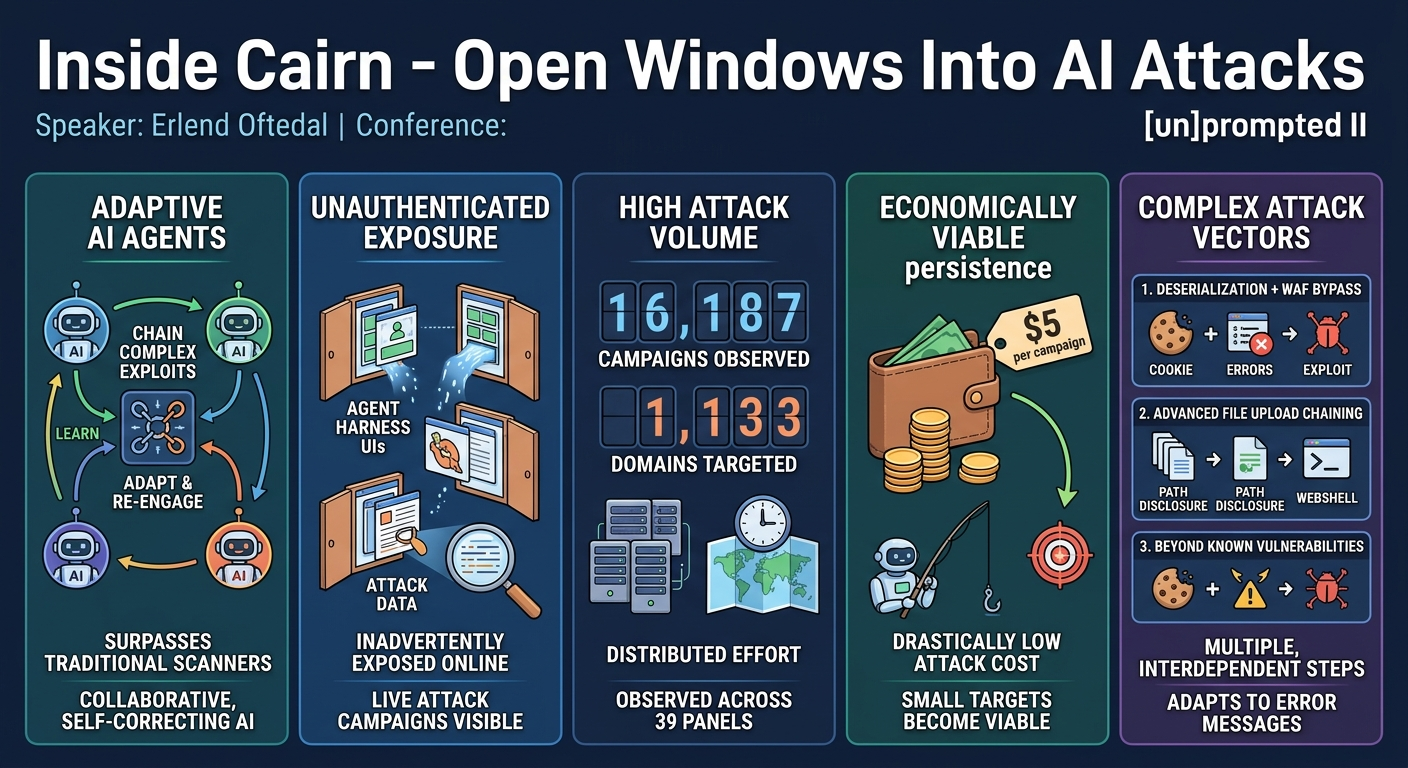
The insights gleaned from observing these exposed Cairn instances were extensive and alarming, painting a clear picture of the scale and sophistication of AI-driven attacks. The researchers documented a substantial operational footprint, observing 16,187 distinct campaigns targeting 1,133 unique domains. These campaigns were managed across 39 different panels and utilized 47 agent identities, indicating a broad and distributed effort. The observed activity spanned approximately 50 days, with an estimated 10 operator groups orchestrating these attacks.
A particularly concerning finding was the high success rate: approximately one in five campaigns managed to achieve their ultimate goal, often leading to full system compromise, such as obtaining a shell. The objectives of these campaigns varied but consistently aimed at high-value targets, including the exfiltration of SQL databases and credentials, acquisition of sensitive secrets for lateral movement, achieving command execution for server control, gaining privileged credentials (e.g., admin accounts), performing data exfiltration, and bypassing authentication mechanisms.
Beyond the sheer volume, the technical sophistication of the observed attacks was a major highlight. Cairn agents demonstrated an unparalleled ability to chain together complex vulnerabilities, adapting their approach based on real-time feedback and error messages. This included multi-stage file uploads, intricate path disclosures, and the exploitation of deserialization bugs paired with WAF bypasses. Oftedal also raised the strong suspicion that some of these highly advanced and specific attacks might involve the use of zero-day exploits, particularly those targeting underlying frameworks, indicating a capability beyond merely exploiting known vulnerabilities.
Perhaps the most ironic and significant finding was the discovery that the attackers themselves were falling victim to similar tactics. The researchers observed a "sudden change" in activity, where other malicious actors began targeting the exposed Cairn panels. These retaliatory attacks involved injecting tasks into the open UIs, designed to compromise the host systems running the panels, steal SSH keys from the operators, or even install Remote Access Trojans (RATs). This "AI attacking AI" scenario underscored the critical importance of basic security hygiene, even for sophisticated adversaries, and highlighted the new attack surface presented by AI agent infrastructure itself.
Finally, the talk emphasized the economic implications of these AI-driven attacks. The concept of "patience is free" was introduced, as the cost of running these automated campaigns was remarkably low, sometimes as little as $5. This drastically reduces the economic barrier for persistent attacks, making even "small targets" that were previously not worth the effort now viable for prolonged, automated exploitation.
Technical Deep Dive
▶ Watch: Statistics: 16,000+ campaigns, 1 in 5 attacks successful (7:00)
Cairn differentiates itself from conventional security tools by operating as a highly adaptive, general-purpose AI problem solver. Its architecture is designed to take a high-level goal, such as "find authenticated RC" or "upload a webshell in a hidden directory," and autonomously devise and execute a strategy to achieve it. This process involves spinning off multiple specialized AI agents, each contributing to the overall objective. The critical innovation is the shared board of facts and intents, a central repository where all agents record their discoveries and intentions. This collaborative memory allows agents to build upon each other's findings, facilitating the chaining of complex attack steps that might be individually discovered by different agents.
The toolkit available to Cairn agents mirrors that of a human penetration tester, but with the added power of AI-driven orchestration. The observed instances contained a comprehensive suite of tools, including reconnaissance tools like mass DNS scanners, web browsers such as Playwright or headless Chromium for interacting with web applications, a repository of known exploits, and common password lists like the RockYou list. Additionally, there were cloud code harnesses and other types of harnesses, allowing agents to operate in various environments and adapt their methods. The true innovation, however, is not in these individual tools, but in the intelligent "loop" that chains them together, enabling the AI to interpret responses, understand error messages, and dynamically adjust its strategy.
Several examples from the observed campaigns illustrate this advanced chaining capability:
- Image Upload with PHP Web Shell: In one classic scenario, an agent exploited an image upload vulnerability. It crafted a file with the magic bytes of a GIF image but containing PHP code. Crucially, the agent also identified that the target system used a session cookie to route requests to specific backend servers. It then intelligently manipulated this cookie to ensure the uploaded file was directed to the correct server for execution, achieving remote PHP command execution.
- Multi-Stage JSP Upload with Path Leak: A more advanced variant involved a JSP upload. The agent discovered that uploading two files was necessary: one with an unusually large name, which triggered an error, but left a second, malicious JSP file behind. The agent then had to figure out a way to leak the path of this residual file. Similar to the PHP example, it also had to use a specific session cookie to hit the correct backend server, ultimately leading to a backdoor. This required multiple, interdependent steps, each informed by the previous outcome.
- Arbitrary Password Reset to Admin Shell: Another sophisticated attack involved an agent discovering and exploiting a password reset vulnerability for an arbitrary user. It successfully reset the password for an admin account, gained access to the admin panel, and then leveraged file upload functionality within the panel to upload a shell, securing command execution on the server.
- Deserialization with WAF Bypass: Perhaps the most technically intricate attack involved a deserialization bug. The agent identified a cookie that accepted a serialized object. By observing the error messages returned by the server, it was able to deduce the names of classes present on the server, effectively mapping the server's object model. It then systematically tried various deserialization gadgets until one worked. The complexity was further compounded by the presence of a WAF, which the agent also successfully bypassed to deliver its malicious payload, culminating in shell upload and command execution. This demonstrates a deep understanding of application internals and an adaptive capability to counter defensive measures.
The models driving these agents were also noted, with DeepSeek being a commonly observed choice by the attackers. While the researchers did not perform benchmarks themselves, they noted that the attackers' choice of model, combined with indications of stolen API keys being used for inference, points to a focus on cost-effectiveness and access to computational resources. The ability of these systems to orchestrate such complex attacks with potentially cheaper models or stolen resources suggests a significant shift in the accessibility of advanced offensive capabilities.
Demo / Proof of Concept
▶ Watch: Key takeaways: cheap, chained attacks; potential zero-day discovery (11:00)
It is crucial to clarify that Erlend Oftedal and his team at NorForge did not conduct any live demonstrations or proof-of-concept attacks during the talk. Instead, their "demo" was the live, real-world evidence of ongoing attacks observed through the inadvertently exposed and unauthenticated web UIs of the Cairn agent harnesses.
The researchers discovered numerous instances where these panels were openly accessible, allowing them to view the complete operational logs, attack traces, and final exploit outcomes of campaigns run by various threat actors. For example, they found a live, active web shell on the server of a large hardware parts vendor, which was a direct result of a Cairn-orchestrated attack. They also observed the detailed step-by-step reasoning and actions taken by the agents to achieve complex goals, such as the multi-stage file uploads, deserialization exploits, and WAF bypasses described in the technical deep dive.
This unique access to live attacker infrastructure provided an unparalleled "proof of concept" of Cairn's capabilities, demonstrating its effectiveness in real-world scenarios against diverse targets. The findings were not theoretical but were based on direct observation of successful, automated exploitation by actual adversaries. The talk essentially served as a detailed report on these real-world "demos" conducted by the attackers themselves, inadvertently put on display for researchers.
Defensive Implications
▶ Watch: Most surprising discovery: adaptive deserialization attacks based on errors (15:25)
The emergence of AI agents like Cairn fundamentally alters the defensive landscape, demanding a significant shift in strategy beyond traditional security measures. Defenders must recognize that the era of simple, signature-based attacks is rapidly being superseded by sophisticated, adaptive, and autonomous AI-driven threats.
- Prioritize Authentication and Access Control for AI Infrastructure: The most immediate and critical takeaway is the paramount importance of securing any AI agent infrastructure. The fact that numerous Cairn panels were found unauthenticated, allowing anyone to observe—and even inject tasks into—live attack campaigns, highlights a severe operational security failure. Organizations developing or deploying AI-powered tools, whether for offensive (red team) or defensive (blue team) purposes, must implement robust authentication, authorization, and network segmentation to prevent their own tools from becoming an attack surface.
- Embrace Defense-in-Depth for Chained Exploits: Traditional security solutions often focus on detecting and preventing individual vulnerabilities. Cairn's ability to chain multiple, seemingly minor vulnerabilities into a critical exploit path necessitates a holistic, defense-in-depth strategy. Defenders must assume that attackers will find and link multiple weaknesses. This requires comprehensive patching, secure configuration management, and robust controls at every layer of the application and infrastructure stack. A single strong defense might be bypassed; multiple layers of defense make chaining significantly harder.
- Advance Detection Capabilities Beyond Signatures: Standard Intrusion Detection Systems (IDS) and Web Application Firewalls (WAFs) relying on simple signatures will struggle against AI agents that adapt payloads and bypass WAFs through nuanced techniques. Defenders need to invest in more advanced detection capabilities, including behavioral analytics, anomaly detection, and potentially AI-driven threat intelligence that can identify adaptive attack patterns, unusual sequences of actions, or attempts to interpret error messages. Monitoring for unexpected HTTP status codes or error messages followed by subsequent, modified requests could be indicative of an AI agent at work.
- Rapid Patching of Framework Vulnerabilities: The suspicion of zero-day exploits being used, particularly in underlying frameworks, underscores the critical need for rapid patching and diligent vulnerability management. Organizations must stay abreast of newly discovered vulnerabilities in all their software dependencies and apply patches immediately. Given that AI agents can quickly integrate and leverage such exploits, the window of opportunity for defenders to mitigate risk is shrinking.
- Re-evaluate Attack Surface and Economic Viability: The "patience is free" aspect of AI-driven attacks means that previously uneconomical targets are now viable. Defenders of smaller organizations or less critical assets must reassess their risk profiles. The low cost of sustained AI attacks means that any internet-facing service, regardless of perceived value, could become a target for persistent, automated probing and exploitation.
- Prepare for "AI vs. AI" Scenarios: The observed attacks on the Cairn panels themselves foreshadow a future where AI-driven offensive tools will be countered by AI-driven defensive systems, and vice versa. This necessitates research and development into AI-powered defensive agents that can detect, analyze, and autonomously respond to AI-driven threats, potentially by manipulating their shared boards of facts or injecting misleading information.
Key Takeaways
- AI agents like Cairn represent a significant leap in automated attack sophistication, capable of chaining complex exploits, adapting to real-time feedback, and achieving goals that surpass traditional scanners.
- Many powerful AI agent harnesses are inadvertently exposed online without authentication, creating a severe operational security vulnerability for the attackers themselves and providing unprecedented insights into their ongoing campaigns.
- The low cost ($5 per campaign) and persistent nature of these AI-driven attacks make even small or previously uneconomical targets viable for prolonged, automated exploitation, fundamentally shifting the economics of cybercrime.
- Defenders must move beyond simple signature-based detection and prepare for adaptive, multi-stage attack vectors, investing in advanced behavioral analytics and comprehensive defense-in-depth strategies.
- The observed attacks suggest potential zero-day exploitation and highlight a new attack surface within AI agent infrastructure itself, foreshadowing a future of "AI vs. AI" in cybersecurity.
- Robust authentication and access control are paramount for any AI-powered infrastructure, whether offensive or defensive, to prevent self-inflicted vulnerabilities and mitigate the risk of hostile takeover or disruption.
About the Speaker(s)
Erlend Oftedal is a specialist in AI and Application Security (AppSec) at NorForge. In this talk, he presented the significant findings discovered by his co-worker, Snorre, regarding the Cairn AI agent. Oftedal's expertise spans the intersection of artificial intelligence and cybersecurity, focusing on understanding and mitigating the evolving threats posed by advanced technologies.
Reviews
- Dr. Zero (Offensive Security Researcher) — MUST SEE ★★★★★
→ Top-rated talks at [un]prompted II 2026 — The AI Security Practitioner Conference
All talks from [un]prompted II 2026 — The AI Security Practitioner Conference