How Transparent is Usable Privacy and Security Research? A Meta-Study on Current Research Transparency Practices
Jan H. Klemmer
34th USENIX Security Symposium (USENIX Security '25) · Day 3 · Usable Privacy and Security 3
Overview
The "ECC.fail" paper presents a groundbreaking study on the persistent hardware vulnerability known as Rowhammer, specifically targeting server platforms equipped with DDR4 ECC memory. Historically, Rowhammer attacks, which allow an attacker to flip bits in memory without directly accessing them by rapidly accessing adjacent memory rows, have been extensively demonstrated on client PCs and mobile devices. However, server-grade memory, fortified with Error Correcting Codes (ECC), was largely considered resilient to such exploits, with no successful end-to-end Rowhammer attack on DDR4 ECC servers having been publicly demonstrated prior to this work. This paper shatters that perception, revealing a sophisticated methodology to bypass these protections.
Read the paper · Download the PDF (PDF) · Slides
Paper abstract
Rowhammer is a hardware vulnerability present in nearly all computer memory, allowing attackers to modify bits in memory without directly accessing them. While Rowhammer has been extensively studied on client and even mobile platforms, no successful Rowhammer attack has been demonstrated on server platforms using DDR4 ECC memory. Tackling this challenge, in this paper we demonstrate the first end-to-end Rowhammer technique effective against Intel servers using Hynix DDR4 ECC memory. To that aim, we first characterize the Hynix implementation of Target Row Refresh (TRR) on server parts, demonstrating effective hammering patterns on both FPGA and Intel-based testing platforms with ECC disabled. We then reverse engineer Intel's ECC implementation on Skylake and Cascade Lake servers. We find that it has a coding distance of four, which often allows triggering incorrect ECC correction with just two bit flips. Combining the two observations, we present an end-to-end Rowhammer attack which can flip bits on Intel servers, without causing crashes. Finally, we demonstrate the effectiveness of our attack by hammering RSA public keys loaded into memory, causing the server to accept messages not signed by the original key.
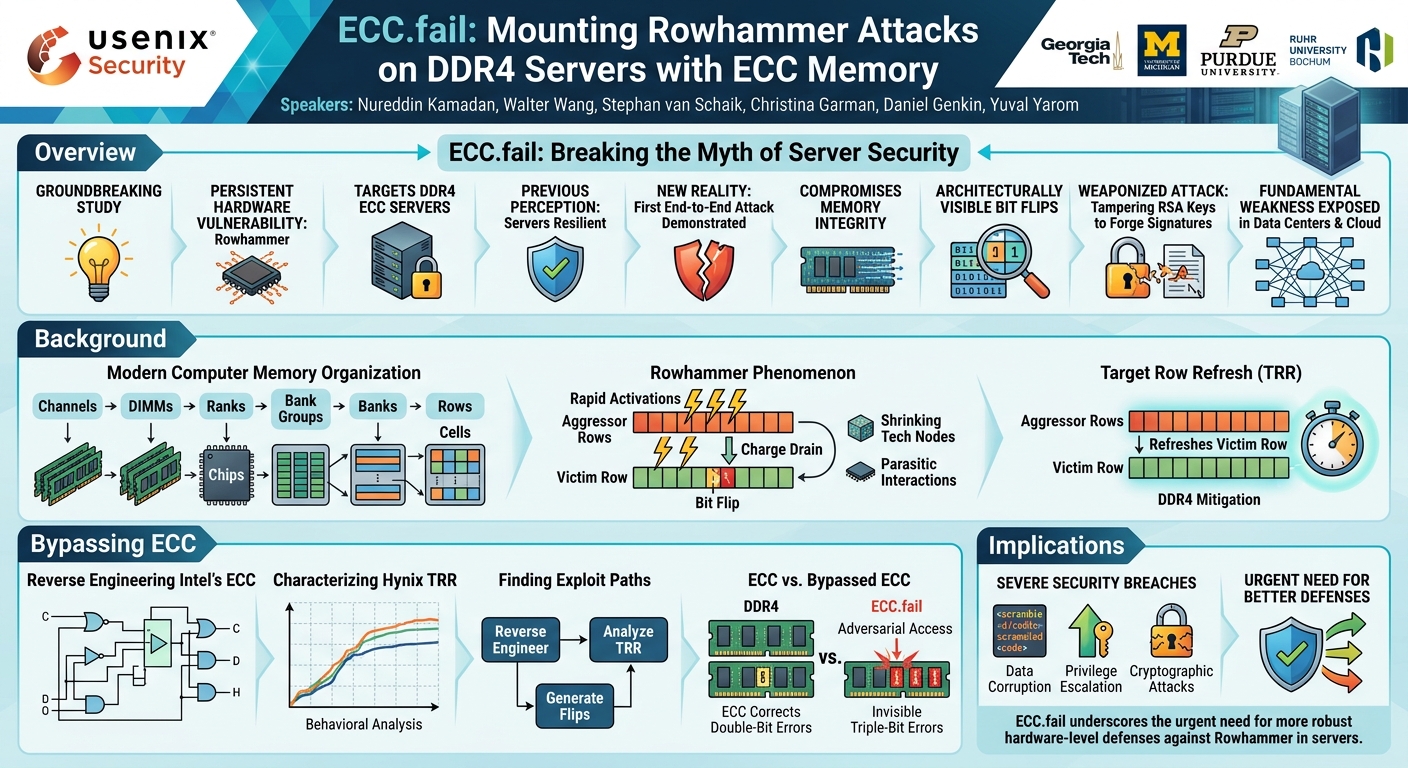
ECC.fail: Mounting Rowhammer Attacks on DDR4 Servers with ECC Memory
Speakers: Nureddin Kamadan (Georgia Tech); Walter Wang (Georgia Tech); Stephan van Schaik (University of Michigan); Christina Garman (Purdue University); Daniel Genkin (Georgia Tech); Yuval Yarom (Ruhr University Bochum)
Conference: USENIX Security
YouTube: N/A (Peer-reviewed paper)
Overview
The "ECC.fail" paper presents a groundbreaking study on the persistent hardware vulnerability known as Rowhammer, specifically targeting server platforms equipped with DDR4 ECC memory. Historically, Rowhammer attacks, which allow an attacker to flip bits in memory without directly accessing them by rapidly accessing adjacent memory rows, have been extensively demonstrated on client PCs and mobile devices. However, server-grade memory, fortified with Error Correcting Codes (ECC), was largely considered resilient to such exploits, with no successful end-to-end Rowhammer attack on DDR4 ECC servers having been publicly demonstrated prior to this work. This paper shatters that perception, revealing a sophisticated methodology to bypass these protections.
Authored by a collaborative team of researchers from Georgia Tech, University of Michigan, Purdue University, and Ruhr University Bochum, this research tackles the significant challenge of compromising the integrity of server memory. The team successfully demonstrates the first end-to-end Rowhammer technique effective against Intel Skylake and Cascade Lake servers utilizing Hynix DDR4 ECC memory. The implications are profound, as the researchers not only achieve architecturally visible bit flips without causing system crashes but also weaponize these flips to compromise cryptographic operations, specifically by tampering with RSA public keys to accept forged signatures.
This work is critical because it exposes a fundamental weakness in hardware that underpins the security of modern data centers and cloud infrastructure. By reverse engineering Intel's ECC implementation and characterizing Hynix's Target Row Refresh (TRR) mitigation, the researchers provide a detailed blueprint for exploiting these systems. The ability to manipulate memory bits on a server, even with ECC enabled, opens doors to severe security breaches, including data corruption, privilege escalation, and cryptographic attacks, underscoring the urgent need for more robust hardware-level defenses against Rowhammer.
Background
Modern computer memory, primarily DRAM (Dynamic Random Access Memory), is organized hierarchically to optimize performance and capacity. A typical system includes multiple channels, each connected to DIMMs (Dual In-line Memory Modules). Within a DIMM, ranks allow parallel access to multiple chips, which are further divided into bank groups, banks, rows, and individual cells. Each DRAM cell, comprising a single transistor and capacitor, stores one bit of data. Accessing a row involves activating its wordline, which loads the row into a row buffer for rapid subsequent access.
The Rowhammer phenomenon arises from the physical proximity and electrical interference between DRAM cells. As technology nodes shrink, cells become more susceptible to parasitic electrical interactions. Rapidly activating two "aggressor" rows can cause charge to drain from a "victim" row sandwiched between them, leading to spontaneous bit flips. This reliability issue, first identified in DDR3 memory, has evolved into a severe security vulnerability, enabling attacks ranging from privilege escalation on client machines to breaking cryptographic implementations and browser-based exploits. Previous work demonstrated Rowhammer on DDR3 servers, but DDR4 ECC servers were considered more resilient.
To combat Rowhammer, DDR4 memory introduced Target Row Refresh (TRR). This mitigation, implemented either in the DRAM chip or the memory controller, tracks potential aggressor rows and proactively refreshes "victim" rows to prevent charge loss. TRR operates in two phases: a tracking phase monitors row activations, and a mitigating phase, triggered during standard DRAM refresh commands (issued every 7.8µs), decides which potential victim rows to refresh. However, prior research has shown that TRR can be bypassed by carefully crafted Rowhammer patterns, often by confusing the TRR logic with "dummy" accesses or specific activation sequences. Reverse engineering TRR implementations often relies on SoftMC, an FPGA-based software memory controller that offers precise control over memory commands.
Server platforms employ an additional layer of protection: Error Correcting Codes (ECC). Unlike standard DDR4 DIMMs with a 64-bit data bus, server Registered DIMMs (RDIMMs) expand the bus to 72 bits, with the extra 8 bits dedicated to storing check bits for ECC. In server-grade systems, ECC is implemented in a side-band manner, meaning ECC bits are stored and accessed on dedicated chips, allowing parallel computation and checking. When the CPU writes data, its memory controller calculates parity bits and writes a resulting codeword. On read, the system checks the codeword; a syndrome (non-zero parity check result) indicates an error. ECC codes are characterized by their minimum code distance (dmin), which determines their error detection and correction capabilities. For example, a code with dmin=3 can detect two errors and correct one. More advanced ECC, such as Single-Device Data Correction (SDDC) or Chipkill, enhance resilience against single-chip failures by correcting multiple bit errors within a single DRAM chip.
Finally, data scrambling is another hardware feature implemented by memory controllers. It mitigates voltage fluctuations on the high-speed memory bus, which can occur during long sequences of identical bits (0s or 1s). Scrambling works by XORing pseudorandom patterns with data writes and then un-XORing them during reads, disrupting these problematic sequences. The effectiveness of data scrambling against Rowhammer depends on whether these patterns are truly random and dynamic, or deterministic and predictable.
Key Findings
This research establishes several critical findings that collectively enable the first end-to-end Rowhammer attack on DDR4 ECC servers:
- Bypass of Hynix TRR on Server DIMMs: The researchers successfully characterized and bypassed the Target Row Refresh (TRR) implementations across 30 server-grade Hynix DDR4 ECC RDIMMs (manufactured between 2017 and 2022). They found that all tested Hynix DIMMs use a sampling-based TRR mechanism with a per-bank, single-aggressor capacity. Crucially, the TRR sampler often exhibits biased sampling, favoring rows activated immediately before a refresh command, which significantly simplifies bypass by strategically placing dummy accesses. They developed effective hammering patterns (e.g., P1, Q1, and the refined P3) that exploit these TRR characteristics, achieving up to 139.5 bit flips per row on server platforms with ECC disabled, a 5-10x improvement over previous techniques like Blacksmith.
- Reverse Engineering Intel's ECC Implementation: For the first time, the paper documents Intel's ECC implementation on Skylake and Cascade Lake server platforms. Using a logic analyzer to snoop DDR4 bus traffic, they discovered that Intel uses a distance-4 ECC code that operates on entire 512-bit cache lines, producing 576-bit codewords (512 data + 64 ECC bits). This implies that a four-bit flip is sufficient for an undetectable ECC bypass, while just two bit flips can trigger incorrect ECC correction.
- Exploiting Intel's SDDC for Incorrect Correction: The research revealed that Intel's ECC includes x4 Single-Device Data Correction (SDDC), capable of correcting multiple bit flips (up to 5 in their tests) within a single x4 DRAM chip, but causing a system crash if errors span two or more chips. By combining knowledge of the distance-4 code and SDDC, the researchers discovered 2-bit correctable bypass templates. These templates involve flipping just two bits in different chips that are part of a 4-bit bypass template spanning three chips. This carefully orchestrated two-bit flip causes the SDDC mechanism to misidentify a non-faulty chip as faulty and incorrectly "correct" the entire codeword, effectively achieving an architectural bit flip without causing a crash.
- Deterministic Data Scrambling: Intel's data scrambling implementation on Skylake and Cascade Lake servers was found to be deterministic. It operates by XORing fixed, hard-coded masks into the 576-bit data stream (after ECC encoding), with different masks used for different banks and cache lines within a row. This predictability means data scrambling does not act as a security countermeasure against Rowhammer, as attackers can easily account for its effects. The researchers recovered a total of 2048 distinct scrambling strings.
- Reliable Observation of Correctable Bit Flips under ECC: A novel timing side channel was identified that allows attackers to reliably detect correctable bit flips even when ECC is enabled. Accessing a cache line containing a correctable bit flip results in a 3-4x longer access latency compared to normal accesses. This delay is attributed to the memory controller issuing three additional read requests to the same location, a "request replay" feature designed for transient bus errors, before correcting the error. This side channel enables the profiling of flippy bits without triggering system crashes.
- End-to-End RSA Public Key Compromise: The ultimate demonstration of the attack's severity involved leveraging Rowhammer-induced bit flips to compromise RSA public keys loaded into server memory. By strategically flipping bits in the RSA modulus
n, the researchers could transform it into a product of smaller, easily factorable primes (n'). This allowed them to recover the corresponding private keyd'and generate forged signatures that the server would accept, proving a complete cryptographic bypass. The attack achieved architectural bit flips on an idle system in approximately 2.5 hours on average, and within 10 hours under a SPEC2017 workload, without causing uncorrectable errors or system crashes.
Technical Deep Dive
The technical core of the ECC.fail attack lies in its multi-stage approach to first understand, then bypass, and finally exploit the complex interactions between DRAM hardware, TRR mitigations, and ECC implementations on server platforms.
The initial phase focused on characterizing Rowhammer susceptibility on Hynix DDR4 ECC RDIMMs. This involved an FPGA-based SoftMC setup (using a Xilinx Alveo U200 FPGA card) which provided granular control over DRAM commands, crucial for reverse engineering TRR. The methodology involved disabling DIMM refresh commands, determining rows' data retention times, and then using stable rows as victims and adjacent ones as aggressors. By observing whether a victim row flipped after a specific hammering pattern followed by a single refresh command, the researchers deduced if TRR was triggered and which rows it targeted for refreshing.
Their analysis revealed that Hynix DIMMs employ sampling-based TRR, where each DRAM bank has an individual sampler with capacity for only a single aggressor. A critical finding was biased sampling, where the TRR sampler is more likely to identify aggressor rows activated immediately before a refresh command. This bias was exploited by designing patterns (like P1) that hammer aggressor rows early in the refresh interval, followed by "dummy" accesses just before the refresh, effectively tricking TRR into refreshing unrelated "fodder" rows while the actual victim row remains vulnerable. For DIMMs with non-biased TRR, a pattern like Q1 exploited the observed far-to-near refresh ratio (e.g., one far-victim refresh after seven near-victim refreshes), hammering aggressors only in "safe" intervals. These FPGA-derived patterns achieved a high average of 200-1000 bit flips per row.
Transitioning to server platforms, the researchers found that existing DDR4 Rowhammer techniques like TRRespass and Blacksmith were largely ineffective. This was attributed to the need for precise refresh synchronization and the throughput limitations of JIT-compiled hammering code. Their manual C++ implementation of hammering patterns achieved a 10.7% higher activation count than JIT-compiled code. They refined their pattern (P3) by optimizing the balance between aggressor activations (46 accesses) and the combined dummy accesses/refresh synchronization (26 accesses), ensuring both TRR bypass and reliable refresh detection within the 7.8µs refresh interval. The most effective data pattern was confirmed as 1-0-1 (aggressors 1s, victim 0s), but even 0-0-0 and 1-1-1 patterns could induce flips.
The second major component was reverse engineering Intel's ECC and data scrambling implementations on Skylake and Cascade Lake platforms. This was achieved using a logic analyzer setup (Nexus Technology DDR4INTR288-BB-XL-A01 interposer with Tektronix TLA7BB4 modules) to observe DDR4 bus transactions directly, including ECC check bits. They determined that Intel's ECC operates on 512-bit cache lines, generating 576-bit codewords. By writing specific single-bit-set data patterns and observing the resulting ECC bits, they recovered the code's generator matrix G and parity check matrix H. This allowed them to calculate the minimum code distance (dmin), which was found to be four. This means an attacker needs four bit flips for an undetectable ECC bypass (resulting in a new valid codeword), or two bit flips to trigger incorrect ECC correction.
Further investigation revealed Intel's x4 Single-Device Data Correction (SDDC) capability, designed to correct multiple errors within a single x4 DRAM chip. The researchers confirmed this by causing multiple bit flips in a single x4 chip (up to 5) and observing successful correction, while flips spanning multiple chips caused crashes. They found that Intel's ECC implementation treats even x8 DIMMs as if they were composed of x4 chips. This understanding was crucial for developing 2-bit correctable bypass templates. Specifically, by flipping two bits from a 4-bit bypass template (which spans three chips) in two different chips, the SDDC mechanism would incorrectly identify the third chip (which had no flips) as faulty and "correct" it, effectively introducing a desired bit flip without a crash.
Finally, Intel's data scrambling was analyzed. By writing all-zero cache lines to various memory locations and observing the scrambled data via the logic analyzer, it was determined that scrambling occurs after ECC encoding and applies to the full 576-bit codeword. Crucially, the scrambling patterns were found to be deterministic and hard-coded, varying across banks and cache lines within a row, but consistent across boots and even different machines. This predictability renders data scrambling ineffective as a Rowhammer countermeasure.
Demo / Proof of Concept
The core demonstration of the ECC.fail research is the successful execution of an end-to-end Rowhammer attack on Intel server platforms with all ECC and data scrambling mechanisms fully enabled in default BIOS settings. This involved a sophisticated multi-step process to achieve architectural bit flips without causing system crashes, culminating in a practical cryptographic exploit.
The experimental setup utilized an ASRock EPC621D8A motherboard with an Intel Xeon W-3235 (Cascade Lake) CPU and Hynix DDR4 ECC memory. The system ran Linux Debian with kernel version 4.9.0-19-amd64, with all BIOS and OS settings (including ECC and data scrambling) left at their defaults, reflecting a real-world server environment.
A significant challenge was reliably observing bit flips under ECC. Since single bit flips are typically corrected silently, software access alone couldn't confirm them. The researchers discovered a timing side channel: accessing a cache line containing a correctable bit flip would take approximately 3-4 times longer than normal access. This delay was traced via the logic analyzer to the memory controller issuing three additional read requests to the same location, a "request replay" feature, before correcting the error. By repeatedly hammering and accessing tested locations, this latency spike became a reliable indicator of a successful, albeit corrected, bit flip, allowing for precise profiling of flippy memory regions.
To prevent system crashes during the profiling phase, which can occur if uncorrectable errors are detected (e.g., due to multiple flips in ECC check bits), the researchers developed ECC-aware hammering techniques. This involved a specific hammering layout (Figure 9 in the paper) where the victim cache line (V) was mostly filled with 1s (except the test bit set to 0), and the aggressor cache lines (A1, A2) were carefully chosen (using "light" Z and W values derived from the generator matrix G) to produce the same ECC check bits as the victim. This minimized unintended hammering effects on ECC bits, primarily resulting in only 0-0-0 and 1-1-1 patterns in the check bits, which are less prone to causing immediate crashes.
Furthermore, a blacklisting phase was introduced. Cache lines whose ECC bits were found to be susceptible to flips even under 0-0-0 or 1-1-1 hammering patterns (which could still cause crashes) were identified and excluded from the hammering list. To make this blacklisting process robust and crash-free, the researchers employed a staged hammering approach, gradually increasing hammering effectiveness. This allowed single bit flips to be corrected by ECC, logging the vulnerable cache line for blacklisting, without crashing the system.
With these techniques in place, the end-to-end Rowhammer attack was evaluated. The process involved allocating 2MB huge pages, performing the blacklisting phase, and then systematically testing each identified 2-bit correctable bypass template for every non-blacklisted cache line. The results were compelling:
- On an idle system, an architectural bit flip was achieved within approximately 2.5 hours on average. Crucially, the system remained fully responsive, and no crashes or machine check exceptions occurred.
- When hammering in parallel with a SPEC2017 benchmark (500.perlbench_r), the time to achieve a bit flip increased to an average of 10.4 hours. In this more stressful scenario, five out of ten experiments did result in system crashes, indicating increased instability under load.
- In both scenarios, the attack consistently generated correctable errors, which were duly reported and logged by both the IPMI (Intelligent Platform Management Interface) and the OS kernel EDAC (Error Detection and Correction), demonstrating the attack's detectability through system monitoring.
The ultimate proof of concept was a Rowhammer-induced RSA public key compromise. The researchers targeted 1024-bit RSA public keys generated using OpenSSL 3.2.2. By carefully manipulating memory allocation (memory massaging) to place a copy of the public key's modulus n onto a flippable memory location, they then used their Rowhammer attack to induce bit flips in n. This transformed the modulus into n', a product of smaller primes that could be easily factored. Using a Sage implementation of the Elliptic Curve Method (ECM) for factoring, they successfully factored modified 1024-bit moduli in times ranging from under 100 seconds to at most 55 minutes. With the factored n', they recovered the corresponding private key d', enabling them to forge signatures that the server's verification oracle (using the modified public key) would accept as valid. This conclusively demonstrated the severe real-world security implications of their Rowhammer technique against ECC-protected servers.
Defensive Implications
The findings of "ECC.fail" highlight a critical need for enhanced Rowhammer mitigation strategies, particularly for server-grade hardware. The paper demonstrates that existing hardware defenses, such as Target Row Refresh (TRR) in DDR4 memory, are insufficient and can be bypassed by carefully crafted attack patterns. Similarly, traditional Error Correcting Codes (ECC), even with advanced features like Single-Device Data Correction (SDDC), do not provide a robust security boundary against sophisticated Rowhammer attacks.
Several avenues for countermeasures are discussed:
- Improved Hardware Mitigations: The most fundamental solution lies in redesigning DRAM and memory controllers. Proposed systematic hardware mechanisms include:
- New In-DRAM Trackers: More robust counter-based or probabilistic trackers with low performance overhead that can mathematically prove Rowhammer resilience, even for DRAM cells with low activation tolerance.
- Randomized Row Swapping/Shuffling: Techniques like BreakHammer and BlockHammer aim to protect DRAM rows by breaking temporal aggressor and victim row adjacency in a randomized fashion. This makes it harder for attackers to consistently target specific physical rows.
- DDR5 Refresh Management (RFM): The DDR5 standard introduces new commands for Rowhammer protection, offering a potential platform for more effective mitigations.
- More Robust ECC Codes: An alternative to monitoring attack behaviors is to strengthen the error correction capabilities. Approaches like CSI:Rowhammer propose replacing standard ECC with cryptographic hashes, promising correction of single-bit errors and probabilistic detection of any number of bit flips. However, such fundamental changes require significant hardware redesign.
- Software-Based Mitigations: For already deployed systems, software-based approaches offer a stop-gap measure, though often with limitations:
- Attack Pattern Detection: Solutions like ANVIL and SoftTRR attempt to detect potential Rowhammer access patterns (e.g., via kernel performance counters monitoring cache miss rates) and proactively refresh victim memory. However, these can suffer from false positives or be bypassed by attackers carefully limiting their hammering rate.
- Memory Isolation: Proposals to isolate memory based on security domains (e.g., between kernel and user space, virtual machines, or different applications) can limit the impact of Rowhammer by preventing an attacker from targeting critical data.
- Enhanced Monitoring and Logging: The research explicitly notes that their Rowhammer attack generates correctable errors that are reported and logged by both the IPMI (motherboard management system) and the OS kernel EDAC. This provides a crucial detection mechanism. As a stop-gap measure, system administrators should:
- Monitor System Logs: Implement rigorous monitoring of IPMI and OS kernel logs for ECC error reports.
- Adjust Logging Thresholds: Consider setting a higher ECC error logging level and a lower bit flip reporting threshold to increase the probability of detecting Rowhammer activity before it leads to architectural compromise. While this doesn't prevent the attack, it provides an opportunity for early detection and response.
It is important to acknowledge that the demonstrated attack is hardware-specific, targeting Intel CPUs and Hynix DIMMs. Generalizing the attack to other memory vendors (e.g., Samsung, Micron) or CPU architectures (e.g., AMD, Apple) would require new reverse engineering efforts due to likely different TRR implementations, ECC algorithms, and memory scrambling functions. This suggests that a truly comprehensive defense must consider the diverse landscape of hardware implementations. The paper also points out that hardware-based approaches cannot be applied to deployed systems, emphasizing the need for both future-proof designs and immediate software/monitoring solutions for current infrastructure.
Key Takeaways
- DDR4 ECC Server Memory is Vulnerable: Contrary to previous assumptions, server platforms equipped with DDR4 ECC memory are demonstrably vulnerable to end-to-end Rowhammer attacks.
- Hynix TRR Bypassed: Hynix's Target Row Refresh (TRR) implementations on server DIMMs, characterized by sampling-based, per-bank, single-aggressor logic and biased sampling, can be effectively bypassed using optimized hammering patterns (e.g., P3).
- Intel ECC Exploited: Intel's distance-4 ECC implementation on Skylake/Cascade Lake CPUs, combined with its x4 SDDC capability, can be exploited using "2-bit correctable bypass templates" to achieve architectural bit flips without causing system crashes.
- Deterministic Scrambling No Defense: Intel's data scrambling on these servers is deterministic and predictable, offering no protection against Rowhammer attacks, as attackers can account for its effects.
- Reliable Flip Detection: A timing side channel, manifesting as 3-4x longer access latencies for corrected cache lines due to memory controller request replay, allows for reliable detection and profiling of Rowhammer-induced bit flips even with ECC enabled.
- Practical Cryptographic Impact: The attack can compromise cryptographic primitives, as demonstrated by flipping bits in RSA public keys to make the modulus easily factorable, enabling signature forgery on a live server within hours.
- Current Mitigations Insufficient: Existing hardware (TRR, ECC) and software Rowhammer mitigations are not robust enough for server environments; enhanced hardware redesigns and improved monitoring of ECC error logs are urgently needed.
About the Speaker(s)
The research presented in the "ECC.fail" paper was a collaborative effort by a team of distinguished academics from various institutions. The authors include Nureddin Kamadan and Walter Wang from Georgia Tech, who contributed equally to this significant work. They were joined by Stephan van Schaik from the University of Michigan, Christina Garman from Purdue University, and Daniel Genkin from Georgia Tech. The team also included Yuval Yarom from Ruhr University Bochum. Their combined expertise in hardware security, memory vulnerabilities, and cryptography was instrumental in conducting this detailed characterization, reverse engineering, and exploitation of Rowhammer on server-grade platforms. Their affiliations highlight the academic rigor and depth of research typical of leading security conferences like USENIX Security.
Reviews
Dr. Zero (Offensive Security Researcher) — MUST SEE
This is the real deal. First end-to-end Rowhammer on DDR4 ECC servers, with a full chain from TRR bypass through ECC exploitation to RSA key forgery. The reverse engineering of Intel's ECC implementation alone would be a solid paper; combining it with the timing side channel for blind flip detection and the 2-bit correctable bypass templates makes this genuinely novel work that changes what defenders need to assume about server memory integrity.
Heather Calloway (CISO) — STRONG ACCEPT
This is required reading for any CISO running Intel server infrastructure with DDR4 ECC memory. The research proves that ECC and TRR—protections we've told our boards provide hardware-level resilience—do not hold against a determined attacker. The cryptographic attack demonstration makes this a board-level concern, not just a research curiosity.
→ Top-rated talks at 34th USENIX Security Symposium (USENIX Security '25)
All talks from 34th USENIX Security Symposium (USENIX Security '25)