Understanding How Users Prepare for and React to Smartphone Theft
Divyanshu Bhardwaj
34th USENIX Security Symposium (USENIX Security '25) · Day 3 · Usable Privacy and Security 3
Overview
Divyanshu Bhardwaj's talk at USENIX Security, titled "Understanding How Users Prepare for and React to Smartphone Theft," delves into the critically underexplored yet increasingly common and traumatic issue of smartphone theft. The presentation highlights that modern smartphones are far more than mere communication devices; they are deeply personal extensions of individuals, housing access to banking, travel, health information, and cherished memories. For many, losing a phone equates to losing control over their entire digital life, a "nightmare" as one participant aptly described it.
Key moments
- 0:00 Introduction: Phone theft is traumatic and underexplored
- 2:30 Research questions: Preparation, response, and recovery from theft
- 4:00 Study design: Interviewing real victims of smartphone theft
- 5:20 The three temporal phases of the phone theft journey
- 7:00 Summary of findings: Before, during, and post-theft struggles
- 8:00 Stolen phones are almost never recovered: a harsh reality
- 8:30 Key insight: Two-factor authentication can become a barrier
- 9:10 Behavioral shifts: Avoiding crowded spaces, carrying burner phones
Understanding How Users Prepare for and React to Smartphone Theft
Speakers: Divyanshu Bhardwaj
Conference: USENIX Security
YouTube: https://www.youtube.com/watch?v=095gattnh0U
Overview
Divyanshu Bhardwaj's talk at USENIX Security, titled "Understanding How Users Prepare for and React to Smartphone Theft," delves into the critically underexplored yet increasingly common and traumatic issue of smartphone theft. The presentation highlights that modern smartphones are far more than mere communication devices; they are deeply personal extensions of individuals, housing access to banking, travel, health information, and cherished memories. For many, losing a phone equates to losing control over their entire digital life, a "nightmare" as one participant aptly described it.
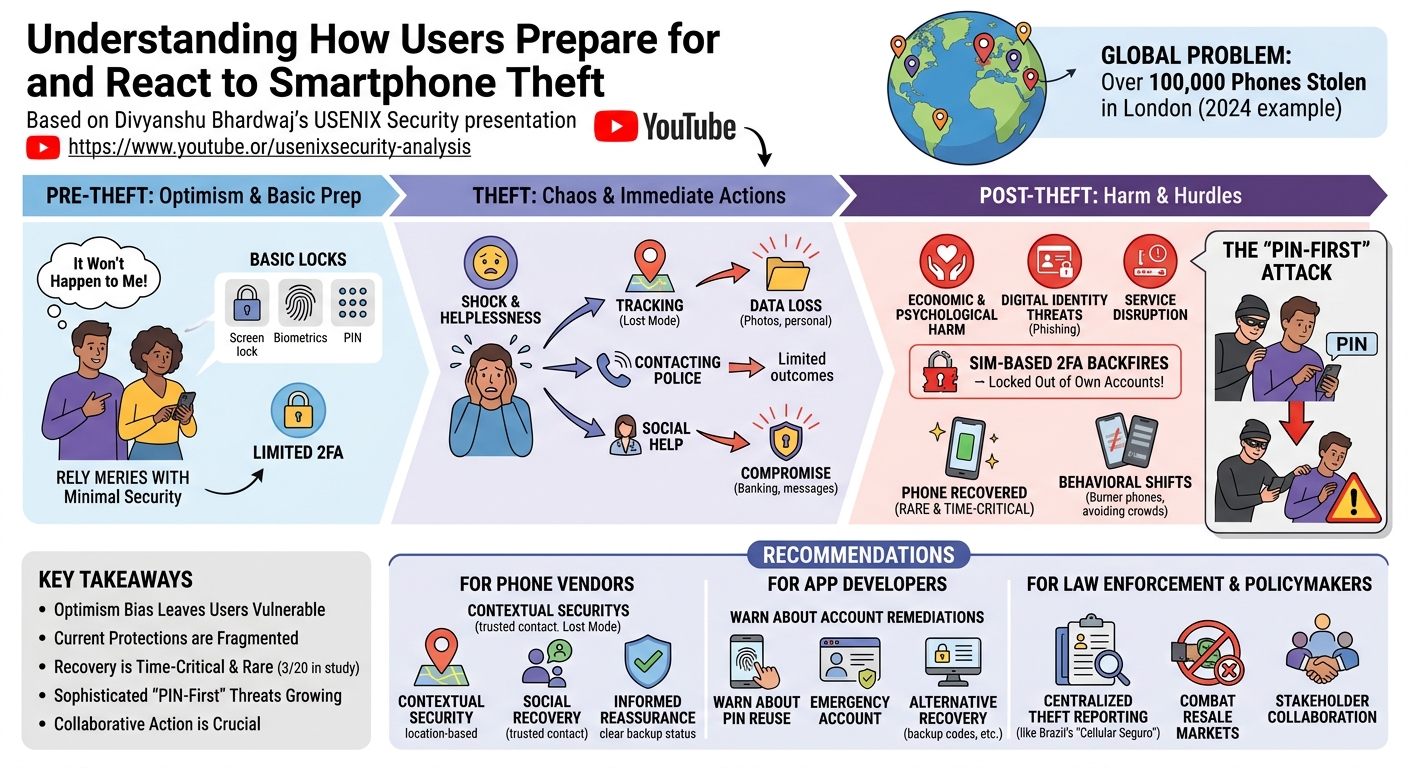
The research presented aims to empirically investigate user preparedness, immediate responses, and the long-term harms and threats faced during recovery from actual phone theft incidents. Despite the prevalence of smartphone theft—with over 100,000 phones reported stolen in London alone in 2024—there is a significant lack of understanding regarding how users truly cope with such an event. Bhardwaj and his team sought to fill this gap by conducting qualitative research, interviewing real victims to capture the complex interplay of technical actions, emotional distress, social dynamics, and decision-making under pressure.
This article dissects the findings of their study, revealing a stark disconnect between user perceptions of safety and the harsh realities of phone theft. It examines the temporal phases of the theft journey—pre-theft, theft, and post-theft—uncovering critical vulnerabilities in user preparedness, the immediate chaos of the incident, and the profound, often permanent, consequences for victims. Ultimately, the talk proposes actionable recommendations for key stakeholders, including phone vendors, app developers, and policymakers, to design more resilient systems and better support individuals in the face of this pervasive digital security threat.
Background
▶ Watch: Introduction: Phone theft is traumatic and underexplored (0:00)
The pervasive integration of smartphones into daily life has transformed them into indispensable tools, yet this centrality also makes them prime targets for theft. The problem is global, common, and deeply traumatic, as highlighted by numerous anecdotes and statistics, such as the alarming number of thefts in major cities. While a common assumption is that individuals can simply lock or track a lost device, empirical data on user preparedness and actual reactions to theft incidents has been severely lacking. This gap motivated Bhardwaj's research, which sought to move beyond hypothetical scenarios to understand the lived experience of phone theft victims.
The research was structured around three core questions: First, how do people conceptualize and prepare for the possibility of their smartphone being stolen? This question aimed to uncover the mental models and preventative measures users adopt. Second, what are the immediate responses to theft, including initial concerns, actions taken, and sources of help? This delved into the high-stress, time-critical decisions made in the immediate aftermath. Third, what types of harms and threats do victims encounter during the recovery phase? This explored the long-term consequences, both digital and psychological.
To address these questions, the research employed an exploratory qualitative research method. This approach was chosen due to the limited existing understanding of phone theft, allowing for a holistic capture of the entire experience. Instead of relying on assumptions, the researchers conducted 20 semi-structured interviews with individuals who had recently experienced actual smartphone theft. Participants were recruited via Reddit, providing access to recent, firsthand accounts from nine different countries, ensuring a diverse range of contexts and experiences. The interviews covered various theft severities, from opportunistic snatching and skilled pickpocketing to incidents involving confrontation and physical violence. This comprehensive approach allowed the researchers to systematically code and thematically analyze the interview transcripts, mapping out the nuanced and often distressing journey of phone theft victims over time.
Key Findings
▶ Watch: Study design: Interviewing real victims of smartphone theft (4:00)
The study's comprehensive analysis revealed a distinct three-phase temporal journey for smartphone theft victims: the pre-theft phase, characterized by expectations and preparation; the theft phase, encompassing the moment of loss and immediate reactions; and the post-theft phase, focusing on recovery, harms, and consequences.
In the pre-theft phase, a significant optimism bias was observed. Most participants felt safe, believing that theft "wouldn't happen to them" and consequently underestimated the risk. Their protection strategies were largely basic, relying on foundational security measures such as screen locks, biometrics, or PINs. A smaller subset reported using Two-Factor Authentication (2FA) for services deemed critical, but this was not universal. This general complacency set the stage for the profound shock that followed actual theft.
The theft phase was marked by immediate emotional and psychological distress, including shock, helplessness, and even self-blame. In the panic, victims attempted a range of immediate actions: trying to track their phone, activating Lost Mode, or contacting their bank and service providers. They also heavily relied on their social network—friends and family—for support and practical assistance. Some reported contacting the police, but often with limited or no effective outcome. The primary concerns during this phase revolved around losing access to irreplaceable personal data, such as photos, and the potential compromise of sensitive information housed in financial apps and private messengers.
The post-theft phase proved to be the most prolonged and challenging, characterized by significant economic, psychological, and digital harms. Economically, victims faced the immediate burden of replacing their device. Psychologically, they experienced ongoing anxiety, stress, and sometimes reputational harm stemming from the incident. A critical finding was the emergence of digital identity threats, including sophisticated phishing attempts where attackers impersonated legitimate entities like Apple customer support to extract account credentials. Access to essential services was severely disrupted. Crucially, 2FA, particularly SIM-based authentication, which is designed to enhance security, paradoxically became a major barrier. When the stolen phone's SIM was linked to 2FA, victims found themselves locked out of their own accounts, leading them to question its effectiveness.
Recovery rates were alarmingly low, with only three out of the 20 participants ever recovering their stolen phones. These rare recoveries were highly time-critical and dependent on immediate access to another logged-in device. For the vast majority, non-recovery meant the daunting task of rebuilding their entire digital life from scratch on a new device. The study also observed significant behavioral shifts post-theft, with victims avoiding phone use in crowded areas or even carrying "burner phones" in high-risk environments, indicating a shift from technical to non-technical protection strategies. Analyzing immediate post-theft actions, the researchers identified two main behavioral patterns: tech-savvy individuals initiated actions through technical means (e.g., tracking apps), while social individuals leaned on their social networks. Interestingly, the exact order of actions had less impact than whether the actions were primarily technical or social. Victims' greatest fears post-compromise were unauthorized access to financial apps, personal photos, messengers, social media, email, and even notes apps, which frequently contained critical information like passwords and PINs. The talk also highlighted a growing, more sophisticated threat model: thieves first socially engineer the victim to obtain their unlock PIN, then steal the phone, leading to severe consequences like drained bank accounts, identity theft, and permanent loss of digital assets, a pattern extensively reported by the Wall Street Journal.
Technical Deep Dive
▶ Watch: Summary of findings: Before, during, and post-theft struggles (7:00)
The technical aspects of smartphone security and its failures under theft scenarios formed a significant part of the discussion. The study revealed that pre-theft technical preparedness was often rudimentary. Users primarily relied on screen locks, biometric authentication (fingerprint, face ID), and basic PINs to secure their devices. While these are foundational security measures, they proved insufficient against determined attackers, particularly in scenarios where the PIN could be observed or socially engineered.
A critical technical finding concerned Two-Factor Authentication (2FA). While 2FA is a widely recommended security practice, the study found that SIM-based 2FA frequently backfired on victims. If the stolen phone's SIM card was used as the primary or only second factor for various online services (e.g., banking, email, social media), victims were effectively locked out of their own accounts. Attackers, by gaining control of the SIM (either by physical theft or by porting the number), could intercept 2FA codes, allowing them to bypass security measures designed to protect the user. This highlights a fundamental design flaw in relying solely on a single, physically vulnerable factor for authentication. The talk emphasized that SIM cards are often tied to national identities, making their compromise particularly difficult to remediate and increasing the severity of identity theft risks.
Phone vendors have begun to address these challenges with new features. Apple's Stolen Device Protection adds an extra layer of security when a device is away from familiar locations. This includes mandating biometric authentication for critical actions, inserting delays before key account or device changes, and requiring additional biometric checks. Similarly, Google's Android Theft Protection Suite incorporates automatic theft detection locks and safeguards that make device resets harder, while also limiting device functionality if theft is detected. These are crucial steps toward mitigating damage.
However, the research identified further technical vulnerabilities and proposed enhancements. Bhardwaj suggested three vendor-level features:
- Contextual Security: This feature would introduce a contextual high-risk mode. Triggered automatically by environmental cues such as location (e.g., concert venues, transit hubs), wallet items, or calendar entries, this mode would temporarily mandate biometric authentication for all third-party applications, not just system-level functions. This proactive, context-aware security aims to elevate protection when users are most vulnerable.
- Social Recovery: To expedite recovery actions, this feature would allow pre-approved contacts to trigger Lost Mode on a stolen device. This addresses the time-critical nature of recovery and the common scenario where victims lack immediate access to another logged-in device to initiate these actions themselves.
- Informed Reassurance: Users often hesitate to remotely lock or erase a device due to fear of losing data. This feature would clearly display backup metadata and status (e.g., "Last backup: 5 minutes ago") before users confirm such actions, providing the confidence needed to act decisively.
For app developers, several technical improvements were recommended:
- Warn about PIN reuse: Users frequently reuse the same PIN for both device unlock and critical app access. If the device PIN is compromised, this creates a direct attack path to sensitive apps. Apps should actively warn users against this practice.
- Emergency Account Remediations: Apps should provide quick, easily accessible mechanisms for users to revoke active sessions, reset credentials, and secure accounts immediately after theft. This streamlined process is vital in high-stress situations.
- Alternative Recovery Options: Moving beyond sole reliance on SIM-based 2FA, apps should support diverse recovery methods such as backup codes, email-based logins, or trusted device authentication as fallbacks. This multi-modal approach enhances resilience against SIM compromise.
The talk underscored the severity of a sophisticated attack vector: thieves who first socially engineer the victim to obtain their unlock PIN and then steal the phone. This "PIN-first" strategy completely bypasses basic screen locks and biometrics, granting attackers immediate, full access to the device and its sensitive applications, leading to severe financial and identity theft. This highlights that current technical protections, while evolving, remain inadequate against adaptive and socially engineered threats.
Demo / Proof of Concept
▶ Watch: Stolen phones are almost never recovered: a harsh reality (8:00)
This talk presented findings from a qualitative research study rather than a technical demonstration or proof of concept of a specific exploit or security tool. The core of the presentation was the empirical investigation of user experiences and behaviors related to smartphone theft, derived from semi-structured interviews with actual victims. Therefore, no live technical demonstration or proof of concept was conducted as part of this research.
Defensive Implications
▶ Watch: Behavioral shifts: Avoiding crowded spaces, carrying burner phones (9:10)
The research provides crucial insights for various stakeholders to enhance defensive strategies against smartphone theft and its aftermath.
For Individual Users:
- Overcome Optimism Bias: Users must acknowledge that smartphone theft is a real and common threat, not just something that happens to others. Proactive preparation is essential.
- Diversify 2FA Methods: Avoid sole reliance on SIM-based 2FA. Set up alternative authentication methods like authenticator apps (e.g., Google Authenticator, Authy), physical security keys, or backup codes for critical accounts (banking, email, social media). Store backup codes securely, preferably offline.
- Avoid PIN Reuse: Never use the same PIN for your device unlock and for sensitive applications (e.g., banking apps). Consider using stronger, unique passcodes for high-value apps.
- Proactive Device Management: Familiarize yourself with and enable your phone's Lost Mode or "Find My" features before theft occurs. Understand how to remotely lock, wipe, or track your device from another device or web browser.
- Regular Data Backups: Regularly back up photos, documents, and other critical data to cloud services or external storage. This minimizes data loss even if the phone is unrecoverable.
- Situational Awareness: Be more aware of surroundings in crowded places. Consider non-technical measures like carrying a "burner phone" for high-risk environments, as some victims have adopted.
- Be Wary of Social Engineering: Understand that sophisticated thieves may attempt to observe or socially engineer your unlock PIN before stealing your device. Protect your PIN diligently.
For Phone Vendors (e.g., Apple, Google):
- Implement Contextual Security: Develop and integrate features that automatically activate a "high-risk mode" based on location, calendar, or other cues, mandating stronger authentication (e.g., biometrics) for all apps in such contexts.
- Enhance Social Recovery: Introduce mechanisms for pre-approved trusted contacts to assist in triggering Lost Mode or other critical recovery actions, addressing the immediate time-critical needs of victims.
- Provide Informed Reassurance: When users attempt to lock or erase their device, provide clear, immediate feedback on the status of their data backups, reducing hesitation and encouraging timely action.
- Strengthen Anti-Theft Features: Continue to evolve existing features like Stolen Device Protection (Apple) and Android Theft Protection Suite (Google) to be more resilient against sophisticated attacks, especially the "PIN-first" theft vector.
For App Developers:
- Educate on PIN Hygiene: Actively warn users within apps about the dangers of reusing their device PIN for app access.
- Streamline Emergency Remediations: Design user-friendly interfaces for quick session revocation, password resets, and account securing in the event of theft. This should be accessible even without the stolen device.
- Offer Diverse Recovery Options: Move beyond exclusive reliance on SIM-based 2FA by offering robust alternative recovery methods such as backup codes, email verification, or trusted device authentication.
For Law Enforcement and Policymakers:
- Centralized Theft Reporting: Support and implement systems similar to Brazil's Cellular Seguro app, which allows for centralized reporting of stolen phones, triggering coordinated blocks across telecom providers, banks, and digital services. This holistic approach can significantly reduce the utility of stolen devices.
- Combat Resale Markets: Introduce policies and enforcement mechanisms to limit the resale of stolen phones and their parts, reducing the economic incentive for theft.
- Promote Stakeholder Collaboration: Incentivize and facilitate collaboration between phone vendors, app developers, telecom companies, and financial institutions to create a more coordinated and effective response ecosystem for victims of phone theft.
By implementing these multi-faceted defensive strategies, the digital ecosystem can become more resilient, better protecting users from the pervasive and traumatic consequences of smartphone theft.
Key Takeaways
- Optimism Bias Leads to Underpreparedness: Users significantly underestimate the risk of smartphone theft, relying on basic protections like screen locks and often lacking comprehensive preparedness for a post-theft scenario.
- Current Protections Are Fragmented and Complex: The existing security landscape for smartphones is scattered across different services and inconsistent in design, making it difficult for users to navigate recovery actions effectively, especially under duress.
- SIM-Based 2FA Can Backfire: While intended for security, Two-Factor Authentication (2FA), particularly when tied to the stolen phone's SIM card, frequently locks victims out of their own accounts, hindering recovery efforts.
- Sophisticated "PIN-First" Theft is a Growing Threat: A more advanced attack vector involves thieves first socially engineering or observing a victim's unlock PIN, then stealing the phone, leading to immediate and severe compromises of financial and personal data.
- Recovery is Time-Critical and Rare: Stolen phones are almost never recovered (only 3 out of 20 in the study), and successful recovery actions are highly dependent on immediate access to another logged-in device, highlighting the need for robust backup and alternative access strategies.
- Collaborative Stakeholder Action is Crucial: Phone vendors, app developers, and policymakers must collaborate to design more contextual, socially supported, and user-friendly security and recovery features to better protect individuals from the full spectrum of harms associated with smartphone theft.
About the Speaker(s)
Divyanshu Bhardwaj is the speaker who presented the paper "Understanding How Users Prepare for and React to Smartphone Theft" at the USENIX Security conference. The transcript indicates he is the primary presenter of this research. Further details about his specific title or company were not provided within the scope of the conference talk transcript.
Reviews
Dr. Zero (Offensive Security Researcher) — SOLID
Solid usable-security research with real interviews and a clear temporal framework, but 20 participants across nine countries is thin, and the findings largely confirm what the field already suspected. The recommendations are sensible but not surprising to anyone who's thought about this problem for more than an hour.
Heather Calloway (CISO) — SOLID
Solid consumer-focused security research with real empirical grounding and a few genuinely useful findings — particularly on SIM-based 2FA failure modes and the PIN-first attack vector. But the institutional and governance dimensions are almost entirely absent, and the recommendations stay at the product-design level without connecting to the accountability structures that would actually drive change.
→ Top-rated talks at 34th USENIX Security Symposium (USENIX Security '25)
All talks from 34th USENIX Security Symposium (USENIX Security '25)