Rogue hirer, rogue hiree: workplace cyber threats to individuals and businesses
Chris Boyd (Rapid7)
Virus Bulletin Conference 2025 (VB2025) · Day 2 · Red room
Overview
In this compelling talk from Virus Bulletin, Chris Boyd, Lead Analyst at Rapid7, sheds light on the multifaceted and evolving landscape of cyber threats impacting both businesses and individuals within the modern employment ecosystem. Titled "Rogue hirer, rogue hiree: workplace cyber threats to individuals and businesses," Boyd meticulously dissects the tactics employed by malicious actors seeking to infiltrate organizations through the hiring process, as well as the pervasive scams targeting job seekers, freelancers, and contractors. The presentation serves as a critical warning, illustrating how a combination of economic pressures, technological advancements like AI, and traditional social engineering are creating fertile ground for sophisticated employment-related fraud.
Key moments
- 0:00 Introduction: Fake jobs and rogue hires
- 2:00 Types of rogue applicants: malicious, state-sponsored, proxy
- 5:00 Weak points in hiring and screening processes
- 9:00 Interview techniques to detect fraudulent candidates
- 13:30 Onboarding protections: access, ID, and manager check-ins
- 16:00 Freelancer scam: The fake music CEO
- 18:30 Freelancer scam: The prolific task scam
Rogue hirer, rogue hiree: workplace cyber threats to individuals and businesses
Speakers: Chris Boyd, Lead Analyst, Rapid7
Conference: Virus Bulletin
YouTube: https://www.youtube.com/watch?v=Kk51vdizuaE
Overview
In this compelling talk from Virus Bulletin, Chris Boyd, Lead Analyst at Rapid7, sheds light on the multifaceted and evolving landscape of cyber threats impacting both businesses and individuals within the modern employment ecosystem. Titled "Rogue hirer, rogue hiree: workplace cyber threats to individuals and businesses," Boyd meticulously dissects the tactics employed by malicious actors seeking to infiltrate organizations through the hiring process, as well as the pervasive scams targeting job seekers, freelancers, and contractors. The presentation serves as a critical warning, illustrating how a combination of economic pressures, technological advancements like AI, and traditional social engineering are creating fertile ground for sophisticated employment-related fraud.
Boyd's analysis is particularly pertinent in an era characterized by remote work, the gig economy, and a competitive job market. He highlights the often-overlooked vulnerabilities in recruitment, onboarding, and internal operations that malicious individuals, state-sponsored actors, and even "overworkers" exploit to achieve their objectives, ranging from data theft and financial fraud to espionage. Simultaneously, he exposes the deceptive schemes that prey on the hopes and financial anxieties of freelance professionals, leading to significant monetary losses and compromised personal data.
The talk underscores the urgent need for organizations to implement robust, multi-layered defenses throughout their hiring lifecycle and for individuals to adopt a heightened sense of skepticism when presented with seemingly lucrative job opportunities. By detailing specific attack vectors and outlining practical countermeasures, Boyd provides invaluable insights for both cybersecurity professionals tasked with protecting corporate networks and everyday individuals navigating the complexities of the modern job market.
Background
▶ Watch: Introduction: Fake jobs and rogue hires (0:00)
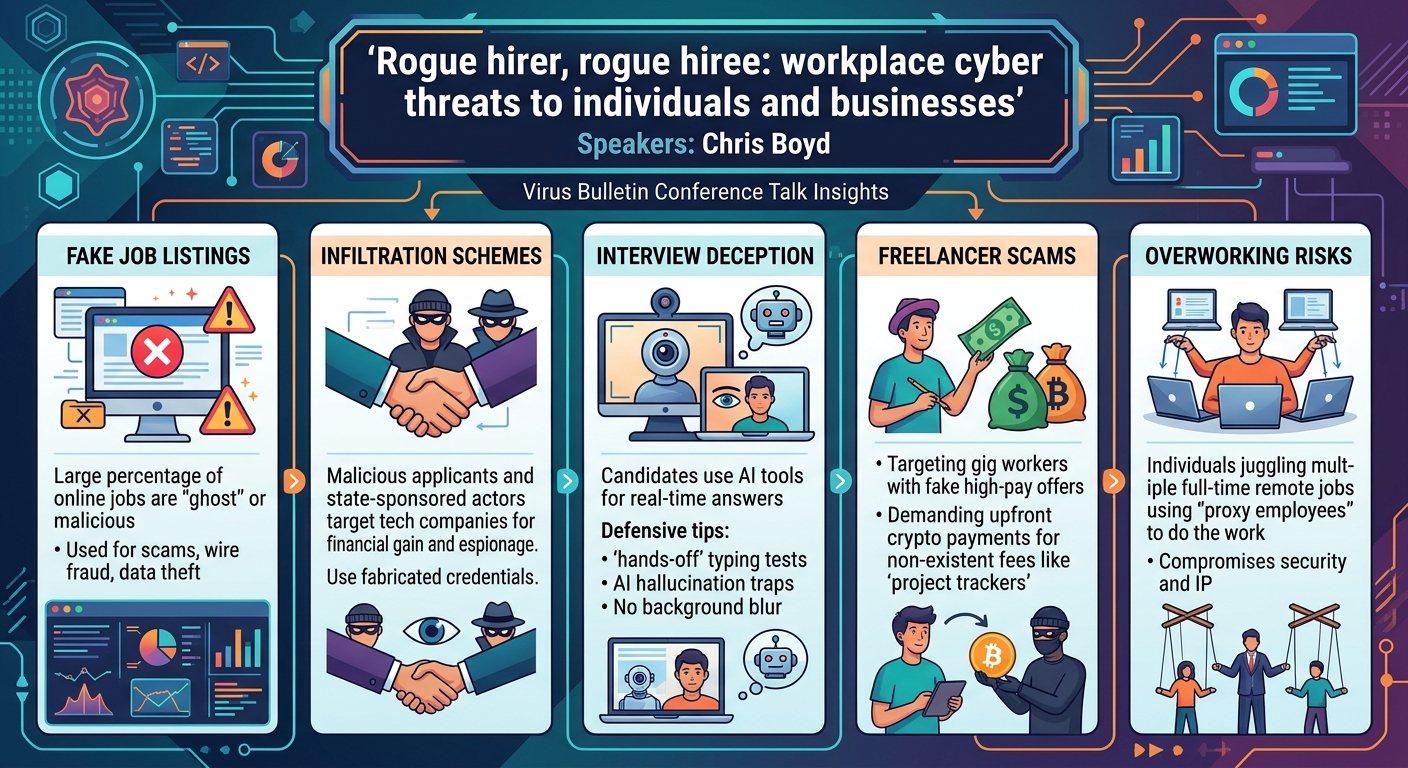
The genesis of the "rogue hirer, rogue hiree" problem is rooted in several converging trends within the contemporary employment landscape. Chris Boyd begins by sharing his personal experience of job searching, which mirrored research findings indicating that a significant portion of online job listings are either ghost jobs – legitimate companies posting non-existent roles to project growth – or outright malicious advertisements designed to ensnare applicants. These malicious listings lead to individuals being added to spam lists, signed up for fake job sites, or directly targeted with theft, wire fraud, and malware.
Beyond these external threats, the core of Boyd's discussion centers on the rogue hire, an individual who successfully infiltrates an organization. He categorizes these actors into three primary archetypes:
- Malicious Applicants: These individuals, working alone or in teams, aim to exploit internal systems for CFO fraud, Business Email Compromise (BEC), data theft, or blackmail. Their ultimate goal is financial gain or sabotage.
- State-Sponsored Rogue Employees: Often operating as freelancers from outside the target country, these individuals frequently target the tech industry. While they may steal data, Boyd notes that many are primarily motivated by financial objectives, performing their jobs competently to funnel earnings back to their sponsoring state, such as North Korea. This introduces significant compliance and ethical risks for businesses.
- Proxy Employees / Overworkers: This increasingly prevalent category stems from economic pressures, particularly in the gig economy. Legitimate employees, often based in countries like India, pay a proxy employee $100-$200 a month to perform their job duties. A related phenomenon, overwork, sees individuals attempting to simultaneously hold three, four, or even five full-time remote jobs, often leveraging proxy employees to manage the workload. Forums and subreddits dedicated to "overworking" share tactics for minimizing effort while maximizing income.
The vulnerability of businesses to these rogue hires is exacerbated by weak points in the hiring process: inadequate protections during screening, interviewing, and onboarding. Many HR and hiring departments, Boyd observes, are "despondent" about these gaps, often lacking any established defenses because the threat of malicious insiders or deceptive applicants has historically been underestimated or unaddressed. This lack of foresight creates critical windows of opportunity for attackers to solidify credibility, evade detection, and ultimately gain access to sensitive corporate resources.
Key Findings
▶ Watch: Weak points in hiring and screening processes (5:00)
Chris Boyd's talk reveals several critical findings regarding the nature of workplace cyber threats:
- Prevalence of Deceptive Job Listings: A significant portion of online job postings are either "ghost jobs" by legitimate companies or outright malicious listings designed to defraud applicants, leading to spam, fake sign-ups, or direct financial/malware attacks.
- Three Rogue Applicant Archetypes: Malicious applicants (seeking financial gain, data theft, or blackmail), state-sponsored rogue employees (often focused on diverting funds or espionage), and proxy employees/overworkers (driven by economic necessity, leading to compromised security and intellectual property risks).
- Exploitable Hiring Lifecycle: Attackers systematically target the screening, interview, and onboarding phases of employment. During screening, they focus on solidifying credibility with fake resumes and documentation (e.g., services in India that forge work history for a fee, ranging from a couple of hundred dollars for short-term to more for 2-3 years). In interviews, their aim is to evade detection, often using AI or external assistance. Upon onboarding, their goal is to quickly achieve their objectives before being discovered.
- Sophisticated Evasion Tactics: Rogue applicants employ advanced techniques, including using AI tools to generate interview answers, faking degrees and transcripts, and leveraging background blur during video calls to conceal their environment or external help. Some even repeat questions mechanically to buy time for AI tools to formulate responses.
- Effective Defensive Countermeasures Exist: Businesses are actively developing and implementing strategies such as Applicant Tracking Systems (ATS) to detect duplicate applications, rigorous background verification (including asking for country-specific documentation like UK transcripts), and specific interview tactics (e.g., asking candidates to disable background blur, conducting "hometown pop quizzes," and using "AI hallucination traps" with nonsense technical questions).
- Pervasive Freelancer Scams: Beyond corporate infiltration, freelancers are heavily targeted by specific, prolific scams. Boyd details two examples:
- Fake Music CEO Scam: Scammers impersonate industry executives (e.g., "Mr. Rob Stringer" of Sony), offering lucrative contracts (e.g., $980,000/year income, $125,000 for upkeep) but demanding small upfront payments for "project trackers" ($300) or "web hosting" via cryptocurrency (Bitcoin preferred). Boyd's personal encounter with this scam revealed an address receiving over $6,000 from 46 inbound transactions in just a few months.
- Task Scam: Freelancers are offered easy money (e.g., £500-£1,000/day for Google reviews). They are initially paid for simple tasks, but then asked to pay to "unlock" higher-tier tasks. This often culminates in demands for "tax payments" (e.g., 40% income tax) to release accumulated funds, which are instead siphoned off by the scammers. Boyd found 20 such scam sites, often clustered, with servers in Japan, India, and Singapore, and noted the emergence of fake recovery scammers preying on victims.
- Overlooked Onboarding Vulnerabilities: Many companies provide new hires with immediate, unrestricted access to systems and unmanaged laptops, creating significant security risks. The lack of direct manager interaction during onboarding further delays detection of rogue employees.
Technical Deep Dive
▶ Watch: Interview techniques to detect fraudulent candidates (9:00)
The technical deep dive into "Rogue hirer, rogue hiree" reveals a sophisticated interplay of social engineering, technological exploitation, and counter-detection mechanisms employed by both attackers and defenders.
Attacker Methodologies and Tools
Rogue applicants leverage a variety of techniques to bypass traditional hiring safeguards:
- Credential Forgery Services: In regions like India, services offer fake documentation and work history verification. For a few hundred dollars, these services will create convincing resumes and even serve as fraudulent references for periods of one to three years, providing fabricated employment details that align with the applicant's claims.
- AI-Assisted Interview Evasion: Attackers increasingly use Artificial Intelligence (AI) tools during remote interviews. This can involve having AI provide real-time answers via a second screen or phone. Defenders note candidates whose eyes are "fixed" or unnaturally still, indicating reliance on an off-screen device. Some even employ background blur to obscure their environment, preventing interviewers from seeing external cues or collaborators.
- Stalling Tactics: A common trick is to repeat the interviewer's question slowly and deliberately. While a legitimate public speaking technique, attackers use this to stall for time, allowing their AI tools to process the question and generate an answer. This requires interviewers to be vigilant about abnormal speech patterns and potential earbuds/headphones that could be relaying AI-generated responses.
- Proxy Work and Overworking Infrastructure: The "overwork" phenomenon relies on individuals managing multiple full-time jobs. This is often facilitated by proxy employees paid to perform tasks. Online forums and subreddits serve as knowledge bases for these "overworkers," sharing technical tricks and operational strategies to juggle multiple roles with minimal effort, effectively creating a distributed, often clandestine, workforce. This can involve using multiple devices, VPNs to spoof locations, and carefully managing communication channels to avoid detection by employers.
Defensive Countermeasures and Technologies
Organizations are responding with a range of technical and procedural controls:
- Applicant Tracking Systems (ATS) for Duplicate Detection: Modern ATS are crucial for identifying fraudulent applications. They are configured to flag duplicate email addresses, repeatedly used fake names, and generic background information that frequently appear across multiple applications. This automation is essential given the volume of applications (e.g., 100-300 per day for a typical job) that make manual review impractical.
- Enhanced Degree and Credential Verification: Beyond basic checks, companies are now rolling out sophisticated verification systems. If an applicant claims a degree, the system can automatically request proof. More advanced systems are tailored by country of origin; for example, if a degree is from the UK, the system might specifically ask for transcripts, which list all course modules, scores, and credits. An applicant's unfamiliarity with such common documentation (e.g., "What's a transcript?") immediately flags suspicion.
- Interview AI Detection Techniques:
- Background Blur Disable: Interviewers request candidates to turn off background blur to reveal their physical environment, checking for external screens, collaborators, or inconsistencies like "daytime" interviews conducted at night (e.g., seeing the moon in the background).
- Eye Movement Analysis: Interviewers are trained to observe a candidate's eye movements for tell-tale signs of AI use, such as eyes being "fixed" or constantly darting to an off-screen device.
- Hometown Pop Quizzes: Leveraging background information provided by the candidate (e.g., LinkedIn, resume), interviewers ask specific, localized questions about the claimed hometown (e.g., "What are the interesting features of the city? What are popular places?"). This tests genuine familiarity versus fabricated knowledge.
- AI Hallucination Traps: Interviewers introduce intentionally fictitious technical questions (e.g., about non-existent coding protocols or engineering concepts). If the candidate responds with "mangled gibberish tech speak" rather than admitting ignorance, it indicates they are relying on an AI that has "hallucinated" an answer.
- Hands-Off Typing Tests: During coding or technical assessments, suspicious interviewers may randomly ask candidates to "stop typing and lift their hands up" to check if typing sounds or code generation continues, indicating remote assistance or automated tools.
- Secure Onboarding Protocols:
- Restricted Access (Least Privilege): New hires should not have immediate, free-reign access to all company systems. Access should be gradually provisioned based on the principle of least privilege, starting with only essential tools (e.g., specific Slack/Teams channels) for their role.
- Managed Laptop Provisioning: Laptops provided to new employees should be securely configured and managed, preventing the installation of unauthorized software (e.g., remote access tools, file transfer software) that could facilitate state-sponsored attacks or data exfiltration.
- Valid ID Verification for Hardware Delivery: When shipping laptops or equipment, companies should use services that verify the recipient's identity upon delivery. While not foolproof against forged or stolen IDs, it's a critical layer of defense against complete anonymity.
- Regular Manager Check-ins: Direct interaction between a new hire and their immediate manager is crucial for early detection of unusual behavior or performance issues. The absence of such interaction in some companies is a significant oversight.
These detailed technical and procedural measures illustrate the escalating arms race between those seeking to exploit the hiring process and organizations striving to protect their assets.
Demo / Proof of Concept
▶ Watch: Freelancer scam: The fake music CEO (16:00)
While the talk did not feature a live technical demonstration of code or system exploitation, Chris Boyd provided compelling "proofs of concept" by detailing two prolific real-world social engineering scams he personally encountered. These served as vivid illustrations of the "rogue hiree" threat, demonstrating how malicious actors target individuals seeking employment or freelance work.
1. The Fake Music CEO Scam
Boyd presented a step-by-step walkthrough of this scam, which targets marketing and PR professionals, as well as freelance musicians, with the goal of acquiring cryptocurrency.
- Initial Approach: Scammers create fake profiles on platforms like SoundCloud and social media, often impersonating genuine PR professionals or A&R agents from well-known music labels (e.g., "ANR agent for Sony," working under "President Mr. Rob Stringer"). These fake profiles often show an inflated number of followers (e.g., 176 opportunities for fraud).
- Building Credibility: Boyd showed screenshots of messages he received, replete with flattery ("I admire your work. It's fantastic. Are you signed?"). The scam quickly moved to WhatsApp for "direct communication" with the fake CEO.
- The Lure: A ridiculous contract was offered, promising exorbitant annual income (e.g., $980,000/year income, plus $125,000 for "upkeep" and money for studio equipment). This high-value offer is designed to override critical thinking.
- The Ask (The "Proof of Concept" of the fraud): The scam's pivot point was the demand for a small, upfront payment. In Boyd's case, it was $300 for a "project tracker." The payment options were limited and time-sensitive, with a strong preference for Bitcoin. Boyd highlighted the absurdity of a high-paying executive not simply deducting $300 from a nearly million-dollar salary.
- Financial Impact: Boyd tracked the Bitcoin address provided by the scammers. Although they "torched" (abandoned) the address once they realized he wouldn't pay, it had recorded 86 transactions, with 46 inbound payments. Between January and March of that year, the scammers collected over $6,000 from victims.
- Secondary Exploitation: As a final attempt, scammers would offer to upload the victim's music to a "company database" (a fake Sony portal) and then demand payment for "web hosting."
2. The Task Scam
This scam targets freelancers, aiming to drain their savings through a gamified, deceptive work process.
- Initial Contact: Scammers approach victims via chat apps and LinkedIn DMs, offering seemingly easy, high-paying work (e.g., "Leave a five-star rating on Google, you'll be paid £500 to £1,000 a day").
- Gamified Tasks: Victims are directed to a website with a list of tasks, from "easy" at the bottom to "impossible" at the top. The scammers genuinely pay for the first few easy tasks, building trust.
- The Trap (The "Proof of Concept" of the fraud): To "unlock" higher-paying tiers of tasks, victims are required to pay money to the scammers. This creates a cycle where victims invest more and more money, hoping to recoup their losses and earn the promised high wages.
- The Final Blow: Once victims have invested significant sums, scammers demand an additional "tax payment" (e.g., 40% income tax) to release the accumulated "funds." This money is sent directly to the scammers, not a legitimate tax agency, and is never returned.
- Scale of Operation: Boyd investigated complaints on Reddit, identifying 20 such scam sites, often clustered into groups of two or three branded sites per scam, with servers located in Japan, India, and Singapore.
- Recovery Scams: Disturbingly, Boyd noted that fake recovery scammers often emerge shortly after these task scams, using the scam sites' web addresses as hashtags on platforms like Instagram. This raises the question of whether these recovery scammers are connected to the original fraud or merely opportunistically preying on victims.
These detailed accounts, presented with real messages and financial data, effectively served as a "proof of concept" for the sophisticated social engineering tactics employed by rogue hirers targeting unsuspecting individuals.
Defensive Implications
▶ Watch: Freelancer scam: The prolific task scam (18:30)
The insights from Chris Boyd's talk provide critical defensive implications for both businesses and individuals navigating the modern employment landscape. A multi-layered approach, combining technological safeguards with heightened human awareness, is essential.
For Businesses: Fortifying the Hiring Pipeline
- Enhance Applicant Tracking Systems (ATS): Invest in advanced ATS capable of duplicate detection across various data points (email addresses, names, background details). These systems should flag inconsistencies or patterns indicative of fraudulent applications, reducing the manual burden on HR teams.
- Implement Rigorous Credential Verification: Move beyond basic checks. For degrees, demand specific, country-standard documentation like UK transcripts listing course modules and scores. Be wary of applicants unable to produce such standard proof. Consider services that specialize in international credential verification.
- Train Interviewers on AI and Deception Detection:
- Standardize Remote Interview Protocols: Require candidates to disable background blur to ensure a transparent environment.
- Observe Non-Verbal Cues: Train interviewers to recognize signs of AI use, such as fixed eye contact (indicating reading from a screen) or unnatural pauses.
- Utilize Targeted Questioning: Employ "hometown pop quizzes" and specific questions about past experiences to gauge genuine knowledge and detect fabricated backgrounds.
- Deploy AI Hallucination Traps: Introduce non-sensical technical questions to test for AI reliance. A legitimate candidate will admit ignorance, while an AI-dependent one may generate gibberish.
- Incorporate Hands-Off Typing Tests: For technical roles, randomly ask candidates to lift their hands during coding tests to ensure they are genuinely performing the work.
- Strengthen Onboarding Security:
- Principle of Least Privilege: New hires should only receive access to the minimum systems and data required for their initial tasks. Access should be gradually expanded as trust and tenure are established.
- Secure Laptop Provisioning: Provide pre-configured, managed laptops that restrict unauthorized software installation. This prevents rogue employees from deploying remote access tools or malware.
- ID Verification for Hardware Delivery: Utilize services that verify the recipient's identity before handing over company assets like laptops. While not entirely foolproof against sophisticated forgeries, it adds a crucial layer of friction.
- Mandate Early Manager Interaction: Ensure new hires have direct and regular interaction with their immediate managers from day one. Managers are often the first to spot inconsistencies or underperformance indicative of a rogue employee.
- Educate HR and Hiring Teams: Raise awareness about the various rogue applicant archetypes, including state-sponsored actors and proxy employees. Equip them with the knowledge to identify red flags and the tools to respond effectively.
For Individuals and Freelancers: Navigating the Job Market Safely
- Be Skeptical of Unsolicited Offers: Treat unsolicited job offers or freelance contracts, especially those received via social media DMs or chat apps, with extreme caution. Verify the sender's identity and the company's legitimacy independently.
- Verify Employer Identity: Research the company and individuals claiming to represent them. Check their official websites, LinkedIn profiles (look for long-standing profiles, not new ones with inflated follower counts), and contact information. Do not rely solely on links or contact details provided by the sender.
- Never Pay Upfront Fees: This is a universal red flag. Legitimate employers or clients will never ask you to pay for "project trackers," "web hosting," "training materials," "software licenses," or "taxes" to release funds. Any request for money from you is almost certainly a scam.
- Beware of Cryptocurrency Demands: Scammers often prefer payments in cryptocurrency (like Bitcoin) due to its irreversible nature and pseudo-anonymity. Be extremely wary of any job offer that requires payment in crypto.
- Recognize Gamified Task Scams: If a job involves performing simple tasks for high pay, then requires you to pay to "unlock" higher tiers or "release funds," it's a task scam. The initial small payments are a psychological trick to build trust and encourage further investment.
- Protect Your Personal Information: Be cautious about sharing sensitive personal or financial information with unverified entities.
- Report Scams: If you encounter a scam, report it to relevant authorities and platforms (e.g., LinkedIn, Google, local law enforcement). This helps protect others and provides data for tracking scam operations.
By implementing these defensive strategies, both organizations and individuals can significantly reduce their exposure to the evolving threats posed by rogue hirers and rogue hirees.
Key Takeaways
- The Hiring Pipeline is a Critical Attack Surface: Malicious actors actively exploit vulnerabilities in screening, interviewing, and onboarding processes to infiltrate businesses.
- Diverse Motivations Drive Rogue Hires: Threats range from financially motivated malicious insiders and state-sponsored espionage to economically driven "proxy employees" and "overworkers."
- AI is a Double-Edged Sword: While AI tools aid attackers in crafting convincing applications and evading interview detection, defenders are developing AI-aware countermeasures.
- Freelancers are Prime Targets for Sophisticated Scams: "Fake Music CEO" and "Task Scams" are prolific, luring individuals with high pay but demanding upfront payments, often in cryptocurrency, for non-existent services or "taxes."
- Robust Verification and Awareness are Paramount: Businesses must implement strong ATS, rigorous credential checks, and train interviewers in deception detection. Individuals must maintain skepticism, verify identities independently, and never pay upfront fees for employment.
- Onboarding Security is Often Overlooked: Restricting access, securing hardware, and ensuring direct managerial oversight during the initial employment phase are crucial for mitigating insider threats.
About the Speaker(s)
Chris Boyd is a Lead Analyst at Rapid7, a leading cybersecurity company. In his role, he focuses on cyber threat research, analyzing emerging trends and attack methodologies to help organizations understand and defend against evolving risks. Boyd's work often involves delving into the psychological and social engineering aspects of cybercrime, as demonstrated by his expertise in identifying and dissecting scams that target individuals and businesses through deceptive employment practices. His background prior to Rapid7 included extensive experience in job searching, which provided him with firsthand insights into the prevalence of fake and malicious job listings, enriching his perspective on the topics he presents.
Reviews
Dr. Zero (Offensive Security Researcher) — SOLID
Useful awareness talk on hiring-related fraud and freelancer scams, but it's survey-level content without novel research or technical depth. Boyd shares real examples and practical interview countermeasures, which has value for HR teams and individuals, but security practitioners won't learn anything they couldn't piece together from threat intel blogs.
Heather Calloway (CISO) — SOLID
Useful operational awareness for HR, recruiting, and security teams on insider threat vectors through hiring fraud. The freelancer scam content is a distraction from the enterprise risk story, and the defensive recommendations are mostly procedural hygiene rather than programmatic change.
→ Top-rated talks at Virus Bulletin Conference 2025 (VB2025)