Production Is the New Attack Surface: Why Post-Deployment Endpoint Detection Is Now Critical
Tracy Ragan (DeployHub.com)
Overview
In a compelling presentation at VulnCon, Tracy Ragan, co-founder of DeployHub.com, challenged the security community to fundamentally rethink its approach to protecting live production environments. While significant progress has been made in "shifting left" — identifying and remediating vulnerabilities early in the software development lifecycle — Ragan argued that a critical "blind spot" persists once software is deployed. This oversight renders production environments the "new attack surface," demanding a robust defensive strategy that goes beyond pre-deployment scanning.
Key moments
- 1:40 Production is the new attack surface
- 6:00 Why post-deployment security is a critical blind spot
- 8:00 Current post-deployment security tools are too complex
- 12:00 Digital twin: tracking S-bombs, Git repos, endpoints
- 14:30 Operationalizing S-bombs for continuous threat management
- 16:00 Auto-remediation: fixing vulnerabilities from months to days
- 20:50 Audience Q&A: The challenge of S-bomb accuracy
- 24:00 Audience Q&A: Using attestation for deployment metadata
Production Is the New Attack Surface: Why Post-Deployment Endpoint Detection Is Now Critical
Speakers: Tracy Ragan, Co-founder, DeployHub.com
Conference: VulnCon
YouTube: https://www.youtube.com/watch?v=K6Z3YRWZ1zA
Overview
In a compelling presentation at VulnCon, Tracy Ragan, co-founder of DeployHub.com, challenged the security community to fundamentally rethink its approach to protecting live production environments. While significant progress has been made in "shifting left" — identifying and remediating vulnerabilities early in the software development lifecycle — Ragan argued that a critical "blind spot" persists once software is deployed. This oversight renders production environments the "new attack surface," demanding a robust defensive strategy that goes beyond pre-deployment scanning.
Ragan highlighted the stark reality that 100% of successful attacks target production, despite efforts to address 80% of vulnerabilities before deployment. She underscored this urgency with real-world examples, such as the 2022 Starlink outage during the Ukrainian war, which took over two weeks to resolve. Her talk introduced the concept of a digital twin as a paradigm-shifting solution for continuous, real-time, and agentless vulnerability detection and remediation in live systems, particularly crucial for constrained and critical edge environments like satellites, fighter jets, and autonomous vehicles.
The core message is a call to action: to balance the industry's strong offensive security posture with an equally powerful defensive one. By operationalizing Software Bill of Materials (S-bombs) and leveraging deployment metadata, Ragan proposed a path to drastically reduce the mean time to remediation (MTTR) from months to days, ultimately aiming for vulnerability resolution within a single day. This approach promises not only enhanced security but also a more efficient and less resource-intensive method for safeguarding the software that powers modern infrastructure.
Background
▶ Watch: Production is the new attack surface (1:40)
The cybersecurity landscape is characterized by an escalating volume and sophistication of threats, yet the industry's defensive capabilities, particularly post-deployment, lag significantly. Tracy Ragan presented a sobering assessment of the current state, revealing that while the community excels at identifying and fixing vulnerabilities in the software supply chain before deployment, these efforts often fall short once software enters production. According to research from organizations like Sonatype and OpenSSF, approximately 80% of vulnerabilities are successfully addressed pre-deployment through techniques such as Static Application Security Testing (SAST), Dynamic Application Security Testing (DAST), and Software Composition Analysis (SCA). However, Ragan emphasized a critical paradox: 100% of successful attacks target production environments. This disconnect creates a perilous "blind spot" where newly discovered vulnerabilities (CVEs) emerge after software has been released, leaving live systems exposed.
The scale of this problem is staggering. Ragan cited a 200% increase in vulnerabilities over the past three years, translating to an average of 47 critical and high-risk vulnerabilities per day. The financial implications are equally severe, with the cost to fix a single vulnerability ranging from $10,000 to $50,000. For an average company, dealing with even a fraction of these daily threats can mean managing 100 to 300 critical and high-risk vulnerabilities annually. Compounding this challenge is the vast disparity between attacker speed and defender response times. While attackers, increasingly leveraging AI, can exploit vulnerabilities in less than six hours, the average time to fix a vulnerability can be 10 days, and for complex, on-orbit systems, it can extend to an alarming 100 to 180 days due to operational constraints like limited communication windows (e.g., satellites having only 10 minutes for updates). The community's urgent goal, Ragan asserted, must be to address runtime software supply chain attacks in less than one day.
The imbalance in security strategy resembles a hockey game, where teams are strong offensively (pre-deployment scanning by tools like Snyk, Sonatype, Mend, GitHub) but weak defensively, lacking adequate "goalies" and "defensemen" for post-deployment protection. Existing post-deployment solutions, such as agent-based and agentless security tools (e.g., Aqua, Rapid7), are often complex, expensive, and require significant organizational resources to deploy. Implementation can take weeks, involving extensive planning, asset inventory (especially challenging in cloud environments), credential setups, and tuning to reduce false positives.
These traditional tools face significant limitations, particularly in modern, distributed, and constrained environments. Agent-based solutions, while powerful, introduce considerable operational overhead and are impractical for highly constrained edge devices like cubesats (which can be the size of a toaster), autonomous tractors, or military hardware. These environments have limited compute, memory, and power, making the deployment of agents infeasible. Furthermore, they operate in "contested" spaces, meaning they could be attacked by other satellites, necessitating "situational awareness" without resource-heavy agents. Agentless solutions, though less intrusive, often suffer from limited visibility, especially with ephemeral resources like containers, whose short-lived nature makes inventory and tracking exceedingly difficult. Consequently, while post-deployment solutions exist, they are hard to implement, do not satisfy all operational needs, and leave significant gaps in securing the production attack surface.
Key Findings
▶ Watch: Current post-deployment security tools are too complex (8:00)
Tracy Ragan's talk articulated several key findings that underscore the urgent need for a paradigm shift in cybersecurity:
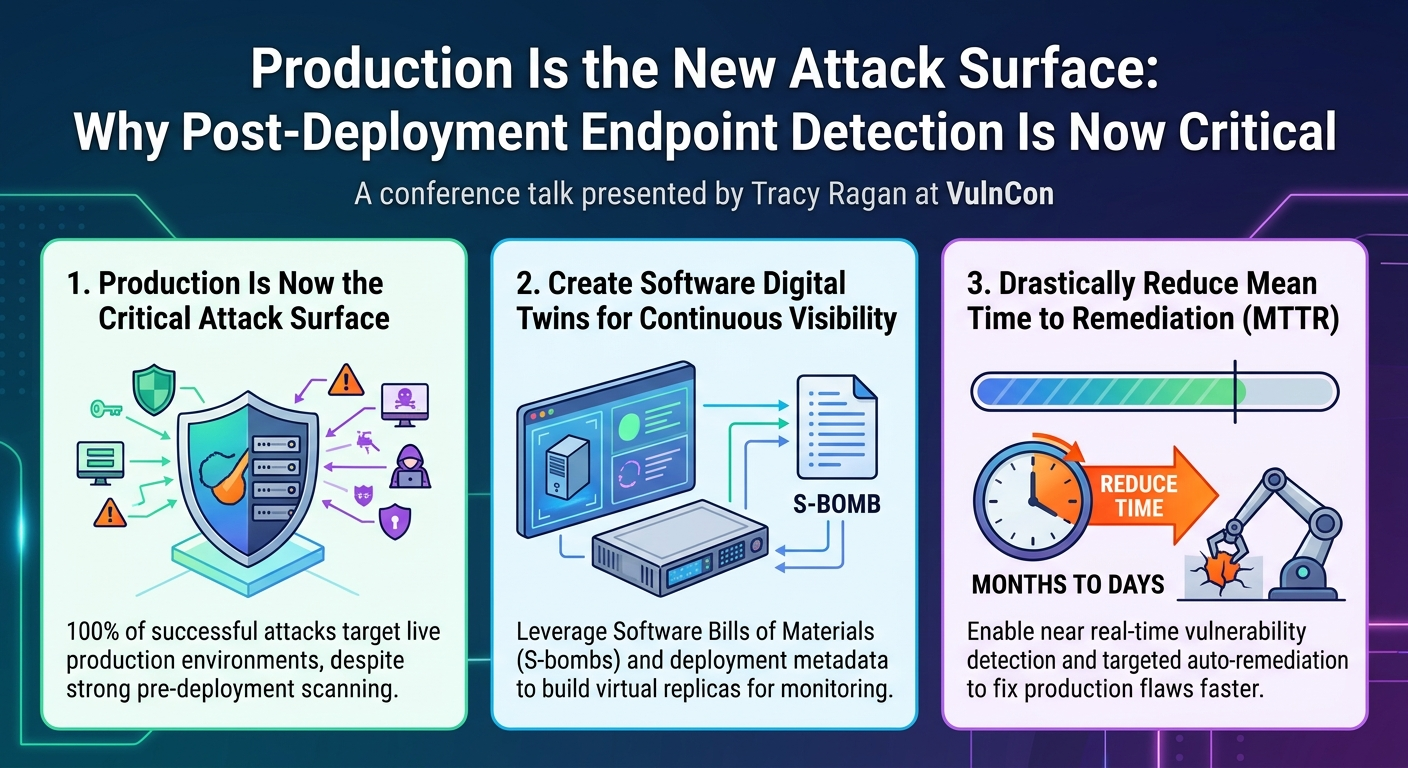
- Production is the New Attack Surface: Despite robust pre-deployment security efforts, the speaker unequivocally stated that 100% of successful attacks target live production environments. This makes post-deployment security the most critical, yet often neglected, battleground.
- The "Blind Spot" in Post-Deployment Security: A significant gap exists in how organizations secure software once it's deployed. New vulnerabilities (CVEs) emerge constantly, rendering pre-deployment scans obsolete. Current post-deployment strategies are largely insufficient, creating a dangerous period of exposure after release.
- Limitations of Traditional Post-Deployment Tools: Existing agent-based and agentless security solutions are often too complex, expensive, and resource-intensive for widespread adoption, especially by smaller organizations or for highly constrained edge environments (e.g., satellites, IoT devices). Their deployment can take weeks, and they struggle with the ephemeral nature of modern cloud-native architectures like containers.
- The Promise of the Digital Twin: Ragan introduced the concept of a digital twin for software as a powerful, agentless, and continuous method for tracking and detecting vulnerabilities in live systems. By building a virtual replica of deployed software configurations, it allows for real-time monitoring without directly interacting with the production endpoint.
- Operationalizing S-bombs is Critical: S-bombs are not merely compliance checkboxes or static documents. Ragan emphasized that they must be operationalized as dynamic data sources that can be continuously synced against vulnerability feeds to provide real-time threat intelligence specific to deployed instances.
- Drastically Reducing Mean Time to Remediation (MTTR): The proposed digital twin approach, combined with the operationalization of S-bombs, offers the potential for near-instant detection (e.g., every 10 minutes) and automated or semi-automated remediation. This can reduce MTTR from months or weeks to days, or even hours, addressing the critical lag between vulnerability discovery and fix.
- Precision Over Noise: By focusing only on vulnerabilities impacting live systems identified through the digital twin, this approach can filter out much of the "noise" generated by broad, pre-deployment scans, allowing security teams to prioritize high-risk and critical CVEs with greater precision.
Technical Deep Dive
▶ Watch: Operationalizing S-bombs for continuous threat management (14:30)
The cornerstone of Tracy Ragan's proposed solution for securing the production attack surface is the digital twin for software. This concept, while popular in the public sector for physical assets, is adapted here to create a dynamic, virtual representation of deployed software and its environment. The goal is to enable continuous, real-time vulnerability detection and even auto-remediation without the operational overhead of traditional agent-based solutions or the limited visibility of agentless scanners in ephemeral environments.
At its core, the digital twin for software tracks three essential pieces of information for every deployed release: the Software Bill of Materials (S-bomb), the associated Git repository (or source code location), and the endpoints where the software is running. Ragan argues that these three elements provide sufficient data to understand what's in production and correlate it with known vulnerabilities. Key deployment metadata, such as Helm charts (for Kubernetes deployments) and Kubernetes audit logs, can be leveraged to automatically capture the necessary information about what is being deployed and where. The beauty of this approach lies in its agentless nature: "We don't even have to touch it. We don't have to scan it. We don't have to do anything to it." The system simply knows what's out there because it was deployed and its S-bomb and Git repo are known.
The digital twin operates on a principle of continuous synchronization. Unlike traditional periodic scans that incur high computing costs and introduce detection delays, the digital twin is designed for real-time correlation. Ragan highlighted CTEM (Continuous Threat Exposure Management), a new term coined by Gartner, as the overarching strategy. The digital twin's configuration data (S-bomb, deployment metadata) is continuously synced against vulnerability feeds, such as OSV.dev. This process, if performed every 10 minutes or even more frequently, can provide "instant alerts" when a new vulnerability is reported that impacts a component running in a production environment. This represents a significant leap from traditional methods, providing a near real-time understanding of production exposure.
A crucial aspect of this architecture is the operationalization of S-bombs. Ragan stressed that S-bombs should not be treated merely as static documents or compliance checkboxes. Instead, they become live, dynamic data sources within the digital twin. By continuously syncing the S-bomb's component list against new CVEs and other vulnerability feeds, the digital twin can precisely identify which deployed components are affected by newly reported threats. This approach offers a level of specificity and timeliness that traditional scanning of source code repositories cannot match, as it focuses solely on what is actually running in production.
Beyond detection, the digital twin architecture opens the door to auto-remediation. If a vulnerability is identified on a specific endpoint, and the associated Git repo and S-bomb are known, the system can potentially automate parts of the remediation process. This involves identifying the updated version of the vulnerable package (potentially using a dependency graph or similar analysis). If the update appears simple and non-breaking, the system could automatically generate a Pull Request (PR) for developers. If breaking changes are anticipated, it could create a detailed issue with all the necessary research, significantly reducing the manual toil developers typically face. While tools like Mend's Renovate exist for automated dependency updates, Ragan noted their tendency to update "everything," whereas the digital twin approach aims for targeted, precision-focused remediation for specific critical vulnerabilities.
The technical workflow for this new architectural pattern involves:
- Consuming the S-bomb and Deployment Metadata: This initial step populates the digital twin with the necessary configuration details of deployed software.
- Synchronizing with Vulnerability Feeds: The digital twin continuously checks sources like OSV.dev for new vulnerability disclosures.
- Reporting New CVEs: When a match is found, the system reports the specific CVEs impacting live systems.
- AI-driven Analysis for Remediation: Artificial intelligence can be employed to analyze the requirements for remediation, identifying potential fixes and suggesting the best course of action (e.g., PR or issue creation).
The benefits of this architecture are substantial. It is designed for easy implementation, requiring developers to simply point to their S-bomb and deployment artifacts (like Helm charts) rather than setting up complex agents or extensive scanning infrastructure. This leads to a time to value in less than 10 minutes, making it accessible even to individual developers without requiring organizational-wide buy-in. By focusing only on deployed vulnerabilities and mapping them precisely to endpoints, it achieves precision over noise, allowing security teams to concentrate on high-risk and critical issues. This approach also aligns well with existing security frameworks, including NIST SSDF, container security best practices, and NIST SP 800-140B (which she referred to as 14028, likely a typo for 800-140B, which deals with Software Supply Chain Risk Management).
During the Q&A, further technical considerations emerged. The importance of S-bomb accuracy was highlighted, with Ragan acknowledging that a lack of trust in S-bomb fidelity is a major barrier to adoption. She also mentioned "de-bloating" software packages as a critical area for research, where removing unused code could significantly reduce the attack surface. The integration of attestation and provenance (e.g., in-toto attestations) was also discussed, with Ragan affirming that the digital twin is extensible and can incorporate such data to provide even richer context on how software is built, deployed, and where its components originate. The Ortelius project, incubating at the Continuous Delivery Foundation, is presented as an open-source platform embodying this post-deployment vulnerability detection strategy.
Demo / Proof of Concept
▶ Watch: Auto-remediation: fixing vulnerabilities from months to days (16:00)
While Tracy Ragan's presentation provided a conceptual framework and detailed architectural insights into the digital twin for post-deployment security, it did not include a live demonstration or a tangible proof of concept of the system in action. The talk focused on articulating the problem, proposing a novel solution, and outlining its technical benefits and implementation approach.
However, Ragan did introduce the Ortelius project as a tangible effort to realize the vision of the digital twin. Ortelius, named after Abraham Ortelius who created the first world map, is an open-source project incubating at the Continuous Delivery Foundation (CDF). It is positioned as a "post-deployment vulnerability detection platform" designed to operationalize the concepts discussed, specifically leveraging S-bombs and deployment metadata for continuous threat exposure management. The project aims to provide a practical implementation of the digital twin architecture, enabling organizations to address the production security blind spot. She also mentioned the CICD Cyber Security Guide within the CDF as a resource for implementing SSDF and other security frameworks with specific tools, inviting community contributions.
Defensive Implications
▶ Watch: Audience Q&A: Using attestation for deployment metadata (24:00)
The insights shared by Tracy Ragan carry profound defensive implications, urging security practitioners and organizations to fundamentally re-evaluate and bolster their post-deployment security strategies. The central tenet is that production is the new attack surface, demanding a pivot from primarily offensive (pre-deployment) to a more balanced and robust defensive posture.
Here are the key defensive implications:
- Prioritize Post-Deployment Defense: Security teams must shift significant focus and resources to defending live production environments. This means acknowledging that pre-deployment efforts, while crucial, are insufficient alone. The "blind spot" after release, where new CVEs emerge, must be actively addressed.
- Adopt Agentless and Lightweight Solutions: For many environments, particularly constrained edge devices like satellites or IoT, traditional heavy agent-based security tools are impractical. Defenders should seek out and implement lightweight, agentless solutions that can provide continuous visibility without impacting operational performance or requiring extensive resources. The digital twin architecture is a prime example of such an approach.
- Operationalize S-bombs for Continuous Monitoring: S-bombs should be elevated from static compliance artifacts to dynamic, operational assets. Organizations need mechanisms to continuously ingest and synchronize S-bomb data with real-time vulnerability feeds (e.g., OSV.dev). This enables precise, up-to-the-minute awareness of vulnerabilities impacting deployed software, moving beyond periodic, outdated scans.
- Implement Continuous Threat Exposure Management (CTEM): The digital twin framework aligns perfectly with CTEM principles. Defenders should establish systems that continuously monitor for new threats, correlate them with deployed software configurations, and provide immediate alerts. This proactive approach significantly reduces exposure windows compared to reactive, periodic scanning.
- Embrace Targeted Auto-Remediation: The goal of reducing MTTR requires moving towards automated or semi-automated remediation. Defenders should explore tools and processes that, upon detection of a critical vulnerability, can automatically identify patch versions, generate pull requests, or create detailed issues for developers. This streamlines the fix process, freeing up valuable developer time.
- Enhance S-bomb Accuracy and Trust: The effectiveness of a digital twin heavily relies on the quality of the S-bomb. Defenders should invest in tools and practices that ensure high accuracy and completeness of generated S-bombs throughout the CI/CD pipeline. Research into improving S-bomb generation and validation is critical.
- Consider Software "De-bloating": As mentioned in the Q&A, the concept of "de-bloating" software—removing unused or unreachable code and dependencies—can significantly reduce the attack surface. Defenders should advocate for and explore strategies to minimize the amount of code deployed, thereby limiting potential vulnerability points.
- Integrate Attestation and Provenance: To further strengthen the digital twin, defenders should look to incorporate attestation and provenance data (e.g., in-toto attestations). This provides cryptographic proof of how software components were built, signed, and deployed, adding a layer of trust and integrity to the digital twin's data.
- Align with Security Frameworks: The proposed architectural pattern aligns well with established security frameworks like NIST SSDF and NIST SP 800-140B. Defenders should leverage these frameworks to guide their implementation of digital twin concepts, ensuring comprehensive coverage and compliance.
- Foster Community Collaboration: Ragan emphasized the importance of open-source projects like Ortelius and collaborative efforts like the CICD Cyber Security Guide. Defenders should engage with these communities to share knowledge, contribute to tool development, and collectively advance post-deployment security practices.
By adopting these defensive implications, organizations can move towards a more resilient and responsive security posture, capable of protecting critical production assets against the ever-evolving threat landscape.
Key Takeaways
- Production is the New Attack Surface: While pre-deployment security is strong, 100% of attacks target live production, making it the critical, yet often neglected, battleground.
- The "Blind Spot" Demands Attention: New vulnerabilities emerge post-deployment, creating a dangerous exposure window that traditional security approaches fail to adequately address, especially in constrained edge environments.
- Digital Twins Offer a Paradigm Shift: A software digital twin, leveraging S-bombs and deployment metadata, enables continuous, agentless, and real-time vulnerability detection in production without direct endpoint interaction.
- Operationalizing S-bombs is Essential: S-bombs must evolve from static documents to dynamic data sources, continuously syncing with vulnerability feeds (e.g., OSV.dev) to provide immediate, precise threat intelligence.
- Drastically Reduce Mean Time to Remediation (MTTR): The digital twin approach, combined with targeted auto-remediation capabilities, promises to reduce vulnerability resolution times from months to days, or even hours, addressing the critical lag in response.
- Simplicity and Accessibility are Key: Post-deployment security tools must be cheaper and easier to implement, accessible to individual developers, and provide rapid time-to-value to enable widespread adoption and effective defense.
About the Speaker(s)
Tracy Ragan is a prominent figure in the open-source and software supply chain security communities. She is the co-founder of DeployHub.com, a company focused on software delivery and deployment. During the COVID-19 pandemic, Ragan initiated the Ortelius open source project, which has since been accepted into the Continuous Delivery Foundation (CDF), where it is currently incubating. She actively contributes to the CDF, serving on its board as a strategic advisor and as a member of its Technology Oversight Committee. Ragan has also held significant roles within the Open Source Security Foundation (OpenSSF), serving on both its Technical Advisory Council (TAC) and Governing Board. Beyond her organizational roles, she is the Community Director for Ortelius and is a regular contributor to the TechStrong Gang on Fridays, where she discusses various topics related to the future of technology and security. Her extensive experience and leadership highlight her commitment to advancing software supply chain security and deployment practices.
Reviews
Dr. Zero (Offensive Security Researcher) — WEAK
A problem statement dressed up as a solution talk. Ragan correctly identifies that post-deployment vulnerability tracking is a gap, but the 'digital twin' she's pitching is just 'store your SBOMs and query OSV.dev' — there's no novel technique here, no implementation depth, and the live demo was... non-existent.
Heather Calloway (CISO) — WEAK
Vendor pitch dressed as thought leadership. The core claim — that production is underdefended — is obvious to anyone running a security program. The proposed solution (digital twins via S-bombs) is light on evidence, heavy on product positioning, and ignores the operational realities that make S-bomb accuracy and deployment metadata correlation hard in the first place.
→ Top-rated talks at CVE/FIRST VulnCon 2026 & Annual CNA Summit