The Drone Renaissance 2 #dronesforgood
Evan Kirstein, Luke Canfield
Overview
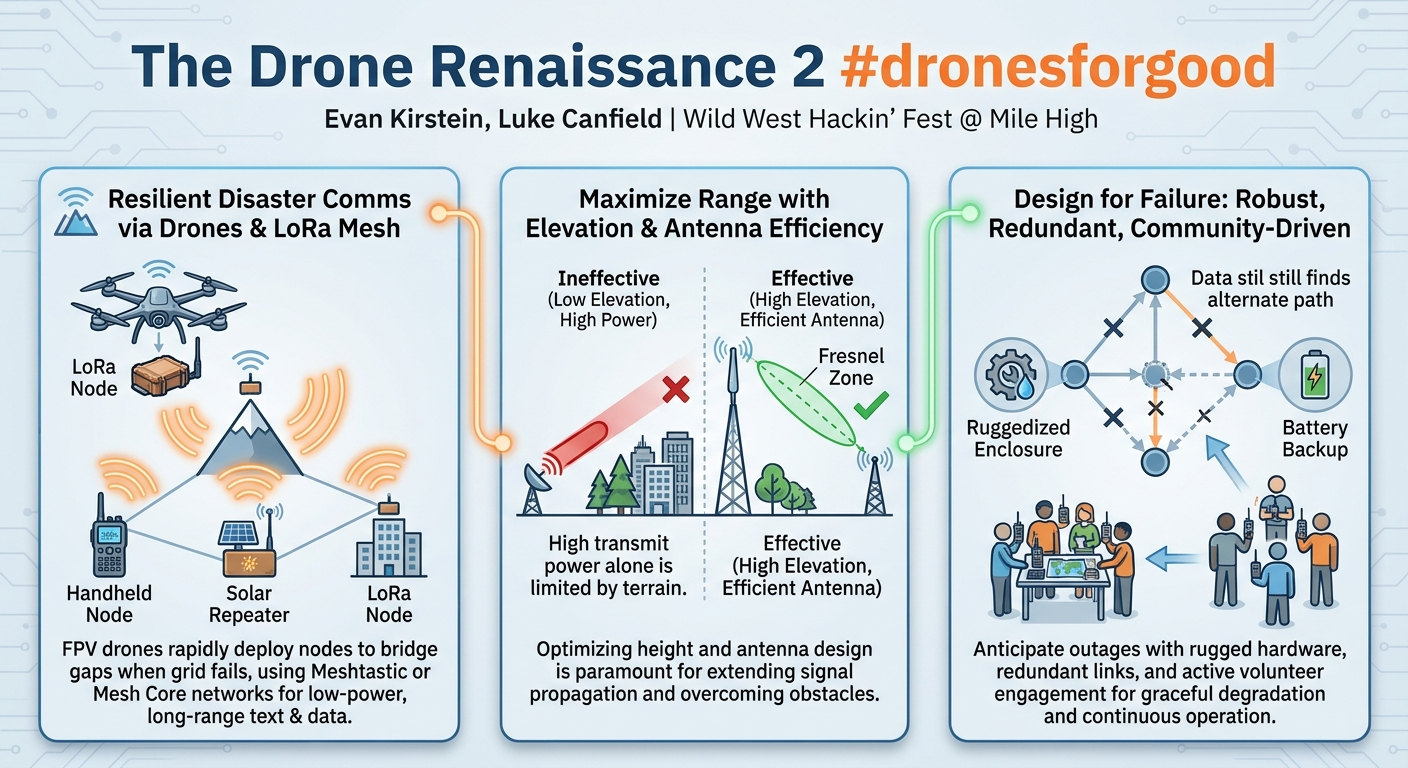
In "The Drone Renaissance 2 #dronesforgood," Evan Kirstein and Luke Canfield deliver a compelling vision for leveraging readily available drone and radio technologies to establish resilient communication networks in the wake of catastrophic disasters. Moving beyond the conventional narrative of drones as attack vectors, this talk pivots to explore their immense potential for humanitarian aid and emergency response. The core premise revolves around deploying First-Person View (FPV) drones and LoRa (Long-Range Radio) communication systems, specifically Meshtastic and Mesh Core networks, to bridge critical communication gaps when traditional infrastructure—like cell towers, internet, and power grids—fails.
Key moments
- 0:00 Introduction: Drones for disaster comms, speaker background
- 6:00 Drones' critical role in disaster intelligence, surveillance, reconnaissance
- 16:00 LoRa and Meshtastic: Open-source, low-power, long-range radio explained
- 20:00 FCC Part 15 vs. Part 97: Licensing for LoRa devices
- 28:00 Maximizing LoRa range: Elevation is king, antenna efficiency, Fresnel zone
- 34:00 Planning and deployment: Identifying risks, coordination, analog information
- 38:00 Kit costs, limitations, and technical/operational risks
- 42:00 Q&A: Pre-disaster deployment, community engagement, future workshops
The Drone Renaissance 2 #dronesforgood
Speakers: Evan Kirstein; Luke Canfield
Conference: Wild West Hackin' Fest @ Mile High
YouTube: https://www.youtube.com/watch?v=liM9nz5mO_8
Overview
In "The Drone Renaissance 2 #dronesforgood," Evan Kirstein and Luke Canfield deliver a compelling vision for leveraging readily available drone and radio technologies to establish resilient communication networks in the wake of catastrophic disasters. Moving beyond the conventional narrative of drones as attack vectors, this talk pivots to explore their immense potential for humanitarian aid and emergency response. The core premise revolves around deploying First-Person View (FPV) drones and LoRa (Long-Range Radio) communication systems, specifically Meshtastic and Mesh Core networks, to bridge critical communication gaps when traditional infrastructure—like cell towers, internet, and power grids—fails.
The speakers, both seasoned experts in amateur radio, drone operation, and emergency response, emphasize the critical need for actionable intelligence and communication during crises. Their presentation outlines practical, budget-friendly strategies for individuals and community groups to build, deploy, and operate these systems. This talk is not merely a technical exposition; it's a call to action for FPV enthusiasts, radio nerds, emergency communication volunteers, and community responders to harness cutting-edge, democratized technology for the greater good, ensuring that vital information can flow even in the most challenging environments.
Background
▶ Watch: Introduction: Drones for disaster comms, speaker background (0:00)
The genesis of this discussion stems from a pervasive and critical vulnerability: the fragility of modern communication infrastructure in the face of natural disasters or widespread power outages. As highlighted by real-world events like Hurricane Helene in Western North Carolina and the 2016 West Virginia floods, when the grid goes down, communications often follow suit, leaving affected communities isolated and emergency responders struggling for actionable intelligence. The speakers recount instances where basic communication could have dramatically improved response efforts, a capability largely absent 15 years ago.
Traditional emergency response relies heavily on the OODA loop (Observe, Orient, Decide, Act), a concept developed by Colonel John Boyd for military dogfighting. A breakdown in observation and orientation—often due to a lack of communication—can cascade into systemic failures in disaster response. The talk underscores that critical information, from intelligence, surveillance, and reconnaissance (ISR) video to rapid needs assessments (food, water, shelter, medical status), must reach incident commanders swiftly. While video and voice demand significant bandwidth and power, text-based communication offers a robust, low-bandwidth alternative for essential data. The recent advancements in drone technology, particularly spurred by conflicts like the war in Ukraine, have demonstrated their utility beyond destruction, opening doors for innovative applications in disaster relief, such as aerial reconnaissance and the rapid deployment of communication nodes.
Key Findings
▶ Watch: LoRa and Meshtastic: Open-source, low-power, long-range radio explained (16:00)
The talk presents several key findings and innovative approaches for disaster preparedness and response:
- LoRa as a Resilient Communication Backbone: LoRa technology, specifically through implementations like Meshtastic and Mesh Core, is identified as a highly effective, low-power, and cost-efficient solution for long-range, low-data communication (text, GPS, sensor data). Its mesh networking capabilities allow messages to be relayed across multiple devices, extending range without requiring fixed infrastructure.
- Drones as Dynamic Communication Platforms: FPV drones, especially 3D-printed, disposable models, are crucial for rapidly deploying communication nodes (perch-and-stay repeaters), conducting thermal imaging search and rescue operations, and overcoming geographical obstructions by providing elevated line-of-sight.
- Dual Legal Frameworks for Deployment: A critical distinction is made between FCC Part 15 (unlicensed, low-power, encrypted, ad-hoc, ideal for community volunteers) and FCC Part 97 (licensed amateur radio, higher power, unencrypted, suitable for backbone infrastructure). Understanding these regulations is vital for effective and compliant network design, noting that encrypted Part 15 devices cannot communicate directly with unencrypted Part 97 devices.
- Elevation and Antenna Efficiency are Paramount: The speakers strongly emphasize that increasing antenna height and optimizing antenna design are far more effective for extending LoRa range than simply increasing transmit power, especially given the significant impact of terrain and obstructions on RF signals. The Fresnel zone concept is introduced as a critical factor in planning antenna placement.
- Robust, Redundant, and Community-Driven Design: The overarching design philosophy advocates for building systems that anticipate failure ("assume your nodes are going to die, some links are going to fail, some drones are going to crash"). This necessitates redundancy, graceful degradation, and a strong emphasis on community involvement, training, and pre-planning through tabletop exercises and field days.
Technical Deep Dive
▶ Watch: Maximizing LoRa range: Elevation is king, antenna efficiency, Fresnel zone (28:00)
The technical core of the talk revolves around the symbiotic relationship between drones and LoRa radio technology for establishing resilient communication.
Drone Hardware and Deployment
The discussion begins with drone hardware and design, emphasizing 3D-printed frames as a budget-friendly and disposable solution, particularly useful in disaster zones where recovery isn't guaranteed. Designs are often shared on platforms like GitHub and Thingiverse. Different drone types are suited for specific missions: traditional quadcopters for hovering, fixed-wing drones for long-range loitering, and utility-grade quads for hauling significant weight over short distances (e.g., 20 minutes flight time).
Drones used in this context typically fall under Groups 1 and 2 of unmanned aerial systems, meaning they are Part 107 compliant (under 55 lbs) and operate below 400 ft AGL (Above Ground Level). Payloads, such as servo latch or gravity hook mechanisms, are used to deploy items, with magnetic releases being less common due to power requirements. The speakers caution against dropping items over people or structures.
A significant application is thermal imaging for search and rescue. Budget-friendly dual-camera FPV setups (visible light, thermal, IR) can be acquired for $250-$800. These allow search drones to scan areas, mark hotspots, visually verify findings, and then pinpoint GPS locations for deploying Meshtastic nodes to survivors. Perching/tethered repeaters are also discussed, where drones are used to elevate ham radio or Meshtastic nodes, extending their range.
LoRa and Mesh Networking
LoRa (Long-Range Radio) is presented as an open-source, encryption-capable mesh networking radio technology. It operates as a low-power wide area network (LPWAN), ideal for long-distance, low-data communications like text, environmental sensor data, and GPS coordinates. Typical device range is 3-6 miles, extendable via relays, with devices costing $30-$90.
Two primary implementations are highlighted:
- Meshtastic: A true mesh network where all devices relay messages. It functions akin to a Layer 1 hub, broadcasting packets to all nodes on the same channel. Its key advantage is requiring no dedicated infrastructure, allowing for rapid, ad-hoc deployment. However, it has limits on message hops, can experience congestion with over 50 nodes, and offers ambiguous delivery status (akin to UDP).
- Mesh Core: Offers extended range (up to 64 hops), lower network congestion, and precise delivery confirmation. The trade-off is that it cannot automatically mesh between handheld devices and requires a dedicated infrastructure of repeaters.
It's possible to run both Meshtastic and Mesh Core in the same area by using separate channels within the ISM band (915 MHz in North America) and ensuring physical antenna separation.
Regulatory Frameworks
Understanding FCC Part 15 and Part 97 is crucial:
- FCC Part 15: Governs unlicensed devices. No license or registration is required, allowing anyone to use them. Transmit power is limited to 1 W on the ISM band, with duty cycle limits. A significant feature is encryption capability, making it suitable for secure, local communications among volunteers. However, the lack of ID means anonymity, which could be a risk for erroneous data injection.
- FCC Part 97: Applies to licensed amateur radio operators (minimum Technician class). This unlocks higher transmit power (up to 1500 W for Amateur Extra) and allows for longer-range backbone infrastructure. A key restriction is no encryption and no commercial use, requiring operators to broadcast their call sign every 10 minutes.
Crucially, Part 15 and Part 97 devices cannot communicate directly due to the encryption difference. Mission parameters dictate the choice of framework for each device, allowing for segregated networks (e.g., Part 15 handhelds for local use, Part 97 repeaters for multi-county backbones).
Node Types and Ruggedization
Three main node types are discussed:
- Handheld Nodes: Typically ESP32 microcontrollers with a LoRa radio chip, GPS, small batteries, and simple screens/keyboards for canned or typed messages.
- Solar Repeaters: Same radio/microcontroller, but with larger batteries, solar panels, and charge controllers for continuous, weatherproof operation. They are designed to be always-on and can restart upon receiving a trickle charge.
- Airborne Nodes: Meshtastic units mounted on drones, either perched or slowly circling, to provide elevated line-of-sight communication.
Building rugged nodes is emphasized for inclement weather. This includes IP65 or IP67 rated enclosures, custom 3D-printed shells (using ASA for UV resistance, with proper ventilation), gaskets and O-rings (3D-printed with TPU), cable glands for sealed cable entry, desiccant packs for moisture, and vent plugs for pressure equalization. Environmental challenges like heat, humidity, cold, and UV exposure must be considered.
Power and RF Propagation
Power budgeting suggests a typical LoRa node (e.g., RAK 197000/4631) draws about 250 mA per day. A 5-6 W solar panel and a 3,000 mAh battery (like an 18650) can provide 5-7 days of autonomy without sun. LiFePO4 and lithium ion batteries are common, with caution advised for lithium ion due to thermal runaway risks (always use a charge controller).
A critical insight is that elevation is king, followed by antenna efficiency, for maximizing range. Trees, buildings, and hills significantly attenuate RF signals. Methods to achieve elevation include weather balloons (e.g., 800g, $80, tethered for stability), kites, perch-in-air drones, arborist lines, church steeples, and flagpoles.
The concept of the Fresnel zone is introduced: a football-shaped area between transmitting and receiving antennas. For optimal signal propagation, at least 60% of this zone should be clear of obstructions. For a 10 km link, the maximum radius of the Fresnel zone at the midpoint is about 93-94 ft, requiring roughly 56 ft of clear space. This dictates antenna height requirements when obstructions are present.
Antenna Types
Four types of antennas are common for LoRa:
- Rubber Duck: Omnidirectional, low gain (sometimes negative), flexible, ideal for portable nodes.
- Whip: Slightly longer, metal, some gain, good for ground/vehicle installations.
- Yagi: Directional, high gain, must be aimed, offering excellent signal amplification in a specific direction.
- Helical Springs: Typically internal and embedded within devices.
Coax discipline is vital: keep coax cables between radio and antenna as short as possible to minimize signal loss, which is critical for low-power LoRa. Testing with tools like a tinySA is recommended. Antenna gain directly correlates with focus: higher gain means a more focused transmission, great for long-distance point-to-point links, but lower gain is preferred for wider coverage (e.g., from a mountain ridge into a valley).
Demo / Proof of Concept
▶ Watch: Planning and deployment: Identifying risks, coordination, analog information (34:00)
While the talk did not feature a live, in-person demonstration of the drone and LoRa systems, the speakers effectively illustrated their concepts through a series of conceptual workflows and real-world case studies. They described standard operational flows for search and rescue, detailing how drones with thermal imaging would scan an area, identify hotspots, verify visually, and then deploy a Meshtastic unit. This unit would then enable victims to relay critical information (e.g., food, medical needs) back to incident command and first responders.
The viability and impact of these technologies were reinforced by specific examples:
- Oklahoma Tornadoes (2022): Meshtastic nodes with solar panels were used to establish communication in disaster areas, complemented by DJI drones for searching rubble.
- Haiti Earthquake (years ago): Radios and solar panels facilitated communication in remote, cut-off locations, demonstrating the power of off-grid solutions.
These case studies serve as powerful proof-of-concept narratives, highlighting how such integrated drone and LoRa systems can provide crucial communication links in situations where traditional infrastructure is non-existent or destroyed. The speakers also outlined a typical "starter kit" cost breakdown (e.g., one repeater and 10 handhelds for around $800), further underscoring the accessibility of these solutions for community-level preparedness.
Defensive Implications
▶ Watch: Q&A: Pre-disaster deployment, community engagement, future workshops (42:00)
The "defensive implications" of this talk are framed not in terms of protecting against cyberattacks, but rather in empowering communities and responders to defend against the devastating communication blackouts that follow disasters. The core message is one of proactive preparedness, redundancy, and community resilience.
Defenders, or more accurately, community emergency preparedness groups and individuals, should:
- Plan Ahead: Identify high-risk areas prone to disasters (e.g., Gulf Coast, Tornado Alley). Coordinate with local emergency services (EMS), fire departments, and other volunteer organizations to gain permissions for infrastructure (e.g., bell towers, water towers, tall buildings) and to establish clear channels and naming conventions.
- Maintain Analog and Offline Resources: When the grid fails, digital resources disappear. Keep laminated checklists, maps, and a tablet with preloaded, offline information and backup power.
- Conduct Regular Exercises: Run tabletop exercises and field days with volunteers to practice deployment, communication protocols, and incident coordination. After any real or simulated incident, perform an after-action review to identify areas for improvement.
- Build Redundancy and Graceful Degradation: Adopt a design philosophy that assumes failure. Drones will crash, nodes will die, and links will fail. Systems must be built with redundancy to ensure graceful degradation rather than catastrophic collapse. Have extra nodes and spare parts.
- Foster Community Engagement: Connect local FPV drone clubs with amateur radio operators (ARES groups) and other responder organizations. Encourage "adopting a county" or parish to build out local Meshtastic networks. This community-based approach is critical, as "you cannot do this on your own and expect it to succeed."
- Understand Limitations: Recognize that these systems are intended to supplement, not replace, official search and rescue or aviation operations. They cannot guarantee message delivery and require ongoing planning and maintenance. Be aware of technical risks like RF interference, node failures, GPS inaccuracy in challenging terrain (canyons, cities), and operational risks like poor incident command coordination, hazards to manned aircraft, and gear theft/misuse.
Ultimately, the defensive implication is to build robust, distributed, and community-owned communication capabilities that provide critical situational awareness and lifeline messaging when all else fails, thereby mitigating the chaos and loss of life in disaster scenarios.
Key Takeaways
- Resilient Communication is Achievable: LoRa-based mesh networks, particularly Meshtastic and Mesh Core, combined with FPV drones, offer a low-cost, effective solution for establishing crucial communication links when traditional infrastructure is down.
- Regulatory Compliance Dictates Design: Understanding the distinctions between FCC Part 15 (unlicensed, encrypted, ad-hoc) and FCC Part 97 (licensed ham, unencrypted, infrastructure-focused) is essential for designing appropriate and compliant communication networks.
- Elevation and Antenna Optimization are Paramount: For maximizing LoRa range, prioritizing antenna height and efficient antenna design (considering the Fresnel zone) is more impactful than simply increasing transmit power, especially in complex terrains.
- Robustness and Redundancy are Non-Negotiable: Disaster response systems must be built with the expectation of component failure. Ruggedized nodes, power budgeting for extended autonomy, and a philosophy of graceful degradation are critical for operational reliability.
- Community Collaboration is Key to Success: Effective deployment and maintenance of these systems require significant pre-planning, coordination with local emergency services, and active participation from volunteer groups, FPV enthusiasts, and amateur radio operators.
- Supplemental, Not Replacement: These technologies are powerful tools for first responders and community groups to provide initial aid and gather intelligence, but they are designed to supplement, not replace, official large-scale search and rescue operations.
About the Speaker(s)
Evan Kirstein is a licensed Amateur Extra ham radio operator with extensive experience in radio and hardware, honed during his time in the Air Force. He also possesses a background in sysadmin roles and has actively volunteered with emergency organizations such as the fire department, ARIES emergency, and EMCOM. A drone enthusiast, Evan is also a survivor of over a decade in the online game EVE Online.
Luke Canfield has been involved with drones for approximately 15 years, initially drawn to their utility for 3D mapping due to his geology background. He served in the National Guard, spending three years on a HAZMAT task force operating under Homeland Security and FEMA, where he recognized the critical need for better radio communication and drone-based intelligence. Like Evan, Luke is also a veteran of over 10 years playing EVE Online.
Reviews
Dr. Zero (Offensive Security Researcher) — SOLID
This isn't a zero-day drop, it's a survival manual. Kirstein and Canfield took the tactical FPV drone and LoRa repeater playbook that Ukraine has been writing for two years and translated it into a highly actionable US civilian disaster response model.
Heather Calloway (CISO) — SOLID
A practical look at using off-the-shelf LoRa mesh networks and drones for out-of-band communication during catastrophic infrastructure failures. While pitched at community emergency responders, it forces a hard look at corporate business continuity plans: when regional power and cell towers drop, your incident command needs a way to communicate that doesn't rely on the broken grid.
→ Top-rated talks at Wild West Hackin' Fest @ Mile High 2026