Hack the Notes: Exploring Pen-Test Documentation
Christian Duncan (Security Consultant · Secure Ideas)
Overview
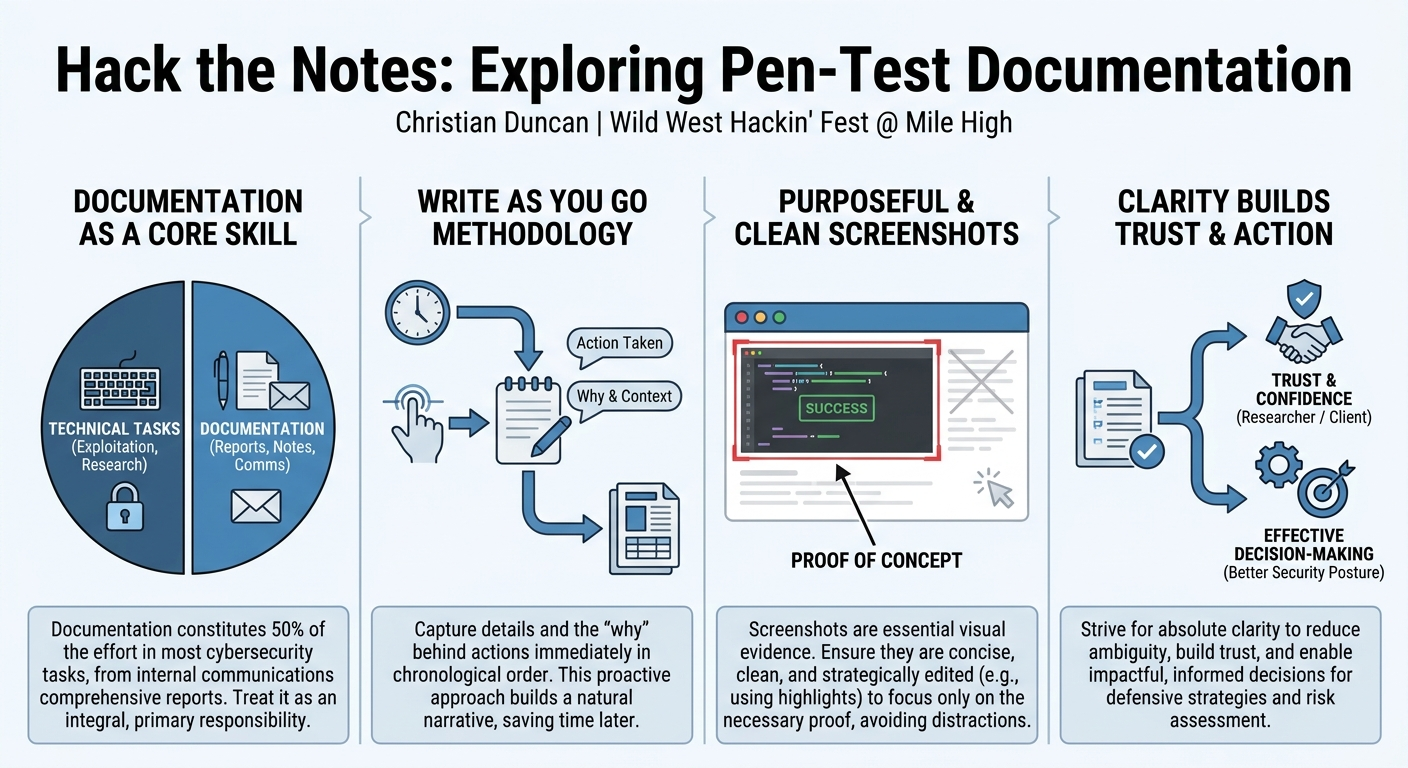
In his Wild West Hackin' Fest @ Mile High talk, "Hack the Notes: Exploring Pen-Test Documentation," Christian Duncan, a Security Consultant at Secure Ideas, delves into the often-underestimated yet critical role of effective documentation in the cybersecurity field. Duncan argues that documentation isn't merely a supplementary task but constitutes a significant 50% of nearly every activity undertaken by security professionals, from drafting emails and blog posts to meticulously detailing attack paths and comprehensive penetration test reports. His presentation serves as a foundational guide for both seasoned practitioners and newcomers, emphasizing that well-structured and clear documentation is indispensable for informed decision-making, whether for an individual researcher exploring a new topic or a client striving to enhance their security posture.
Key moments
- 0:00 Introduction and importance of pen test documentation
- 2:00 Practical tips for writing notes as you go
- 4:00 How structured notes create a compelling narrative
- 6:00 Making screenshots provide value and proof of concept
- 8:00 Advanced screenshot tips: cleaning up pesky cursors
- 10:00 Why clarity builds trust and aids decision-making
- 12:00 The ongoing journey of improving documentation skills
Hack the Notes: Exploring Pen-Test Documentation
Speakers: Christian Duncan, Security Consultant, Secure Ideas
Conference: Wild West Hackin' Fest @ Mile High
YouTube: https://www.youtube.com/watch?v=I09yftmvejc
Overview
In his Wild West Hackin' Fest @ Mile High talk, "Hack the Notes: Exploring Pen-Test Documentation," Christian Duncan, a Security Consultant at Secure Ideas, delves into the often-underestimated yet critical role of effective documentation in the cybersecurity field. Duncan argues that documentation isn't merely a supplementary task but constitutes a significant 50% of nearly every activity undertaken by security professionals, from drafting emails and blog posts to meticulously detailing attack paths and comprehensive penetration test reports. His presentation serves as a foundational guide for both seasoned practitioners and newcomers, emphasizing that well-structured and clear documentation is indispensable for informed decision-making, whether for an individual researcher exploring a new topic or a client striving to enhance their security posture.
Duncan’s insights are particularly valuable given his background, which includes starting his cybersecurity journey by reviewing existing reports to understand effective communication strategies. This experience has endowed him with a unique perspective on the nuances of impactful writing within a highly technical domain. The talk transcends specific toolsets or methodologies, instead offering broad, adaptable guidelines that apply across various forms of security-related communication. By highlighting the tangible benefits of meticulous note-taking, strategic screenshot utilization, and coherent narrative construction, Duncan champions documentation as a core competency that directly influences the success and credibility of security engagements.
Ultimately, Duncan's presentation underscores that the art of documentation is not a static skill but an evolving practice requiring continuous refinement. It’s about building trust, reducing ambiguity, and ensuring that the valuable work performed in offensive security translates into actionable intelligence for defenders. He posits that the clarity and depth of documentation directly correlate with a client's ability to make effective decisions, thereby improving their overall security posture and validating the investment in security services.
Background
▶ Watch: Introduction and importance of pen test documentation (0:00)
The pervasive challenge in cybersecurity, particularly within offensive security, is the disconnect between executing complex technical tasks and effectively communicating their outcomes. Christian Duncan's talk addresses this fundamental problem: the frequent oversight and underappreciation of documentation as a core skill. Many security professionals, driven by technical prowess and a passion for problem-solving, often view report writing and note-taking as secondary, tedious necessities rather than integral components of their craft. This perspective often leads to rushed, disorganized, or incomplete documentation, diminishing the impact of otherwise brilliant technical work.
Duncan highlights that this issue isn't confined to formal reports; it permeates all forms of professional communication. Whether it's an internal memo, a shared finding within a team, or a public blog post, the efficacy of the message hinges on its clarity and structure. The speaker's own journey, starting with the review of existing reports, revealed a spectrum of documentation quality and the profound impact it had on comprehension and actionability. He observed that while the technical execution might be flawless, a poorly documented process or finding could render it almost useless to the intended audience.
The problem exists because, unlike the immediate gratification of exploiting a vulnerability or bypassing a control, the rewards of good documentation are often indirect and long-term. It requires discipline, foresight, and a user-centric mindset—qualities not always prioritized in fast-paced technical environments. Duncan implicitly draws a parallel to basic educational principles, suggesting that the foundational elements of structured writing, taught even in grade school, are often neglected in the pursuit of advanced technical skills. This oversight creates a gap where valuable insights remain trapped in the minds of the testers or are presented in a manner that obstructs understanding and decision-making for clients and peers alike. The talk, therefore, serves as a crucial reminder that bridging this gap is not just about improving administrative tasks, but about elevating the overall professionalism and impact of the cybersecurity industry.
Key Findings
▶ Watch: How structured notes create a compelling narrative (4:00)
Christian Duncan's talk distills several critical findings regarding effective documentation, emphasizing its foundational role in cybersecurity:
- Documentation is 50% of the Task: Duncan asserts that writing and documenting are not ancillary activities but constitute half of the effort in virtually any cybersecurity task. This includes everything from internal communications and blog posts to detailed attack paths and client reports. Recognizing this proportion elevates documentation from a chore to a primary responsibility.
- Early and Continuous Note-Taking is Essential: The practice of writing as you go is paramount. Taking quick notes, especially capturing the "why" behind an action, significantly reduces the need to backtrack and reconstruct events later. This chronological approach builds a natural narrative, saving substantial time and effort during the final reporting phase.
- First-Person Writing Enhances Clarity: For personal notes and initial drafts, adopting a first-person writing style ("I did X," "I found Y") makes the documentation more active and present-tense. This approach streamlines the process of recalling and translating actions into a coherent story, making it easier to articulate the tester's journey and discoveries.
- Screenshots are Vital but Require Curation: Screenshots are indispensable for providing visual proof and context. However, their value is contingent on their quality and relevance. Duncan stresses that screenshots must be clean, concise, and purposeful, focusing only on the proof of concept or the specific detail being highlighted. They should not be haphazardly included but carefully edited to enhance the narrative.
- Structured Notes Tell a Coherent Story: Whether for a blog, an attack path, or a report, documentation should follow a clear structure and chronological flow. This "step one to step two to step three" approach creates a narrative that guides the reader through the discovery process, explaining not just what was found, but how it was found.
- Clarity Builds Trust and Enables Effective Decision-Making: The ultimate goal of documentation is to provide clarity. Clear, well-organized, and detailed documentation fosters trust between the writer and the reader (be it a client or a fellow researcher). This trust is crucial for enabling effective, impactful decisions, whether for improving a client's security posture or advancing personal knowledge.
- Poor Documentation Undermines Confidence: Conversely, missing steps, unclear screenshots, and disorganization in documentation lead to confusion, reduce confidence, and erode trust. This directly impacts a client's ability to assess risk accurately and implement effective remediation strategies, potentially leading to significant security pitfalls.
- Documentation is a Skill Requiring Continuous Improvement: Duncan acknowledges that documentation is a skill that is constantly refined. It’s never fully mastered but requires ongoing practice, self-review, and seeking feedback from others. The mantra is "better to have a little more than a little less" when taking notes, providing a rich repository of information to draw from.
These findings collectively underscore that robust documentation is not merely an administrative overhead but a strategic asset that enhances the credibility, impact, and actionable value of cybersecurity work.
Technical Deep Dive
▶ Watch: Making screenshots provide value and proof of concept (6:00)
While Christian Duncan's talk "Hack the Notes: Exploring Pen-Test Documentation" doesn't delve into specific code exploits or network protocols, it offers a profound technical deep dive into the craft of documentation itself, presenting it as a precise, systematic process akin to any other technical discipline. The "technical" aspect here lies in the structured application of methodologies to ensure accuracy, clarity, and impact in written communication within a security context.
The core of this deep dive revolves around structure and flow. Duncan emphasizes that every piece of documentation, whether a simple note, a blog post, or a comprehensive penetration test report, must adhere to a logical progression. This isn't just about aesthetics; it's about engineering a narrative that accurately reflects the investigative process. He advocates for a chronological order in note-taking and reporting, moving from "step one to step two to step three." This linear storytelling ensures that the reader can follow the exact path taken by the tester, understanding the context and sequence of actions that led to a discovery. This structured approach prevents confusion and allows for a comprehensive understanding of the attack chain, rather than just isolated vulnerabilities.
A key technique highlighted is writing as you go. This proactive documentation method involves capturing details, observations, and, crucially, the "why" behind specific actions in real-time. Instead of attempting to reconstruct complex technical sequences from memory days or weeks later, this practice ensures fidelity to the actual events. Duncan also advocates for using first-person writing in notes, as it keeps the content active and present-tense, making it easier to translate into a coherent report later. For example, "I attempted a SQL injection on the login page and observed an error message" is more direct and less prone to ambiguity than a passive third-person account in raw notes.
The most visually technical aspect of documentation discussed is the strategic use of screenshots. Duncan dedicates significant attention to their proper capture and curation. He treats screenshots not as mere images but as integral data points that provide proof of concept and visual evidence. The "technical" rigor here involves:
- Purposeful Capture: Only showing what is absolutely necessary to convey the proof or value. This requires a discerning eye to crop out extraneous information, ensuring the image is clean and concise.
- Highlighting Key Information: Using visual aids like red boxes or arrows to draw the reader's attention to specific elements within the screenshot. This technique directs focus, preventing the reader from getting lost in a busy interface and ensuring they grasp the critical detail immediately.
- Eliminating Distractions: Actively removing "pesky cursors" or any off-centered elements. Duncan notes that while these might seem minor, they cumulatively detract from the professionalism and clarity of the documentation. He suggests using screenshot tools that allow for editing or simply recropping to achieve a polished look. The underlying technical principle is that every visual element should contribute to clarity, not detract from it.
Finally, Duncan ties these elements together with the overarching goal of clarity. This isn't just about simple language but about the precise articulation of technical findings. Clear documentation, he argues, reduces the need for constant back-and-forth communication, which can be a significant time sink in technical engagements. By meticulously detailing "what was done, why it was done, and what was learned," the documentation itself becomes a robust technical artifact, capable of standing alone and conveying comprehensive insight. This level of detail and structure instills confidence in the reader, affirming the technical competence and thoroughness of the security professional. In essence, Duncan provides a blueprint for making documentation as technically sound and impactful as the security work it describes.
Demo / Proof of Concept
▶ Watch: Why clarity builds trust and aids decision-making (10:00)
Christian Duncan's talk, "Hack the Notes: Exploring Pen-Test Documentation," was primarily a conceptual and methodological presentation focused on best practices for written communication in cybersecurity. As such, it did not include a live technical demonstration of an exploit or a specific proof of concept tool. Instead, the concept of "proof of concept" was discussed in the context of effective documentation itself, particularly through the use of high-quality, targeted screenshots that visually validate findings within a report.
Defensive Implications
▶ Watch: The ongoing journey of improving documentation skills (12:00)
The quality of documentation directly impacts the effectiveness of defensive strategies, transforming raw findings into actionable intelligence. Christian Duncan's emphasis on clarity, structure, and detail in documentation holds profound defensive implications for organizations and their security teams.
Firstly, clear and comprehensive penetration test reports enable effective decision-making for defenders. When a report meticulously details "what was done, why it was done, and what was learned," security teams gain a holistic understanding of vulnerabilities and attack paths. This goes beyond a simple list of CVEs; it provides the narrative context—the "how you got there"—that allows defenders to grasp the true risk. For instance, understanding how an attacker chained multiple low-severity issues to achieve domain administrator privileges is far more valuable than merely being told that DA was compromised. This deeper insight empowers defenders to prioritize remediation efforts based on actual attack vectors and business impact, rather than just theoretical risks.
Secondly, robust documentation reduces ambiguity and minimizes back-and-forth communication. Poorly documented findings often lead to confusion, requiring security teams to seek clarification from testers. This consumes valuable time and resources, delaying remediation and potentially leaving critical vulnerabilities exposed for longer. With clear, self-contained documentation, security analysts can quickly understand the findings, reproduce issues if necessary, and formulate precise remediation plans. This efficiency is crucial in fast-paced environments where time is of the essence in mitigating threats.
Thirdly, well-structured documentation builds trust and confidence in the security assessment. When a client receives a report that is organized, precise, and supported by clean, relevant screenshots, it instills confidence in the tester's professionalism and the validity of the findings. This trust is vital for security teams to advocate for necessary changes, secure budget for security improvements, and gain buy-in from leadership for implementing recommended controls. Conversely, disorganized or unclear reports can undermine credibility, leading to skepticism and resistance from stakeholders.
Furthermore, detailed documentation facilitates knowledge transfer and institutional learning. A clear record of attack paths and vulnerabilities serves as a valuable educational resource for internal security teams. They can use these reports to understand common attack patterns, identify weaknesses in their security architecture, and train new personnel. This contributes to a stronger, more resilient defensive posture over time, moving beyond reactive fixes to proactive security enhancements. Defenders can leverage the "story" told in the documentation to refine their security controls, incident response playbooks, and security awareness training.
Finally, the absence of good documentation creates significant pitfalls for risk management. If findings are unclear or steps are missing, organizations may incorrectly assess their risk exposure, leading to misallocated resources or, worse, a false sense of security. Duncan's point about poor documentation leading to confusion and reduced trust directly translates to an inability for defenders to make "effective decisions on their day-to-day risk." This could result in critical vulnerabilities being overlooked or inadequately addressed, leaving the organization exposed to potential breaches. In essence, good documentation is not just a reporting requirement; it is a fundamental enabler of effective cybersecurity defense.
Key Takeaways
- Documentation is a Core Competency: Treat documentation as an integral part of cybersecurity work, comprising 50% of the effort in most tasks, from internal communications to comprehensive reports.
- Adopt Proactive and Structured Writing: Implement a "write as you go" methodology, capturing details and the "why" behind actions chronologically, often utilizing a first-person perspective in notes for clarity and ease of recall.
- Master the Art of Purposeful Screenshots: Utilize screenshots as essential visual evidence, ensuring they are clean, concise, and strategically edited (e.g., using red boxes) to highlight only the necessary proof of concept, avoiding distractions like cursors or extraneous details.
- Prioritize Clarity for Trust and Actionability: Strive for absolute clarity in all documentation to build trust with the reader, reduce ambiguity, and enable effective, impactful decision-making for both researchers and client defenders.
- Tell a Complete Narrative: Focus on telling a comprehensive story that details not only "what was found" but also "how it was found," providing deep insight into the attack path and its implications.
- Embrace Continuous Improvement: Recognize that documentation is an evolving skill requiring constant practice, self-review, and feedback to refine, always aiming for more detail rather than less in initial note-taking.
About the Speaker(s)
Christian Duncan is a Security Consultant with Secure Ideas, a cybersecurity firm based out of Jacksonville, Florida. Though relatively new to the Secure Ideas team, he brings approximately five years of experience primarily focused on offensive cybersecurity. Duncan is based in Colorado, where he enjoys spending time outdoors when not engaged with his computer. His journey into cybersecurity was driven by passion, following an earlier career path that included military service and business school. This presentation marked his first time presenting remotely, sharing valuable insights gleaned from his extensive experience reviewing and contributing to penetration test documentation.
Reviews
Dr. Zero (Offensive Security Researcher) — SOLID
A purely foundational talk on how not to write garbage pen-test reports. It won't drop any zero-days, but since half this industry still hands clients unreadable grep output, it's a necessary evil. Good for juniors, skip it if you've been doing this longer than six months.
Heather Calloway (CISO) — SOLID
This is not a session for your leadership team, but it is highly relevant for the director managing your offensive security vendors. Duncan correctly frames penetration test documentation not as administrative overhead, but as the core deliverable that determines whether a technical finding translates into a business decision.
→ Top-rated talks at Wild West Hackin' Fest @ Mile High 2026