Unmasking Romance Scams with OSINT
Mishaal Khan
Overview
In this compelling talk from Wild West Hackin' Fest @ Mile High, ethical hacker Mishaal Khan unveils the "magic and power" of Open-Source Intelligence (OSINT) as a formidable tool for solving crimes and unraveling mysteries. Khan demonstrates his methodology through two real-world case studies: a sophisticated romance scam targeting an executive and the unmasking of a popular online magician who profited from revealing others' trade secrets. The presentation serves as a masterclass in persistent digital forensics, illustrating how seemingly disparate pieces of online information can be meticulously pieced together to expose anonymous adversaries.
Key moments
- 0:00 Introduction to OSINT and romance scam case
- 2:00 Spotting common romance scam red flags
- 5:45 Using Whoxy.org to expose fake bank
- 13:40 Identifying real person behind stolen photos
- 15:10 Unmasking the anonymous online magician
- 19:15 Unique trick to find name via OneDrive
- 21:50 Connecting identities through visual details
- 24:05 Rapid name discovery using PayPal
Unmasking Romance Scams with OSINT
Speakers: Mishaal Khan
Conference: Wild West Hackin' Fest @ Mile High
YouTube: https://www.youtube.com/watch?v=5dXXrUqpwec
Overview
In this compelling talk from Wild West Hackin' Fest @ Mile High, ethical hacker Mishaal Khan unveils the "magic and power" of Open-Source Intelligence (OSINT) as a formidable tool for solving crimes and unraveling mysteries. Khan demonstrates his methodology through two real-world case studies: a sophisticated romance scam targeting an executive and the unmasking of a popular online magician who profited from revealing others' trade secrets. The presentation serves as a masterclass in persistent digital forensics, illustrating how seemingly disparate pieces of online information can be meticulously pieced together to expose anonymous adversaries.
Khan's talk resonates deeply in an era where online deception is rampant, from financial fraud to intellectual property theft. He highlights the critical need for robust investigative techniques that can cut through layers of digital obfuscation. By showcasing his thought process and the specific tools and strategies employed, Khan empowers both technical and non-technical audiences to approach online verification with a critical, analytical mindset. His work underscores that while scammers may attempt to erase their digital footprints, a determined OSINT practitioner, armed with the right skills and persistence, can invariably uncover the truth.
This article dissects Khan's investigative journey, detailing the red flags identified, the technical tools leveraged, and the psychological tactics exploited by the perpetrators. It provides a comprehensive look at how OSINT can be applied to complex real-world problems, offering valuable insights for cybersecurity professionals, law enforcement, and individuals seeking to protect themselves from online fraud.
Background
▶ Watch: Introduction to OSINT and romance scam case (0:00)
The landscape of online interaction, while offering unprecedented connectivity, also presents fertile ground for various forms of deception. Romance scams, in particular, prey on human emotions, leveraging fabricated identities and elaborate narratives to build trust before orchestrating financial fraud. These scams are often characterized by a rapid escalation of emotional attachment, claims of being in foreign countries, and eventual requests for money under duress or perceived emergency. Victims, often emotionally invested, frequently struggle to discern the deception, requiring external, objective evidence to confront the reality of the situation. Mishaal Khan emphasizes this emotional aspect, noting that victims become so involved they "can't think logically anymore."
Beyond emotional exploitation, the internet facilitates intellectual property theft and the unauthorized dissemination of protected information. In the second case presented, Khan addresses a different, yet equally pervasive, form of online misconduct: a popular content creator monetizing the stolen trade secrets of other professionals. This highlights the challenge of maintaining anonymity online while exploiting public platforms, and the need for OSINT techniques to identify individuals who operate behind a veil of secrecy.
Khan frames his approach with a crucial distinction: "In sales, you know, they say the customer is always right. In OSINT, you say your client is always lying." This principle underscores the necessity of independent verification for every piece of information, even when provided by the victim. This skeptical, evidence-driven mindset is fundamental to effective OSINT, as perpetrators often manipulate narratives, and victims, inadvertently or otherwise, may provide incomplete or inaccurate details due to emotional distress or a lack of technical understanding. The problem exists because digital identities are easily forged or stolen, and the global nature of the internet allows malicious actors to operate across jurisdictions, complicating traditional law enforcement efforts.
Key Findings
▶ Watch: Using Whoxy.org to expose fake bank (5:45)
Mishaal Khan’s investigations yielded critical insights into the modus operandi of online scammers and the power of persistent OSINT.
Case 1: The Romance Scam
Khan meticulously documented numerous red flags that, when combined, unequivocally pointed to a scam:
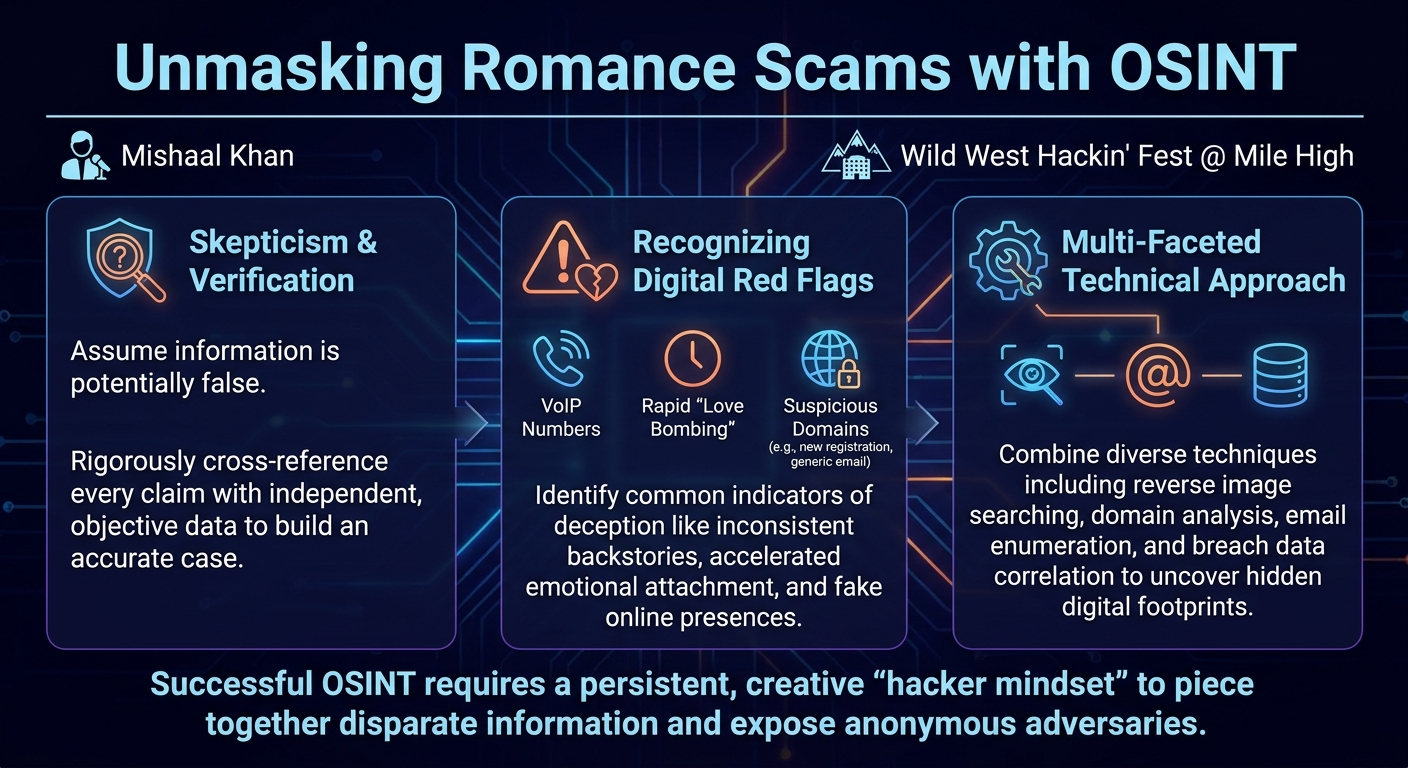
- Lack of Digital Footprint: The initial red flag was the scammer's complete absence from search engines and social media. As Khan notes, "if you're not Googleable, yeah, that you're it's probably a scam." Normal individuals tend to have some online presence.
- Voice over IP (VoIP) Phone Number: The scammer used a VoIP number, a common tactic for anonymity and avoiding traceability, unlike typical personal mobile numbers.
- Inconsistent Backstory and Accent: The scammer claimed to be German but spoke with a French accent, a detail picked up by the victim who spoke German. This discrepancy broke the facade of the fabricated identity.
- Unusual Communication Platform: The scammer insisted on moving conversations to Microsoft Teams, a platform rarely chosen for personal, romantic communication, raising immediate suspicion.
- Accelerated Emotional Manipulation: Phrases like "I'm falling for you" and "I love you" were used within weeks, or even days, of initial contact, a hallmark of love bombing designed to quickly establish emotional control.
- Fabricated Employment Details: The scammer claimed to work for "Turner Construction," which Khan found to be either non-existent or too generic to verify, often accompanied by stock images of construction sites.
- The "Pity Party" and Money Mule Scheme: The scam escalated to a "pity party," with claims of a mother needing surgery and an inability to access funds while abroad. This quickly transitioned into a money mule operation, where the victim was asked to log into the scammer's "bank account" and transfer $10,000 to another account. This not only extracted money but also implicated the victim as an unwitting accomplice.
- Fraudulent Bank Domain: The "bank" login page,
easycommbn.com, appeared legitimate but was revealed bywhoxy.orgto be registered only one year prior in Nigeria and associated with a Gmail address – all definitive indicators of a fraudulent operation. - Rapid Digital Erasure: Upon confrontation, the scammer swiftly deleted all online evidence, including the website, email, and Teams presence, demonstrating a calculated effort to evade detection and move on to new targets.
- Unmasking the Stolen Identity: Through extensive reverse image searching and geo-location techniques, Khan identified the individual whose photos were stolen: Manu Garcia, a Spanish reporter. This confirmed the scammer was using a catfishing identity.
Case 2: Unmasking the Masked Magician
This case involved a different form of deception – a popular online figure profiting from revealing the trade secrets of other magicians, operating under a veil of anonymity.
- Initial Anonymity: The target, with millions of followers, meticulously hid his identity, showing only his hands in videos, with no face, body, or tattoos.
- Geographic Clue: A subtle detail in one video indicated the channel originated from Italy, narrowing the search.
- Microsoft 365 Account Link: Using the scammer's public Gmail address, Khan identified an associated Microsoft 365 account, which was unusual for a personal Gmail. Exploiting a password reset flow, he obtained a redacted secondary email and partial phone number, indicating a deeper digital footprint.
- OneDrive Name Leak: A clever technique involving sharing a file via OneDrive to the Gmail address, without notification, revealed the registered name associated with the Microsoft account upon hovering: Mago Dominique. (Mago means "magician" in Italian).
- Visual Correlation for Confirmation: Khan then found an Italian magician named Mago Dominique and began a painstaking visual comparison, identifying unique elements in both the public magician's videos and Dominique's personal photos. Key correlations included:
- Specific floor tiles.
- A distinctive flower pot.
- A unique guillotine prop.
- Specific glasses.
- Breach Data and Birthday Correlation: Further investigation using the Italian magician's email (ending in
.IT) uncovered breach records containing his date of birth. This was then cross-referenced with a YouTube post from the masked magician celebrating his "51st birthday," providing a full date of birth match. - PayPal Name Verification: As a final, swift verification, Khan demonstrated how attempting to send money via PayPal to the original Gmail address would reveal the full name associated with the account: Leonardo Chimenti (also known as Domenico Chimenti), confirming the identity.
- Hypocrisy Uncovered: The unmasked magician, Domenico Chimenti, was found to have posted on Facebook celebrating overcoming "pages and profiles that were using my videos and identity without my consent," a stark example of hypocrisy given his own actions.
These findings highlight the effectiveness of a multi-pronged OSINT approach, combining technical tools with keen observation and lateral thinking to overcome sophisticated attempts at anonymity.
Technical Deep Dive
▶ Watch: Unmasking the anonymous online magician (15:10)
Mishaal Khan's talk is a masterclass in applying a diverse array of OSINT techniques, moving beyond simple Google searches to uncover hidden information. His methodology emphasizes persistence, cross-referencing, and a "hacker mindset" to bypass obstacles and connect seemingly unrelated data points.
1. Initial Information Gathering & Mind Mapping
Khan begins every investigation by collecting all available information, no matter how small, and organizing it into a mind map. This visual representation helps to track connections, identify gaps, and maintain a clear overview of complex cases. Initial data points typically include names, images, phone numbers, email addresses, and contextual details from conversations.
2. Image Analysis and Reverse Image Search
For the romance scam, the initial piece of evidence was a picture of the alleged scammer. Khan demonstrated a systematic approach to image analysis:
- Reverse Image Search Tools: He utilized a suite of tools including Google Images, Bing Images, TinEye, and PimEyes. While initial searches for the scammer's image yielded no direct hits, this step is crucial for identifying stolen identities or stock photos.
- Facial Recognition: Khan attempted to use facial recognition websites, though these often require clear, high-quality images and can be hampered by VPNs and CAPTCHAs, as he experienced.
- Background Analysis and Geo-location: When direct image matches failed, Khan shifted focus to the background elements within the picture. In the romance scam case, he meticulously analyzed a blurred background detail, identifying "two garbage cans" and other structures. This led to geo-location efforts, searching for similar background elements in public videos or images from specific geographic areas.
- Bypassing Paywalls/Blurring: A critical technical trick involved using browser developer tools (e.g., Chrome Developer Tools) to bypass website paywalls or blurred content. By inspecting the page element, identifying the CSS class responsible for blurring (e.g.,
class="blur"), and deleting it from the browser's rendering, Khan was able to reveal the underlying text, which was in Spanish. This text, once visible, provided new search terms for geo-locating the image.
3. Domain Name and Email Address Analysis
When the romance scammer requested the victim to log into a "bank account," Khan immediately focused on the domain name: easycommbn.com.
- WHOIS and Historical Data (
whoxy.org): Khan usedwhoxy.orgto retrieve WHOIS records, which provide information about domain registration. Key findings included: - Registration Date: The domain was registered only "1 year ago," a significant red flag for an alleged bank.
- Registration Location: The domain was registered in Nigeria, a country notoriously associated with online financial fraud and romance scams.
- Associated Email: The domain was associated with a Gmail address, highly unusual for a legitimate financial institution.
These three data points were sufficient to definitively prove the "bank" was fraudulent. Khan also looked at the scammer's use of a ProtonMail address, noting that while ProtonMail is legitimate, it's also frequently used by scammers due to its privacy features.
4. Advanced Email and Account Enumeration
For the masked magician case, Khan started with a public Gmail address.
- Google Dorking: To filter out noise from the magician's prominent social media presence, Khan employed Google dorks such as
email -site:youtube -site:instagram. This allowed him to search for the email address across the broader internet, excluding specific sites that were already known. - Account Enumeration Tool (
Olehi): Khan utilized a Linux-based tool calledOlehi. This tool takes a Gmail address and checks for its registration across various online services. In this case,Olehirevealed that the Gmail address was used to register accounts on Firefox, Office 365, and Twitter. The Office 365 link was particularly intriguing. - Microsoft 365 Password Reset Trick: Khan exploited the password reset functionality of Microsoft 365. When attempting a password reset, Microsoft often displays a redacted version of an associated email address or phone number (e.g.,
s**@domain.comor66). This provided Khan with clues about a secondary email and the last two digits of a phone number, narrowing down the search. - OneDrive File Sharing Name Leak: This was a highly effective, less publicly known technique. By initiating a file share in Microsoft OneDrive to the target's Gmail address, without sending a notification, and then hovering over the shared file in the OneDrive interface, the full name associated with that Microsoft account was revealed: "Mago Dominique." This technique leverages how Microsoft associates accounts and displays user information internally.
5. Cross-Referencing and Correlation
Once potential names or identities were uncovered, Khan's next step was rigorous correlation:
- Visual Comparison: For the masked magician, Khan performed a rapid visual scan of hundreds of videos and images, looking for minute details that could link the anonymous magician to the identified "Mago Dominique." This included specific floor tiles, a flower pot, a guillotine prop, and even the type of glasses used. This meticulous attention to environmental and personal details proved decisive.
- Social Media and Public Records: Once the name "Manu Garcia" (romance scam) and "Mago Dominique" (magician) were found, Khan used these names to search for public profiles on platforms like X (Twitter), LinkedIn, and Instagram. This allowed him to confirm the identity, find more images, and in the case of Manu Garcia, even contact the real person.
- Breach Data Correlation: For the magician, Khan found an Italian email address (ending in
.IT) associated with the suspected identity. This email was then checked against breach records databases, which sometimes contain leaked personal information such as date of birth. This date of birth was then cross-referenced with a YouTube post from the masked magician celebrating his "51st birthday," providing a complete match and undeniable proof of identity. - PayPal Name Verification: A final, quick verification method involved using PayPal. By initiating a "send money" transaction to the target's email address, PayPal often displays the registered name of the recipient before the transaction is completed. This revealed the magician's full name, Leonardo Chimenti (also known as Domenico Chimenti), in a matter of seconds.
Khan's technical deep dive illustrates that successful OSINT is not about a single "magic bullet" tool, but rather a methodical, iterative process of gathering clues, applying diverse technical and analytical methods, and relentlessly verifying information until an undeniable conclusion is reached.
Demo / Proof of Concept
▶ Watch: Unique trick to find name via OneDrive (19:15)
Mishaal Khan's entire presentation served as a live demonstration and proof of concept for the efficacy of his OSINT techniques. Rather than a separate segment, the talk itself was a walkthrough of his investigative process, showing how he applied various tools and methodologies in real-time (albeit fast-forwarded for brevity) to solve complex cases.
For the romance scam, Khan narrated his journey from receiving initial fragmented information – a dating app picture, a name – to meticulously building a case. He demonstrated the iterative nature of OSINT, explaining how initial reverse image searches on platforms like Google, Bing, TinEye, and PimEyes led to dead ends, prompting him to dig deeper into background details. His live demonstration of using browser developer tools to bypass a blurry image paywall and reveal text on a website was a particularly striking example of a "hacker mindset" applied to OSINT, showcasing how technical knowledge can circumvent common online barriers. He showed how whoxy.org provided the critical domain registration details (Nigeria, 1-year old, Gmail associated) that definitively exposed the fake bank.
Similarly, for the masked magician case, Khan walked the audience through his process of sifting through "over a thousand videos in an hour," looking for subtle clues. He highlighted the use of the Olehi tool on Linux to enumerate accounts linked to an email and then demonstrated the less-known Microsoft OneDrive file sharing trick that unveiled the magician's real name. The subsequent visual correlation, where he rapidly scanned through videos and images to match distinct floor tiles, a flower pot, and specific props, underscored the power of keen observation and pattern recognition. Khan's willingness to show his struggles, such as encountering VPN issues and CAPTCHAs during image searches, added authenticity to the "live OSINT" experience, emphasizing that real investigations are often challenging and require persistence. This continuous, interactive demonstration of problem-solving is what made the talk a compelling proof of concept for OSINT's practical application.
Defensive Implications
▶ Watch: Rapid name discovery using PayPal (24:05)
The insights gleaned from Mishaal Khan's OSINT investigations offer crucial defensive implications for both individuals and organizations. Understanding the tactics of scammers and the methods used to unmask them is key to building resilience against online deception.
For Individuals:
- Cultivate a Skeptical Mindset: The primary defense against romance scams and similar fraud is skepticism. If something feels "too good to be true" or escalates too quickly (e.g., "I love you" within days), it likely is. Assume initial information from online contacts may be fabricated and verify claims independently.
- Verify Online Identities: A lack of an online footprint (not being "Googleable") is a significant red flag. Encourage individuals to perform their own reverse image searches on photos sent by new online contacts and to search for names and claimed employment.
- Recognize Common Red Flags: Educate yourself on the patterns identified by Khan:
- Use of VoIP numbers.
- Inconsistent backstories or accents.
- Pushing to move conversations to unusual platforms (e.g., Microsoft Teams for romance).
- Rapid emotional attachment ("love bombing").
- Claims of being in a foreign country with limited communication.
- The "pity party" leading to requests for financial assistance.
- Requests to log into their bank accounts or transfer money for them (money mule schemes).
- Suspicious domain names (recent registration, unusual location, generic email association).
- Protect Personal Information: Be wary of what personal details you share online, as scammers can use this to build more convincing narratives.
- Document Everything: If you suspect a scam, meticulously document all communications, images, links, and transaction details. This evidence is crucial for later investigation.
- Seek External Verification: When emotionally involved, it's difficult to think logically. Encourage individuals to consult trusted friends, family, or professionals (like an OSINT investigator) for an objective assessment of a suspicious relationship.
For Organizations:
- Employee Education and Awareness: Organizations, especially those with executives who are prime targets for sophisticated scams, must implement robust training programs. These should cover:
- Social Engineering Tactics: How scammers exploit human emotions and trust.
- Romance Scam Awareness: Specific red flags and psychological manipulation techniques.
- Money Mule Schemes: The risks of being coerced into transferring funds for unknown parties, which can have legal repercussions for the individual and the organization.
- Responsible Use of Company Platforms: Educate employees on the appropriate use of collaboration tools like Microsoft Teams, and highlight that unusual personal requests on such platforms are suspicious.
- Enhanced Financial Transaction Controls: Implement multi-factor authentication and strict verification processes for all financial transactions, especially those involving external parties or unusual requests.
- Digital Footprint Management: For high-profile individuals within an organization, consider managing their public digital footprint to make it harder for scammers to create convincing fake identities or exploit existing information.
- Incident Response Planning: Have a clear plan for how to respond if an employee falls victim to a scam, including who to contact (law enforcement, cybersecurity team, OSINT specialists) and how to preserve evidence.
- Leverage OSINT for Proactive Threat Intelligence: Organizations can utilize OSINT to monitor for potential threats targeting their employees or brand, such as fake profiles, phishing domains, or impersonations.
By understanding the intricate methods employed by Mishaal Khan to uncover digital deception, individuals and organizations can adopt more proactive and informed defensive strategies, turning the tables on those who seek to exploit trust and anonymity online.
Key Takeaways
- OSINT is a Powerful Investigative Tool: Mishaal Khan's talk unequivocally demonstrates the capability of Open-Source Intelligence to unmask anonymous online adversaries, from romance scammers to intellectual property thieves, by piecing together seemingly disparate public data.
- Skepticism and Verification are Paramount: A core principle of OSINT is to "assume your client is always lying." Every piece of information, even from a victim, must be independently verified to build an accurate and objective case, counteracting emotional biases.
- Scammers Leave Digital Breadcrumbs: Despite efforts to hide or delete traces, scammers often leave subtle clues like VoIP numbers, inconsistent backstories, fake domain registrations (e.g.,
easycommbn.comregistered in Nigeria, 1 year ago, with a Gmail), or connections to other online accounts. - Persistence and a "Hacker Mindset" are Crucial: Successful OSINT requires relentless determination, a willingness to "try a hundred different things," and the ability to think creatively to bypass obstacles (e.g., using browser developer tools to reveal blurred text, exploiting OneDrive file sharing to leak names).
- Multi-faceted Approach for Comprehensive Investigations: Effective OSINT combines diverse techniques, including reverse image searching (Google, Bing, TinEye, PimEyes), domain analysis (
whoxy.org), email enumeration (Olehi), social media mapping, breach data correlation, and even financial service lookups (PayPal email verification). - Emotional Manipulation is a Core Scam Tactic: Romance scams heavily rely on "love bombing" and "pity parties" to exploit emotions, making it difficult for victims to think logically. Recognizing these psychological tactics is crucial for defense.
About the Speaker(s)
Mishaal Khan is an ethical hacker with a strong technical background in networking and programming. He describes his work in OSINT and cybersecurity as something he does "for fun" and "for living," showcasing a deep passion for uncovering online mysteries and solving complex challenges. Khan is also an author, having written a book with Phantom CISO. His expertise lies in applying a "hacker mindset" to investigations, meticulously connecting digital dots to expose deceptive online activities.
Reviews
Dr. Zero (Offensive Security Researcher) — SOLID
Khan walks through two OSINT case studies using a mix of entry-level dorking and solid platform abuse. It won't melt your brain and the techniques aren't new, but it's a highly competent live demonstration that proves he actually does the work.
Heather Calloway (CISO) — SOLID
A sharp, practical breakdown of OSINT tradecraft for fraud investigation. While aimed at individual investigators, it highlights the exact techniques threat actors use to compromise high-value targets. Send it to your threat intel and executive protection teams.
→ Top-rated talks at Wild West Hackin' Fest @ Mile High 2026