CMMC & Higher Ed: What Tech Teams Need to Know Now
Dawn Dunkerley (CEO · Max2 Security)
Overview
In this insightful talk from Wild West Hackin' Fest @ Mile High, Dawn Dunkerley, CEO of Max2 Security, demystifies the Cybersecurity Maturity Model Certification (CMMC) and its profound implications, particularly for higher education institutions and organizations engaged with the Department of Defense (DoD). Drawing on two decades of experience in cyber intelligence and cybersecurity supporting the DoD, Dunkerley highlights CMMC as a critical response to persistent supply chain breaches, such as the infamous SolarWinds incident, which have threatened sensitive information and operational security. The core message is clear: CMMC represents a fundamental shift from mere self-attestation to a verifiable, evidence-based framework for ensuring robust cybersecurity.
Key moments
- 0:00 Introduction: CMMC's "trust but verify" for DoD supply chain
- 5:55 Certification level driven by data type, not institution size
- 7:45 Key changes in CMMC Version 2: tiers, POAMs, self-assessment
- 16:00 Scoping CUI: often harder than implementing the controls
- 19:00 CMMC uses NIST 800-171 Rev 2, not the newer Rev 3
- 27:30 POAM limitations and serious consequences for non-compliance
- 31:00 Scoping is critical: avoid over/under-scoping, include supporting services
- 44:00 Final takeaways: data, scope, and thoughtful preparation are key
CMMC & Higher Ed: What Tech Teams Need to Know Now
Speakers: Dawn Dunkerley (CEO, Max2 Security)
Conference: Wild West Hackin' Fest @ Mile High
YouTube: https://www.youtube.com/watch?v=SA7PFyD2axU
Overview
In this insightful talk from Wild West Hackin' Fest @ Mile High, Dawn Dunkerley, CEO of Max2 Security, demystifies the Cybersecurity Maturity Model Certification (CMMC) and its profound implications, particularly for higher education institutions and organizations engaged with the Department of Defense (DoD). Drawing on two decades of experience in cyber intelligence and cybersecurity supporting the DoD, Dunkerley highlights CMMC as a critical response to persistent supply chain breaches, such as the infamous SolarWinds incident, which have threatened sensitive information and operational security. The core message is clear: CMMC represents a fundamental shift from mere self-attestation to a verifiable, evidence-based framework for ensuring robust cybersecurity.
The presentation emphasizes that CMMC is no longer a theoretical concept but a tangible contractual requirement with real-world penalties, including loss of grant funding, for non-compliance. While the focus is tailored for the unique challenges faced by higher education—especially research universities handling federal grants and sensitive data—the principles and preparation steps are universally applicable to any entity within the DoD supply chain. Dunkerley aims to cut through the confusion surrounding CMMC, providing actionable insights into scoping, version differences, and practical implementation strategies, empowering attendees to make informed decisions without succumbing to fear, uncertainty, and doubt.
A central theme of the talk revolves around the critical importance of data classification and proper scoping. Dunkerley meticulously breaks down the different CMMC levels, explaining how the type of sensitive information handled—be it Federal Contract Information (FCI) or Controlled Unclassified Information (CUI)—directly dictates the required certification level, regardless of an institution's size or sector. This talk serves as a vital guide for technical teams navigating the complexities of CMMC, offering a roadmap for achieving and maintaining compliance in an increasingly stringent regulatory landscape.
Background
▶ Watch: Introduction: CMMC's "trust but verify" for DoD supply chain (0:00)
The genesis of CMMC lies in a recognized and persistent vulnerability within the Department of Defense's extensive supply chain. For years, the DoD relied heavily on self-attestation, where contractors simply declared their adherence to security standards. This "trust us, we're good" approach proved insufficient in the face of sophisticated cyber threats and numerous high-profile breaches. Dawn Dunkerley cites examples like SolarWinds, which had far-reaching consequences, threatening not only sensitive information but also potentially impacting "boots on the ground" operational security. The speaker also alludes to incidents involving major universities like Penn State and Georgia Tech, where self-attestation failed, leading to government intervention, penalties, and loss of critical grant monies. These failures underscored the urgent need for a more robust and verifiable system.
CMMC was thus developed as a "trust but verify" mechanism, a significant departure from previous practices. It integrates existing contractual and regulatory obligations, primarily drawing from the Defense Federal Acquisition Regulation Supplement (DFARS) clauses and the National Institute of Standards and Technology (NIST) Special Publications (SP), specifically NIST SP 800-171 and NIST SP 800-172. The framework aims to ensure consistent application of security controls across the entire defense industrial base, including non-traditional contractors such as research universities.
Higher education institutions, particularly R1 (Research 1) universities, are increasingly vital partners for the federal government, conducting basic and applied research funded by grants. As such, they often handle sensitive government information. Prior to CMMC, many of these research programs operated without explicit, verifiable security requirements embedded from project initiation, creating significant security gaps. CMMC now mandates that these university environments apply proper security controls, making it a critical mechanism for validating that security.
The initial iteration, CMMC Version 1.0, introduced five certification levels and proved difficult to scale, suffering from ambiguity and complexity. Recognizing these challenges, the DoD undertook a "reset," leading to CMMC Version 2.0. This updated version aims to simplify the framework, reducing the number of certification levels to three, making it more practical, verifiable, and sustainable. It also focuses explicitly on the type of data being protected, rather than arbitrary organizational characteristics, and seeks to create a clearer ecosystem for validation, involving accredited third-party assessment organizations (C3PAOs). While version two introduced flexibility in areas like Plans of Action and Milestones (POAMs) and expanded self-assessment options for certain information types, Dunkerley stresses that the fundamental obligation to protect sensitive data and the rigorous evidence standards remain unchanged.
Key Findings
▶ Watch: Key changes in CMMC Version 2: tiers, POAMs, self-assessment (7:45)
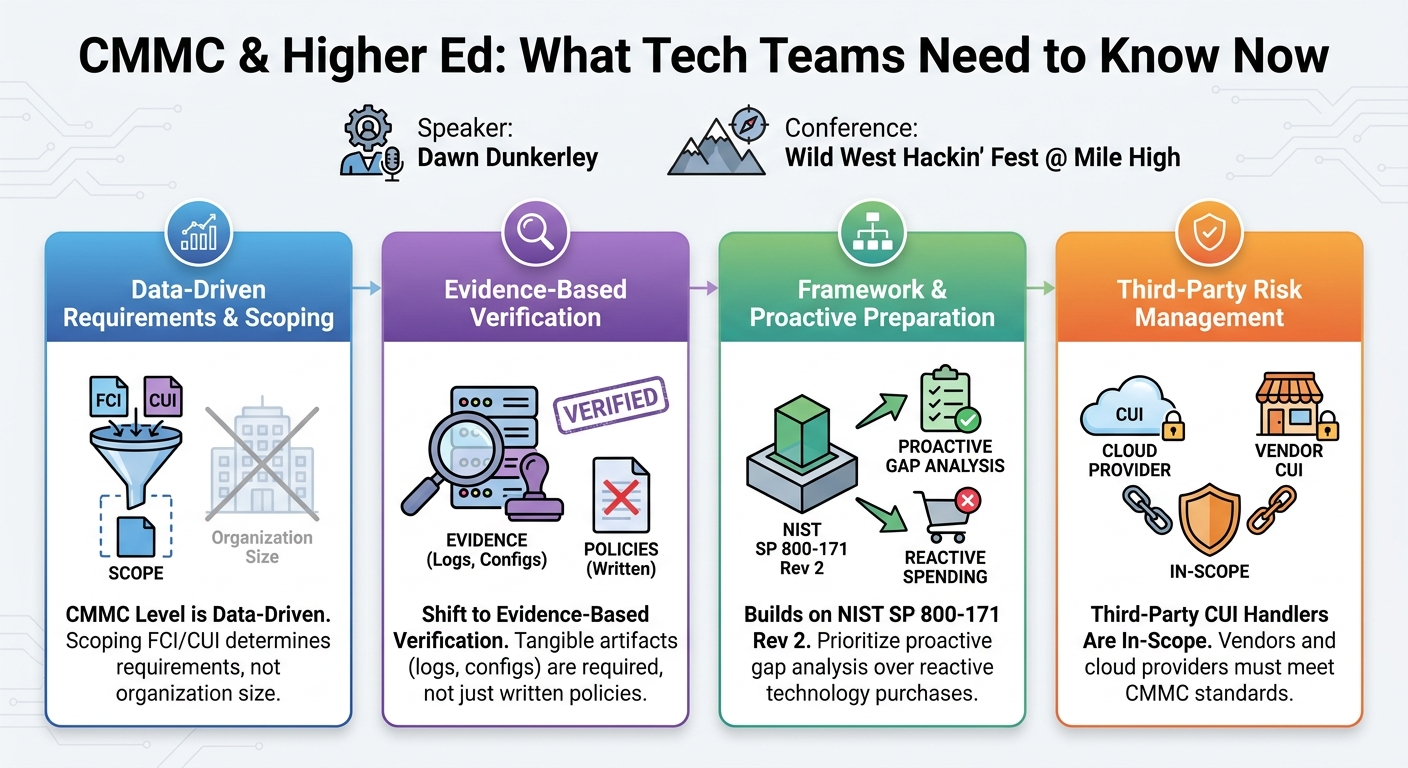
The central tenets of CMMC, as outlined by Dawn Dunkerley, revolve around data-driven requirements, stringent verification, and meticulous scoping. The most critical finding is that the certification level is dictated solely by the type of sensitive data an organization handles, not by its size, classification, or sector. This means a small research lab handling Controlled Unclassified Information (CUI) under a DoD project must meet the same standards as a large defense contractor.
The CMMC framework, in its Version 2.0 iteration, distills compliance into three distinct levels:
- Level 1 (Foundational): This level applies to organizations handling Federal Contract Information (FCI). It mandates adherence to 17 controls derived from FAR 52.204-21 and a subset of NIST SP 800-171 controls. These represent basic cyber hygiene practices, such as access control. For Level 1, organizations can generally perform a self-assessment, attesting to their compliance directly to government systems.
- Level 2 (Advanced): This is the level for organizations processing Controlled Unclassified Information (CUI). It requires implementing all 110 controls from NIST SP 800-171 Revision 2. This represents a significant step up to comprehensive security practices. While some Level 2 contracts may allow for self-assessment, higher-risk contracts will necessitate a third-party assessment by an accredited C3PAO.
- Level 3 (Expert): Designed for organizations handling highly sensitive CUI, this level incorporates a subset of enhanced security requirements from NIST SP 800-172. Dunkerley notes that Level 3 is currently less defined and is expected to involve government-led assessments, rather than C3PAOs.
A pivotal finding is the emphasis on evidence standards. CMMC auditors (C3PAOs) will not simply accept documented plans or policies. Organizations must provide tangible evidence that plans are not only written but also actively used, tested, and exercised. This includes logs, configurations, and other technical artifacts demonstrating consistent implementation and effectiveness of controls.
Furthermore, Dunkerley repeatedly highlights that scoping is often the most challenging and critical aspect of CMMC compliance. Identifying precisely where CUI exists within an organization's environment and correctly defining the CMMC boundary (the assessment scope) is more difficult than implementing the technical controls themselves. Over-scoping leads to unnecessary burden and cost, while under-scoping increases risk and can lead to assessment failure. She estimates that careful scoping can reduce the assessment environment by approximately 80%.
Finally, the talk reveals a crucial distinction regarding the underlying standard: CMMC Version 2.0 specifically relies on NIST SP 800-171 Revision 2, even though NIST itself has progressed to Revision 3. This creates a potential future conflict, particularly for higher education institutions that may be required to comply with Revision 3 for other regulatory frameworks like the Gramm-Leach-Bliley Act (GLBA) for financial aid processing.
Technical Deep Dive
▶ Watch: CMMC uses NIST 800-171 Rev 2, not the newer Rev 3 (19:00)
The technical core of CMMC compliance, as detailed by Dawn Dunkerley, is rooted in the meticulous protection of specific data types and the precise application of NIST security controls. The framework's entire structure is predicated on distinguishing between Federal Contract Information (FCI) and Controlled Unclassified Information (CUI).
FCI is defined as information, not intended for public release, that is provided by or generated for the government under a contract. This encompasses a broad range of data, including technical specifications, pricing information, contract performance data, proposal materials, and cost breakdowns. Many organizations handle FCI unknowingly, emphasizing the need for careful internal data identification. FCI requires adherence to CMMC Level 1, which mandates 17 foundational cybersecurity controls, primarily drawn from FAR 52.204-21 and select basic cyber hygiene controls from NIST SP 800-171. These controls cover fundamental practices such as limiting system access to authorized users, training personnel, media protection, physical access control, and system integrity.
CUI, on the other hand, is information the government creates or possesses, or that an entity creates or possesses for or on behalf of the government, that a law, regulation, or government-wide policy requires or permits an agency to handle using safeguarding or dissemination controls. It is explicitly not classified information but requires protection. Examples include engineering data, research results, and data transmitted or stored on shared systems or cloud platforms. Organizations processing CUI must achieve CMMC Level 2, which requires full implementation of all 110 controls specified in NIST SP 800-171 Revision 2. Dunkerley stresses that implementing NIST SP 800-171 is "no joke," signifying the comprehensive and often complex nature of these controls, which cover 14 families of security requirements, including access control, incident response, system and information integrity, and configuration management.
A critical technical nuance highlighted is that CMMC currently pegs its requirements to NIST SP 800-171 Revision 2, not the newer Revision 3. While Revision 3 introduces some changes, consolidations, and removals of controls, organizations pursuing CMMC must ensure their implementation aligns with Revision 2. This distinction is particularly relevant for higher education, where other compliance mandates (like GLBA for financial aid) may soon require adherence to Revision 3, creating potential architectural and operational challenges for IT teams.
Scoping is identified as the paramount technical challenge. Effective scoping requires a deep understanding of data flows, user access patterns, and inter-system dependencies. Any system that stores, processes, or transmits CUI is in scope, including potentially mobile devices. Furthermore, all users with access to CUI—from researchers to IT administrators—are part of the scope. Crucially, the supporting services that enable access to CUI, such as authentication systems, identity management, logging infrastructure, and backup systems, must also be included, even if they are shared assets across the enterprise. Forgetting these shared foundational services is a common under-scoping mistake.
To manage scope and reduce the compliance burden, segmentation strategies are essential. These can range from logical segmentation (e.g., VLANs, network ACLs) to restrict network access between CUI and non-CUI environments, to physical separation (e.g., dedicated infrastructure, secure enclaves like skiffs). Dedicated enclaves for CUI-related identity, logging, and security systems are ideal but often financially prohibitive for higher education. The boundaries of cloud and third-party platforms that process or store CUI on behalf of the organization must also be clearly defined and included in the scope.
Finally, documentation is not merely an administrative task but a critical technical artifact. Assessors evaluate:
- Policies aligned to practice: Security policies must accurately describe what is actually done, not just aspirational goals.
- Accurate System Security Plans (SSPs): The SSP is the master document detailing the implementation of all controls, reflecting the current environment.
- Evidence of consistency: This includes logs, configuration files, audit trails, and other technical artifacts that provide concrete proof of continuous compliance.
Dunkerley explicitly states that CMMC does not dictate specific technologies or vendors; rather, it focuses on outcomes and evidence. This allows organizations flexibility in choosing tools that best fit their existing infrastructure and budget, provided they can demonstrate compliance with the required controls.
Demo / Proof of Concept
▶ Watch: POAM limitations and serious consequences for non-compliance (27:30)
This conference talk was a presentation providing detailed information and guidance on CMMC, rather than a live demonstration or proof of concept of a specific tool or technique. Dawn Dunkerley focused on explaining the CMMC framework, its requirements, and practical preparation steps for organizations.
Defensive Implications
▶ Watch: Final takeaways: data, scope, and thoughtful preparation are key (44:00)
The implications of CMMC for cybersecurity defenders are profound, requiring a strategic and proactive shift in approach. Dawn Dunkerley's talk provides several critical directives for strengthening an organization's defensive posture:
- Understand Your Data and Contractual Requirements: The absolute first step is to accurately identify the type of government information being handled (FCI or CUI) and the specific CMMC level mandated by current or prospective contracts. This dictates the entire scope and depth of required security controls. Defenders must collaborate with legal and contracts departments to ensure clarity.
- Prioritize and Master Scoping: This is arguably the most crucial defensive action. Defenders must conduct a meticulous analysis of all data flows, user access patterns, and system dependencies related to CUI. The goal is to create a precisely defined CMMC boundary that includes every system, network, user, and supporting service (identity management, logging, backups) that touches CUI, while aggressively excluding unrelated systems to avoid over-scoping. Implementing segmentation strategies (logical, physical, dedicated enclaves) is key to limiting the attack surface and reducing the compliance burden. A properly scoped environment can reduce the assessment effort by up to 80%.
- Embrace Evidence-Based Security: Move beyond "paper security." Defenders must ensure that security policies and procedures are not just written but are actively implemented, tested, and continuously verified. This means collecting and maintaining robust evidence of compliance, including system logs, configuration files, audit trails, penetration test results, incident response exercises, and proof of security awareness training. Assessors will look for technical artifacts demonstrating consistent practice, not just theoretical plans.
- Rigorous Third-Party Risk Management: A significant defensive vulnerability lies in overlooking third-party vendors and cloud providers. Any external entity that stores, processes, or transmits CUI on behalf of the organization must meet the same CMMC requirements. Defenders need to implement a robust vendor vetting program, utilizing tools like BitSight or SecurityScorecard for external posture assessment, and comprehensive questionnaires like the Higher Education Community Vendor Assessment Tool (HECVAT) for internal process evaluation. Contractual agreements with vendors must explicitly address CMMC compliance.
- Proactive Gap Analysis and Roadmap Development: Instead of reacting to an impending assessment, organizations should proactively conduct an internal CMMC assessment. This involves reviewing existing controls against NIST SP 800-171 Rev 2, identifying gaps, and developing a structured, time-bound Plan of Action and Milestones (POAM) to address deficiencies. This strategic preparation, often taking months to over a year, is far more effective than impulsive technology purchases.
- Maintain Continuous Compliance and Audit Readiness: CMMC certification is valid for three years, but compliance is an ongoing expectation. Defenders must embed CMMC requirements into daily operations and be prepared for potential surveillance audits. This means maintaining the documented security posture, continuously monitoring for deviations, and being ready to provide evidence of ongoing adherence at any time.
- Understand NIST Version Nuances: Be aware that CMMC currently mandates NIST SP 800-171 Revision 2, even as NIST itself progresses to Revision 3. While staying current with security best practices is vital, CMMC compliance specifically requires adherence to Revision 2. For higher education, this means anticipating potential conflicts with other regulations (like GLBA) that may require Revision 3 in the future and planning for potential architectural segmentation to address differing requirements.
By focusing on these defensive implications, organizations can systematically build a robust, verifiable security program that not only meets CMMC requirements but also significantly enhances their overall cybersecurity posture against evolving threats.
Key Takeaways
- Data and Scoping are Paramount: The CMMC certification level is driven exclusively by the type of data handled (FCI for Level 1, CUI for Level 2), not organizational size. Properly identifying where CUI resides and meticulously defining the assessment scope—including all systems, users, networks, and supporting services—is the single most critical and challenging aspect of compliance, offering significant burden reduction if done correctly.
- CMMC Builds on Existing, Proven Frameworks: CMMC is not a new set of security controls but rather a verification layer built upon the robust NIST SP 800-171 Revision 2 framework (and select FAR clauses). Organizations should leverage existing security practices and NIST guidance rather than reinventing the wheel.
- Evidence of Practice is Non-Negotiable: Simply having documented policies and plans is insufficient. CMMC demands tangible evidence—such as logs, configurations, audit trails, and records of tested procedures—to prove that security controls are actively implemented, consistently followed, and routinely exercised.
- Third-Party Risk is Your Risk: Any cloud provider or third-party vendor that processes, stores, or transmits CUI on an organization's behalf is considered part of the CMMC scope. Rigorous vetting and continuous monitoring of these partners are essential to ensure they meet the required security standards.
- Proactive Preparation Trumps Reactive Spending: A strategic approach involving early gap assessments, meticulous scoping, and the development of a structured Plan of Action and Milestones (POAM) is far more effective and cost-efficient than impulse purchases of security tools. Understanding true gaps before investing in technology is key.
- CMMC is a Fundamental Shift with Real Consequences: This framework marks a definitive move from self-attestation to verifiable security, backed by contractual requirements and potential penalties, including loss of grant funding, for non-compliance. It demands continuous security posture maintenance, not just a one-time audit.
About the Speaker(s)
Dawn Dunkerley is the CEO of Max2 Security, a firm specializing in virtual Chief Information Security Officer (CISO) services and managed security for a wide range of educational institutions, from K12 to higher education. Her expertise is deeply rooted in her extensive background, having spent approximately 20 years supporting the Department of Defense in critical roles within cyber intelligence and cybersecurity. This experience provides her with a unique perspective on government security frameworks like NIST 800-171, NIST 800-853, and the NIST Cybersecurity Framework (CSF), making her a highly knowledgeable authority on CMMC and its practical implementation challenges.
Reviews
Dr. Zero (Offensive Security Researcher) — WEAK
This is a boilerplate compliance primer dressed up as a conference session. If you've read the DoD's CMMC 2.0 FAQ page, you already know every single thing presented here. Zero insider signal, zero novel interpretation, just a consultant regurgitating definitions of CUI and NIST control counts.
Heather Calloway (CISO) — SOLID
A clear-eyed, practical translation of CMMC requirements for higher education and DoD supply chain entities. The speaker nails the core business reality: federal grants are now gated by verifiable security execution, and aggressive scoping is the only way to survive the audit without bankrupting your IT budget.
→ Top-rated talks at Wild West Hackin' Fest @ Mile High 2026