Abusing Backup Operators with TrustedSec's Titanis
Jim Sykora (Security Researcher · SpecterOps)
Overview
In this insightful talk from Wild West Hackin' Fest @ Mile High, Jim Sykora, a Security Researcher at SpecterOps, delves into the often-underestimated power of the Backup Operators group within Windows environments. Sykora introduces a novel approach to abusing these privileges, leveraging the relatively new cross-platform framework Titanis from TrustedSec. His research highlights that the capabilities of Backup Operators extend far beyond the commonly known technique of dumping the SAM hive, revealing a much broader attack surface.
Key moments
- 0:00 Introduction: Abusing Backup Operators with Titanis
- 1:21 Understanding Backup Operators' unique privileges and DACL override
- 2:32 Introducing TrustedSec's Titanis: A powerful protocol library
- 7:00 Demo: Bypassing DACLs with Titanis SMB2 client
- 9:02 Introducing TBO: PowerShell module built on Titanis
- 12:08 TBO Remote Registry Provider: Live registry manipulation
- 15:00 Recovering credentials from registry without dumping files
- 16:30 Defending against Backup Operator abuse and logging
Abusing Backup Operators with TrustedSec's Titanis
Speakers: Jim Sykora, Security Researcher, SpecterOps
Conference: Wild West Hackin' Fest @ Mile High
YouTube: https://www.youtube.com/watch?v=7lL58PHVVEY
Overview
In this insightful talk from Wild West Hackin' Fest @ Mile High, Jim Sykora, a Security Researcher at SpecterOps, delves into the often-underestimated power of the Backup Operators group within Windows environments. Sykora introduces a novel approach to abusing these privileges, leveraging the relatively new cross-platform framework Titanis from TrustedSec. His research highlights that the capabilities of Backup Operators extend far beyond the commonly known technique of dumping the SAM hive, revealing a much broader attack surface.
Sykora’s presentation culminates in the demonstration of his own PowerShell module, Titanis Backup Operator (TBO), which builds upon the Titanis framework. This module showcases advanced techniques such as modifying scheduled tasks without relying on the Windows API, direct manipulation of the registry over remote connections, and comprehensive credential recovery without requiring files to be written to disk or processes to be executed on remote hosts. The talk emphasizes that understanding these extended capabilities is crucial for both attackers seeking to expand their lateral movement and persistence options, and defenders aiming to secure their environments against sophisticated threats. Sykora also notes the importance of integrating these findings into tools like BloodHound, with a new "Can Backup" edge soon to be added to the attack graph.
The significance of this research lies in its methodical exploration of "as designed behaviors" within the Windows ecosystem, turning seemingly innocuous privileges into potent attack vectors. By combining a modern, robust protocol framework like Titanis with a deep understanding of Windows internals, Sykora not only demystifies complex privilege escalation paths but also provides practical, cross-platform tooling. This empowers security professionals to better understand, detect, and mitigate threats stemming from the abuse of Backup Operator privileges, ultimately enhancing the overall security posture of Windows-based networks.
Background
▶ Watch: Introduction: Abusing Backup Operators with Titanis (0:00)
The Backup Operators group is a built-in local group that exists on every Windows host and a domain group that applies to all domain controllers within a Windows domain. Its primary purpose is to allow designated users or service accounts to perform backup and restore operations across the system, even for files and directories they normally wouldn't have access to. This functionality is enabled by two powerful privileges: SE_BACKUP_PRIVILEGE and SE_RESTORE_PRIVILEGE. Crucially, these privileges, when active in a user's access token and used with the correct flags in file or registry operations, override discretionary access control lists (DACLs). This means that an entity with Backup Operator privileges can read and write virtually any file or registry key, regardless of its explicit permissions. Jim Sykora references James Forshaw's "Windows Security Internals" to underscore this fundamental aspect of Windows security architecture.
A key differentiator highlighted in the talk is that Backup Operators are explicitly granted rights on default administrative shares (like C$) and the remote registry named pipe, a capability not extended to the Server Operators group. This distinction is vital for understanding why Backup Operators can be abused remotely on domain controllers while Server Operators cannot in the same manner.
Historically, the abuse of Backup Operators has largely focused on dumping the SAM hive of the registry. Early tradecraft, influenced by tools like PowerDump (developed by Cathy Powers, Josh Kelley, and Dave Kennedy) and Backup Operators CPP by Philip Dragovic, centered on using the REG_OPTION_BACKUP_RESTORE flag to open registry keys with backup intent. This allowed attackers to extract critical information such as NT hashes from SAM, cached domain credentials, machine account passwords and hashes, application credentials, service account credentials, and local EFS and DPAPI keys. While effective, this approach often involved dumping registry hives to disk or using tools like Mimikatz for secret extraction. Sykora notes that he initially explored these avenues, even modifying an Impacket-based "Backup Operators Toolkit" to test his ideas.
However, the landscape of Windows protocol interaction received a significant upgrade with the release of Titanis by Alex Ball (who goes by Code Whisperer 84). Titanis is a cross-platform library and framework designed to implement Microsoft Windows protocol support based on Microsoft's own detailed protocol specifications. This meticulous approach ensures that Titanis's interactions with protocols like SMB, RPC, DCOM, LSA, SAM, services, and WMI closely mimic Microsoft's intended uses. Sykora describes Titanis as being "something like the Impacket library, but it sucks less," emphasizing its robustness and accuracy. Titanis is designed to be a platform for building custom tools, and at Sykora's request, Alex Ball added remote registry support to an early feature branch, with LDAP support rumored to be coming soon. This powerful new framework provided Sykora with a much more effective and flexible path for exploring the full extent of Backup Operator abuse.
Key Findings
▶ Watch: Introducing TrustedSec's Titanis: A powerful protocol library (2:32)
Jim Sykora's research and the development of Titanis Backup Operator (TBO) unveil several critical findings regarding the true power and potential for abuse inherent in the Backup Operators group:
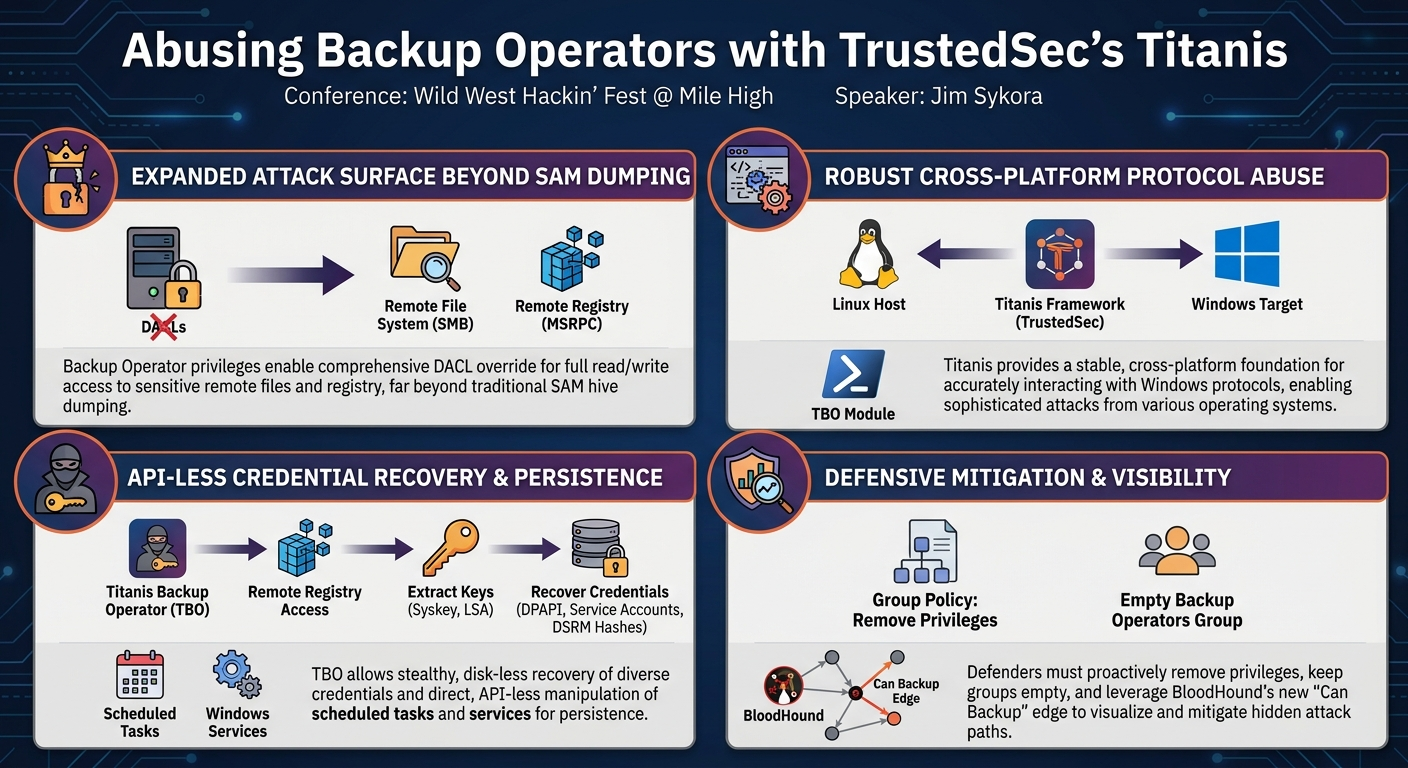
- Expanded Attack Surface Beyond SAM Dumping: The talk conclusively demonstrates that Backup Operator privileges offer a far broader range of exploitation possibilities than merely dumping the SAM hive for credential extraction. While SAM dumping remains a viable technique, it represents only a fraction of what's achievable.
- Robust Cross-Platform Protocol Abuse: The Titanis framework proves to be an exceptionally stable and accurate platform for interacting with Windows protocols. Its design, based on Microsoft's official specifications, enables reliable and consistent exploitation across different operating systems, allowing attackers to perform Windows-specific attacks from Linux hosts.
- DACAL Override for Comprehensive Remote Access: A central finding is the effective and consistent override of DACLs across both remote file systems (via SMB) and the remote registry. This capability grants Backup Operators unparalleled access to sensitive data and configurations that would otherwise be protected, enabling full read/write access to practically any part of the system.
- Advanced Credential Recovery Without Disk Interaction: TBO introduces methods to recover a wide array of credentials—including machine account credentials, DPAPI system keys, plaintext passwords for service accounts, and DSRM password hashes from SAM—all without writing temporary files to disk or executing processes on the target system. This significantly reduces forensic artifacts and detection opportunities.
- API-Less System Modification: A particularly impactful finding is the ability to enumerate, view, and modify critical system components like scheduled tasks and Windows services directly through remote registry and SMB access, bypassing their respective Windows APIs. This offers a stealthier and more direct means of achieving persistence or privilege escalation.
- Real-time Remote Monitoring: TBO's capability to monitor remote file system activity over SMB highlights a novel use case for Backup Operators, allowing an attacker to observe changes in sensitive directories in near real-time, which could be used for targeted data exfiltration or dynamic response to system events.
- Enhanced BloodHound Visibility: The research directly contributes to improved defensive capabilities by leading to the creation of a new "Can Backup" edge in BloodHound. This will enable defenders to visualize and identify previously hidden attack paths involving Backup Operators, significantly improving their ability to map and mitigate risks.
These findings collectively redefine the understanding of Backup Operator privileges, transforming them from a niche concern into a potent and versatile attack vector that demands significant attention from both offensive and defensive security practitioners.
Technical Deep Dive
▶ Watch: Introducing TBO: PowerShell module built on Titanis (9:02)
The core technical foundation of Jim Sykora's work rests on the abuse of two critical Windows privileges: SE_BACKUP_PRIVILEGE and SE_RESTORE_PRIVILEGE. When these privileges are active in a user's access token and specific flags are used during file or registry operations, they allow an authenticated user to bypass discretionary access control lists (DACLs). For file system operations over SMB, this involves using the FILE_FLAG_BACKUP_SEMANTICS flag. For registry operations, the REG_OPTION_BACKUP_RESTORE flag is employed. This mechanism is fundamental to how legitimate backup software functions, but it's equally exploitable by adversaries.
The Titanis framework, developed by Alex Ball, provides the robust, cross-platform engine for these abuses. Unlike many other open-source tools that might approximate Windows protocol interactions, Titanis is built directly from Microsoft's own protocol specifications. This ensures a high degree of fidelity and reliability when interacting with services like SMB, RPC, DCOM, LSA, SAM, and WMI. Titanis tools are implemented as .NET console applications, making them cross-platform (e.g., runnable on Linux), support consistent command-line structures, are SOCKS5 proxyable, and offer standardized output options.
One of the key Titanis tools demonstrated is the SMB2 client. This client specifically includes a use backup semantics flag which, when enabled, inserts the FILE_FLAG_BACKUP_SEMANTICS into the SMB file open request. This allows a user with Backup Operator privileges to list directories and copy files from locations where they are explicitly denied access by the DACLs. Sykora showed this by successfully listing and copying files from a folder configured to explicitly deny access to his test Backup Operator account.
A significant enhancement to Titanis, added by Alex Ball at Sykora's request, is MSRPC (Microsoft Remote Procedure Call) support for the remote registry protocol. This feature branch enables Backup Operator semantics over remote registry connections, allowing for privileged operations directly on the registry of a remote system. This includes the ability to list, set, save, and retrieve key information, obtain the syskey, and even dump the SAM hive—all remotely and with DACL override.
Building upon Titanis, Sykora developed the Titanis Backup Operator (TBO) PowerShell module. TBO extends the capabilities of Titanis by wrapping its functionality into user-friendly PowerShell commandlets and providers, making advanced Backup Operator abuse accessible to Windows administrators and penetration testers. The module is designed for live remote access, performing all operations over an SMB connection—either to an SMB share or to the Win Reg named pipe—with SE backup privilege and SE restore active in the access token, and backup intent on the share connection.
TBO introduces two primary PowerShell providers:
- File System Provider: This allows users to create a PS drive that maps to a remote administrative share (e.g.,
C$) on a target server. Through this drive, users can navigate the remote file system as if it were local, creating, removing, copying files and folders, and even checking and setting security descriptors—all while bypassing DACLs. The module can also discover and browse existing volume snapshots, copying files directly from them, and even detect alternate data streams. A powerful feature demonstrated was the ability to copy the NTDS.dit file directly off a domain controller. Furthermore, TBO offers a unique capability to watch a folder for activity over SMB, providing real-time alerts on file system changes. - Remote Registry Provider: Similar to the file system provider, this allows the creation of a PS drive mapped to the remote registry. Users can browse the registry like a file system, retrieve information from keys and values, add, set, and remove keys and values. This live remote access on a domain controller enables a wide array of data collection and manipulation.
Beyond navigation, TBO includes several utility commandlets:
- Enumerating Remote Sessions: Similar to how SharpHound might collect this data, TBO can extract remote session information from the registry.
- Network Interface Information: Pulling IP addresses and network configuration directly from the remote registry.
- Windows Services Management: TBO can enumerate hundreds of Windows services remotely, including detailed information like their trigger info, failure actions, special DLLs, and crucially, their security descriptors (stored as
REG_BINARYvalues). It can parse, modify, and write these security descriptors back to the registry, effectively allowing an attacker to modify service permissions or configurations without interacting with the service control manager API. It can also identify weak services. - Scheduled Task Manipulation (API-less): Perhaps one of the most significant technical capabilities is the ability to enumerate, view triggers and actions, read security descriptors, and determine the principal for scheduled tasks—all without using the Task Scheduler API. This is achieved through direct access to the registry over SMB named pipes, offering a covert way to understand and potentially alter task behavior.
Finally, TBO integrates advanced credential recovery. By leveraging the ability to arbitrarily read the entire remote registry, TBO can construct the syskey and LSA key. These are then used to recover the machine account credential, DPAPI system keys, and even plaintext passwords of any service accounts stored in the registry. This information can then be used to recover hashes from the SAM, which on a domain controller, would include the DSRM password. This process effectively "loops back to dumping SAM again," but in a far more sophisticated, API-less, and disk-less manner.
Sykora also noted post-conference additions to TBO, including local caching of retrieved credentials and an operator log in an SQLite database, with export options to JSON (for tools like Nemesis) or BloodHound open graph. He also added local backup privilege support, acknowledging prior work by Dieter Stevens with ReactOS in 2015.
Demo / Proof of Concept
▶ Watch: TBO Remote Registry Provider: Live registry manipulation (12:08)
Jim Sykora conducted a series of live-recorded demonstrations from his lab environment, showcasing the practical application of Titanis and his Titanis Backup Operator (TBO) PowerShell module. The lab setup consisted of an Active Directory forest named corp1.lab.homelabs.lol, featuring a domain controller (DC01), a member server (corp1-web01 - both Server 2022), and a Windows 10 workstation. Two key user accounts were used: psxl backup operator (a standard domain user added as a local Backup Operator on the web server) and psxd backup op (a domain user and a member of the domain's Backup Operators group on the domain controller). Crucially, test folders under SQL\test were configured with highly restrictive DACLs, granting access only to Administrator and System, and explicitly denying access to the test accounts, serving as a robust testbed for DACL bypass.
The demonstrations began with the Titanis SMB2 Client:
- Sykora connected to
corp1-web01as thepsxl backup operatorusing theuse backup semantics flag. - He successfully listed the contents of a directory (
SQL\test\denied) where the account was explicitly denied access. - He then copied a file from this denied folder to his local device, confirming the
FILE_FLAG_BACKUP_SEMANTICSeffectively bypassed the DACLs.
Next, the Titanis MSRPC (Remote Registry) functionality was showcased:
- Using a DLL from the feature branch, Sykora demonstrated listing, setting, and saving registry keys.
- He also showed the ability to get the syskey and dump the SAM hive via the remote registry, illustrating the DACL bypass for registry operations.
The bulk of the demonstration focused on the Titanis Backup Operator (TBO) PowerShell module:
- Sykora imported the TBO module and established a connection to the domain controller (
DC01) aspsxd backup op, using plaintext authentication for the demo. - A new PowerShell drive named
TBOwas created, pointing to theC$administrative share onDC01. - Navigating this drive, he demonstrated treating the remote file system as local, even within the
SQL\test\deniedfolder. He created files, created folders, removed files, and copied files both from the remote server to his local host and vice-versa, all within a DACL-denied context. - He showed how to check and set security descriptors on remote files and folders.
- While TBO cannot create snapshots, it could find and browse existing ones, showcasing the ability to copy files from these historical versions.
- A particularly impactful demo was copying the NTDS.dit file directly off the domain controller.
- Sykora then demonstrated monitoring a remote folder for activity over the SMB protocol, showing how changes on the remote share would be outputted to the PowerShell prompt in real-time.
The TBO Remote Registry Provider was then introduced:
- A separate PowerShell drive was created, mapping to the remote registry of
DC01. - Sykora browsed the registry like a file system, retrieving information from keys and values.
- He added, set, and removed registry keys and values, emphasizing that all these operations were live and remote on the domain controller, bypassing DACLs.
- Utility commandlets were demonstrated, including enumerating remote sessions from the registry, pulling network interfaces and IP addresses, and extracting information about Windows services. The service enumeration was notably slow, as it pulled over 600 services remotely, highlighting the depth of information available.
- He showed how to retrieve detailed service information (e.g., trigger info, failure actions, special DLLs), view security descriptors stored as
REG_BINARYvalues, parse them, modify them, and write them back. - The ability to identify weak services was also highlighted.
- Crucially, he demonstrated enumerating scheduled tasks, viewing their triggers and actions, and reading their security descriptors—all without utilizing the Task Scheduler API, relying solely on direct registry and SMB access.
- The final segment of the demo showcased credential recovery: constructing the syskey and LSA key from the remote registry, then using them to recover the machine account credential, DPAPI system keys, and plaintext passwords of any service accounts. This information was then used to recover hashes from SAM, specifically the DSRM password in the context of a domain controller.
Sykora underscored that all these demos were pre-recorded to avoid "demo gods" issues, but represented live interactions with his lab environment, confirming the efficacy and practicality of the techniques. He also mentioned significant post-submission additions to TBO, including local caching of credentials and an operator log in an SQLite database, with export capabilities to JSON (for Nemesis) or BloodHound's open graph format, further expanding its utility for both offensive and defensive engagements.
Defensive Implications
▶ Watch: Defending against Backup Operator abuse and logging (16:30)
The detailed exploration of Backup Operator abuse by Jim Sykora provides crucial insights for defenders looking to harden their Windows environments. The primary and most straightforward recommendation is to keep Backup Operator groups empty. In modern environments, especially those utilizing backup software with agents, the necessity of granting human users or even service accounts membership in these highly privileged groups is often negligible. Many contemporary backup solutions operate with their own service accounts or mechanisms that do not require the broad, system-wide privileges of the Backup Operators group.
Beyond simply emptying the groups, organizations should leverage Group Policy to explicitly remove the SE_BACKUP_PRIVILEGE and SE_RESTORE_PRIVILEGE from not only Backup Operators but also Server Operators and, where feasible, even Administrators. While administrators can always re-grant themselves these privileges, doing so remotely or without a clear audit trail becomes significantly more difficult, raising the bar for an attacker. This proactive removal of default privileges drastically reduces the attack surface.
A significant challenge highlighted by Sykora is the poor logging associated with these types of abuses. Default Windows auditing often fails to capture the granular events necessary to detect DACL bypasses or remote registry manipulations using backup semantics. To gain visibility, defenders must enable advanced auditing and configure SACLs (System Access Control Lists) on sensitive files, folders, and registry keys. Specifically, auditing for object access attempts (especially failed ones, which could indicate privilege escalation attempts) and registry access events is critical. However, even with advanced auditing, the volume of logs can be overwhelming, necessitating robust SIEM solutions and dedicated monitoring efforts.
While traditional logging might be insufficient, Sykora acknowledges that an EDR (Endpoint Detection and Response) solution might still detect some of these activities. EDRs often monitor for sensitive registry key accesses, unusual process behavior, or direct memory manipulation that might occur during credential recovery, even if the underlying protocol operations themselves are not explicitly logged by Windows. Therefore, collecting logs, enabling advanced auditing, and actively monitoring these systems are paramount.
Finally, the research directly contributes to improved defensive visibility through BloodHound. The upcoming "Can Backup" edge will allow security teams to visualize and identify users or groups that possess Backup Operator privileges and the attack paths that could be exploited. This will be invaluable for understanding the blast radius of such privileges and prioritizing remediation efforts within an organization's attack graph. By integrating this new edge, defenders can proactively identify and mitigate complex privilege escalation and lateral movement paths that were previously difficult to map.
Key Takeaways
- Backup Operators are a Potent and Underestimated Attack Vector: The Backup Operators group, with its SE_BACKUP_PRIVILEGE and SE_RESTORE_PRIVILEGE, offers far more extensive capabilities for remote system compromise than commonly understood, extending well beyond traditional SAM hive dumping.
- Titanis Provides a Robust, Cross-Platform Foundation for Protocol Abuse: TrustedSec's Titanis framework is a highly accurate and reliable library for interacting with Windows protocols (SMB, RPC, Remote Registry, etc.), enabling sophisticated attacks from any platform.
- TBO Enables API-less DACL Override and Credential Recovery: Jim Sykora's Titanis Backup Operator (TBO) PowerShell module demonstrates comprehensive DACL override for both remote file systems and the remote registry, facilitating direct manipulation of system components and the recovery of various credentials (machine account, DPAPI, service account plaintext passwords, DSRM hashes) without writing to disk or executing processes on the target.
- Scheduled Task and Service Manipulation Without APIs: TBO showcases the ability to enumerate, view, and modify critical system configurations like scheduled tasks and Windows services directly through remote registry and SMB access, bypassing their respective Windows APIs for stealthier persistence and privilege escalation.
- Defenders Must Proactively Remove Privileges and Enhance Monitoring: Organizations should keep Backup Operator groups empty, use Group Policy to remove associated privileges, enable advanced auditing and SACLs on sensitive resources, and actively monitor logs with EDR and SIEM solutions to detect these covert activities.
- BloodHound Integration Enhances Defensive Visibility: The upcoming "Can Backup" edge in BloodHound will empower defenders to visualize and understand attack paths involving Backup Operators, significantly improving their ability to identify and mitigate risks within their attack graph.
About the Speaker(s)
Jim Sykora is a Security Researcher at SpecterOps. His work focuses on deep dives into Windows internals and protocol behaviors to uncover new attack vectors and enhance defensive strategies. His background, which includes experience as a sysadmin, provides him with a practical understanding of how Windows environments function, enabling him to identify and exploit "as designed behaviors." Sykora is also active in the security community, contributing to research that helps both offensive and defensive security practitioners better understand complex attack paths. His LinkedIn profile is available at https://www.linkedin.com/in/jimsykora.
Reviews
Dr. Zero (Offensive Security Researcher) — MUST SEE
Sykora took a dusty, well-known primitive—Backup Operators SAM dumping—and dragged it kicking and screaming into the modern era using TrustedSec's Titanis framework. It's a masterclass in API-less system manipulation and protocol-level DACL bypasses. This is exactly the kind of deep-weeds tradecraft that forces EDR vendors to rethink their telemetry.
Heather Calloway (CISO) — SOLID
This is deep technical research demonstrating how adversaries can use default Backup Operator privileges to extract credentials without triggering standard API-based alerts. While the exploit mechanics are for your red team, the takeaway for leadership is simple: Backup Operators are functionally Domain Admins. If your AD teams are still putting service accounts or users in this group, your Tier 0 perimeter is exposed.
→ Top-rated talks at Wild West Hackin' Fest @ Mile High 2026