RATs & Ladders: Climbing from Access to Control
Nevan Beal, Jason Rathbun
Overview
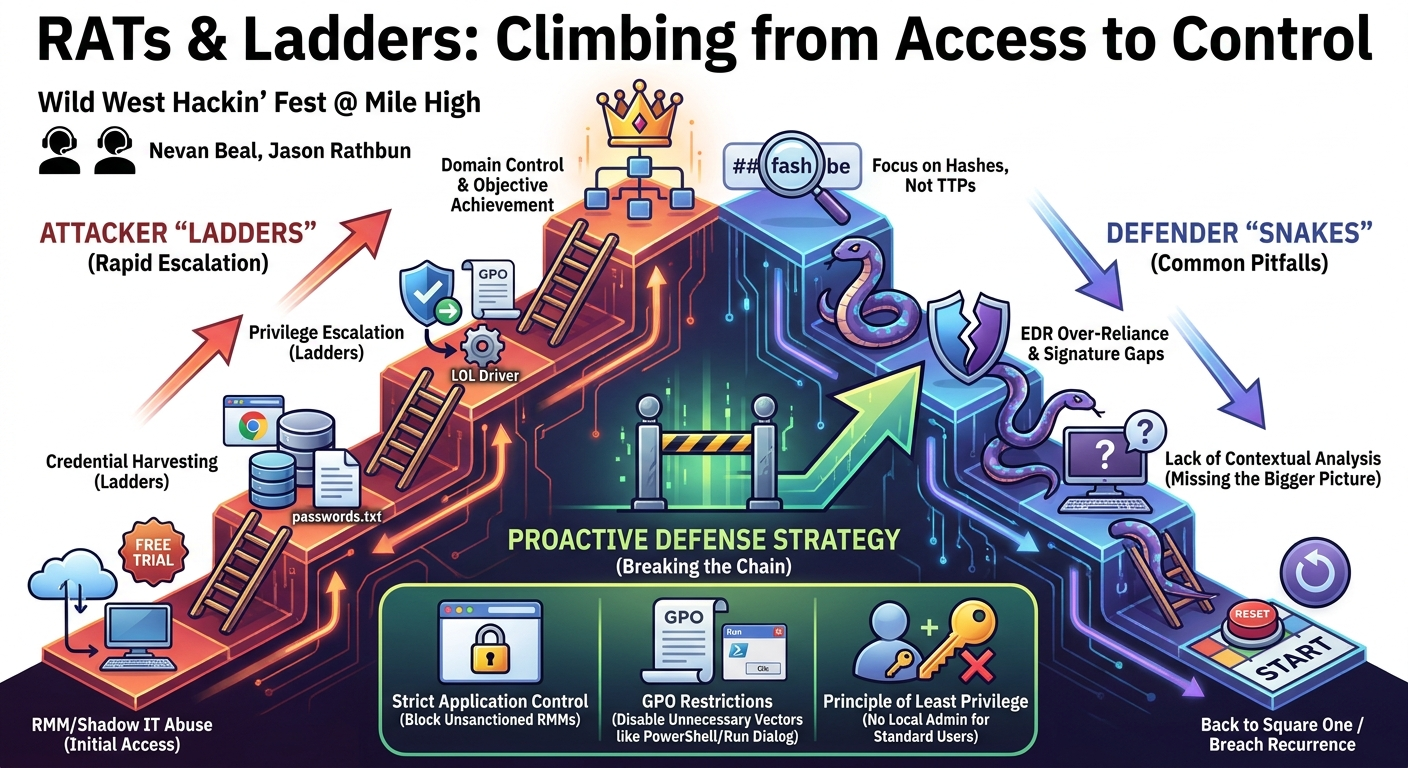
In their Wild West Hackin' Fest @ Mile High talk, "RATs & Ladders: Climbing from Access to Control," Nevan Beal and Jason Rathbun deliver a compelling analysis of modern threat actor staging patterns and the psychological factors influencing both attackers and defenders. The presentation leverages the familiar "Snakes and Ladders" board game as a potent metaphor for the incident response landscape, where threat actors exploit "ladders"—shortcuts like credentials and over-privileged accounts—to rapidly achieve their objectives, while defenders frequently encounter "snakes" that send them back to square one due to misinterpretations, detection gaps, or inadequate security practices.
Key moments
- 0:00 Introduction to Rats & Ladders metaphor
- 1:45 Threat actors abusing RMM free trials
- 7:00 Key initial access techniques for threat actors
- 11:00 MSP breach case study using ScreenConnect wrapper
- 13:00 Credential and privilege escalation strategies
- 18:40 Defender missteps and EDR detection gaps
- 23:30 Latrodectus infection: fake captcha to domain admin
- 28:30 Analyzing LLM impact on security and threat actors
RATs & Ladders: Climbing from Access to Control
Speakers: Nevan Beal, Black Point SOC; Jason Rathbun
Conference: Wild West Hackin' Fest @ Mile High
YouTube: https://www.youtube.com/watch?v=oEjn8CFP5R0
Overview
In their Wild West Hackin' Fest @ Mile High talk, "RATs & Ladders: Climbing from Access to Control," Nevan Beal and Jason Rathbun deliver a compelling analysis of modern threat actor staging patterns and the psychological factors influencing both attackers and defenders. The presentation leverages the familiar "Snakes and Ladders" board game as a potent metaphor for the incident response landscape, where threat actors exploit "ladders"—shortcuts like credentials and over-privileged accounts—to rapidly achieve their objectives, while defenders frequently encounter "snakes" that send them back to square one due to misinterpretations, detection gaps, or inadequate security practices.
The core of their discussion revolves around the widespread abuse of legitimate Remote Monitoring and Management (RMM) tools and other "shadow IT" applications. Beal and Rathbun highlight that small to medium-sized businesses (SMBs), often lacking the financial and human resources for extensive security stacks, are particularly vulnerable targets. Threat actors capitalize on the inherent trust in these tools, their free trial availability, and common misconfigurations to establish initial access, maintain persistence, and rapidly escalate privileges. The talk underscores a critical shift in adversary tactics: moving away from bespoke malware to weaponizing everyday software, demanding a corresponding evolution in defensive strategies that focus on Tactics, Techniques, and Procedures (TTPs) rather than just signature-based detection.
This article delves into the intricate details presented by Beal and Rathbun, dissecting the "ladders" threat actors climb and the "snakes" that trip up defenders. It explores the technical nuances of initial access, credential harvesting, privilege escalation, and evasion techniques, all while emphasizing the psychological game at play. By analyzing real-world case studies and offering actionable defensive implications, the article aims to equip security professionals with a deeper understanding of the modern threat landscape and the strategic mindset required to counter sophisticated adversaries effectively.
Background
▶ Watch: Introduction to Rats & Ladders metaphor (0:00)
The premise of "RATs & Ladders" is rooted in the observation that despite advancements in cybersecurity, incident response often feels like a frustrating game of "Snakes and Ladders." This metaphorical framework helps illustrate the dynamics of modern cyberattacks. "Ladders" represent the swift and often opportunistic methods threat actors employ to gain elevated access and accelerate their progress towards their "action on objectives." These can include readily available credentials, over-privileged accounts, or exploiting existing trust relationships within a network. Conversely, "snakes" symbolize the common pitfalls and failures that cause defenders to lose ground, such as misinterpreting security alerts, failing to properly handle incidents, or relying too heavily on automated defenses without proper tuning.
A significant portion of the talk's background context centers on the unique challenges faced by Small and Medium Businesses (SMBs). Unlike large enterprises with dedicated security teams and substantial budgets for advanced security tools, SMBs—like local dentists or CPA firms—often cannot afford, implement, or properly manage complex security stacks. This financial and technical disparity makes them prime targets for threat actors who can exploit simpler vulnerabilities and less sophisticated defenses.
Beal and Rathbun emphasize the pervasive abuse of legitimate Remote Monitoring and Management (RMM) tools such as ScreenConnect and NetSupport. These applications, designed for legitimate IT support, are frequently weaponized by adversaries. The talk also highlights the exploitation of shadow IT tools and even legitimate classroom monitoring software like Classroom Spy, which, when analyzed for its operational mechanics, functions identically to a Remote Access Trojan (RAT). A critical concern is the widespread availability of free trials for many RMM tools. Threat actors can rapidly spin up trial instances, use them for initial access, deploy other RATs (like AsyncRAT), and then discard the trial before it expires, making attribution and long-term tracking more difficult.
The speakers also pinpoint a significant detection gap: a tendency for security teams to focus too granularly on specific malware families or hashes rather than the underlying Tactics, Techniques, and Procedures (TTPs). This "insert RAT problem" means that while a specific malware might be blocked, the TTPs used to deploy it—such as leveraging PowerShell or legitimate binaries—remain undetected, allowing adversaries to simply pivot to a different payload. This leads to the "modern assumption gap," where organizations might mistakenly believe their EDR or security stack provides complete protection, overlooking the need for proactive measures and comprehensive TTP-based detection.
Key Findings
▶ Watch: Key initial access techniques for threat actors (7:00)
The presentation reveals several critical insights into how threat actors operate and how defenders often fall short.
Firstly, a primary finding is the ubiquitous abuse of legitimate RMM tools and shadow IT applications for initial access and persistence. Threat actors don't always need complex custom malware; they can leverage tools like ScreenConnect, NetSupport, or even Classroom Spy software, which function as powerful RATs once compromised. The availability of free trials for these tools significantly lowers the barrier to entry, allowing adversaries to quickly establish beachheads, deploy other RATs, and then churn through trial accounts to evade detection and maintain operational agility.
Secondly, the talk meticulously details the concept of "ladders"—the rapid escalation paths adversaries exploit. This includes credential ladders, where attackers quickly harvest credentials from browser data, SAM/Security hives, LSASS, plaintext files on shared drives, or exploit weak/reused passwords and misconfigured service accounts. Coupled with this are privilege ladders, which leverage common Windows configurations and vulnerabilities such as SEImpersonate privileges, UAC bypasses via scheduled tasks, and the modification of Group Policy Objects (GPOs) to gain domain-wide control. The flat network architectures prevalent in many SMBs exacerbate these issues, making lateral movement trivial once initial access is achieved.
Thirdly, the speakers underscore the pervasive use of Living Off The Land (LOTL) binaries and techniques. Adversaries actively seek out executables and scripts already present on Windows systems (e.g., PowerShell, WScript, CScript, conhost, WMI exec) to perform malicious actions. This approach helps them evade EDRs, which are often configured to flag unknown or custom executables but struggle with legitimate tools performing suspicious actions. Techniques like DLL sideloading within signed, legitimate applications further aid evasion by allowing malicious code to run under the guise of trusted processes.
Fourthly, the presentation highlights common "snakes" or critical missteps by defenders. These include:
- Misreading attacker incentives: Focusing on blocking individual hashes rather than understanding the attacker's broader objectives and TTPs.
- Over-reliance on EDR: Believing EDR will catch everything, often leading to a false sense of security, especially when EDRs might quarantine too late or miss proxy execution chains.
- Lack of contextual viewpoint: Isolating compromised systems without investigating the full scope of the breach (who, what, when, where, why, how), leading to adversaries resurfacing later.
- Detection without denial: Identifying a threat but failing to implement proactive measures to prevent its reoccurrence or initial execution.
Finally, a forward-looking finding is the increasing role of Large Language Models (LLMs). While LLMs can enhance defensive capabilities by accelerating analytical efficiency and pattern matching, they also significantly lower the barrier to entry for malicious activity. The talk provided an example of a WhatsApp worm built with an LLM, demonstrating how adversaries can rapidly generate sophisticated tools, making the cybersecurity landscape a continuous "arms race."
Technical Deep Dive
▶ Watch: Credential and privilege escalation strategies (13:00)
Threat actors employ a sophisticated array of techniques, often leveraging legitimate functionalities to achieve their objectives, from initial access to full domain control. The talk meticulously dissects these methods, providing a technical blueprint of their operations.
Initial Access and Staging:
Initial access frequently begins with social engineering, often involving a fake help desk call where an attacker, having performed prior reconnaissance (e.g., identifying public IPs, VPN appliances), convinces a user to install an RMM tool.
- ClickOnce Applications: A key technique is the use of ClickOnce applications. These allow non-local administrators (standard users) to run applications without needing elevated permissions. The applications execute from the user's
AppDatadirectory, avoiding traditional installation paths that might trigger security alerts. This method is particularly effective for deploying tools like ScreenConnect. - Run Dialog & Fake Captchas: Adversaries extensively use fake captcha campaigns. Users browsing to a seemingly legitimate site are prompted to open the Windows Run dialog and execute a command copied to their clipboard to "prove they are not a robot." This command typically initiates a PowerShell script that downloads and executes malicious software, bypassing direct file downloads that might be flagged.
- DLL Sideloading: This technique involves taking a legitimate, signed application and placing a malicious DLL in its execution path. The application, when launched, loads the malicious DLL before its legitimate counterpart, allowing the attacker's code to run within a trusted process. The talk cited an example where a randomly generated DLL was sideloaded into an
Nvidiasigned executable. - Cloud-Hosted Intermediaries: For payload delivery and Command and Control (C2), attackers use various cloud-based services. This includes Content Delivery Networks (CDNs), compromised legitimate websites, and even platforms like Discord (where uploaded files remain accessible even after chat deletion). This makes network traffic appear legitimate, as DNS callouts go to trusted domains. Threat actors also host their C2 on custom domains with suspicious TLDs like
.xyzor.click, often using cheap domain registrations or free trials of services like Cloudflare to hide their infrastructure. - RMMs as Persistence: Beyond initial access, RMMs are abused for persistence. Threat actors might use a 14-day free trial of ScreenConnect to gain initial access, but before the trial expires, they deploy other RMMs or traditional RATs. The "Yours is Mine" case study revealed attackers breaching an MSP's cloud-hosted ScreenConnect, then pushing a custom ScreenConnect wrapper (
wes_e.exe) to over 50 customer environments. This wrapper leveraged existing legitimate ScreenConnect dependencies to establish its own C2 with a VPS in Italy, ensuring persistent access even after the original MSP credentials were reset.
Credential and Privilege Escalation (Ladders):
Once on a system, threat actors prioritize escalating privileges and harvesting credentials.
- Credential Ladders:
- Browser Data: Stored credentials in web browsers (often in SQLite databases) are a rich source.
- SAM and Security Hives / LSASS: Attackers dump these memory and registry hives to extract hashed and plaintext credentials.
- Plaintext Files: A surprisingly common method is finding files named
passwords.txtorpasswords.xlson local disks or shared network drives. Config files and service account passwords on shares are also targeted. - Weak/Reused Passwords: Many users and even service accounts utilize weak, personal, or shared passwords, making brute-forcing or dictionary attacks highly effective.
- Privilege Ladders:
- Local Admin to System: With local administrator access, attackers often possess the
SEImpersonateprivilege, which can be abused to escalate toSYSTEMcontext using various techniques (e.g., named pipes). - UAC Bypass via Scheduled Tasks: To install software or execute commands at an elevated level without triggering a User Account Control (UAC) prompt, attackers create scheduled tasks. These tasks, when run, bypass UAC, allowing silent execution of administrative commands, even remotely.
- Domain-Wide Privileges: Gaining access to a Domain Controller (DC) allows modification of Group Policy Objects (GPOs). Attackers can push malicious payloads directly into
Sysvolshares, ensuring they are executed on every domain-joined machine. The talk noted that in some SMBs, the DC doubles as an RDS server, making it publicly exposed and vulnerable to brute-force attacks. - LOL Drivers: An emerging technique involves using Living Off the Land (LOL) drivers to disable Endpoint Detection and Response (EDR) solutions. Attackers exploit vulnerabilities in legitimate drivers (e.g., the
beepservice) to gain kernel-level access and tamper with EDR processes.
Evasion Techniques:
Evasion is woven into every stage of the attack chain.
- Abusing Legitimate Tools: This is the cornerstone of their strategy, as legitimate RMMs, cloud services, and Windows binaries are inherently trusted.
- Proxy Execution: Techniques like using
conhostto run PowerShell in headless mode obfuscate the process tree, making it harder for defenders to trace the origin of a malicious PowerShell script (e.g.,explorer.exe->conhost.exe->powershell.exe). Similarly, leveragingsync app publishing.vbs(a low-base binary often found on Windows Enterprise versions) to proxy execute PowerShell provides another layer of obfuscation and targets specific environments. - Signed Binaries: Presenting malware as legitimate software signed by reputable companies (e.g., the
Nvidiasignedin the video notification.exein the Latrodectus case) is a social engineering and evasion tactic that throws off initial analysis. - Cloudflare Free Trials: Hosting C2 infrastructure behind services like Cloudflare's free tier provides a legitimate-looking proxy, making it difficult to block the C2 traffic based on IP address alone.
These technical details underscore the adversary's adaptability and their preference for stealth and leveraging existing infrastructure, presenting a formidable challenge for traditional security models.
Demo / Proof of Concept
▶ Watch: Defender missteps and EDR detection gaps (18:40)
The talk presented two compelling case studies that serve as proof points for the discussed attack methodologies, illustrating how threat actors leverage "ladders" to rapidly achieve their objectives.
The first case study, dubbed "Yours is Mine," showcased the exploitation of a compromised Managed Service Provider (MSP) and its cloud-hosted ScreenConnect instance. The incident began when a threat actor gained control of an MSP's legitimate ScreenConnect account. From this vantage point, they executed a curl command as the ScreenConnect account administrator across all the MSP's customer environments. This command downloaded wes_e.exe from metalink.click, a file hosting platform likely hosted on a VPS in the Netherlands. This single action impacted over 50 customer organizations, potentially compromising 500 to 1,000 devices.
The wes_e.exe binary was not a traditional RAT but a ScreenConnect wrapper. Its purpose was to leverage the existing ScreenConnect dependencies already present on the compromised machines to build and run its own version of ScreenConnect, effectively living off the land. This custom version established C2 with a random VPS in Italy and created a new service named Mosaic service (specifically, microsoft.net assembly reference system service) for persistence. The cleverness of this approach lies in its foresight: the attackers knew their access to the original MSP-hosted ScreenConnect would eventually be revoked or credentials reset. By deploying their own wrapper, they ensured long-term, independent persistence across hundreds of devices, highlighting their strategic thinking beyond immediate access.
The second case study detailed a Latrodectus infection, an example of malware-as-a-service often delivered via fake captchas. In this scenario, a user fell for a fake captcha campaign, which led to the download of in the video notification.exe. A critical detail for defenders is that this executable was signed by Nvidia, a legitimate company. This signature often causes analysts to dismiss it during initial triage, overlooking its malicious nature. However, the application performed DLL sideloading, loading a randomly generated malicious DLL to establish C2.
Once C2 was established, the threat actor quickly moved to escalate privileges and perform reconnaissance. They dropped 0.exe and 111.exe in the public folder and initiated a rapid sequence of commands:
- Pinging
DC1andDC2to identify domain controllers. - Running
whoami,net group "domain admins", andnet localgroup administratorsto enumerate users and groups. - Brute-forcing local admin access across the network using ADSI to identify credential reuse.
- Fingerprinting machines with
find string. - Dumping
SAMandSystemhives, which contained a domain administrator credential. - Executing
WMI execfor remote execution on the DCs. - Using
Quserto check logged-on users on the DCs, potentially looking for an admin with an active GUI session for RDP.
Remarkably, this entire sequence—from initial access to domain admin credential harvesting and remote execution on DCs—occurred within 15 to 20 minutes. This rapid "keys to the kingdom" acquisition vividly demonstrates the speed and efficiency with which threat actors can operate once they gain a foothold and exploit common misconfigurations, effectively climbing multiple "ladders" in quick succession.
Defensive Implications
▶ Watch: Analyzing LLM impact on security and threat actors (28:30)
The insights shared by Nevan Beal and Jason Rathbun offer critical guidance for defenders looking to fortify their environments against modern RAT infestations and sophisticated staging patterns. The core message is a shift from reactive, signature-based defense to proactive, TTP-focused strategies.
- Robust Application Control: This is paramount. Organizations must implement strict application control policies to restrict unauthorized applications. If a specific RMM tool like ScreenConnect or a shadow IT application is not officially sanctioned and used by the organization, it should be blocked outright. This prevents threat actors from abusing legitimate tools for initial access and payload execution.
- Remove Unnecessary Attack Vectors via GPO: Adversaries heavily rely on built-in Windows functionalities. Defenders should proactively disable or restrict these where not essential:
- PowerShell and JavaScript: If not critical for day-to-day operations, consider cutting off PowerShell or configuring Group Policy Objects (GPOs) to open JavaScript files in Notepad by default, preventing their execution.
- Run Dialog Box: Restricting access to the
Rundialog box via GPO can prevent users from executing arbitrary commands, a common vector in fake captcha campaigns. - Power User Menu (Windows + X): This menu often provides quick access to
CMDandPowerShell. Blocking access through GPO can further limit execution vectors. - MSHTA, WScript, CScript, VBScript: While some legacy applications might rely on these, a thorough environmental assessment should identify if they can be blocked.
MSHTAis often a strong candidate for blocking.
- Implement Principle of Least Privilege: This foundational security practice directly counters "credential ladders" and "privilege ladders":
- No Local Admin for Standard Users: Granting standard users local administrator rights on their workstations significantly simplifies an attacker's lateral movement. This should be strictly enforced.
- Proper Service Account Configuration: Service accounts should have the absolute minimum necessary privileges, unique and complex passwords, and ideally, their access should be confined to specific systems or tasks. Misconfigured service accounts with domain privileges are a direct path to domain admin.
- Secure Share Permissions and ADCS Templates: Regularly review and update share permissions to prevent unauthorized access to sensitive files (e.g.,
passwords.txt). Ensure Active Directory Certificate Services (ADCS) templates are securely configured to prevent abuse for privilege escalation.
- Contextual Incident Response and TTP-Focused Detection: Move beyond isolated alerts. When an alert fires, ask the "who, what, when, where, why, and how" questions. Understand the attacker's objectives and the broader narrative of the breach.
- Focus on TTPs, not just Hashes: Instead of blocking a specific malware hash (which changes frequently), build detections around the TTPs used for deployment, proxy execution, credential harvesting (e.g., specific PowerShell commands,
conhostspawningPowerShell, unusual RMM callouts to suspicious TLDs). - Proactive Threat Intelligence Sharing: Documenting and sharing new TTPs (like
Sync AppV publishing.vbstargeting Enterprise Windows) helps the broader defensive community build more effective detections.
- Leverage LLMs Strategically: While LLMs lower the barrier for adversaries, defenders can also use them to their advantage. They can increase analytical efficiency, accelerate pattern matching in logs (e.g., parsing SSL VPN logs), and aid in building tools for automated analysis, turning raw artifacts into actionable intelligence.
By adopting these proactive and TTP-centric defensive strategies, organizations can significantly raise the cost for adversaries, break their kill chains earlier, and avoid falling victim to the "snakes" that send incident response back to square one.
Key Takeaways
- Abuse of Legitimate Tools is Rampant: Threat actors heavily weaponize legitimate Remote Monitoring and Management (RMM) tools and shadow IT applications, often leveraging free trials, for initial access, persistence, and evasion, especially targeting SMBs.
- Adversaries Prioritize Rapid Escalation: Attackers quickly move from initial access to control by exploiting "credential ladders" (e.g., browser data, SAM/LSASS dumps, plaintext files, weak passwords) and "privilege ladders" (e.g., UAC bypasses via scheduled tasks, GPO abuse, LOL drivers).
- Living Off The Land (LOTL) is Key to Evasion: Threat actors extensively use built-in Windows binaries and scripts (PowerShell,
conhost,WMI exec, DLL sideloading) to blend in with legitimate activity, making detection by traditional EDR solutions challenging. - Defenders Must Shift to TTP-Focused Strategies: Over-reliance on signature-based detection and isolated alerts is a critical "snake." Effective defense requires a deep understanding of adversary Tactics, Techniques, and Procedures (TTPs), proactive application control, and contextual incident analysis.
- Proactive GPO and Least Privilege are Essential: Implementing strict GPO restrictions (e.g., disabling Run dialog, Power User menu, unnecessary scripting engines) and enforcing the principle of least privilege (no local admin for standard users, secure service accounts) can significantly disrupt common attack paths.
- LLMs Lower the Bar for Attackers and Defenders: While Large Language Models empower adversaries to create malicious tools more easily, defenders can also leverage them for increased analytical efficiency, log parsing, and accelerated pattern matching to stay ahead in the evolving security landscape.
About the Speaker(s)
Nevan Beal is associated with the Black Point SOC (Security Operations Center), where he gains firsthand experience observing and analyzing threat actor activities, particularly those targeting Small and Medium Businesses (SMBs). His insights in the talk are drawn from practical incident response scenarios and detection engineering efforts within the SOC.
Jason Rathbun is a co-speaker for this presentation. The transcript and metadata do not provide specific details about his current role or company, but his contributions to the talk demonstrate expertise in attack methodologies, privilege escalation, and defensive strategies.
Reviews
Dr. Zero (Offensive Security Researcher) — SOLID
If you're defending SMBs, this is exactly what's burning your networks down right now. RMM abuse and LOTL aren't new, but the case studies here are grounded in actual incident response data rather than vendor hypotheticals. Solid baseline briefing, even if the TTPs are well-trodden ground.
Heather Calloway (CISO) — STRONG ACCEPT
A stark reminder that attackers aren't burning expensive zero-days when your IT team's own remote management tools work just fine. Beal and Rathbun lay out exactly how adversaries use shadow IT and trial software to bypass endpoint defenses and hit domain admin in under twenty minutes. This is required reading for any leadership team relying on flat networks and signature-based EDR to protect their business.
→ Top-rated talks at Wild West Hackin' Fest @ Mile High 2026