Announcements & Evolving ROADtools for Entra ID Recon & Tokens
Dirk-jan Mollema (Founder · Outsider Security)
Overview
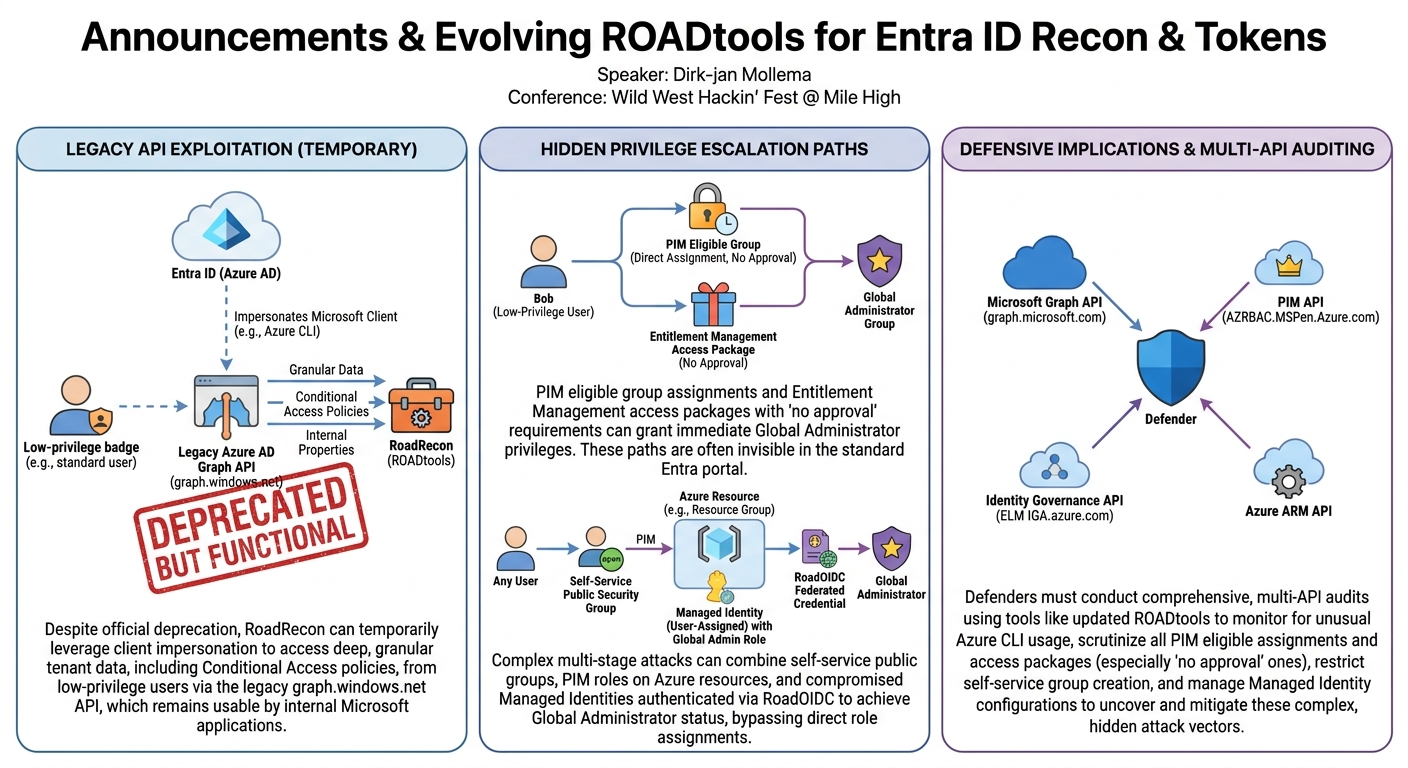
In this insightful talk, Dirk-jan Mollema, founder of Outsider Security, delves into the latest advancements and challenges facing his popular open-source toolkit, ROADtools, specifically focusing on Entra ID (formerly Azure AD) reconnaissance and token manipulation. The presentation highlights critical updates to RoadRecon and RoadTX, necessitated by Microsoft's deprecation of the venerable Azure AD Graph API, and introduces novel methods for uncovering hidden privilege escalation paths within complex Entra ID tenants. Mollema demonstrates how even seemingly harmless users, like his fictional "Bob," can possess multiple, non-obvious routes to Global Administrator privileges through features like Privileged Identity Management (PIM), Entitlement Management (Access Packages), and self-service group management.
Key moments
- 0:00 Introduction to ROADtools and Entra enumeration
- 4:40 Azure AD Graph deprecation and Microsoft Graph challenges
- 16:40 New RoadRecon UI: Conditional Access Policies per user
- 22:00 Bob's first hidden path: PIM eligible group membership
- 30:00 Bob's second hidden path: Entitlement Management access packages
- 38:00 Full demo: Public group to Global Admin via Managed Identity
- 49:00 Q&A: Why PIM eligible groups are not visible in portal
Announcements & Evolving ROADtools for Entra ID Recon & Tokens
Speakers: Dirk-jan Mollema, Founder, Outsider Security
Conference: Wild West Hackin' Fest @ Mile High
YouTube: https://www.youtube.com/watch?v=Tt7mCJDJB9s
Overview
In this insightful talk, Dirk-jan Mollema, founder of Outsider Security, delves into the latest advancements and challenges facing his popular open-source toolkit, ROADtools, specifically focusing on Entra ID (formerly Azure AD) reconnaissance and token manipulation. The presentation highlights critical updates to RoadRecon and RoadTX, necessitated by Microsoft's deprecation of the venerable Azure AD Graph API, and introduces novel methods for uncovering hidden privilege escalation paths within complex Entra ID tenants. Mollema demonstrates how even seemingly harmless users, like his fictional "Bob," can possess multiple, non-obvious routes to Global Administrator privileges through features like Privileged Identity Management (PIM), Entitlement Management (Access Packages), and self-service group management.
The talk is particularly relevant for both red team operators seeking to expand their attack surface in cloud environments and blue team defenders striving to identify and mitigate sophisticated identity-based risks. Mollema's work consistently exposes the discrepancies between what administrators see in the Entra ID portal and the underlying, often more permissive, reality of API interactions. By illustrating how to leverage specific Microsoft client applications and parse data from various undocumented APIs, he provides practitioners with the tools and knowledge to conduct comprehensive security assessments that go beyond superficial portal views.
This discussion is crucial as organizations increasingly adopt Entra ID and its intricate ecosystem of identity governance features. The evolving landscape of cloud APIs, coupled with the inherent complexity of integrating multiple services, creates fertile ground for misconfigurations and hidden attack vectors. Mollema's presentation not only updates users on the future of ROADtools but also serves as a stark reminder that a deep understanding of API interactions is paramount for effective cloud security.
Background
▶ Watch: Introduction to ROADtools and Entra enumeration (0:00)
ROADtools, first released in 2020, emerged as a response to the growing need for robust tools to interact with and enumerate Entra ID environments. At its core is roadlib, a foundational library designed to support nearly every conceivable authentication flow within Entra ID, encompassing documented, undocumented, and even "hacky" methods. This library also underpins the API schemas used by the suite's various components.
The initial flagship tool, RoadRecon, was developed as a reconnaissance utility capable of enumerating an Entra ID tenant from a low-privilege user context. Its dual red and blue team utility stems from its ability to gather comprehensive tenant data, offering insights often obscured or simplified by the native Microsoft portal. Following RoadRecon, Mollema introduced RoadTX (Road Token Exchange), a powerful tool for performing various token operations, enabling users to authenticate using a wide array of stolen or acquired authentication materials, from refresh tokens to cookies and memory artifacts. All ROADtools components are open-source and available on GitHub, reflecting Mollema's commitment to community-driven security research.
A central theme of the talk revolves around the deprecation of the Azure AD Graph API (graph.windows.net), which RoadRecon has historically relied upon. This API, especially its "internal" versions, provided a wealth of granular data, such as Conditional Access policies, accessible even to normal users – a significant advantage for red team operations. In contrast, the officially endorsed Microsoft Graph API (graph.microsoft.com) is a higher-level, documented production API. While comprehensive, it imposes stricter permission requirements, often necessitating privileged roles (e.g., Security Reader, Global Reader) to access sensitive data like Conditional Access policies. This shift presents a challenge for low-privilege enumeration and necessitates a re-evaluation of data gathering strategies.
The deprecation of the Azure AD Graph API, officially set for August 31st of the previous year, highlights a common dichotomy in Microsoft's ecosystem: "rules for thee and rules for them." While new third-party applications can no longer target this API, many internal Microsoft applications continue to use it. This allows tools like RoadRecon to temporarily bypass the deprecation by impersonating these Microsoft applications, although this is acknowledged as a temporary workaround. Microsoft's blocking of the Azure AD PowerShell module, a primary client for RoadRecon, in October, underscored the urgency of finding alternative access methods and planning for a full migration to the Microsoft Graph API.
Key Findings
▶ Watch: New RoadRecon UI: Conditional Access Policies per user (16:40)
Dirk-jan Mollema's research and the latest updates to ROADtools reveal several critical findings regarding Entra ID security and enumeration:
- Azure AD Graph API Persistence (Temporary): Despite official deprecation, the Azure AD Graph API remains functional for many Microsoft-published applications. RoadRecon can leverage this by impersonating specific client IDs (e.g., the Azure CLI client ID) that still possess the necessary
user_impersonationscope forgraph.windows.net. This allows continued access to granular data, including Conditional Access policies, from a low-privilege user, a capability lost with direct Microsoft Graph API calls without elevated roles. This is, however, a temporary solution, and a full migration to the Microsoft Graph is inevitable.
- Microsoft Graph API Migration Challenges: Migrating to the Microsoft Graph API for reconnaissance presents significant hurdles for red teams. It's a higher-level API, exposing less "internal" data by default. Crucially, it lacks a magic
user_impersonationwildcard scope, meaning different types of data (e.g., Conditional Access policies, user details) require specific, often privileged, scopes and potentially multiple token exchanges with different client applications. This also increases API-level logging, making enumeration efforts more visible to defenders.
- Hidden Global Admin Paths: The talk's central discovery revolves around demonstrating multiple, non-obvious paths to Global Administrator privileges that are completely invisible through standard Entra ID portal views or even traditional reconnaissance tools like AzureHound. Mollema's "Bob" user, appearing to have no roles, groups, or assigned permissions, was shown to have three distinct routes to GA.
- PIM Eligible Group Assignments: Privileged Identity Management (PIM), while widely adopted for Entra roles, also supports eligible assignments for security groups and Azure resources. These eligible group memberships are not displayed in the Entra ID portal's user profile or group membership views. Attackers can activate these assignments (potentially without approval), gain membership to a highly privileged group, and then inherit its elevated permissions (e.g., Global Administrator). The PIM API (
AZRBAC.MSPen.Azure.com), which can be queried by the Azure CLI client, is required to uncover these.
- Entitlement Management (Access Packages) Abuse: Entitlement Management, a component of Entra ID Identity Governance, allows the creation of "access packages" that grant users access to various resources, including security groups. If an access package adds users to a role-assignable group that is Global Admin-equivalent, and the package does not require approval, any user can request it and elevate their privileges. Like PIM groups, these access packages are not visible on a user's profile in the Entra portal, requiring interaction with the Identity Governance API (
ELM IGA.azure.com).
- Self-Service Public Groups as Privilege Escalation Vectors: A rarely discussed feature, self-service public security groups, can be configured to allow any user to join without approval. If such a group is then granted an eligible assignment in PIM (e.g., Managed Identity Contributor on a resource group containing a Global Admin-privileged Managed Identity), any user can join the group, activate the PIM role, compromise the Managed Identity, and effectively become Global Admin. This multi-stage path demonstrates a complex chain of trust that bypasses direct role assignments.
Technical Deep Dive
▶ Watch: Bob's first hidden path: PIM eligible group membership (22:00)
The technical core of Mollema's presentation lies in the evolving architecture of ROADtools, particularly RoadRecon, to adapt to Microsoft's shifting API landscape and uncover complex privilege paths.
Azure AD Graph API Workaround and Microsoft Graph Migration:
RoadRecon initially relied heavily on the Azure AD Graph API (graph.windows.net), specifically leveraging undocumented "internal" versions that exposed more data, such as detailed Conditional Access policies, to low-privileged users. With its deprecation, Mollema implemented a workaround: obtaining a token for graph.windows.net with the user_impersonation scope by impersonating a Microsoft-published application. The Azure CLI client ID emerged as a suitable default for this purpose, as it still retains the necessary permissions to call the legacy API. This strategy is temporary, however, as Microsoft is actively blocking clients.
The long-term solution involves migrating RoadRecon to the Microsoft Graph API (graph.microsoft.com). This transition is complex due to several factors:
- Higher-Level Abstraction: Microsoft Graph provides a more abstracted view of Entra ID, potentially obscuring internal properties and requiring elevated roles (e.g., Global Reader, Security Reader) to access sensitive data like Conditional Access policies.
- No Wildcard Scope: Unlike Azure AD Graph's
user_impersonationscope, Microsoft Graph requires specific delegated or application permissions (e.g.,ConditionalAccessPolicy.Read.All). This means a single token might not be sufficient to enumerate all desired data, necessitating multiple token acquisitions and exchanges, each targeting different scopes and potentially different client applications. - Increased Visibility: Microsoft Graph API interactions generate more detailed API-level logs, which are often integrated by default into security solutions like Defender XDR, increasing the visibility of reconnaissance activities for defenders.
Mollema acknowledges ongoing work, including contributions from Thomas Barren (Reverse Hack), to implement a Microsoft Graph-based front end for RoadRecon, which will offer users a choice between the legacy API and the new Graph API.
Evolving Data Model and Multi-API Integration:
A significant technical advancement in ROADtools is the evolution of its internal data model. Initially, RoadRecon built a relational SQLite database based solely on the OData metadata document of the Azure AD Graph API. This data-driven approach dynamically creates a SQL Alchemy schema, allowing for flexible querying and offline analysis.
To expose the newly discovered attack paths, Mollema has extended this model to integrate data from multiple, disparate APIs:
- Privileged Identity Management (PIM) API: An undocumented API (
AZRBAC.MSPen.Azure.com) is queried to retrieve eligible assignments for groups and Azure resources, which are not visible in the Entra portal. The Azure CLI client coincidentally has the correct scopes for this API. - Entitlement Management (Identity Governance) API: Another undocumented API (
ELM IGA.azure.com) is used to gather information about access packages, their assignments, and approval settings. Again, the Azure CLI client proves capable of querying this API. - Azure Resource Manager API: For enumerating Azure subscriptions, resource groups, and managed identities, a custom schema was built as Azure is not an OData API.
The core innovation here is the relationship mapping. While Microsoft calls it "Microsoft Graph," many objects lack direct, queryable relationships (e.g., a Conditional Access policy might only store GUIDs of target users). RoadRecon manually calculates and inserts these relationships into its SQLite database, effectively creating a more comprehensive "graph" than the native Microsoft Graph API. This allows users to query, for instance, which Conditional Access policies apply to a specific user, or which PIM roles a user has assigned, across different API schemas as if they were natively linked.
RoadOIDC for Managed Identity Exploitation:
The final demo introduces RoadOIDC, a component of ROADtools designed to work with federated credentials. This toolkit allows an attacker to set up a custom identity provider and use it to authenticate as a User-Assigned Managed Identity. Managed Identities are typically linked to Azure resources, but with federated credentials, they can be authenticated from anywhere. By compromising an eligible PIM role that grants control over a Managed Identity, an attacker can configure a federated credential, then use RoadOIDC to generate a self-signed token that Azure accepts, thereby authenticating as the Managed Identity and inheriting its permissions (e.g., Global Administrator).
Demo / Proof of Concept
▶ Watch: Full demo: Public group to Global Admin via Managed Identity (38:00)
Dirk-jan Mollema's talk was heavily demo-driven, showcasing the practical application of ROADtools' new features and the discovery of hidden privilege escalation paths.
1. Initial Reconnaissance and Conditional Access Policies (00:14:00)
- Objective: Demonstrate basic tenant enumeration and the new per-user Conditional Access (CA) policy visibility.
- Steps:
- Mollema first obtains an authentication token using
roadtx get-token --client AZCLI --resource AADGraphwith his Global Admin account, leveraging the Azure CLI client ID to access the Azure AD Graph API. - He then runs
roadrecon gatherto collect tenant data, which performs approximately 6,000 requests in 40 seconds. - To process CA policies, he executes
roadrecon plugin ca_scope --db test.db, which calculates policy scopes and applies them to users. - Launching the UI (
roadrecon gui) reveals a new "Policies" tab, displaying all CA policies scoped to individual users. This addresses a common annoyance for auditors by showing exactly which policies apply to a specific admin, a capability normally requiring privileged roles in the Entra portal. Crucially, this data is accessible to normal users via the Azure AD Graph API.
2. Uncovering PIM-based Global Admin (00:19:00)
- Objective: Show how PIM eligible group assignments can grant Global Admin, unseen in the Entra portal.
- Scenario: The user "Bob" appears to have no roles, group memberships, or owned objects in the Entra admin center, RoadRecon's initial output, or even AzureHound.
- Steps:
- Mollema extends the data gathering by obtaining a token for the PIM API (
AZRBAC.MSPen.Azure.com) usingroadtx get-token --refresh-token <token> --resource PIM. - He then runs
roadrecon gather --api pimto collect PIM-specific data. - Upon reloading the RoadRecon UI, a new "PIM" tab appears for Bob. This tab reveals that Bob has an eligible direct assignment to a group named "GA group."
- Further investigation into "GA group" shows it's a role-assignable group with the Global Administrator role. The PIM settings for this assignment indicate "no approval required," meaning Bob can self-activate his membership and then elevate to Global Admin. Mollema even demonstrates a "blue teamer" toggle in the UI that changes the color of "no approval" from green (red team perspective) to red (blue team perspective).
3. Entitlement Management (Access Packages) for Global Admin (00:28:00)
- Objective: Demonstrate how Access Packages can be used to gain Global Admin privileges.
- Steps:
- Similar to the PIM demo, Mollema obtains a token for the Identity Governance (IG) API (
ELM IGA.azure.com) usingroadtx refresh-token --resource IG. - He executes
roadrecon gather --api igto collect data related to Entitlement Management. - In the RoadRecon UI for Bob, a new "Access Packages" tab appears. It shows Bob has an assigned access package named "give me GA."
- This access package, again, requires "no approval" and adds Bob to "another GA group," which is also a Global Administrator-equivalent group. This illustrates another hidden path to GA via identity governance features.
4. Self-Service Public Group to Global Admin via Managed Identity (00:38:00)
- Objective: Uncover a complex, multi-stage path to Global Admin involving self-service groups, PIM, and Managed Identities.
- Scenario: A public security group called "Azure group" is configured to allow anyone to join. This group has an eligible PIM assignment for the Managed Identity Contributor role on an "identities RG" resource group. Within this resource group, there's a User-Assigned Managed Identity named "GA identity," which is a Global Administrator.
- Steps:
- Mollema authenticates as Bob using the Azure CLI client.
- He requests a token for the "My Accounts" API (a specific GUID) using
roadtx get-token --resource MyAccountsAPI. The Azure CLI client can access this API, which handles self-service group join requests. - He then performs a
POSTrequest to the My Accounts API's approvals page, essentially programmatically joining the "Azure group" as Bob, bypassing any potential license requirements that might exist in the portal. - As Bob, he navigates to PIM, activates his eligible "Managed Identity Contributor" role on the "identities RG."
- Using RoadOIDC, Mollema sets up a federated credential for the "GA identity" (the Global Admin Managed Identity) within that resource group. This allows for authentication as the Managed Identity without being tied to an Azure resource.
- Finally, he uses
roadtx federated-app-authto authenticate as the "GA identity," obtaining a Microsoft Graph token. Describing this token reveals the Global Admin role ID in its claims, confirming successful privilege escalation. He demonstrates this by listing users in the tenant viaroadtx graph-request users.
These demos collectively illustrate the profound limitations of relying solely on the Entra portal for security posture assessment and the power of ROADtools in uncovering these complex, often overlooked, attack vectors.
Defensive Implications
▶ Watch: Q&A: Why PIM eligible groups are not visible in portal (49:00)
The insights and tools presented by Dirk-jan Mollema offer critical implications for defenders managing Entra ID environments:
- Comprehensive PIM Auditing: Defenders must expand their auditing of Privileged Identity Management (PIM) beyond just Entra roles. Crucially, they need to audit eligible assignments for security groups and Azure resources, as these are not visible in standard Entra portal user profiles. Tools like RoadRecon (with the new PIM API integration) are essential for this. Ensure all eligible assignments have appropriate approval workflows and MFA requirements.
- Scrutinize Entitlement Management (Access Packages): Access packages in Entitlement Management can be powerful tools for automating access but are also significant privilege escalation vectors. Organizations must meticulously audit access packages, especially those that grant membership to high-privilege groups or roles. Prioritize packages that require no approval, as these represent immediate attack paths. Implement multi-stage approval processes, manager approval, or specific approver groups for all sensitive access packages.
- Restrict Self-Service Group Creation/Management: The "self-service public group" attack path highlights a dangerous capability. Defenders should review and severely restrict or disable the ability for users to create and manage security groups, particularly those that can be joined publicly or without approval. If self-service is necessary, ensure strict policies are in place to prevent these groups from gaining privileged access to PIM-managed roles or resources.
- Enhanced API Call Monitoring: The reliance of ROADtools on specific Microsoft client IDs (like Azure CLI) to access various APIs (Azure AD Graph, PIM, Identity Governance) should prompt defenders to enhance their monitoring for unusual API calls. Look for the Azure CLI client ID making requests to the
graph.windows.net,AZRBAC.MSPen.Azure.com, orELM IGA.azure.comendpoints, especially from non-administrative accounts or at unusual times. These could indicate reconnaissance or attempted privilege escalation.
- Monitor Managed Identity Configurations: The Managed Identity attack path underscores the need to carefully manage and monitor User-Assigned Managed Identities. Regularly audit their assigned permissions, especially those granting highly privileged roles (like Global Administrator). Implement strict controls over who can create, modify, or assign federated credentials to Managed Identities. Monitor for the creation of new federated credentials on existing Managed Identities, as this is a key step in their exploitation.
- Deep Dive Audits Beyond the Portal: The most overarching defensive implication is that the Entra ID portal provides an incomplete and often misleading view of an organization's security posture. Defenders must adopt tools like the updated RoadRecon to conduct deep-dive audits that query all relevant APIs (Entra ID, PIM, Identity Governance, Azure ARM) to uncover hidden permissions, eligible assignments, and complex attack paths that are otherwise invisible.
- Recognize "Identity Governance Administrator" as Privileged: Microsoft's classification of the Identity Governance Administrator role as non-privileged is incorrect, as demonstrated by its ability to elevate to Global Administrator. Defenders should treat this role with the highest level of privilege and apply the same stringent controls (MFA, PIM, access reviews) as they would for other highly privileged roles.
By understanding and addressing these implications, defenders can significantly strengthen their Entra ID security posture against sophisticated identity-based attacks.
Key Takeaways
- The Azure AD Graph API, despite official deprecation, remains temporarily usable for reconnaissance by impersonating specific Microsoft client applications (like the Azure CLI), offering granular data access often unavailable through the Microsoft Graph API for low-privileged users.
- Entra ID's complexity creates numerous hidden privilege escalation paths through features like Privileged Identity Management (PIM), Entitlement Management (Access Packages), and self-service group management, which are not visible in the standard Entra portal.
- Microsoft's portal and default tools provide an incomplete view of permissions and configurations, necessitating specialized tools like the updated ROADtools to conduct comprehensive security assessments and uncover critical attack vectors.
- The Azure CLI client ID is a powerful, often overlooked, client that possesses the necessary scopes to access a wide array of Entra-related APIs, including the legacy Azure AD Graph, PIM, and Identity Governance APIs, making it a valuable target for attackers and a critical monitoring point for defenders.
- The Identity Governance Administrator role, despite Microsoft's classification, is a highly privileged role capable of elevating to Global Administrator, requiring strict security controls and careful auditing.
- Defenders must adopt a multi-API approach to auditing, integrating data from Entra ID, PIM, Entitlement Management, and Azure Resource Manager to gain a complete understanding of their tenant's security posture and identify complex, multi-stage attack paths.
About the Speaker(s)
Dirk-jan Mollema is the founder of Outsider Security, an independent company based in The Hague. With a distinctive Dutch accent, Dirk-jan provides consulting, training, and conducts in-depth security research. He is a well-known figure in the cybersecurity community, particularly recognized for his extensive work on Active Directory and cloud security. His research often culminates in the development of powerful open-source tools, with ROADtools being his latest and most comprehensive suite for Entra ID (Azure AD) security. While he has participated in virtual Wild West Hackin' Fest events during COVID, this was his first in-person appearance at the conference.
Reviews
Dr. Zero (Offensive Security Researcher) — MUST SEE
Dirk-jan Mollema just proved the Entra ID admin portal is actively lying to you. This is masterclass-level API abuse that exposes hidden paths to Global Admin that native views and AzureHound completely miss. If you defend or attack Azure, you don't have an option—watch this.
Heather Calloway (CISO) — MUST SEE
Mollema proves that the native Entra ID portal cannot be trusted to show who actually holds Global Administrator privileges. By exposing hidden escalation paths through PIM and Access Packages, this research fundamentally invalidates standard access review procedures. This is required reading for your identity architecture and internal audit teams.
→ Top-rated talks at Wild West Hackin' Fest @ Mile High 2026