Attacking SCCM with SCCMHunter
Garrett Foster (Senior Security Researcher · SpecterOps)
Overview
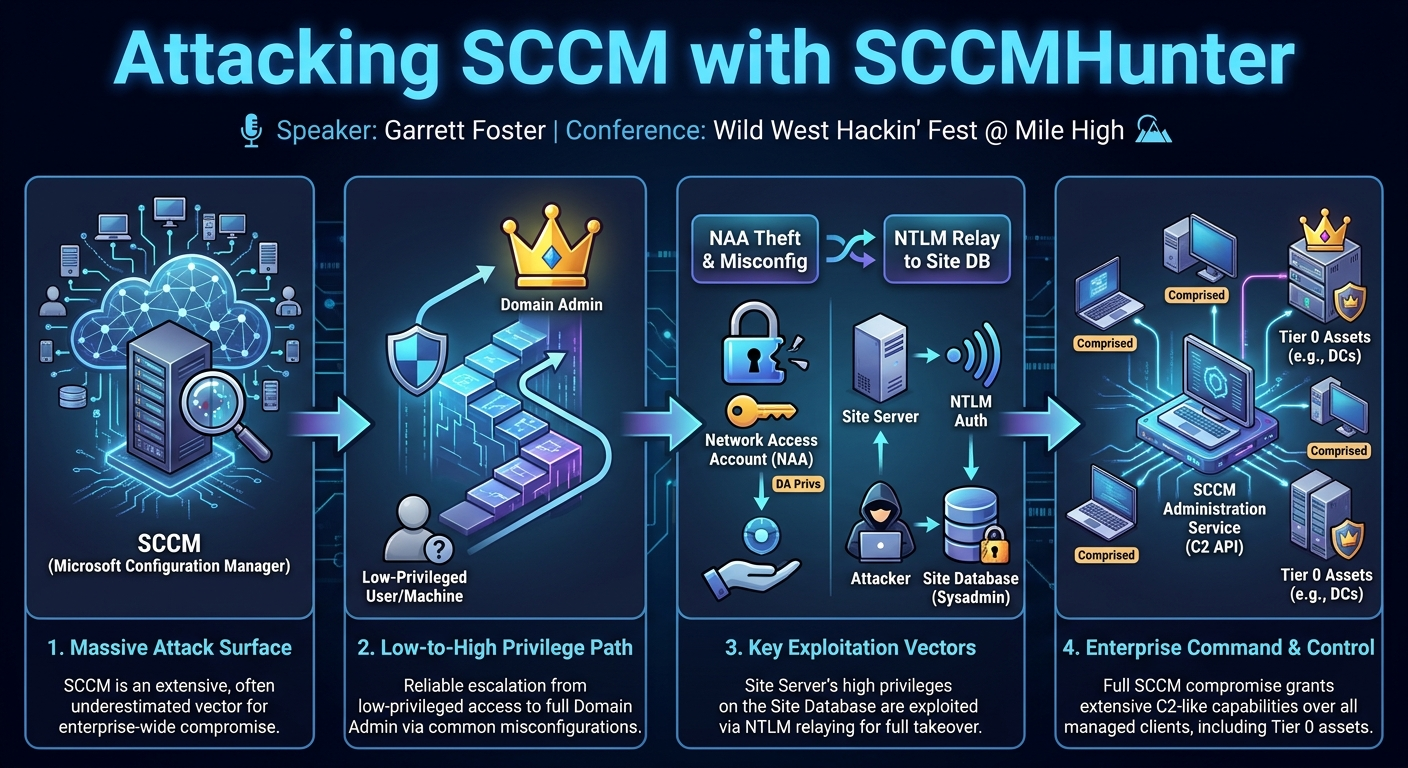
In this insightful talk from Wild West Hackin' Fest @ Mile High, Garrett Foster, a Senior Security Researcher at SpecterOps, delves into the often-underestimated attack surface of Microsoft Configuration Manager (SCCM), historically known as System Center Configuration Manager. Foster, whose day-to-day role involves researching Active Directory security with a focus on endpoint management software, highlights how SCCM, a ubiquitous enterprise solution, can be a critical weak point for organizations. The presentation culminates in the introduction of SCCMHunter, a powerful tool developed by Foster to identify, map, and exploit SCCM environments, demonstrating a comprehensive attack path from a low-privileged user to full domain administrator compromise.
Key moments
- 0:00 Speaker intro and SCCMHunter overview
- 4:00 Understanding SCCM's core architecture and roles
- 8:20 Misconfiguration Manager project and attack taxonomy
- 10:00 SCCMHunter: Mapping the SCCM environment via recon
- 20:00 Stealing Network Access Account credentials
- 25:00 Privilege escalation via SQL relay to site database
- 30:00 Post-exploitation: Controlling SCCM via Admin API
- 40:40 Defensive recommendations for SCCM hardening
Attacking SCCM with SCCMHunter
Speakers: Garrett Foster, Senior Security Researcher, SpecterOps
Conference: Wild West Hackin' Fest @ Mile High
YouTube: https://www.youtube.com/watch?v=sh3Zb7MbiIg
Overview
In this insightful talk from Wild West Hackin' Fest @ Mile High, Garrett Foster, a Senior Security Researcher at SpecterOps, delves into the often-underestimated attack surface of Microsoft Configuration Manager (SCCM), historically known as System Center Configuration Manager. Foster, whose day-to-day role involves researching Active Directory security with a focus on endpoint management software, highlights how SCCM, a ubiquitous enterprise solution, can be a critical weak point for organizations. The presentation culminates in the introduction of SCCMHunter, a powerful tool developed by Foster to identify, map, and exploit SCCM environments, demonstrating a comprehensive attack path from a low-privileged user to full domain administrator compromise.
The talk underscores a crucial reality in modern enterprise security: the very tools designed to manage and secure endpoints can, if misconfigured or improperly defended, become a primary vector for attackers. Foster illustrates how SCCM's extensive reach and deep integration within an Active Directory environment make it a highly attractive target for adversaries. By providing system-level access to potentially every client in an organization, a compromised SCCM instance effectively hands over the keys to the entire enterprise.
This presentation is particularly significant for both red teamers seeking new avenues for lateral movement and privilege escalation, and blue teamers who need to understand and mitigate these critical risks. Foster's work with SCCMHunter and the broader Misconfiguration Manager project aims to demystify SCCM's offensive capabilities, providing structured methodologies and a powerful toolkit to expose and address these pervasive security blind spots. The talk serves as a stark reminder that trust placed in powerful management software must be accompanied by rigorous security practices.
Background
▶ Watch: Speaker intro and SCCMHunter overview (0:00)
SCCM, or Microsoft Configuration Manager, has a long history, initially released as System Management Server (SMS) in 1994, capable even of managing MS-DOS clients. Over the years, it underwent several rebrandings: System Center Configuration Manager in 2007, Microsoft Endpoint Configuration Manager (MECM) in 2019, and finally, Microsoft Configuration Manager or simply Config Manager in 2023. Regardless of the name, its core function remains consistent: centralized endpoint management for tasks like operating system deployment (OSD), automated application installation, and software patching across an enterprise.
The architecture of SCCM is complex, involving several key roles. The Site Server is the central "body" where administrators connect, hosting the crucial SMS Provider role. It requires administrator rights on all other corresponding role operating systems and is responsible for publishing information to Active Directory via the System Management Container. The Site Database serves as the "brain," storing all SCCM configurations, client policies, self-signed certificates, and Role-Based Access Control (RBAC) definitions. The Site Server typically holds Sysadmin rights on this database. Management Points manage client communications, delivering policies and configurations. Distribution Points act as glorified file shares, storing application packages and OS images, often integrating with Windows Deployment Services (WDS). Finally, Clients are the managed endpoints, running the CCM Exec agent as NT System, with child processes for logged-on users.
Offensive research into SCCM has evolved over time. Early examples include Dave Kennedy's demonstration at Defcon 20, where he abused PXE and OSD to "rain shells" on managed clients. In 2015-2016, Matt Nelson explored code execution via SCCM agents. A significant resurgence of interest occurred in 2022, largely driven by Chris Thompson's renewed research, leading to a "big spike" in tradecraft development. Noteworthy contributions also came from Synactive, who published several CVEs related to SCCM. To consolidate this burgeoning research, Garrett Foster, Dwayne Michael, and Chris Thompson co-founded the Misconfiguration Manager project. This "living document" provides a taxonomy for SCCM attack techniques, such as "takeover one" for compromising an entire hierarchy, covering credential abuse, privilege elevation, code execution, reconnaissance, and credential coercion. The project currently outlines six offensive techniques and nine distinct paths to take over an SCCM site, highlighting the "absolutely massive attack surface" of the product. The primary challenge identified was the lack of a comprehensive tool to map out all these components and attack paths, which directly led to the development of SCCMHunter.
Key Findings
▶ Watch: Misconfiguration Manager project and attack taxonomy (8:20)
The central finding presented in this talk is that SCCM possesses an extensive and frequently underestimated attack surface, offering numerous pathways for attackers to achieve system-level control over an entire enterprise from a low-privileged starting point. SCCMHunter was developed to exploit this reality, providing a structured approach to reconnaissance and exploitation.
Key discoveries and contributions highlighted include:
- Reliable Component Discovery: SCCMHunter's
findandSMBmodules provide robust methods for identifying critical SCCM roles like Site Servers, Site Databases, Management Points, and Distribution Points within an Active Directory environment. This includes leveraging Active Directory schema extensions, specific SMB shares, and a novel technique for remotely querying the Site Server's registry to pinpoint the Site Database's FQDN – a "huge win" for attackers. - Network Access Account (NAA) Misconfigurations: The Network Access Account (NAA), intended for low-privileged network access during client operations, is frequently misconfigured with high privileges, often up to Domain Admin (DA). This account is highly vulnerable to theft.
- Client Enrollment Credential Theft: Adam Chester's research revealed that NAA credentials can be intercepted and decrypted during the initial client enrollment process, as the encryption key is included in the communication. This allows for a swift escalation from a low-privileged machine account to potentially DA.
- Client-Side Credential Extraction: Dwayne Michael's work demonstrated that NAA credentials, when distributed to clients, are stored encrypted within WMI (SMS namespace) and on disk. With local administrator privileges on a client, these credentials can be decrypted using DPAPI, making them accessible to attackers.
- Site Server to Site Database NTLM Relay: Chris Thompson discovered a critical attack path leveraging the Site Server's inherent Sysadmin rights on the Site Database. By coercing authentication from the Site Server (e.g., via PetitPotam) and relaying it to the Site Database, attackers can execute arbitrary SQL queries, effectively taking over the SCCM hierarchy and granting themselves full administrative rights.
- Powerful Post-Exploitation via Administration Service: Once administrative access to SCCM is achieved (e.g., through database compromise), the Administration Service (REST API) provides a comprehensive interface for post-exploitation activities. This includes extracting other highly privileged SCCM accounts (e.g., Client Push, SMTP), executing commands on all managed clients with system-level access, performing extensive situational awareness, and enumerating collections, devices, and users.
- New Execution Primitives: Foster's additions to SCCMHunter, such as application deployment (allowing command execution in user or system context) and Speak to the Manager (extracting credentials from policies and task sequences), further expand the range of post-exploitation capabilities, demonstrating how even a domain controller can be compromised if enrolled as an SCCM client.
Technical Deep Dive
▶ Watch: Stealing Network Access Account credentials (20:00)
SCCMHunter is designed with modularity, offering distinct functionalities for reconnaissance and exploitation. The initial phases focus on mapping the SCCM environment.
The find module initiates reconnaissance by querying Active Directory from a low-privileged context. It performs several key lookups:
- System Management Container: This child object within the Active Directory
Systemcontainer indicates the presence of an SCCM deployment. The module checks for a Full Control ACE granted to a computer account, which strongly suggests that this account belongs to an SCCM Site Server, as it's required for publishing data to AD. MS SMS management pointObject: This specific LDAP object is reliably created for every Management Point. Its presence confirms an active SCCM deployment, as it's removed if the Management Point is retired.- Service Connection Point Object: For Distribution Points configured for Operating System Deployment (OSD), SCCM often wraps Windows Deployment Services (WDS). WDS creates a Service Connection Point object as a child of its AD identity. SCCMHunter queries for this, providing a "potential" Distribution Point, which requires further validation.
- String Search: The module also queries AD for computer names containing "SCCM" or "MECM," leveraging common naming conventions to broaden the discovery net.
All discovered potential roles are stored in an SQLite database, building an initial, albeit incomplete, picture of the SCCM hierarchy.
The SMB module (despite its name, queries SMB, HTTP, MSSQL, and remote registry) then profiles these potential endpoints to confirm their roles.
- Site Server Profiling: The module looks for specific SMB shares. The
SMS_123share (where123is the site code) with a description like "SMS site one two three" unequivocally identifies the Site Server. Additionally, theSMS_DPshare with the description "Config Manager site server DP share" further solidifies this. It also checks for active/passive configurations in highly available environments. - Site Database Location: This was historically a significant challenge. Foster's research (building on a community contribution) found that the Site Server's local security policy allows
Authenticated Usersto remotely read specific registry paths underHKLM:\Software\Microsoft\SMS. Crucially, withinMulti-Sight Component Servers, a child key is named with the Fully Qualified Domain Name (FQDN) of the Site Database. This provides a "reliable way" to locate the database. - Management Point Profiling: While already identified in AD, the module checks for SMB signing requirements on the Management Point, which is crucial for determining the viability of NTLM relay attacks.
- Distribution Point Confirmation: The
SMS_DPshare is also present on remote Distribution Points, but its description differs from that on the Site Server. This distinction allows SCCMHunter to confidently differentiate between the Site Server's integrated DP and standalone Distribution Points.
Once the environment is mapped, SCCMHunter transitions to exploitation.
Client-Side Credential Theft (HTTP module): Based on Adam Chester's research, the http module spoofs the initial client enrollment process. During this, the Management Point assigns policies, which can include Network Access Account (NAA) credentials. These are encrypted, but the encryption key is sent in the same communication. SCCMHunter captures and decrypts these credentials, often leading to highly privileged accounts (frequently Domain Admin). This can be done by passing existing machine account credentials or by automatically creating a new machine account.
Network Access Account Extraction from Clients (WMI module): Dwayne Michael's work demonstrated that NAA credentials persist on clients. They are stored encrypted in the SMS namespace within WMI and on disk. If an attacker has local administrator privileges on a client, the wmi module (a community contribution by Ralph Dejong) can leverage DPAPI to decrypt these stored credentials, again potentially yielding DA credentials "laying around everywhere."
Site Server to Site Database NTLM Relay (MSSQL module): This technique, inspired by Chris Thompson's work, exploits the Site Server's Sysadmin privileges on the Site Database. The mssql module facilitates this by:
- Coercing Authentication: An NTLM authentication request is coerced from the Site Server (e.g., using tools like PetitPotam targeting the EFS service, though this is increasingly locked down) to an attacker-controlled listener (e.g.,
ntlmrelayx.py). - Relaying to Site Database: The captured NTLM authentication is then relayed to the Site Database.
- Executing SQL Queries: The
mssqlmodule generates a pre-crafted SQL query blob that, when executed under the Site Server's Sysadmin context, elevates a specified target account (e.g., a standarddomain user) to a full SCCM administrator. This simplifies the process, preventing "Johnny Drop Tables" scenarios.
Post-Exploitation via Administration Service (Admin module): Once full SCCM administrator privileges are obtained (e.g., via the MSSQL relay), the admin module weaponizes the Administration Service, an OData REST API installed with the SMS Provider role on the Site Server. This API provides extensive control over the SCCM environment:
- Credential Extraction: Retrieves credentials for various SCCM accounts like Client Push, SMTP, and discovery accounts, which are often over-privileged.
- Post-Exploitation Commands: Executes arbitrary commands or scripts on managed clients with system-level privileges.
- Situational Awareness: Functions like a C2 framework, allowing enumeration of processes, services, collections (logical groupings of devices/users, e.g., "CrowdStrike missing"), devices, and users. Commands like
get p user(primary user of a device) andget last loon(last logged-on user) aid in user hunting and targeting. - Database Commands: Direct querying of SCCM database information.
- Remote Credential Decryption: By "interacting" with the Site Server, SCCMHunter can use system-level access to decrypt credential blobs stored in the database, requiring access to a specific certificate on the Site Server.
- Application Deployment: A new feature allowing the deployment of arbitrary applications or scripts to clients, with the option to run them in either system or the context of a logged-on user.
- Speak to the Manager: This module pulls all policies and task sequences via the API. It automatically parses NAA policies for cleartext credentials and provides the capability to search massive XML task sequence documents for embedded passwords. This was recently used to achieve Domain Admin compromise.
- Kerberos Support: Recent updates include Kerberos support for the Administration Service, countering Microsoft's removal of NTLM authentication in SCCM version 259.
Demo / Proof of Concept
▶ Watch: Privilege escalation via SQL relay to site database (25:00)
The talk itself serves as a comprehensive demonstration of SCCMHunter's capabilities, guiding the audience through a simulated attack against an SCCM environment.
The first phase showcased the find module, illustrating how it queries Active Directory to identify potential SCCM roles and populates an SQLite database. This initial output, though "anti-climactic" on screen, is crucial for building the foundational understanding of the environment. Following this, the SMB module was demonstrated, showing how it profiles these potential endpoints by querying various services (SMB, HTTP, MSSQL, remote registry). A key highlight was the reliable identification of the Site Database's FQDN by reading specific registry paths on the Site Server, a technique that previously eluded researchers. The output transitioned from an incomplete list of potential roles to a fully mapped hierarchy, specifying Site Servers, Management Points, Distribution Points, and the Site Database.
The presentation then moved into exploitation primitives. Although not explicitly demonstrated live, the functionality of the HTTP module for spoofing client enrollment to steal Network Access Account (NAA) credentials was described as a "quick easy win" for moving from a beachhead to Domain Admin. Similarly, the WMI module was shown to remotely extract and decrypt NAA credentials from client WMI, assuming local admin access, leveraging a community contribution by Ralph Dejong.
A core demonstration involved the MSSQL module for SCCM takeover. Foster showed how ntlmrelayx.py could be used to relay coerced authentication from the Site Server to the Site Database. He emphasized the module's ability to generate a pre-constructed SQL statement blob, simplifying the process of elevating a domain user account to full SCCM administrator privileges without manual SQL query construction. The successful execution was confirmed by refreshing the SCCM admin table, showing the domain user now as a full admin.
With full administrative control over SCCM, the admin module was then extensively showcased for post-exploitation. This included:
- Reconnaissance: Commands like
get collection(e.g., to find "CrowdStrike missing" devices),get user domain admin,get p user(primary users of devices), andget last loon(last logged-on user for a device) were run to enumerate critical assets and user sessions. - Credential Extraction: The
interactcommand was used to establish a session with the Site Server, followed byget credsto retrieve encrypted credential blobs anddecryptto obtain cleartext passwords for accounts like Client Push or Discovery accounts. - Command Execution: A compelling demonstration involved targeting a
domain controllerthat was enrolled as an SCCM client. Therun scriptscommand was used to execute a payload on the DC, resulting in a callback and full compromise of the domain controller, illustrating the "puppet master" capability over the entire enterprise.
Finally, Foster discussed recent additions to SCCMHunter, including Kerberos support for the Administration Service (due to Microsoft killing NTLM in version 259). He briefly mentioned the application deployment feature, which allows arbitrary command execution in user or system context on clients, noting that a live demo was not possible due to lab issues. The Speak to the Manager module was demonstrated, showing its ability to automatically parse network access account policies for credentials and highlighting its success in recent red team engagements for obtaining Domain Admin.
Defensive Implications
▶ Watch: Defensive recommendations for SCCM hardening (40:40)
The detailed attack paths presented by Garrett Foster underscore critical defensive implications for organizations using SCCM:
- Least Privilege for Network Access Account (NAA): The most recurring vulnerability is the Network Access Account (NAA) being granted excessive privileges, often Domain Admin (DA). Defenders must ensure the NAA adheres strictly to the principle of least privilege, limiting it to only the necessary network access permissions. There is no documentation supporting the elevation of this account to DA.
- Secure Site Server-to-Database Communication: The Site Server's Sysadmin rights on the Site Database are a fundamental requirement but present a high-value target for NTLM relaying.
- Enable SMB Signing: Enforce SMB signing across the environment, especially on critical servers like the Site Database, to mitigate NTLM relay attacks.
- Restrict NTLM Relaying: Implement network controls and host-based configurations to prevent NTLM relaying. Consider disabling NTLM where possible or using Enhanced Protection for Authentication (EPA).
- Harden Coercion Vectors: Regularly review and harden services that can be coerced to authenticate, such as the Encrypted File System (EFS) service (relevant for PetitPotam). While often locked down, continuous vigilance is needed.
- Control Local Administrator Privileges on Clients: The ability to decrypt NAA credentials from client WMI or disk requires local administrator access. Tightly control and monitor local admin rights on all endpoints, as a single compromised client with local admin can lead to the theft of highly privileged SCCM credentials.
- Restrict Remote Registry Access: The discovery of the Site Database FQDN relies on remote registry access to the Site Server. Review and restrict remote registry access to only authorized users and paths, minimizing exposure to reconnaissance.
- Secure SCCM Administrative Access: Full administrative access to SCCM grants system-level control over the entire enterprise. Implement strong authentication (MFA), monitor administrative logons, and limit the number of users with SCCM administrative roles. Employ dedicated administrative workstations for SCCM management.
- Leverage Misconfiguration Manager for Hardening: Foster strongly recommends consulting the Misconfiguration Manager project. This resource provides not only attack techniques but also comprehensive defensive guidance, including an attack matrix similar to MITRE ATT&CK, with specific recommendations to harden against each identified attack primitive.
- Regular Configuration Audits: Conduct regular audits of SCCM configurations to identify over-privileged accounts, unnecessary roles, and insecure settings. Pay particular attention to client push accounts, SMTP accounts, and discovery accounts, which are often found to be highly privileged.
- Monitor for Anomalous Activity: Implement robust logging and monitoring for unusual SCCM client enrollments, policy requests, Administration Service activity, and SQL queries against the Site Database. Such anomalies could indicate an ongoing attack.
- Isolate Tier 0 Assets: Ensure critical Tier 0 assets like Domain Controllers are not enrolled as SCCM clients, or if they must be, implement extremely strict policies and monitoring to prevent them from becoming an attack vector for full domain compromise.
Key Takeaways
- SCCM is a Critical Attack Surface: Microsoft Configuration Manager, despite its purpose as a management tool, presents a "massive attack surface" that, if misconfigured, can lead to enterprise-wide compromise.
- Low-Privilege to Domain Admin is Achievable: SCCMHunter demonstrates clear, reliable paths from a low-privileged machine account or domain user to full SCCM administration and ultimately Domain Admin compromise, often leveraging common misconfigurations.
- Network Access Account (NAA) is a Prime Target: The NAA is frequently over-privileged (often to DA) and vulnerable to theft during client enrollment or extraction from client endpoints, making it a high-value target.
- NTLM Relaying is a Key Escalation Vector: Exploiting the Site Server's Sysadmin rights on the Site Database via NTLM relaying is a powerful technique for achieving full SCCM administrative control.
- Post-Exploitation Capabilities are Extensive: Once SCCM is compromised, the Administration Service (REST API) provides C2-like control, enabling credential extraction, command execution on clients (including Domain Controllers), and comprehensive reconnaissance.
- Defensive Measures are Crucial and Available: Organizations must implement strong defensive measures, including least privilege for SCCM accounts, SMB signing, restricted remote registry access, and diligent monitoring, guided by resources like the Misconfiguration Manager project.
About the Speaker(s)
Garrett Foster is a Senior Security Researcher on the team at SpecterOps. With approximately three years at the company, he initially focused on red teaming and penetration testing. Following the establishment of a research branch at SpecterOps, Foster transitioned into a dedicated research role. His day-to-day work now involves attacking and researching Active Directory security, with a particular emphasis on identifying vulnerabilities in endpoint management software that administrators place significant trust in. Foster is also instrumental in extending the tradecraft and research developed from these efforts into the BloodHound graph. He is a co-creator of the Misconfiguration Manager project, which aims to document and categorize offensive techniques against SCCM, and the author of the SCCMHunter tool.
Reviews
Dr. Zero (Offensive Security Researcher) — STRONG ACCEPT
Garrett Foster didn't invent SCCM abuse, but he just automated the hell out of it. SCCMHunter operationalizes years of fragmented research into a single, lethal toolkit that turns misconfigured endpoint management into a domain compromise waiting to happen. If you're on a red team and not using this, you're wasting your client's time.
Heather Calloway (CISO) — SOLID
SpecterOps just commoditized SCCM exploitation. This talk demonstrates how routine IT misconfigurations—specifically over-privileged Network Access Accounts and NTLM relay vulnerabilities—turn enterprise endpoint management into a turnkey Domain Admin compromise.
→ Top-rated talks at Wild West Hackin' Fest @ Mile High 2026