AppSec Village Keynote: From Camels to Collaboration, A Journey Through Technology AND Humans
Chris Roberts (CISO · Boom Supersonic)
AppSec Village @ DEF CON 31 · Day 1 · AppSec Village
Overview
In his keynote at AppSec Village @ DEF CON 31, renowned security researcher Chris Roberts delivered a compelling and often humorous address titled "From Camels to Collaboration, A Journey Through Technology AND Humans." Roberts, known for his provocative insights and no-nonsense approach, challenged the cybersecurity community to fundamentally rethink its approach to security, moving beyond a sole reliance on technological solutions to embrace the critical, yet often overlooked, human element. His talk underscored the pervasive issue of professional silos, communication breakdowns, and the industry's historical tendency to blame external factors rather than looking inward.
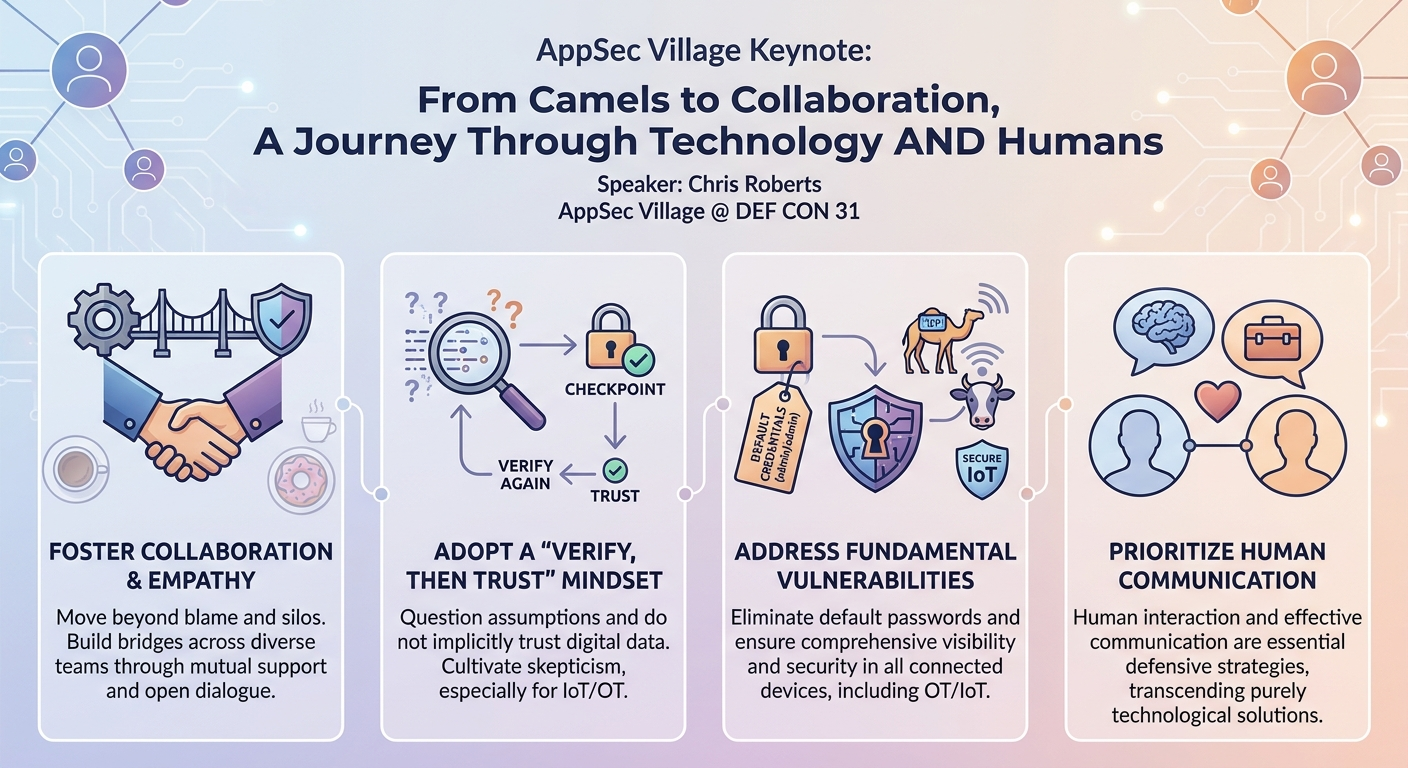
Key moments
- 1:00 Defcon community: Welcome and helping newcomers
- 3:30 Shifting blame: From users to self-reflection
- 6:30 Breaking silos: The donut collaboration strategy
- 15:00 The 'Camel Story': Hacking animal pedometers
- 24:00 Cross-village collaboration: Integrating knowledge across Defcon
- 29:30 CISO's guide to effective vendor collaboration
- 39:00 Effective communication with engineering teams
AppSec Village Keynote: From Camels to Collaboration, A Journey Through Technology AND Humans
Speakers: Chris Roberts (CISO, Boom Supersonic)
Conference: AppSec Village @ DEF CON 31
YouTube: https://www.youtube.com/watch?v=vxwOhs8buok
Overview
In his keynote at AppSec Village @ DEF CON 31, renowned security researcher Chris Roberts delivered a compelling and often humorous address titled "From Camels to Collaboration, A Journey Through Technology AND Humans." Roberts, known for his provocative insights and no-nonsense approach, challenged the cybersecurity community to fundamentally rethink its approach to security, moving beyond a sole reliance on technological solutions to embrace the critical, yet often overlooked, human element. His talk underscored the pervasive issue of professional silos, communication breakdowns, and the industry's historical tendency to blame external factors rather than looking inward.
Roberts argued that despite decades of technological advancement and increasingly complex digital landscapes, the core problems in security often stem from human interactions, assumptions, and a lack of effective collaboration. He implored attendees, whether seasoned veterans or newcomers, to foster a culture of mutual support, empathy, and open dialogue. By weaving together personal anecdotes, sharp critiques of industry norms, and a memorable "cow/camel story" illustrating profound security vulnerabilities, Roberts made a powerful case for prioritizing interpersonal skills and cross-functional partnerships as the bedrock of robust application security.
The keynote served as a vital call to action for the AppSec community, urging practitioners to build bridges between disparate teams—from developers and network engineers to leadership and even other DEF CON villages—to create more resilient systems. Roberts emphasized that in an era where technology abstracts complexity to an unprecedented degree, the ability to communicate, question assumptions, and verify information becomes paramount, transcending the mere deployment of security tools.
Background
▶ Watch: Defcon community: Welcome and helping newcomers (1:00)
For decades, the cybersecurity industry has been caught in a cyclical pattern of blame. As Chris Roberts vividly recounted, the narrative typically began with "the user" – lamenting their clicks, their movements, their general inability to adhere to security protocols. When users remained stubbornly human, the blame shifted to "the network team" for perceived shortcomings, then to "the DBAs" for their "weird database shit," and finally, to "leadership" – the CFO refusing funds, the CEO not listening, the CISO being an "ass." Roberts powerfully articulated that throughout this blame game, the industry consistently failed to "look in the mirror" and ask, "What can we do differently? How can we talk with people differently?"
This historical context is crucial because it highlights a fundamental flaw in the industry's approach: a relentless focus on technology to the detriment of human factors. Roberts pointed out that the very existence of terms like "DevOps" and "DevSecOps" arose because the industry struggled to simply use the word "collaboration." This linguistic evolution underscores a deep-seated resistance to inter-team cooperation, perpetuated by professional silos that inhibit effective security practices.
The increasing abstraction of the internet further exacerbates this problem. Roberts reminisced about a simpler time with "three layers to the internet" – web server, application layer, and database layer – where a single person might grasp the entire stack. Today, with "20, 30, 40, 50 different layers," no single individual can fully comprehend the entire ecosystem. This complexity makes it harder for specialized teams to understand each other's challenges, leading to fractured communication and a greater reliance on isolated expertise. The problem is compounded by fragmented communication tools, with individuals juggling WhatsApp, Signal, LinkedIn, and more, further hindering a unified approach. Roberts' core argument is that in this hyper-complex, digitally abstracted world, the human element—our ability to collaborate, communicate, and question—becomes not just important, but absolutely essential for security that actually works.
Key Findings
▶ Watch: Breaking silos: The donut collaboration strategy (6:30)
Chris Roberts' keynote delivered several profound "key findings" that challenge conventional cybersecurity wisdom, centering on the critical interplay between technology and human behavior.
First and foremost, Roberts asserted that the industry’s long-standing focus on blaming others—users, network teams, DBAs, or leadership—has been a significant impediment. The true finding is that the industry must "look in the mirror" and question its own communication methods and collaborative failures. This introspection reveals that many security issues are not purely technical but stem from human processes, assumptions, and organizational silos.
A central theme was the concept of "analog humans working in a digital world." Roberts, quoting a friend, highlighted the inherent disconnect between our human ways of understanding and interacting with a rapidly evolving digital landscape. He illustrated this with the advent of technologies like ChatGPT, which were "dropped on almost 8 billion people with no sodding instructions," leading to predictable human reactions of fight, flight, or freeze. This emphasizes that technology adoption without adequate human consideration creates significant new vectors for risk and misunderstanding.
Another critical finding, powerfully demonstrated through his "cow/camel story," was the danger of unquestioning trust in digital information. Roberts argued that while we often talk about "trust, then verify," the reality should be reversed: "verify, be sarcastic, verify again, and then maybe trust you for five minutes." This skepticism is crucial in an era where digital systems can easily be manipulated, leading to a distorted sense of reality for those relying on them. The ability to discern between digital representations and physical truth becomes a fundamental security skill.
Finally, Roberts underscored that collaboration is not just a buzzword, but an existential necessity. He lamented that the industry had to invent terms like "DevOps" and "DevSecOps" because it couldn't simply embrace "collaboration." The finding here is that breaking down organizational silos—whether between security and development, or even between different DEF CON villages—is not optional. It’s about building bridges, fostering empathy, and understanding each other's perspectives to create more robust, integrated security solutions. Roberts' call for security professionals to engage with other teams, not "talk to" them but "talk with" them, represents a fundamental shift in how security can be effectively implemented and maintained.
Technical Deep Dive
▶ Watch: The 'Camel Story': Hacking animal pedometers (15:00)
The most compelling technical illustration in Roberts' talk, which also served as a profound "key finding," was his "cow/camel story." This anecdote meticulously detailed how seemingly innocuous IoT devices, coupled with lax security practices and an unquestioning reliance on digital data, could lead to significant real-world vulnerabilities.
The genesis of the discovery occurred years ago while Roberts was driving across Wyoming. His wireless network and NFC antennas, usually quiet in the middle of nowhere, began pinging. Investigating the source, he found a cow equipped with an earpiece (NFC) and a pedometer. These devices were collecting critical data: temperature, heartbeat, and movement, transmitting it to a centralized database.
Upon further investigation, Roberts discovered that the vendor's system typically involved a Windows 98 machine running a MySQL database. Critically, many of these installations were found to use default user IDs and passwords, specifically "admin/admin." Utilizing tools like Shodan, Roberts was able to identify numerous such vulnerable databases across the United States and Europe.
The core technical vulnerability lay in the ability to rewrite the GPS coordinates within these databases. Roberts, collaborating with a friend in Colorado, developed a method to modify these coordinates every 28 minutes. The practical effect was "digital cattle rustling" – farmers, relying on their systems to locate their herds, would find their cattle virtually relocated, creating confusion and operational disruption. The humor of the situation belied the serious security implications of trusting unverified digital inputs.
This methodology was later adapted and "upscaled" to the Middle East, specifically Saudi Arabia, where similar pedometers were used on camels for tracking. These were not just any camels; they were often highly valuable animals, some worth up to 8 million USD, participating in beauty pageants. Roberts, in a pre-recorded demonstration for a Middle Eastern conference, exploited the same default admin password vulnerability found in the Chinese equivalent systems used for camel tracking (similar to the US cow systems).
The "attack" involved a dramatic manipulation of reality: Roberts digitally "moved" all the Saudi camels to the middle of China and, conversely, moved "flea-bitten Chinese camels" to prestigious locations in Riyadh. The impact was immediate and real: "His Excellency" (the owner of many camels) inquired about the whereabouts of his animals, only for his staff, relying solely on the database, to report their absence. The only way to "fix" the issue was to reboot the physical pedometers on the camels, forcing them to re-report their actual location.
This technical deep dive into the cow/camel story serves as a powerful metaphor for the dangers of unverified data, default credentials, inadequate security by design in IoT/OT systems, and the human tendency to trust digital representations over physical reality. It highlights how vulnerabilities in seemingly niche applications can have significant economic and operational consequences, underscoring the universal applicability of basic security principles, regardless of the target asset.
Demo / Proof of Concept
▶ Watch: CISO's guide to effective vendor collaboration (29:30)
The "cow/camel story" served as the quintessential demonstration and proof of concept within Chris Roberts' keynote. While not a live, on-stage hack at DEF CON, Roberts recounted its execution as a pre-recorded attack for a conference in the Middle East, illustrating its real-world impact.
The proof of concept began with the exploitation of default "admin/admin" credentials on centralized databases managing IoT pedometers attached to livestock—first cows in the U.S., then camels in Saudi Arabia and Mongolia. These pedometers were designed to transmit location data, along with biometric information, to a central system.
The demonstration involved Roberts digitally rewriting the GPS coordinates for highly valuable camels (some valued at 8 million USD) within the Saudi database. The core impact of the "demo" was the digital relocation of these camels: all Saudi camels were virtually moved to China, while less valuable Chinese camels were "teleported" to prestigious locations in Riyadh.
The success of this proof of concept was evident in the immediate, real-world confusion it caused. As Roberts recounted, the owner of many of these camels, "His Excellency," questioned his staff about the whereabouts of his animals. The staff, relying solely on the compromised database, reported that the camels were not where they should be. This created a profound disconnect between the digital representation of reality and the physical truth. The only way to rectify the situation was to physically reboot the pedometers on the actual camels, forcing them to re-transmit their correct GPS coordinates and overwrite the malicious entries in the database.
This "demo" powerfully illustrated several critical points:
- The vulnerability of IoT/OT systems: Even seemingly simple tracking devices can introduce significant risk if their backend systems are poorly secured.
- The danger of default credentials: A recurring theme in security, default passwords remain a pervasive and easily exploitable vulnerability.
- The human reliance on digital truth: Individuals, from farmers to royal staff, often trust digital displays implicitly, even when they contradict common sense or physical observation.
- The impact of data integrity attacks: Manipulating data, rather than stealing it, can cause significant operational chaos and financial loss.
The "cow/camel story" was not just an entertaining anecdote; it was a potent, technically grounded proof of concept that highlighted how a fundamental lack of collaboration (between security and development), poor security hygiene (default passwords), and an absence of critical verification (trusting the database without question) can lead to impactful security incidents.
Defensive Implications
▶ Watch: Effective communication with engineering teams (39:00)
Chris Roberts' keynote, while emphasizing human collaboration, laid out several crucial defensive implications for cybersecurity professionals, particularly those in AppSec. These go beyond mere technical fixes, advocating for a holistic shift in mindset and practice.
- Prioritize Human-Centric Security: Defenders must move beyond solely technical solutions and acknowledge the human element as both a primary vulnerability and a powerful defensive asset. This means investing in effective communication, empathy, and relationship-building across teams (e.g., security, development, networking, HR). Roberts' "coffee and donuts" analogy for bridging silos is a simple yet profound defensive strategy.
- "Verify, Be Sarcastic, Verify Again, Then Maybe Trust": This mantra should become a core principle. Defenders must cultivate a deep skepticism towards all data, especially from automated or third-party systems. The "cow/camel story" unequivocally demonstrates the risks of implicit trust in digital information, even when it pertains to physical assets. Implement robust data integrity checks, multi-source verification, and anomaly detection that can flag discrepancies between digital representations and real-world conditions.
- Eliminate Default Credentials and Strengthen Authentication: The exploitation of "admin/admin" in the cow/camel story is a classic, yet still prevalent, vulnerability. Organizations must enforce strict policies against default passwords, mandate strong, unique credentials, and implement multi-factor authentication (MFA) across all systems, especially those connected to IoT/OT infrastructure or critical data. Regular audits for default or weak credentials are a must.
- Enhance Visibility into IoT/OT Ecosystems: The discovery of vulnerable livestock trackers via Shodan highlights the need for comprehensive asset inventory and vulnerability management for Operational Technology (OT) and Internet of Things (IoT) devices. Defenders need to understand not just their traditional IT attack surface but also the often-overlooked devices and their backend systems that may be running outdated OS (e.g., Windows 98) or exposed databases (e.g., MySQL with default configs).
- Foster Cross-Village/Cross-Departmental Collaboration: Roberts explicitly called for collaboration between different DEF CON villages (e.g., AppSec and Car Hacking, or Aviation). This translates to the enterprise as a mandate for breaking down internal silos. Security teams should actively seek to understand the challenges of development, network operations, engineering, and even HR. Tools like Strength Finders can help understand team dynamics and foster better working relationships, improving overall security posture.
- Redefine Vendor Relationships: Rather than an adversarial dynamic, Roberts advocated for a collaborative approach with vendors. Defenders should provide constructive feedback on products, explaining how they meet or fail to meet real-world security needs. This can drive better security features and more relevant solutions, ultimately benefiting the entire ecosystem.
- Implement Engaging Security Awareness Training: Roberts mentioned success with fun, short awareness training and rewarding employees for reporting suspicious activities (e.g., $5-$25 gift cards for reporting text message scams). This proactive, positive reinforcement builds a strong human firewall and transforms employees into active participants in defense.
- Professional Development for Developers: A question from the audience highlighted the need for "professional engineers" in software development. While Roberts didn't offer an easy answer, the implication is that security teams should advocate for and support continuous learning and skill development for their development counterparts, recognizing the rapid evolution of software languages and architectures. This ensures code is built securely from the ground up, reducing the security team's burden downstream.
In essence, Roberts' talk urged defenders to become more human, more skeptical, and more collaborative. By moving beyond a purely technical lens, organizations can build truly resilient systems that account for the unpredictable nature of both attackers and the human elements within their own operations.
Key Takeaways
- Collaboration Over Confrontation: The cybersecurity industry must move past blaming users, network teams, or leadership and instead foster genuine collaboration across all departments. Silos are detrimental to effective security.
- Humans are the Weakest and Strongest Link: While humans introduce vulnerabilities through assumptions and lack of verification, they are also the most critical asset for identifying and resolving security issues through communication and empathy.
- Verify, Then Trust: Do not implicitly trust digital information or systems. Adopt a skeptical mindset – "verify, be sarcastic, verify again, and then maybe trust for five minutes" – especially when dealing with IoT/OT data or third-party systems.
- Break Down Silos, Build Bridges: Actively seek to connect with other teams and even other communities (e.g., different DEF CON villages). Understand their challenges, offer help, and communicate with them, not to them, to create a unified security front.
- Address Fundamental Vulnerabilities: Basic security hygiene, such as eliminating default credentials (e.g., "admin/admin") and ensuring comprehensive visibility into all connected devices (especially IoT/OT), remains critically important.
- Embrace Empathy and Communication: Approach interactions with other teams with humility and a willingness to understand. Simple acts like offering coffee and donuts, or hand-written thank you notes, can significantly improve inter-team dynamics and security outcomes.
About the Speaker(s)
Chris Roberts is a highly influential and often controversial figure in the cybersecurity community, known for his direct communication style and extensive experience in breaking into complex systems. As he humorously noted in his talk, he "left school at 16" and spent less than a year studying "pure mathematics and cryptography at Oxford" before getting "bored and left." Despite this unconventional academic path, Roberts has accumulated a wealth of practical knowledge and certifications, mentioning his MCT, CISSP, and CCIE, though he quipped that "they've all got dust on them."
His reputation for pushing boundaries is evident in his anecdote about being "banned from ISC Square" (the certifying body for CISSP) for "breaking into avionics and airplanes and making shit do shit that shouldn't shit shouldn't do." Currently, Roberts holds the position of CISO at an organization building supersonic airplanes, where he applies his deep understanding of security to cutting-edge engineering. He actively engages with the community, running a "tinkerers group" and participating in discussions about vendor relationships and professional development. Roberts embodies the spirit of a lifelong learner and practitioner who challenges the status quo, advocating for a more human-centric and collaborative approach to security.
Reviews
Dr. Zero (Offensive Security Researcher) — SOLID
Chris Roberts delivered the obligatory 'empathy and collaboration' keynote, anchored by a highly entertaining story about hijacking camel pedometers via Shodan. It’s a charismatic stage show that preaches to the choir about breaking down organizational silos. Fills the village keynote slot well, but if you're looking for actual technical AppSec signal, you're in the wrong room.
Heather Calloway (CISO) — SOLID
This is an entertaining culture keynote that uses a memorable IoT data-integrity attack to argue for better cross-team collaboration. While the core 'stop blaming the user' message is well-worn, the illustration of how operational blind trust in digital dashboards creates physical chaos is worth internalizing. It's an engaging watch for practitioners, but it won't fundamentally reshape how you structure your risk program.