Getting More Bang for your Buck:Appsec on a Limited Budget
Vandana Verma Sehgal (Security Leader · Snyk), Viraj Gandhi (Product Security Manager · SailPoint)
AppSec Village @ DEF CON 31 · Day 2 · AppSec Village
Overview
In the dynamic landscape of modern software development, establishing a robust application security (AppSec) program is not merely an option but a critical imperative. However, for startups, mid-sized businesses, or even larger organizations operating under budget constraints, the perceived cost and complexity of such initiatives can be daunting. This insightful talk, "Getting More Bang for your Buck: Appsec on a Limited Budget," delivered by Vandana Verma Sehgal and Viraj Gandhi at AppSec Village @ DEF CON 31, addresses this precise challenge head-on. The speakers articulate a compelling vision for building effective and comprehensive AppSec programs by strategically leveraging open-source tools and methodologies, particularly those from the extensive OWASP ecosystem.
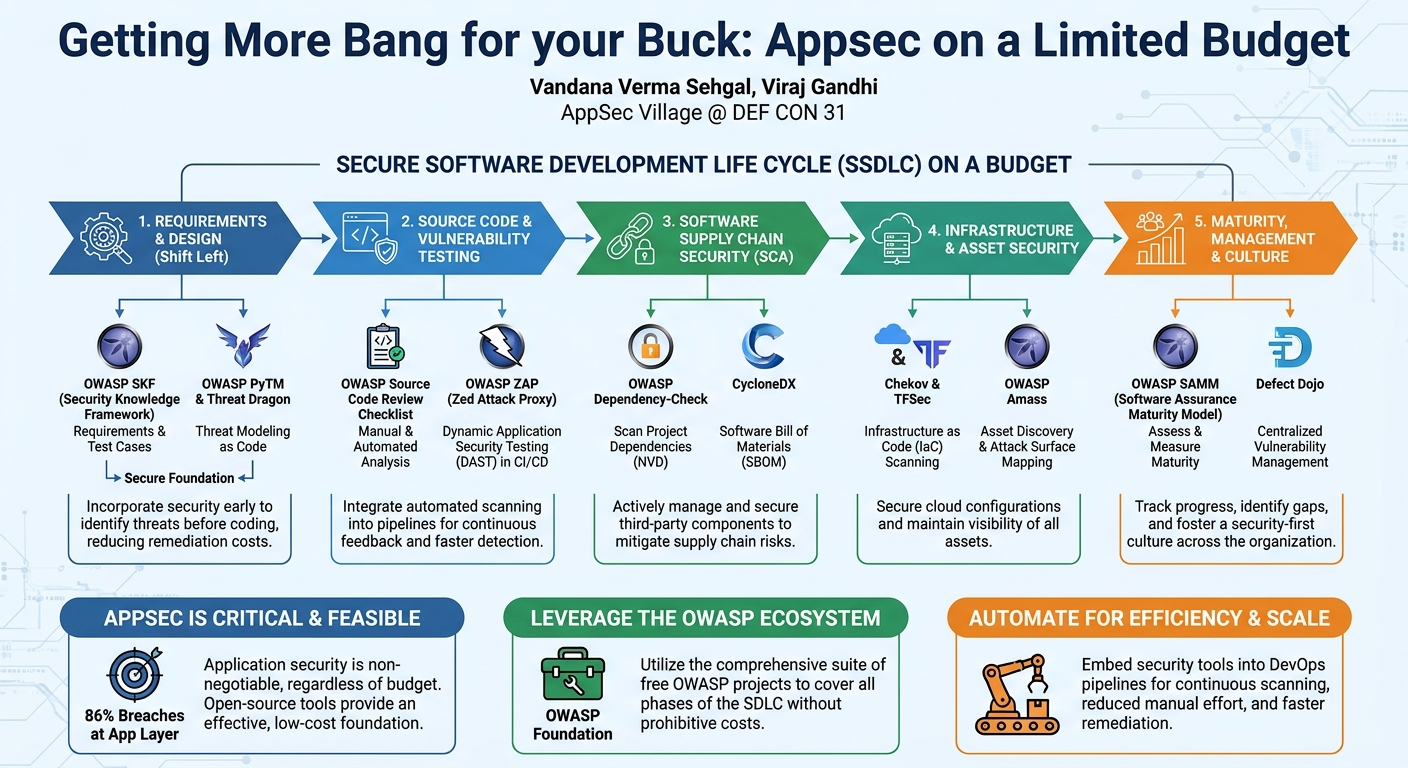
Key moments
- 0:00 Introduction: AppSec on a Limited Budget
- 7:40 Core pillars of an effective AppSec program
- 11:40 OWASP SKF for requirements and threat modeling
- 19:30 Lessons from Log4j and supply chain attacks
- 26:30 Overview of essential open-source AppSec tools
- 29:40 Understanding OWASP ASVS and community contribution
- 34:00 Measuring AppSec maturity with OWASP SAMM
- 40:30 Q&A: Asset inventory and classification with Amass
Getting More Bang for your Buck: Appsec on a Limited Budget
Speakers: Vandana Verma Sehgal (Security Leader, Snyk); Viraj Gandhi (Product Security Manager, SailPoint)
Conference: AppSec Village @ DEF CON 31
YouTube: https://www.youtube.com/watch?v=k3Nkj6HuJ_Y
Overview
In the dynamic landscape of modern software development, establishing a robust application security (AppSec) program is not merely an option but a critical imperative. However, for startups, mid-sized businesses, or even larger organizations operating under budget constraints, the perceived cost and complexity of such initiatives can be daunting. This insightful talk, "Getting More Bang for your Buck: Appsec on a Limited Budget," delivered by Vandana Verma Sehgal and Viraj Gandhi at AppSec Village @ DEF CON 31, addresses this precise challenge head-on. The speakers articulate a compelling vision for building effective and comprehensive AppSec programs by strategically leveraging open-source tools and methodologies, particularly those from the extensive OWASP ecosystem.
The core premise of the presentation revolves around the undeniable reality that application layer breaches account for a staggering 86% of all security incidents, making web applications a primary target for malicious actors. Against this backdrop, the talk emphasizes that security cannot be an afterthought, nor should it be exclusive to organizations with deep pockets. Vandana and Viraj meticulously outline how a "people, process, and tools" framework, anchored by free and low-cost open-source solutions, can empower any organization to foster a security-first development culture, reduce business risk, achieve compliance, and ultimately build more resilient software. Their practical, experience-driven approach offers a much-needed roadmap for securing applications without incurring prohibitive costs.
Background
▶ Watch: Introduction: AppSec on a Limited Budget (0:00)
The journey of modern software development has been marked by rapid innovation and increasing complexity. Methodologies like Agile, the widespread adoption of Kubernetes for orchestration, the pervasive shift to cloud deployments, and the heavy reliance on third-party components and libraries have undeniably accelerated software delivery. Yet, this acceleration has simultaneously introduced new layers of complexity and inherent risks that traditional security approaches often struggle to address. Organizations face constant pressure to innovate quickly while contending with evolving compliance requirements such as GDPR, CCPA, and ISO, alongside the ever-present threat of sophisticated cyberattacks.
The speakers highlight a common dilemma: startups and smaller businesses often lack the substantial budgets required to acquire expensive commercial AppSec tools. Even larger enterprises, while potentially having more resources, still seek to optimize their security spending and demonstrate clear Return on Investment (ROI). The fundamental problem is a perceived dichotomy: either invest heavily in commercial solutions or risk exposure due to inadequate security. This talk challenges that notion, arguing that the open-source community, particularly the OWASP (Open Worldwide Application Security Project), provides a rich, often overlooked, alternative. With 80-90% of modern applications relying on open-source components, the speakers stress the importance of understanding and securing this foundational layer, which many organizations neglect to update or maintain, as vividly illustrated by the Log4j and Equifax (Apache Struts) breaches. The goal is to bridge the gap, enabling organizations of all sizes to implement a robust Secure Software Development Life Cycle (SSDLC) that is both effective and financially feasible.
Key Findings
▶ Watch: OWASP SKF for requirements and threat modeling (11:40)
The presentation distills several critical findings that collectively advocate for a paradigm shift in how organizations approach AppSec, especially when operating with limited resources:
- Open Source Dominance and Opportunity: A staggering 80-90% of modern applications incorporate open-source components. This pervasive reliance on open source presents both significant risk (if not managed) and an unparalleled opportunity to leverage free, community-driven security tools to secure the very foundations of contemporary software.
- AppSec as a Foundational Imperative: With 86% of all breaches occurring at the application layer, AppSec is not a luxury but a fundamental necessity. The talk strongly asserts that every organization, irrespective of size or budget, must establish an AppSec program to protect its assets and customer trust.
- Strategic Integration Across the SDLC: Effective security must be infused into every phase of the Software Development Life Cycle (SDLC), moving beyond reactive post-deployment scanning. Early detection of threats, through design reviews and threat modeling, is significantly more cost-effective than remediating vulnerabilities later.
- The Power of the OWASP Ecosystem: The OWASP Foundation provides a comprehensive suite of projects that cover virtually every aspect of AppSec. These tools, developed and maintained by a global community of volunteers, offer enterprise-grade capabilities at little to no direct cost, making them ideal for budget-constrained environments.
- Cost-Effectiveness and Feasibility: It is entirely possible to establish a functional AppSec program with a budget as low as $0 to $10 (for cloud hosting fees). The speakers demonstrated that a basic, yet effective, program can be set up in as little as 15 days on a local VM, or within a month for a team environment.
- Automation as a Force Multiplier: Automation is repeatedly emphasized as crucial for efficiency and scalability. Integrating security tools directly into DevOps pipelines allows for continuous scanning, faster feedback, and reduces the manual effort required from security teams.
- Demonstrating Maturity and ROI: A successful AppSec program requires not only technical implementation but also the ability to measure progress, identify gaps, and communicate its value to leadership. Frameworks like OWASP SAMM (Software Assurance Maturity Model) provide a structured approach for this assessment and reporting.
Technical Deep Dive
▶ Watch: Overview of essential open-source AppSec tools (26:30)
The core of the talk provides a robust framework and a comprehensive list of specific open-source tools, primarily from the OWASP ecosystem, that can be integrated into a cost-effective AppSec program. The speakers meticulously map these tools to various stages of the Secure Software Development Life Cycle (SSDLC).
Requirements Gathering and Design
The first crucial step in any development project is gathering requirements. Historically, this often involved chaotic Excel sheets. The speakers advocate for the OWASP Security Knowledge Framework (SKF). SKF is an open-source tool with an intuitive Graphical User Interface (GUI) that allows teams to manage security requirements systematically. It supports language-specific test cases, integrates with sprint-based development, and maintains version control, ensuring traceability and preventing the "blunder" of unmanaged iterations.
Following requirements, threat modeling is essential. While often perceived as a tedious task, the speakers stress its importance at every phase of development—from initial discussions to code implementation and cloud deployment. They highlight OWASP PyTM (Python Threat Modeling), a tool capable of navigating application code and cloud environments to identify potential threats programmatically. Another recommended tool is Threat Dragon, which aids in visualizing threat models. The Threat Modeling Manifesto is cited as a foundational resource for those interested in deepening their understanding of this critical practice. The concept of threat modeling as code is introduced as a way to integrate security analysis directly into the development pipeline for both application logic and cloud configurations.
Source Code Review and Vulnerability Testing
For source code review, the speakers mentioned an upcoming OWASP Source Code Review Checklist, which is being updated from its 2017 version to include test cases for modern languages such as Node, JavaScript, and Go. This checklist aims to provide developers and security professionals with comprehensive guidance for manual and automated code analysis.
When it comes to vulnerability testing, OWASP ZAP (Zed Attack Proxy) is presented as a cornerstone tool. ZAP is a widely used, open-source Dynamic Application Security Testing (DAST) solution that can be seamlessly integrated into DevOps pipelines, including environments leveraging Selenium. Its extensive array of plugins and test cases makes it highly adaptable for automated security scanning during runtime.
For defect tracking and vulnerability management, the speakers strongly recommend Defect Dojo. This open-source tool centralizes all vulnerabilities discovered from various sources—be it manual testing, automated scans (including commercial tools), or external reports. It provides a single pane of glass for managing the entire vulnerability lifecycle, from detection to remediation, and offers comprehensive dashboards suitable for both technical teams and executives, helping to demonstrate the program's effectiveness and ROI.
Software Composition Analysis (SCA) and Supply Chain Security
The discussion heavily emphasizes the critical need for Software Composition Analysis (SCA) and securing the software supply chain. The speakers recount the widespread impact of vulnerabilities like Log4j and the Equifax breach (due to an unpatched Apache Struts vulnerability in 2017), underscoring how neglected open-source dependencies can lead to catastrophic consequences. They also reference the SolarWinds (Orion server) attack as a prime example of a sophisticated supply chain compromise.
To combat these threats, OWASP Dependency-Check is introduced as a vital tool. It scans project dependencies, pulling data from the National Vulnerability Database (NVD) to identify known vulnerabilities. The output from Dependency-Check can then be fed into CycloneDX, an SBOM (Software Bill of Materials) standard. CycloneDX helps organizations maintain an accurate and comprehensive list of all components and dependencies within their software, providing crucial visibility into the "attic" of their applications, as Vandana vividly metaphorized.
Infrastructure as Code (IaC) and Container Security
As applications increasingly move into containers and cloud environments, securing Infrastructure as Code (IaC) becomes paramount. The speakers highlight that vulnerable baseline images or misconfigured IaC can directly lead to application vulnerabilities. They recommend open-source tools like Chekov and TFSec (specifically for Terraform files) to scan IaC configurations, detect misconfigurations, and ensure secure cloud deployments.
Asset Discovery and Maturity Assessment
To effectively secure assets, organizations first need to know what they have. OWASP Amass is presented as an excellent open-source tool for network discovery, helping to identify and map an organization's external attack surface. Once assets are identified, tagging and classification are crucial for effective vulnerability management.
Finally, to measure the overall maturity and effectiveness of an AppSec program, the OWASP Software Assurance Maturity Model (SAMM) is recommended. SAMM provides a flexible framework for assessing an organization's current security posture across various domains (governance, design, implementation, verification, operations) and charting a roadmap for improvement. It helps identify gaps even when an organization uses various SAST, DAST, and SCA tools.
Training and Awareness
Beyond tools, security education and awareness are fundamental. The OWASP Application Security Verification Standard (ASVS) is highlighted as a comprehensive set of requirements for secure application design, development, and testing. ASVS offers different levels (0 to 3), allowing organizations to tailor their security efforts to their specific risk profile, with Level 3 being suitable for highly sensitive applications like those in the fintech sector. The speakers also encourage developers to engage with the OWASP community via GitHub and Slack channels, fostering a collaborative approach to security. Other non-OWASP open-source tools mentioned include Semgrep (a lightweight static analyzer with customizable rule sets) and Dependabot (GitHub's integrated tool for detecting vulnerabilities in third-party libraries).
Demo / Proof of Concept
▶ Watch: Understanding OWASP ASVS and community contribution (29:40)
While the talk itself did not include a live, step-by-step demonstration of the tools, the speakers extensively referenced existing resources that serve this purpose. Vandana Verma Sehgal mentioned creating 10-minute video recordings for at least 30 different tools, available through the OWASP Project Spotlight Series on YouTube. These videos are designed to provide practical guidance on how each tool works and how it can be implemented, effectively serving as a readily accessible proof-of-concept for those looking to integrate these open-source solutions into their own environments. The speakers emphasized that these video guides simplify the learning curve, making it easier for developers and security teams to adopt and utilize the tools without having to sift through extensive documentation.
Defensive Implications
▶ Watch: Q&A: Asset inventory and classification with Amass (40:30)
The insights shared in this talk provide a clear, actionable roadmap for defenders seeking to enhance their AppSec posture, particularly when operating with limited budgets.
- Shift Left and Prioritize Early Detection: Implement design and architectural reviews and threat modeling as early as possible in the SDLC. Tools like OWASP SKF and OWASP PyTM facilitate this, helping identify and mitigate threats before they become costly vulnerabilities. This proactive approach significantly reduces remediation costs and effort compared to detecting issues later in the cycle or in production.
- Embrace the OWASP Ecosystem: Leverage the vast array of free and powerful OWASP projects (SKF, PyTM, ZAP, Dependency-Check, CycloneDX, Defect Dojo, Amass, SAMM, ASVS) as the backbone of your AppSec program. These tools offer enterprise-grade capabilities without the licensing costs associated with commercial products.
- Foster a Security-First Development Culture: Invest in developer training and awareness programs. Establish security champions within development teams to embed security knowledge and ownership throughout the organization. The goal is to make security everyone's responsibility, not just the security team's.
- Automate Everything Possible: Integrate security tools directly into your CI/CD pipelines. Tools like OWASP ZAP, Dependency-Check, Chekov, and TFSec can be automated to provide continuous security feedback, enabling faster detection and remediation of vulnerabilities. The principle of "automate, automate, automate" is critical for efficiency and scalability.
- Strengthen Software Supply Chain Security: Actively manage and monitor your third-party dependencies. Use OWASP Dependency-Check to scan for known vulnerabilities and CycloneDX to generate and maintain a comprehensive Software Bill of Materials (SBOM). This provides crucial visibility into your software's components and helps mitigate risks from supply chain attacks.
- Implement Robust Vulnerability Management: Centralize all vulnerability data using a tool like Defect Dojo. This allows for efficient tracking, prioritization, and remediation of security defects across your applications, providing a clear overview of your security posture.
- Know Your Assets and Assess Your Maturity: Utilize tools like OWASP Amass for asset discovery and ensure proper tagging and classification of all assets. Regularly assess your AppSec program's maturity using OWASP SAMM to identify strengths, weaknesses, and areas for improvement, providing a data-driven approach to security enhancements.
- Strategic Resource Allocation: For organizations with limited budgets, consider reducing the cadence of external penetration testing by complementing it with internal pentesting programs. Avoid spending resources on scanning features that are about to be deprecated. Leverage Vulnerability Disclosure Programs (VDPs) and private bug bounty programs to gain external security insights cost-effectively.
- Communicate Value to Leadership: Track metrics and demonstrate the ROI of your AppSec initiatives. Use dashboards from tools like Defect Dojo and assessments from OWASP SAMM to articulate the program's effectiveness in reducing risk and achieving business objectives.
Key Takeaways
- AppSec is Non-Negotiable, Regardless of Budget: A robust application security program is essential for all organizations, and open-source tools, particularly from OWASP, offer a powerful and cost-effective foundation for achieving this.
- Embrace the OWASP Ecosystem: Leverage the extensive suite of OWASP projects—including SKF for requirements, PyTM for threat modeling, ZAP for DAST, Dependency-Check for SCA, CycloneDX for SBOMs, Defect Dojo for vulnerability management, and SAMM for maturity assessment—to cover all phases of your SDLC.
- Shift Left and Automate: Integrate security early into the development lifecycle through design reviews, continuous threat modeling, and automated scanning in CI/CD pipelines. This proactive approach significantly reduces costs and improves efficiency.
- Prioritize Software Supply Chain Security: Actively manage and secure your third-party dependencies using tools like OWASP Dependency-Check and CycloneDX to mitigate risks from open-source vulnerabilities and supply chain attacks.
- Measure, Manage, and Communicate: Utilize frameworks like OWASP SAMM to assess your AppSec maturity, track vulnerabilities with Defect Dojo, and effectively communicate the program's value and ROI to both technical teams and executive leadership.
- Empower Developers and Foster a Security Culture: Invest in developer training, establish security champions, and encourage engagement with open-source security communities to embed security as a shared responsibility across the organization.
About the Speaker(s)
Vandana Verma Sehgal is a prominent figure in the cybersecurity community, serving as one of the Global Board of Directors for OWASP (Open Worldwide Application Security Project). Her work extends to the private sector, where she is currently associated with Snyk, a software security company. Vandana is known for her deep expertise in application security and her passion for promoting open-source tools and education to make security accessible to a broader audience.
Viraj Gandhi is a Product Security Manager at SailPoint. With a focus on integrating security into product development, Viraj brings practical experience in establishing and managing AppSec programs within organizational contexts. Together, Vandana and Viraj shared their combined knowledge to provide a comprehensive and actionable guide for building effective application security on a limited budget.
Reviews
Dr. Zero (Offensive Security Researcher) — WEAK
This isn't a DEF CON talk; it's a live reading of the OWASP project directory. If you've been in application security for more than a week and haven't heard of ZAP or Dependency-Check, you're in the wrong room. Fills a slot for absolute beginners, but delivers zero novel signal for actual practitioners.
Heather Calloway (CISO) — SOLID
This is a foundational playbook for building an application security program from scratch using the OWASP open-source ecosystem. It is an excellent roadmap for a Series A startup or a mid-market security director with zero budget, though mature enterprises will find it to be a recap of standard operating procedures rather than net-new strategy.