AppSec Village Keynote: Collaborative Security: Fostering Innovation and Resilient Cyber Practices
Maril Vernon (Senior Application Security Architect and Purple Team Program Manager)
AppSec Village @ DEF CON 31 · Day 2 · AppSec Village
Overview
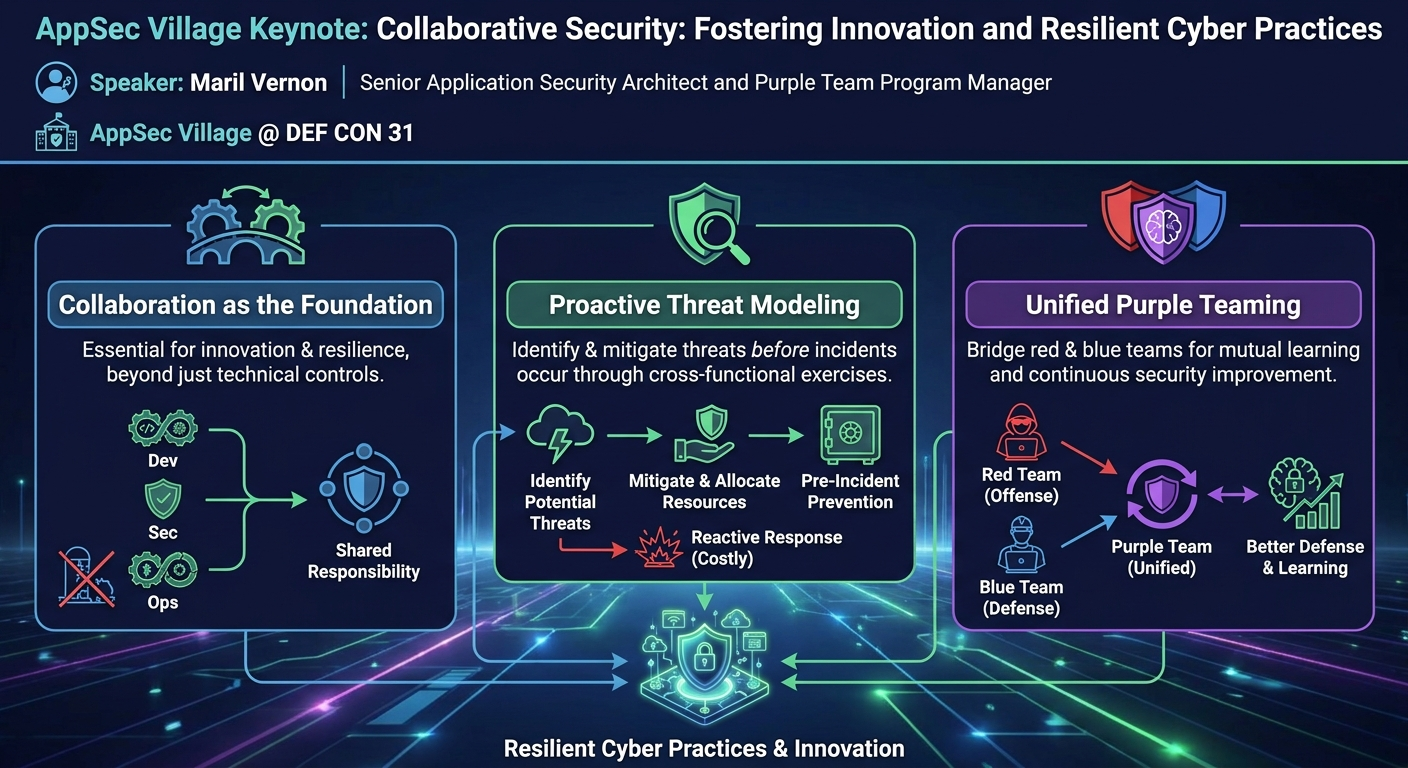
In her keynote at AppSec Village @ DEF CON 31, Maril Vernon, a recognized cybersecurity leader and self-described "one woman purple team," delivered a compelling argument for the transformative power of collaborative security. The talk, titled "Collaborative Security: Fostering Innovation and Resilient Cyber Practices," underscored a fundamental yet often overlooked truth in the cybersecurity landscape: robust technical defenses are insufficient without strong interdepartmental relationships and a culture of shared responsibility. Vernon passionately advocates for breaking down the pervasive organizational silos that plague many enterprises, asserting that true innovation and resilience against an ever-evolving threat landscape can only be achieved through collective effort.
Key moments
- 0:50 Collaborative security: breaking silos for innovation
- 2:20 Relationships are foundation for assurance, resilience, trust
- 3:25 Collaboration and information sharing for AppSec
- 5:00 Proactive threat modeling as a safety net
- 6:05 Purple teaming: bridging perspectives, fostering adaptation
- 8:15 Cyber resilience requires collective, cross-functional effort
- 9:20 Human-centric approach: security methodologies echo values
AppSec Village Keynote: Collaborative Security: Fostering Innovation and Resilient Cyber Practices
Speakers: Maril Vernon (Senior Application Security Architect and Purple Team Program Manager)
Conference: AppSec Village @ DEF CON 31
YouTube: https://www.youtube.com/watch?v=q35qf1lDF5Q
Overview
In her keynote at AppSec Village @ DEF CON 31, Maril Vernon, a recognized cybersecurity leader and self-described "one woman purple team," delivered a compelling argument for the transformative power of collaborative security. The talk, titled "Collaborative Security: Fostering Innovation and Resilient Cyber Practices," underscored a fundamental yet often overlooked truth in the cybersecurity landscape: robust technical defenses are insufficient without strong interdepartmental relationships and a culture of shared responsibility. Vernon passionately advocates for breaking down the pervasive organizational silos that plague many enterprises, asserting that true innovation and resilience against an ever-evolving threat landscape can only be achieved through collective effort.
Vernon's keynote is particularly salient in an era where technological advancements and cyber threats evolve at an exponential pace. She challenges the traditional adversarial dynamic between different security functions—such as red team versus blue team, or developers versus security—proposing instead a unified front where diverse perspectives converge for a common goal: securing applications and organizations. This perspective is critical for application security practitioners, as it moves beyond mere technical implementations to address the foundational human and organizational elements that dictate the success or failure of any security program.
The talk serves as a call to action for the cybersecurity community to recognize and cultivate the human element within their technical roles. By emphasizing the strategic importance of communication, shared knowledge, and mutual reliance, Vernon provides a roadmap for organizations to not only respond more effectively to incidents but also to proactively anticipate and mitigate threats. Her insights are vital for anyone involved in securing applications, from developers and security engineers to operations teams and executive leadership, offering a refreshing and pragmatic approach to building truly resilient cyber defenses.
Background
▶ Watch: Collaborative security: breaking silos for innovation (0:50)
The modern cybersecurity landscape is characterized by a relentless arms race: technology's exponential growth and capability are matched only by the rapid evolution of cyber threats. This dynamic environment often exposes critical weaknesses within organizational structures, particularly the prevalence of vertical silos. These silos hinder crucial information sharing and collaboration, leading to fragmented security efforts and reactive incident responses. As Vernon aptly points out, "how well we perform an incident response literally depends on how well we work with each other, and yet we continue to not do those things." This disconnect creates a fertile ground for adversaries who, conversely, often excel at widespread coordination and unified goal pursuit.
Vernon highlights several industry buzzwords—assurance, resilience, and trust—and posits that none of these can truly exist without a strong foundation of relationships. Assurance, defined as a state of confidence that an outcome will be fulfilled; resilience, the ability to bounce back from or thwart adverse events; and trust, faith in reliability—all inherently depend on collaborative practices. Concepts like "24/7 monitoring" and "zero trust" are often discussed in purely technical terms, yet their ultimate effectiveness is deeply intertwined with the human element and the quality of interdepartmental communication. For instance, achieving a state of complete assurance or implementing zero trust principles effectively requires a holistic understanding of an organization's assets, processes, and potential vulnerabilities, which can only be gained through shared insights across development, security, and operations teams.
The problem, therefore, is not merely a lack of advanced security tools or sophisticated techniques, but a systemic failure to leverage the collective intelligence and diverse skill sets present within an organization. This leads to underresourced and overextended teams, struggling to keep pace with threats while operating in isolation. Vernon's talk directly addresses this foundational issue, arguing that the solution lies not in more technology, but in fostering a culture where knowledge, insights, and experiences are recognized as the strongest weapons in the cybersecurity arsenal. She frames this as a "village" approach, where securing applications requires the collective effort and mutual reliance of everyone involved, fundamentally shifting the paradigm from isolated functions to integrated, collaborative security practices.
Key Findings
▶ Watch: Collaboration and information sharing for AppSec (3:25)
Maril Vernon's keynote distills several critical findings, all centered on the overarching theme that collaboration is the indispensable foundation for innovation and resilience in cybersecurity. Her primary assertion is that the power of interdepartmental relationships directly translates into tangible security improvements, moving beyond theoretical concepts to practical, impactful strategies.
First, Vernon emphatically states that information is power, and the act of sharing knowledge, insights, and experiences across teams is the "strongest weapon" an organization possesses. She observes that while many organizations acknowledge the importance of collaboration, few effectively implement it, leading to persistent vulnerabilities and reactive security postures. This finding underscores a cultural rather than purely technical challenge, emphasizing that the human element of security—mutual reliance and communication—is paramount.
Second, Vernon identifies three key manifestations where this collaborative power concretely applies to application security: DevSecOps, threat modeling, and purple teaming. These are not merely methodologies or buzzwords, but practical frameworks that, when properly leveraged, break down silos and enable teams to secure applications more effectively. She argues that securing code and architecture alone is "simply not enough"; success hinges on these integrated approaches.
Third, the talk highlights that these collaborative practices allow organizations to "do more with what we've already got"—a crucial finding for teams that are often "inundated, overextended, and underresourced." By optimizing existing human capital through better communication and shared processes, organizations can enhance their security posture without necessarily requiring significant new investments in tools or personnel. This efficiency stems from proactive identification and mitigation of threats, rather than costly reactive responses.
Finally, Vernon posits that cyber resilience—the ability to anticipate, prevent, respond to, contain, and eradicate problems—is no longer a separate functional objective but a collective endeavor. It transcends the traditional "developers versus security" or "red team versus blue team" dichotomies, demanding a unified "all of us" approach. This finding reframes security not as a departmental responsibility, but as an organizational core value driven by integrated relationships across all verticals and functions.
Technical Deep Dive
▶ Watch: Proactive threat modeling as a safety net (5:00)
Vernon's keynote delves into three core methodologies that embody the principles of collaborative security: DevSecOps, threat modeling, and purple teaming. These are presented not as isolated practices but as interconnected strategies designed to embed security throughout the application lifecycle and foster a culture of shared responsibility.
DevSecOps: Harmonizing Development, Security, and Operations
DevSecOps is often misunderstood as simply integrating security into development. Vernon clarifies that it is a tripartite function encompassing development, security, and operations. Each component plays a distinct yet interdependent role:
- Development represents the creative force, responsible for building and innovating applications.
- Security acts as the safeguard, ensuring that security considerations are "baked into" the development process from inception, rather than being an afterthought.
- Operations focuses on the smooth assembly, deployment, and ongoing management of these applications, ensuring their reliable delivery and performance in production environments.
The essence of DevSecOps, as articulated by Vernon, is the harmonious coexistence of culture, technology, and security. It's about breaking down the traditional handoff mentality and fostering continuous feedback loops. This means developers understand security requirements early, security teams are integrated into the development pipeline, and operations teams have the necessary insights to deploy and monitor secure applications. The goal is to create an environment where security is a shared responsibility, seamlessly integrated into every stage of the software development lifecycle, thereby driving both innovation and security forward.
Threat Modeling: Proactive Safety Net for Applications
Threat modeling is championed by Vernon as one of the most crucial proactive security measures available. She likens it to "weaving a safety net underneath your application," proactively identifying and mitigating potential threats before they can be exploited. This contrasts sharply with reactive security measures, which only address vulnerabilities after an incident has occurred. Vernon laments that too few organizations adequately engage in threat modeling, often realizing its necessity only after a breach.
The technical depth of threat modeling lies in its comprehensive, cross-functional approach. It's not solely a task for developers or red teamers. Instead, Vernon advocates for bringing together a diverse group of stakeholders, including:
- Developers: To provide insight into the application's architecture and functionality.
- Red Teamers: To offer an adversarial perspective on potential attack vectors.
- Stakeholders: To define business objectives, critical assets, and acceptable risk levels.
- Designers and UX/UI specialists: To identify vulnerabilities introduced by user interaction flows or design choices.
By convening these varied perspectives, threat modeling facilitates a holistic understanding of the application's attack surface. Teams collaboratively identify potential vulnerabilities, analyze adversary motivations ("what did the adversary want?"), and proactively allocate resources to targeted remediation efforts. This collaborative identification process allows organizations to prioritize their "mitigation dollar" effectively, ensuring that limited resources are spent on the highest-impact security controls. The outcome is a "web of insights" that anticipates threats, allowing teams to "do more with less" by preventing costly incidents.
Purple Teaming: Bridging Red and Blue for Amplified Defense
Purple teaming is presented as the ultimate embodiment of collaborative security, acting as a crucial bridge that connects diverse perspectives and skills from both offensive (red team) and defensive (blue team) security functions, as well as development and builder teams. Vernon, as a "one woman purple team," clearly believes in its foundational core values.
Conceptually, purple teaming aims to synthesize the strengths of red and blue teams. Instead of operating in isolation, the red team (simulating attacks) and blue team (defending and detecting) work in concert. This collaborative exercise involves:
- Cross-education: Red teamers explain their attack methodologies, tools, and objectives, while blue teamers demonstrate their detection, investigation, and remediation capabilities. This mutual understanding is critical.
- Adversary Emulation: The red team executes specific attack scenarios, often tailored to the organization's unique threat landscape.
- Real-time Feedback and Improvement: The blue team attempts to detect and respond to these simulated attacks. Crucially, they communicate in real-time or near real-time, allowing immediate adjustments to detection rules, security controls, and response procedures. Vernon highlights instances where defenders, having learned from red team actions, recognize suspicious patterns: "I wouldn't have thought that was suspicious before but I remembered that was like the fifth step in the thing that you did and I saw all the other steps and I knew we were in trouble."
- Understanding Adversary Intent: Purple teaming helps both sides understand why an adversary might target specific assets or follow certain paths, rather than just what they did. This insight allows for more strategic defense planning.
Through purple teaming, organizations amplify their ability to adapt and respond to evolving threats. It fosters preparedness and innovation by systematically testing defenses, identifying gaps, and improving security posture in a controlled, educational environment. This continuous feedback loop ensures that security measures are not only robust but also relevant to current threat intelligence and adversarial tactics.
Demo / Proof of Concept
▶ Watch: Cyber resilience requires collective, cross-functional effort (8:15)
The keynote address by Maril Vernon focused on conceptual frameworks, cultural shifts, and strategic methodologies for collaborative security rather than a live technical demonstration or proof of concept. The transcript does not indicate any specific tools, code, or exploit demonstrations were presented during her talk.
Defensive Implications
▶ Watch: Human-centric approach: security methodologies echo values (9:20)
The insights shared by Maril Vernon carry profound implications for cybersecurity defenders, urging a fundamental shift from isolated operations to deeply integrated, collaborative practices. Defenders must internalize that their effectiveness is directly proportional to their ability to foster strong relationships across the organization.
Firstly, embrace DevSecOps culture wholeheartedly. This means moving beyond merely "shifting left" security to actively integrating security professionals into development and operations teams from the very beginning. Defenders should advocate for security to be a core component of the software development lifecycle, ensuring security requirements are understood, implemented, and continuously monitored. This involves providing developers with actionable security training, embedding security champions within development teams, and automating security checks within CI/CD pipelines. The goal is to make security an enabler, not a blocker, fostering a harmonious environment where security is a shared responsibility.
Secondly, prioritize and institutionalize threat modeling. Defenders should champion threat modeling as a mandatory, proactive measure for all new and significant application features or architectures. This involves facilitating cross-functional workshops that bring together developers, architects, product owners, and even red teamers. The focus should be on identifying potential threats, understanding their impact, and collaboratively determining effective mitigation strategies before code is written or deployed. By allocating resources to proactive threat mitigation, organizations can significantly reduce their attack surface and avoid costly reactive incident responses, effectively "doing more with less."
Thirdly, implement and expand purple teaming exercises. Defenders (blue teams) should actively seek opportunities to collaborate with offensive security teams (red teams) and development teams in structured purple teaming engagements. These exercises are invaluable for cross-educating teams, understanding adversary tactics, techniques, and procedures (TTPs) in a controlled environment, and refining detection and response capabilities. Blue teams should use purple teaming to test their security controls, improve their logging and monitoring, and develop more sophisticated incident response playbooks based on real-world attack simulations. This continuous feedback loop builds preparedness and amplifies the organization's adaptive capacity against evolving threats.
Finally, actively break down organizational silos and foster communication. Defenders must proactively build relationships with other departments—IT, legal, HR, and even business units—to understand their needs and integrate security into broader organizational objectives. This involves regular communication, sharing threat intelligence, and collaborating on security awareness initiatives. By acting as allies and educators, security professionals can transform the perception of security from a standalone cost center to an integrated strategic partner, ultimately building a more resilient and innovative cyber defense posture for the entire organization.
Key Takeaways
- Collaboration is the Foundation of Security: Strong interdepartmental relationships and open communication are as critical as technical controls for driving innovation and resilience in cybersecurity.
- Break Down Silos: Organizational silos hinder information sharing and lead to reactive security postures; active efforts to foster cross-functional teamwork are essential for effective defense.
- Embrace DevSecOps: Integrate development, security, and operations into a harmonious culture where security is baked into every stage of the application lifecycle, fostering shared responsibility.
- Prioritize Proactive Threat Modeling: Utilize threat modeling as a collaborative, cross-functional exercise to identify and mitigate vulnerabilities before they emerge, optimizing resource allocation and preventing incidents.
- Leverage Purple Teaming: Implement purple teaming to bridge offensive and defensive security, cross-educate teams, and continuously refine detection, investigation, and remediation capabilities against real-world threats.
- Cyber Resilience is a Collective Effort: Achieving true cyber resilience requires a unified approach across all teams and functions, moving beyond traditional adversarial dynamics to a "we're all in this together" mindset.
About the Speaker(s)
Maril Vernon is a distinguished figure in the cybersecurity community, known for her expertise in offensive and collaborative security practices. She describes herself as a "one woman purple team," highlighting her unique ability to bridge the gap between offensive and defensive security operations. Vernon's contributions to the field have earned her significant recognition, including being named "Cyber Security Woman of the Year" and "Hacker of the Year." Her professional background includes work with Aqu Incorporated, where she contributes to building resilient cyber practices. Vernon is a passionate advocate for interdepartmental collaboration, believing that mutual learning and shared knowledge are key to advancing security for all.
Reviews
Dr. Zero (Offensive Security Researcher) — HARD PASS
This is a 2015 LinkedIn post stretched into a DEF CON keynote. We don't need another session defining DevSecOps, threat modeling, and purple teaming to an AppSec Village crowd. It's pure awareness theater with zero actionable signal.
Heather Calloway (CISO) — SOLID
A competent but familiar argument for breaking down organizational silos through DevSecOps, threat modeling, and purple teaming. It correctly diagnoses the danger of isolated security teams but prescribes cultural fixes to what are fundamentally structural and incentive problems.