Peril at the Plug: Investigating EV Charger Security and Safety Failures
Black Hat USA 2025 · Day 1 · Briefings
Overview
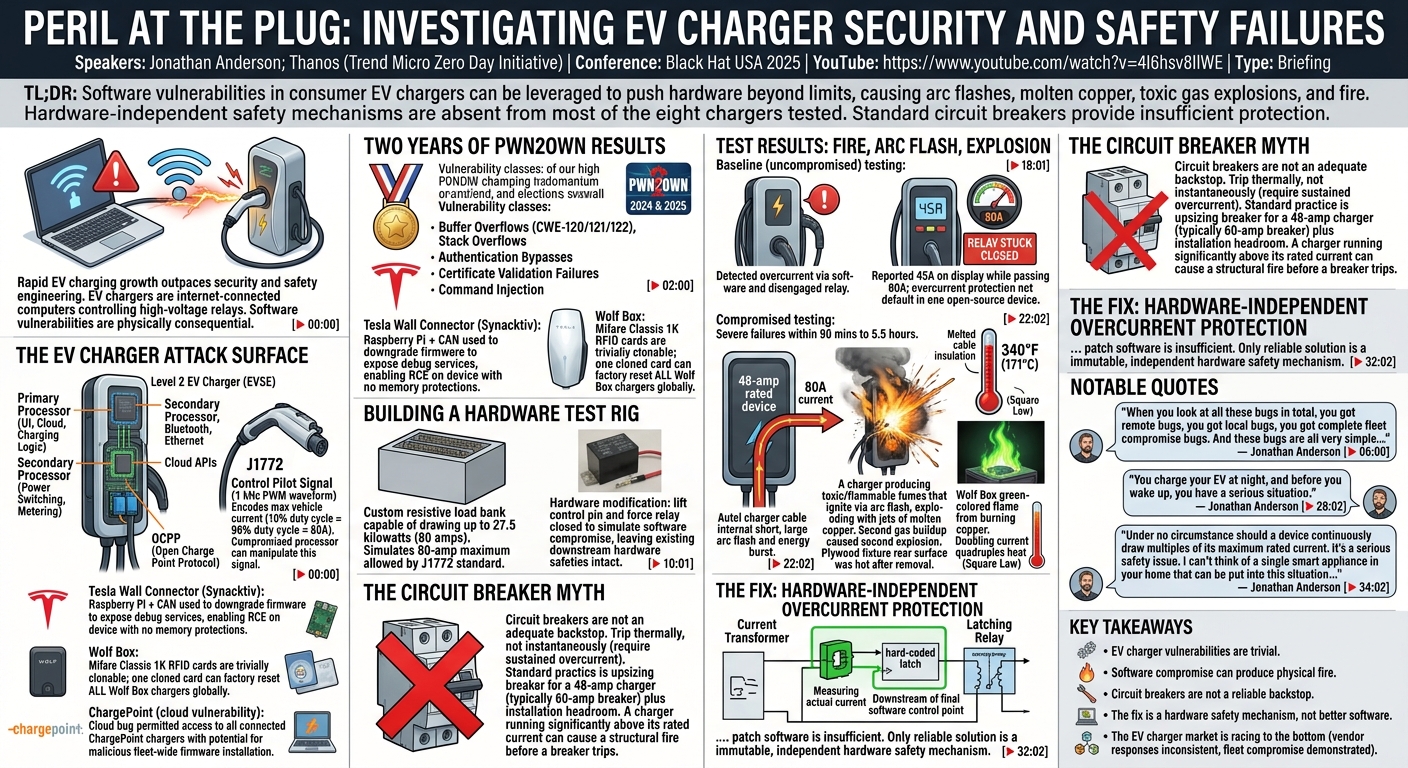
Researchers from Trend Micro's Zero Day Initiative demonstrated that software vulnerabilities in consumer EV chargers — including bugs exposed at Pwn2Own 2024 and 2025 — can be leveraged to push hardware beyond its rated limits, producing arc flashes, molten copper, toxic gas explosions, and sustained fire. Hardware-independent safety mechanisms are absent from most of the eight chargers tested, and standard circuit breakers provide far less protection than consumers assume. ---
Key moments
- 2:00 Pwn2Own Automotive: vulnerabilities not decreasing year-over-year across EV charger brands
- 4:00 Pwn2Own 2024-25: 4 contestants successfully modified J1772 charging protocol to the vehicle
- 6:00 Wolf Box: cloneable RFID card resets any Wolf Box globally; enables malicious firmware install
- 6:30 ChargePoint cloud bug let single attacker push malicious firmware to entire charger fleet
- 17:59 Over-current test: charger reaches 300-340°F; thermal runaway interrupts test
- 21:59 Demo: arc flash on Autel device under sustained over-current; cable degrades visibly
- 25:59 Demo: flammable gas ignition causes two explosions — open-air test shows serious fire hazard
- 28:00 Key finding: half of tested chargers failed within 90 minutes; no hardware safety backstop
Peril at the Plug: Investigating EV Charger Security and Safety Failures
Speakers: Jonathan Anderson; Thanos (last name not stated), Trend Micro Zero Day Initiative
Conference: Black Hat USA 2025 — August 6-7, 2025, Mandalay Bay, Las Vegas
YouTube: https://www.youtube.com/watch?v=4l6hsv8IlWE
Reading Time: ~10 minutes
Type: Briefing
TL;DR
Researchers from Trend Micro's Zero Day Initiative demonstrated that software vulnerabilities in consumer EV chargers — including bugs exposed at Pwn2Own 2024 and 2025 — can be leveraged to push hardware beyond its rated limits, producing arc flashes, molten copper, toxic gas explosions, and sustained fire. Hardware-independent safety mechanisms are absent from most of the eight chargers tested, and standard circuit breakers provide far less protection than consumers assume.
Introduction
The EV charging industry is expanding rapidly, with new chargers appearing on marketplaces daily. What has not kept pace is security and safety engineering. EV chargers are, in essence, internet-connected embedded computers controlling high-voltage electrical relays — a combination that makes software vulnerabilities physically consequential in ways that most IoT devices are not.
Jonathan Anderson and Thanos presented findings from two years of EV charger research at Pwn2Own, extended with original laboratory testing designed to answer a precise question: if a charger's software is compromised and forced to operate above its rated current, what actually happens? The answer, demonstrated on video, involves cable failures, arc flashes, jets of molten copper, and small explosions from ignited toxic fumes. The conclusion is unambiguous — the industry needs hardware-level safeties that are immune to software compromise, and most products on the market today do not have them.
The EV Charger Attack Surface
▶ Watch: EVSE Attack Surface Overview (00:00)
A Level 2 EV charger (EVSE) is a surprisingly complex device. The primary processor handles user interface, cloud connectivity, and charging logic; a secondary processor typically manages lower-level power switching and metering. The attack surface includes Wi-Fi, Bluetooth, Ethernet, OCPP (Open Charge Point Protocol), cloud APIs, and mobile applications. Bluetooth is commonly used to provision Wi-Fi credentials during initial setup, making the mobile app a useful entry point for reverse engineering.
The J1772 charging cable carries two control signals alongside the power conductors. The control pilot signal — a 1 kHz PWM waveform — encodes the maximum current the vehicle is permitted to draw, expressed as a duty cycle: 10% represents 6 amps, 96% represents 80 amps. An attacker who controls the charger's processor can manipulate this signal to instruct the vehicle to draw far beyond the charger's physical design limit.
Two Years of Pwn2Own Results
▶ Watch: Pwn2Own Results and Bug Classes (02:00)
Pwn2Own 2024 and 2025 both included EV charger categories. The vulnerability classes observed across both years reflect the state of the industry: buffer overflows and stack-based overflows (CWE-120/121/122) accounted for eight or nine separate findings. Authentication bypasses, certificate validation failures, and command injection vulnerabilities were also present. The researchers describe these as "pretty low-level bugs" — the kind of issues that comprehensive security review would catch before shipping.
Three specific findings were highlighted:
Tesla Wall Connector (Synacktiv): Researchers used a Raspberry Pi with a CAN controller to downgrade the charger's firmware to an older version containing debug services. Those debug services exposed the charger's Wi-Fi credentials. With network access, a global buffer overflow in a debug service allowed RCE — on a device with no memory protections.
Wolf Box: The management RFID card shipped with each Wolf Box is a Mifare Classic 1K card — trivially clonable. More critically, a single cloned card resets not just one Wolf Box but all Wolf Box chargers in existence. Resetting a charger to factory state enables extraction of a firmware encryption key during the pairing process, followed by delivery of malicious firmware through an undocumented update channel via encrypted JSON.
ChargePoint (cloud vulnerability): A researcher found a cloud-side bug that permitted access to all connected ChargePoint chargers, with the potential to install malicious firmware fleet-wide. The vendor had not fully resolved this issue at the time of the talk.
Building a Hardware Test Rig
▶ Watch: Test Methodology and Rig Design (10:01)
To answer the question of what happens when a compromised charger is forced beyond its limits, the team built a custom resistive load bank capable of drawing up to 27.5 kilowatts — equivalent to the 80-amp maximum the J1772 standard allows. The fixture included Wi-Fi-controlled breakers (to avoid having hands near high-voltage components during testing), current and voltage instrumentation, and a bank of resistive heating elements.
To simulate software compromise across eight different charger designs without individually exploiting each one, the researchers identified the physical relay control point in each charger's circuit and made a hardware modification: lifting the control pin and connecting a wire that allowed them to externally force the relay closed regardless of what the software decided. Downstream hardware safeties — if they existed — remained intact and could still interrupt an overcurrent condition. This approach created an equalized test methodology applicable to all eight chargers.
Test Results: Fire, Arc Flash, and Explosion
▶ Watch: Uncompromised Baseline Testing (18:01)
Baseline (uncompromised) testing: Most chargers detected overcurrent conditions in software and disengaged the relay. Two did not. One continued to pass current with its relay stuck closed; another reported drawing 45 amps on its display while actually passing 80 — its sensor readings were not only wrong but mathematically inconsistent with each other, yet it continued charging. One device, an open-source design, appeared to have overcurrent protection that was simply not enabled by default.
▶ Watch: Compromised Charger Testing and Destruction (22:02)
Compromised testing: With software safeties bypassed, chargers were run at their maximum possible current — 80 amps through devices rated for 48 amps. Results were severe:
- An Autel charger's cable degraded and shorted internally, releasing a visible arc flash and a substantial burst of energy.
- A second charger produced toxic and flammable off-gassing fumes. Those fumes ignited via arc flash, producing an explosion with jets of molten copper ejected from the cable. A second gas buildup produced a second explosion. The plywood test fixture's rear surface was still hot after the charger was removed.
- The Wolf Box showed a green-colored flame characteristic of burning copper.
Temperatures on charging cables reached 340°F (171°C) during testing — well above the threshold for first-degree burns (100°F) and sufficient to melt cable insulation off a wall mount. The thermal relationship is a square law: doubling current quadruples heat. Half the chargers tested failed within 90 minutes; the remainder failed within five and a half hours. The overnight charging scenario is the relevant one — these failures can unfold while occupants sleep.
The Circuit Breaker Myth
A common assumption is that a correctly sized circuit breaker provides an adequate backstop. The researchers dismantle this assumption in detail. Circuit breakers trip thermally, not instantaneously — they require sustained overcurrent to heat a bimetal strip before tripping. Standard installation practice for EV chargers calls for upsizing the breaker: a 48-amp charger is typically installed on a 60-amp breaker. Typical breakers also have built-in headroom above their rated value before they trip. Combining manufacturer upsizing recommendations, installation headroom, and the common consumer behavior of installing "future-proof" oversized breakers, a charger running significantly above its rated current can operate long enough to cause a structural fire before any breaker trips.
The Fix: Hardware-Independent Overcurrent Protection
▶ Watch: Proposed Mitigation and Conclusion (32:02)
The researchers argue that patching software is insufficient. The only reliable solution is a hardware safety mechanism that operates independently of software and is immutable after manufacturing: a current transformer measuring actual current, compared against a hard-coded maximum set point, driving a latch that de-energizes the relay when the set point is exceeded. This mechanism would be positioned downstream of the final software control point — meaning no software exploit can disable it.
The cost of such a mechanism is modest, and the researchers note that any number of common household appliances would refuse to operate in a continuously overcurrent condition. EV chargers, in their current market state, are an exception — and an inexplicable one.
Notable Quotes
"When you look at all these bugs in total, you got remote bugs, you got local bugs, you got complete fleet compromise bugs. And these bugs are all very simple, don't take chains."
— Jonathan Anderson ▶ 06:00
"You charge your EV at night, and before you wake up, you have a serious situation."
— Jonathan Anderson ▶ 28:02
"Under no circumstance should a device continuously draw multiples of its maximum rated current. It's a serious safety issue. I can't think of a single smart appliance in your home that can be put into this situation — and apparently, vendors need some more push than us just begging them to make their software better."
— Jonathan Anderson ▶ 34:02
"To EV vendors, I would just say: own this problem, fix it, brag about it in the market, and you'll win — because I would buy your charger if you had these kinds of safety mechanisms."
— Jonathan Anderson ▶ 34:02
Key Takeaways
- EV charger vulnerabilities are trivial. Buffer overflows, authentication bypasses, and command injection — bugs that should not survive a basic security review — are common across the market, including in products from established vendors.
- Software compromise can produce physical fire. Arc flashes, molten copper, toxic gas explosions, and sustained cable fires were all observed during controlled testing at 80 amps on 48-amp-rated devices.
- Circuit breakers are not a reliable backstop. Upsizing requirements, thermal trip dynamics, and consumer behavior combine to mean a charger running well above its rated current may burn for an extended period before any breaker trips.
- The fix is a hardware safety mechanism, not better software. An independent current transformer with a hard-coded set point, positioned downstream of all software control, is the only reliable solution. It is not expensive and should be standard.
- The EV charger market is racing to the bottom. Vendor responses to Pwn2Own findings are inconsistent; new vendors enter with the same naive bugs; and fleet-wide compromise scenarios have been demonstrated via cloud-side vulnerabilities. Regulatory pressure or liability exposure may be required to drive change.
No slides PDF was listed for this briefing.
Reviews
Dr. Zero (Offensive Security Researcher) — STRONG ACCEPT
ZDI sets chargers on fire in a laboratory and calls it security research — and they're right to. The Wolf Box attack chain is clever, the hardware destruction footage makes the threat visceral, and the circuit-breaker myth debunking is the kind of practical consumer safety information that has real-world consequences. This earns its slot.
Heather Calloway (CISO) — MUST SEE
EV charger software vulnerabilities cause physical fires. This talk proves it with video evidence: arc flashes, jets of molten copper, toxic gas explosions, and sustained cable fires during controlled testing. Circuit breakers are not a reliable backstop. Hardware-independent overcurrent protection is the fix and the industry is not building it.