Chronicles of Counter-Intelligence from the Citizen Lab (Keynote)
Black Hat USA 2025 · Day 1 · Briefings
Overview
Ron Deibert, founder of the Citizen Lab at the University of Toronto, delivered a sweeping account of 25 years investigating mercenary spyware, state surveillance, and the growing intersection of tech platforms with authoritarian politics. His core argument: a self-reinforcing vicious cycle — surveillance-enabling technology, weakened democratic norms, and the retreat of regulatory oversight — is accelerating in ways that threaten civil society research itself, and the security community must step in to defend public-interest work. ---
Key moments
- 3:59 Pegasus and Khashoggi: spyware on friend's phone preceded journalist's murder one day later
- 5:59 Citizen Lab origin: first-ever public cyber espionage report (GhostNet) named APT concept in 2009
- 8:29 2016 case: Pegasus zero-day chain first captured in lab via Ahmed Mansoor text messages
- 9:59 ForcedEntry 2021: zero-click Pegasus exploit disclosed from phone of jailed women's rights activist
- 10:30 Apple response to ForcedEntry: Lockdown Mode, $10M research fund, threat notification system
- 12:00 Paragon spyware: zero-click WhatsApp group exploit found targeting civil society targets
- 20:00 Counter-intelligence finding: Citizen Lab itself subjected to persistent nation-state targeting
- 30:00 Systemic problem: mercenary spyware industry continues despite NSO Group litigation and bans
Chronicles of Counter-Intelligence from the Citizen Lab
Speaker: Ron Deibert, Founder and Principal Investigator, Citizen Lab, University of Toronto
Conference: Black Hat USA 2025 — August 6-7, 2025, Mandalay Bay, Las Vegas
YouTube: https://www.youtube.com/watch?v=frmGzgBvGdg
Reading time: 7 min
Type: Keynote
TL;DR
Ron Deibert, founder of the Citizen Lab at the University of Toronto, delivered a sweeping account of 25 years investigating mercenary spyware, state surveillance, and the growing intersection of tech platforms with authoritarian politics. His core argument: a self-reinforcing vicious cycle — surveillance-enabling technology, weakened democratic norms, and the retreat of regulatory oversight — is accelerating in ways that threaten civil society research itself, and the security community must step in to defend public-interest work.
Introduction
The Citizen Lab — an academic research group housed at the University of Toronto's Munk School — has spent more than two decades doing what Ron Deibert calls "counterintelligence for civil society." The lab occupies a unique niche: it is not a company, not an NGO, and not a government agency. It is a university research unit with no booth in the business hall and nothing to sell. Yet its investigations have helped expose NSO Group's Pegasus spyware, triggered executive orders, gotten intelligence chiefs fired in two countries, and contributed directly to the eventual bankruptcy of surveillance firm Sandvine.
Deibert's keynote at Black Hat USA 2025 was both a chronicle of that work and an increasingly urgent call to action. As federal oversight of the technology sector retreats, as platforms gut their trust-and-safety teams, and as AI-powered surveillance tools multiply, Deibert warned that organizations like the Citizen Lab may not survive the current political climate — and the security community must recognize what is at stake.
Greatest Hits: Pegasus, Sandvine, and Paragon
▶ Watch: Early Investigations (04:00)
Deibert walked through some of the Citizen Lab's most consequential cases:
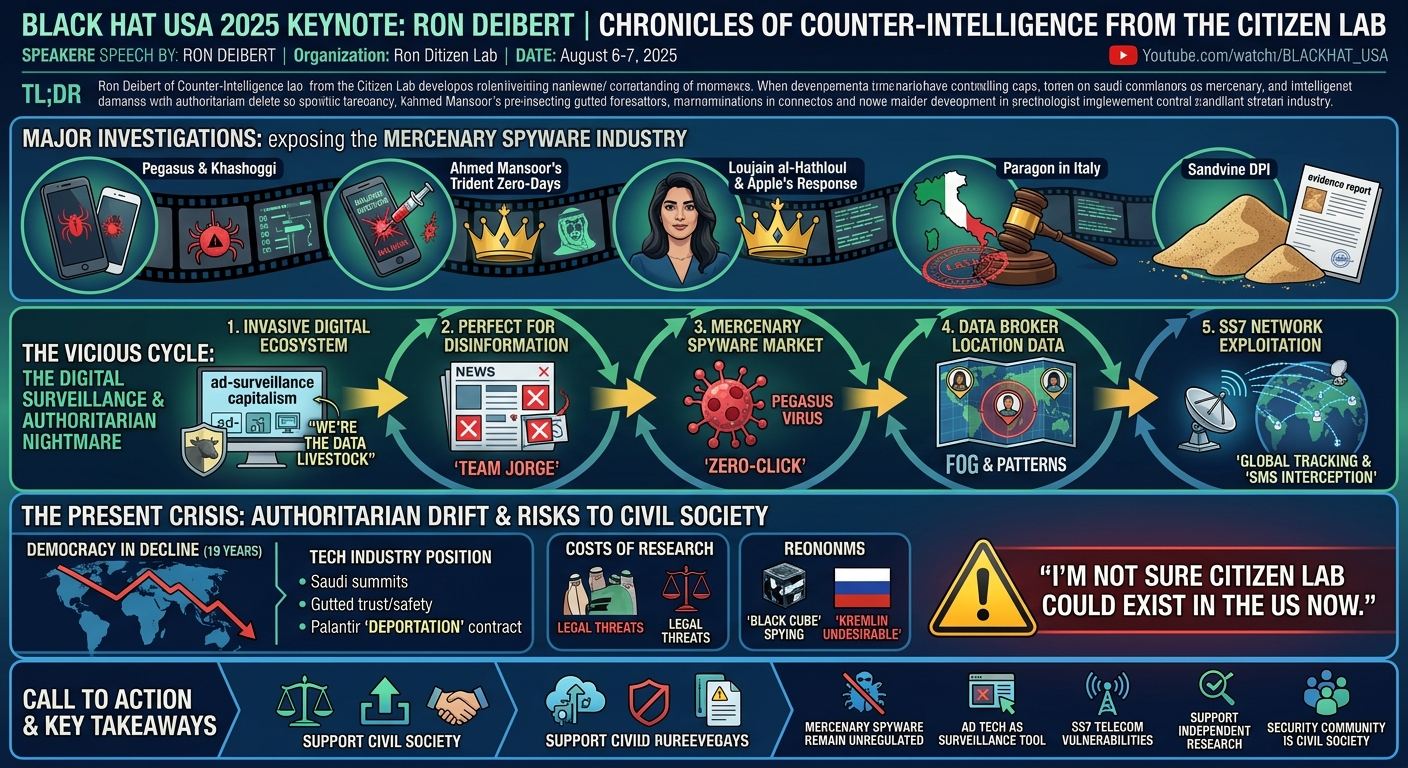
Pegasus and the Khashoggi connection. In 2018, the lab discovered that Omar Abdulaziz — a Saudi activist and close friend of Washington Post journalist Jamal Khashoggi — had his phone hacked with NSO Group's Pegasus spyware. The Citizen Lab published its report on October 1, 2018. The very next day, Khashoggi walked into the Saudi consulate in Istanbul and was murdered. Deibert noted that the two men had been communicating over WhatsApp, believing it to be secure — while Saudi operatives listened.
Ahmed Mansoor's "Trident" zero-days. In 2016, UAE human rights defender Ahmed Mansoor forwarded suspicious text messages to Citizen Lab researcher Bill Marczak. Marczak deliberately infected a test iPhone and captured the Pegasus exploit chain — a three-vulnerability zero-day sequence that became known as "Trident." It was the first time anyone had captured NSO Group's spyware in the wild. Apple patched the vulnerabilities within eleven days of receiving Citizen Lab's responsible disclosure.
Loujain al-Hathloul and Apple's response. A Saudi activist imprisoned for advocating women's right to drive was found to have her phone targeted with Pegasus. This case prompted Apple to introduce Lockdown Mode, to sue NSO Group (a lawsuit later withdrawn), and to launch a $10 million fund supporting civil society cybersecurity research — and to begin proactively notifying customers when their devices may have been targeted.
Paragon and Italy. More recently, the Citizen Lab identified that Paragon — an Israeli spyware firm that marketed itself as the "clean" alternative to NSO — was being used by the Italian government to hack the phones of migrant support workers and journalists.
Sandvine's DPI systems. The lab investigated abuse of Sandvine's deep packet inspection hardware to inject malware into targets' devices. Sandvine threatened legal action against the University of Toronto before the research was published. The lab published anyway. Sandvine was subsequently placed on a US sanctions list, went bankrupt, and rebranded. As Deibert noted: "Revenge is a dish best served as an evidence-based research report."
The Vicious Cycle: Surveillance, Disinformation, and Authoritarian Drift
▶ Watch: Welcome to My Nightmare (22:01)
The heart of the keynote was a framework Deibert called "Welcome to My Nightmare" — a diagram of interlocking social forces he believes are currently in a negative feedback loop:
- The digital ecosystem is invasive by design. Ad-surveillance capitalism requires harvesting ever-more-granular data — behavioral, biometric, physiological. "We're ultimately the livestock for their data farms," Deibert said.
- This ecosystem is perfect for disinformation. Platforms optimized for outrage and emotional engagement create ideal conditions for professional information operations. He cited Team Jorge, an operation that claimed involvement in 33 presidential elections, as an example of the professional "dark PR" industry now available.
- The mercenary spyware market proliferates. The capabilities of tools like Pegasus — zero-click, full-device compromise — are "almost godlike." The industry is built on hoarding vulnerabilities rather than disclosing them, making collective digital security worse.
- Location surveillance from data brokers. Deibert highlighted firms like Patterns (claiming 5 billion profiled user IDs) and Fog, which advertise the ability to geo-fence a room and generate intelligence dossiers on everyone inside it, derived from advertising data.
- SS7 network exploitation. Surveillance firms have found that leasing telco spectrum licenses gives them access to the global signaling network, enabling silent location tracking and SMS interception. Citizen Lab researcher Gary Miller — a whistleblower from the telecom surveillance industry — brought data showing Saudi Arabia made millions of secret tracking requests against US residents via these systems.
"Civil society is under assault — major chilling effects, paranoia, fear, withdrawal. This is exactly the opposite of what we expected when the internet was supposed to lead to democratization." — Ron Deibert ▶ 34:03
The Present Crisis
▶ Watch: Current Threats to Civil Society (36:03)
Deibert spoke directly about the US political environment in 2025. Freedom House data, he noted, shows a 19-year consecutive decline in global democracy — a trend that correlates strongly with the rise of mass-scale social media platforms beginning around 2006.
He was blunt about the technology industry's current posture: tech leaders attending Saudi investment summits, aligning with an administration that has cut civil society oversight, and platforms eliminating fact-checking and trust-and-safety teams. He pointed to Palantir's contract to build a deportation surveillance platform, and to AI-powered undercover bots being used to monitor protesters.
"I can tell you confidently, I'm 100 percent sure that something like the Citizen Lab could not exist in the United States right now, and I'm not even sure we'll be able to exist that much longer if these trends continue." — Ron Deibert ▶ 40:04
He also described the personal costs of the work: Citizen Lab staff targeted by Black Cube (a private intelligence firm staffed by ex-Mossad agents) in a covert operation to steal research methodology; staff depicted in Polish state TV as assets of Russian intelligence; the lab being designated an "undesirable organization" by the Kremlin.
Call to Action
▶ Watch: Call to Action (42:04)
Deibert closed with a direct appeal to the Black Hat audience. The Citizen Lab's work, he said, has depended on the security community: pro bono legal support, data feeds, threat intelligence sharing, responsible disclosure pipelines.
His ask: recognize that public-interest research is under threat, and actively support it — whether through data sharing, legal assistance, or simply speaking up about why groups like the Citizen Lab need to exist.
Key Takeaways
- The mercenary spyware market remains largely unregulated despite litigation, sanctions, and years of public reporting. NSO Group's legal cases — including WhatsApp v. NSO and Apple v. NSO — have produced important precedents but have not dismantled the industry.
- Location data from advertising networks is now a surveillance tool. Firms like Patterns and Fog are selling intelligence-grade dossiers derived from ad-tech infrastructure, and governments are buying.
- SS7 telecom vulnerabilities enable mass tracking without device-level compromise. Surveillance firms operating as virtual telcos can track location and intercept SMS at scale with no forensic footprint on the target device.
- The Citizen Lab's investigative model — academic, independent, public — faces existential pressure from both government overreach and platform opacity. Supporting such institutions is a defensive act for the security community.
- The security community is part of civil society. The same surveillance tools built for "national security" are used against journalists, activists, and researchers. The boundary between "protecting systems" and "protecting the people who use them" does not hold.
Reviews
Dr. Zero (Offensive Security Researcher) — ACCEPTABLE
Deibert built the Citizen Lab from nothing and the Pegasus-to-Khashoggi timeline is genuinely chilling. But this is a keynote address, not a technical briefing, and the Black Hat audience already knows the surveillance industry exists. The call-to-action lands but doesn't give practitioners anything to do Monday morning.
Heather Calloway (CISO) — MUST SEE
Deibert's 12 years of Citizen Lab research documented Pegasus spyware on the devices in Khashoggi's circle 36 hours before his murder, 500,000 Predator victims across 50 countries, and court-ordered NSO discovery showing formal government intelligence requirements driving targeting decisions. Zero-click surveillance is not a nation-state curiosity. It is a documented operational capability used against journalists, lawyers, and civil society researchers globally.