You Need a Jay-z and a Beyoncé: How Sponsors and Mentors Can Supercharge Your Career in Cybersecurity
Anthony Hendricks
Blue Team Con Online 2026 · Day 1 · Blue Team Con Online
Overview
In a compelling presentation at Blue Team Con Online, Anthony Hendricks delivered an insightful talk titled "You Need a Jay-Z and a Beyoncé: How Sponsors and Mentors Can Supercharge Your Career in Cybersecurity." This session meticulously dissected the often-confused roles of mentors and sponsors, illustrating their distinct yet complementary contributions to career advancement. Drawing on pop culture icons Jay-Z and Beyoncé as relatable archetypes, Hendricks provided a framework for understanding how these relationships can significantly impact professional growth, particularly within the demanding field of cybersecurity.
Key moments
- 2:00 Jay-Z's Grammy Speech: The Embodiment of Sponsorship
- 3:00 Agenda: Mentors, Sponsors, and Becoming Safer Online
- 4:15 Defining Mentorship: Guidance, Advice, and Encouragement
- 4:45 Guiding Light, Windows, and Mirrors: Types of Mentors
- 6:35 Defining Sponsorship: Advocating with Social Capital
- 7:20 Sponsor's Role: Amplifying, Betting Reputation, and Defending
- 8:20 Career Impact: Development, Relationships, and Retention
You Need a Jay-z and a Beyoncé: How Sponsors and Mentors Can Supercharge Your Career in Cybersecurity
Speakers: Anthony Hendricks, Cybersecurity Attorney, Crow & Dun Levy
Conference: Blue Team Con Online
YouTube: https://www.youtube.com/watch?v=-bqVrFzHPGk
Overview
In a compelling presentation at Blue Team Con Online, Anthony Hendricks delivered an insightful talk titled "You Need a Jay-Z and a Beyoncé: How Sponsors and Mentors Can Supercharge Your Career in Cybersecurity." This session meticulously dissected the often-confused roles of mentors and sponsors, illustrating their distinct yet complementary contributions to career advancement. Drawing on pop culture icons Jay-Z and Beyoncé as relatable archetypes, Hendricks provided a framework for understanding how these relationships can significantly impact professional growth, particularly within the demanding field of cybersecurity.
The talk is crucial for anyone looking to navigate their career path more effectively, from entry-level professionals to seasoned executives. Hendricks emphasized that while mentors offer invaluable guidance and encouragement, sponsors actively leverage their social capital and influence to advocate for their proteges, opening doors to opportunities that might otherwise remain inaccessible. The distinction is not merely semantic; it represents two fundamentally different forms of support, both of which are essential for sustained success and combating common industry challenges like burnout and lack of promotion.
Hendricks, a cybersecurity attorney, presented this topic from a unique perspective, blending legal acumen with a passion for career development. His work focuses on exposing underrepresented groups to cybersecurity and data privacy, underscoring the talk's broader relevance to fostering diversity and inclusion within the industry. By demystifying the dynamics of mentorship and sponsorship, the presentation empowers individuals to proactively seek out and cultivate these crucial relationships, ultimately supercharging their career trajectory in an increasingly competitive landscape.
Background
▶ Watch: Jay-Z's Grammy Speech: The Embodiment of Sponsorship (2:00)
Career advancement and personal satisfaction are often significantly influenced by the support systems individuals cultivate. Within professional environments, two terms frequently arise: mentor and sponsor. While often used interchangeably, Anthony Hendricks's presentation meticulously delineates their unique functions and profound impact on an individual's career. This distinction is particularly vital in fields like cybersecurity, where high stress and rapid technological evolution necessitate robust support networks.
A mentor is defined as someone who shares knowledge and provides guidance, advice, and encouragement directly to an individual. It is a relationship-driven dynamic focused on personal development and skill enhancement, though not primarily on teaching specific technical skills. Mentorship manifests in various forms:
- Guiding Lights: These are mentors with extensive industry experience who help individuals plan their future and navigate unfamiliar industry landscapes. They offer strategic foresight based on years of accumulated wisdom.
- Windows: Colleagues who have already encountered and overcome challenges currently faced by the mentee. They provide practical advice, sharing lessons learned from their own experiences to help avoid pitfalls.
- Mirrors: Often peers, these mentors help individuals identify their inherent strengths and weaknesses, offering a reflective perspective that the mentee might not see in themselves. They act as a "hype person," bolstering confidence and recognizing latent talents. Mentorship, in essence, is about fostering a supportive, encouraging environment where the mentee feels heard and understood, ultimately reducing feelings of loneliness and emotional exhaustion that contribute to burnout.
In contrast, a sponsor is a senior leader who actively invests their social capital and influence to advocate for their protege. Unlike the two-party relationship of mentorship, sponsorship involves three key players: the sponsor, the protege, and the audience – the decision-makers or influential figures the sponsor addresses on behalf of their protege. The core function of a sponsor is to amplify the protege's accomplishments, bet their own reputation on the protege's future success, share their goodwill, and crucially, defend their protege from criticism or explain instances of poor performance. Sponsors actively work to change perceptions and ensure their protege is considered for significant opportunities, such as promotions and stretch assignments.
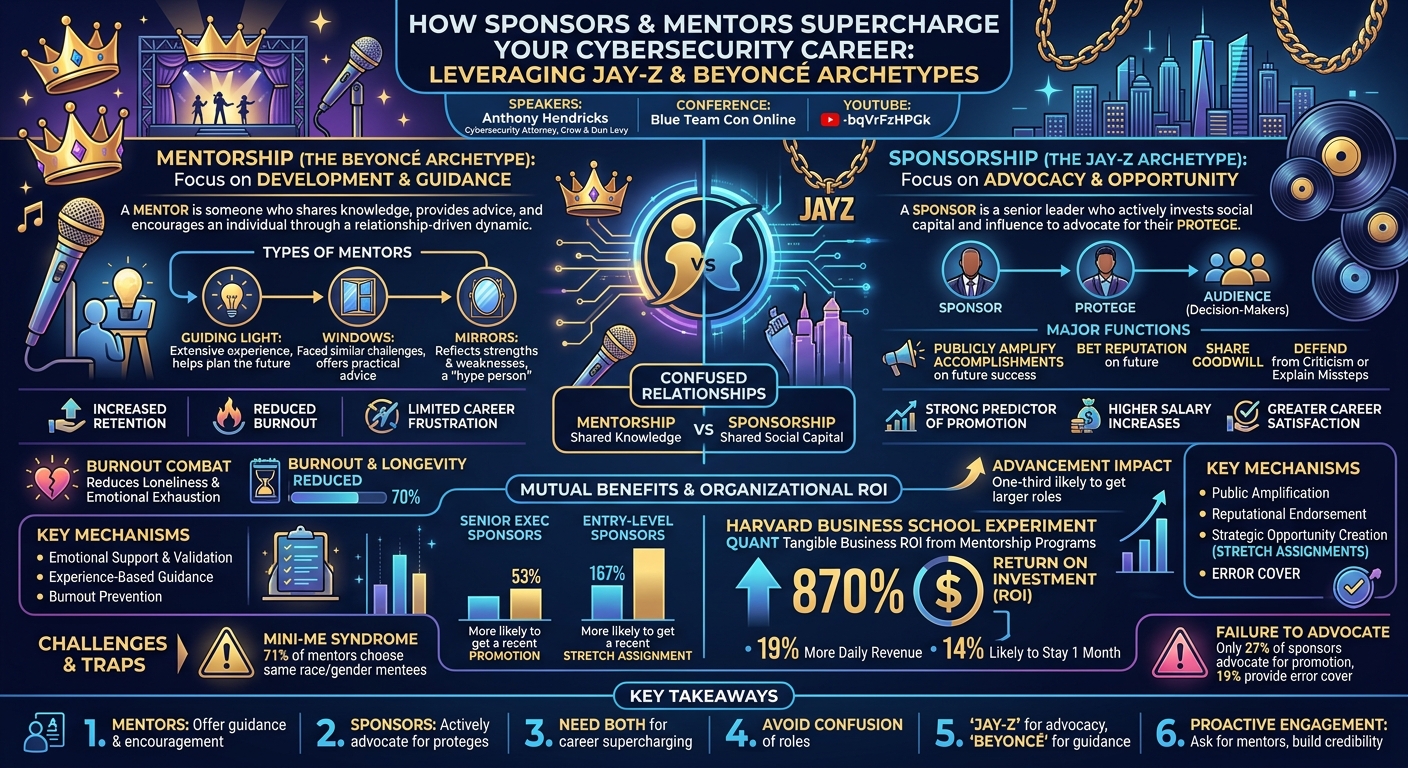
The problem, as Hendricks highlighted, is that people frequently confuse these two roles, leading to ineffective relationships and missed opportunities. Understanding the clear distinctions is paramount because while both contribute to career success, they serve different, irreplaceable functions. Research underscores their importance: mentors increase retention, reduce burnout, and limit career frustrations. Sponsors, on the other hand, are one of the strongest predictors of promotion and salary increases, often outweighing factors like gender, personality, education, or experience. This comprehensive background sets the stage for a deeper exploration of their individual and combined power.
Key Findings
▶ Watch: Defining Mentorship: Guidance, Advice, and Encouragement (4:15)
Anthony Hendricks's presentation illuminated several critical findings regarding the impact of mentorship and sponsorship on career development, particularly within the cybersecurity domain. These findings underscore not only individual benefits but also significant organizational advantages:
- Retention and Burnout Reduction: Mentors play a crucial role in increasing employee retention and combating workplace burnout. The cybersecurity industry, in particular, faces high levels of work stress and a perceived lack of management support, leading to professionals leaving organizations. Mentorship directly addresses these issues by fostering stronger, more valuable relationships at work, providing access to influential individuals, and developing social skills. A study from the Harvard Business Review identified loneliness and emotional exhaustion as key causes of burnout, which mentorship actively mitigates. The financial implications of burnout are substantial, with businesses experiencing a 37% higher absentee rate and 16% lower profitability. Even more critically, a UC Irvine study found that burnout and loneliness can decrease longevity by 70%, highlighting the profound personal cost.
- Promotion and Salary Advancement: Sponsorship is identified as one of the strongest predictors of promotion and salary increases. It acts as a "great equalizer," often having a greater impact on career progression than an individual's gender, personality, education, or experience. Individuals with sponsors report higher levels of career satisfaction, demonstrating the qualitative benefits beyond just financial gains.
- Mutual Benefits for Sponsors: The relationship is not one-sided; sponsors also reap significant rewards. Senior executives who actively sponsor proteges are 53% more likely to have received a recent promotion themselves. Furthermore, entry-level professionals who sponsor someone else are an astounding 167% more likely to have gotten a recent stretch assignment. These stretch assignments are pivotal for skill development, increased visibility, and ultimately, further career advancement, creating a virtuous cycle of growth within organizations.
- Tangible Business ROI from Mentorship Programs: A 2017 Harvard Business School experiment at a U.S. call center demonstrated the quantifiable benefits of mandatory mentorship programs. New employees assigned mentors generated 19% more daily revenue than their unmentored counterparts in the first two months, with over 90% of this revenue gain sustained over six months. Additionally, mentored representatives were 14% more likely to stay with the company for at least a month, a significant factor in high-turnover environments like call centers. The program ultimately yielded an impressive 870% return on investment (ROI), proving that well-structured mentorship is a powerful business strategy.
- The Critical Role of Advocacy and "Error Cover" in Sponsorship: The talk emphasized that effective sponsors do more than just guide; they actively advocate and provide "error cover." This means shielding proteges from criticism, especially when they take on challenging "stretch roles" outside their comfort zone. Ursula Burns, former CEO of Xerox, exemplified this, describing how prior CEOs (who she mistakenly called mentors) provided her with responsibilities she wasn't ready for, while simultaneously protecting her from the inevitable missteps, leading to significant growth and exposure to senior leadership.
- Challenges and Pitfalls: Hendricks highlighted that despite the clear benefits, both mentorship and sponsorship face challenges. A study from the Center for Talent Innovation revealed that only 27% of self-identified sponsors actively advocate for their protege's promotion, and only 19% reported providing "error cover." This indicates a widespread misunderstanding of the sponsor's true role. Furthermore, the "mini-me" syndrome is prevalent, with 71% of mentors choosing mentees of the same race and gender, limiting opportunities for diverse groups and potentially hindering long-term growth, as opposite-gender mentorship has been shown to lead to more sustained development.
These findings collectively underscore the strategic importance of understanding and actively cultivating both mentorship and sponsorship for individual career success and organizational health, particularly in a complex and evolving field like cybersecurity.
Technical Deep Dive: Mechanisms of Mentorship and Sponsorship
▶ Watch: Guiding Light, Windows, and Mirrors: Types of Mentors (4:45)
While "You Need a Jay-Z and a Beyoncé" does not delve into technical cybersecurity concepts, its "technical deep dive" lies in the meticulous deconstruction of the mechanisms and practical applications of mentorship and sponsorship. Hendricks provided a detailed exploration of how these relationships function, the specific actions involved, and the underlying psychological and organizational dynamics that make them so impactful.
The Beyoncé Archetype: Mechanisms of Mentorship
Mentorship, personified by Beyoncé, primarily operates through encouragement, guidance, and the sharing of experience. It's a direct, relational exchange where the mentor's role is to uplift and advise. Hendricks outlined several practical mechanisms:
- Emotional Support and Validation: Mentors provide a crucial source of encouragement, helping mentees celebrate their wins and offering kind words during challenges. This was exemplified by Beyoncé's note of encouragement to singer Khloe Bailey after her solo performance, a simple act that validates effort and success.
- Experience-Based Guidance (Guiding Light): Mentors leverage their own career trajectories to illuminate paths for their mentees. The example of Beyoncé mentoring the R&B group Chloe x Halle, who are signed to her label, is illustrative. As Beyoncé started in a girl group and transitioned to a solo career, her journey directly mimics theirs, allowing her to serve as a "guiding light" through similar career phases.
- Self-Awareness and Strength Identification (Mirror): Mentors act as "mirrors" by reflecting a mentee's strengths and potential back to them. Lizzo's account of Beyoncé recognizing her artistic strength, even after Lizzo beat her for a Grammy, demonstrates how mentors can highlight qualities the mentee might undervalue or not fully perceive in themselves. This mechanism fosters self-confidence and helps mentees lean into their unique talents.
- Burnout Prevention: By providing a connection and reducing feelings of isolation, mentors directly combat the loneliness and emotional exhaustion that are primary drivers of burnout. This is a critical, often overlooked, mechanism that sustains careers in high-stress fields.
The efficacy of structured mentorship programs was quantified by a 2017 Harvard Business School experiment at a U.S. call center. New employees in a mandatory four-week mentorship program generated 19% more daily revenue than unmentored counterparts in the first two months, with 90% of this gain sustained over six months. Furthermore, mentored employees were 14% more likely to stay with the company for at least a month. The program's 870% ROI demonstrates that intentional mentorship is a powerful business mechanism, not just a feel-good initiative.
The Jay-Z Archetype: Mechanisms of Sponsorship
Sponsorship, embodied by Jay-Z, is a more active, politically charged form of advocacy. It involves a senior leader leveraging their social capital and influence within an organization on behalf of a protege. The mechanisms are distinct:
- Public Amplification of Accomplishments: Sponsors proactively publicize their protege's achievements to a relevant "audience." Jay-Z's Grammy speech, where he highlighted Beyoncé's record number of Grammys while criticizing her lack of Album of the Year wins, is a prime example of a sponsor publicly advocating and attempting to shift perception.
- Reputational Endorsement and Goodwill Transfer: A sponsor essentially "bets" their own reputation on their protege. Jay-Z's relationship with Memphis Bleek, the first artist signed to Rockefeller Records, illustrates this. Giving artists the Rockefeller chain or "shout-outs" in lyrics ("Bleek could be a hit away his whole career, but if he dies, he's in my will") signifies a public endorsement, associating the protege with the sponsor's established goodwill and success.
- Defense and "Error Cover": A critical mechanism of sponsorship is the defense of a protege from criticism and, if necessary, offering explanations for poor performance. This is particularly vital when proteges are given stretch assignments – challenging roles designed to foster growth but that carry inherent risks. Ursula Burns, former Xerox CEO, described how her senior leaders provided "error cover" while she tackled responsibilities she felt unprepared for, protecting her from the consequences of potential missteps as she learned and developed.
- Strategic Opportunity Creation (Stretch Assignments): Sponsors actively create and provide opportunities for their proteges to grow and gain visibility. Jay-Z's assignment of Memphis Bleek to run his alcohol company, despite Bleek lacking a business background, is a classic example of a stretch assignment. This mechanism forces the protege to learn new skills and provides a platform to demonstrate capabilities, leading to advancement.
- Targeted Advancement Programs: Organizations can formalize sponsorship. The Deutsch Bank example showcased a program pairing female managing directors with executive committee members. This increased the female talent pool's exposure to decision-makers and ensured they had influential advocates for critical positions, resulting in one-third of participants being placed in larger roles within a year.
Distinguishing and Avoiding Pitfalls
Hendricks stressed that confusing these roles renders them less effective. The issue of sponsors acting like mentors, providing guidance but failing to advocate or offer error cover, is a significant problem. A Center for Talent Innovation study revealed that only 27% of self-identified sponsors advocate for promotion, and only 19% provide error cover, highlighting a widespread failure to execute the core functions of sponsorship.
Another critical mechanism discussed was the "mini-me" syndrome. 71% of mentors choose mentees of the same race and gender, which limits diversity and perpetuates existing power structures. While initial comfort may exist, studies of medical residents showed that while same-gender mentorship provided initial growth, opposite-gender mentorship led to longer-term growth and success, demonstrating the value of diverse perspectives in fostering comprehensive development. Effective mentorship and sponsorship require a conscious effort to overcome these biases and leverage the distinct mechanisms of each relationship for maximum impact.
Demo / Proof of Concept
▶ Watch: Sponsor's Role: Amplifying, Betting Reputation, and Defending (7:20)
The talk "You Need a Jay-Z and a Beyoncé" was a conceptual presentation focused on career development strategies, rather than a technical demonstration. As such, there was no live demo or proof of concept in the traditional cybersecurity sense involving tools, code, or exploit techniques. Instead, Anthony Hendricks utilized real-world examples from pop culture, business case studies, and personal anecdotes to illustrate the concepts of mentorship and sponsorship, effectively serving as compelling "proofs of concept" for the theories he presented.
For instance, the speaker referenced the Harvard Business School experiment at a U.S. call center as a robust business case study demonstrating the tangible benefits and return on investment of structured mentorship programs. Similarly, the Deutsch Bank sponsorship program for women served as a proof of concept for how targeted sponsorship initiatives can lead to significant career advancement within an organization. These examples, alongside the Jay-Z and Beyoncé metaphors, provided strong empirical and anecdotal evidence to support the talk's core arguments.
Defensive Implications
▶ Watch: Career Impact: Development, Relationships, and Retention (8:20)
While this talk does not directly address cybersecurity defenses, its implications for career development within the cybersecurity industry are profound and can be reframed as actionable strategies for professional resilience and growth. The concepts of mentorship and sponsorship offer critical "defensive mechanisms" against career stagnation, burnout, and the challenges of navigating a complex professional landscape.
For Cybersecurity Professionals (Mentees/Proteges):
- Proactive Mentorship Seeking: Cybersecurity professionals should actively seek out mentors. This doesn't require a formal program; simply asking someone to serve as a mentor is often effective. Mentors can be peers, junior leaders, or senior figures, both within and outside one's company. They provide crucial guidance on social skills, office dynamics, and dealing with challenging managers or colleagues – skills often overlooked but vital for long-term career survival and success, especially when technical expertise alone isn't enough.
- Strategic Sponsorship Cultivation: Gaining a sponsor requires more deliberate effort. Professionals must first build credibility by consistently performing well and taking responsibility for their work. Researching potential sponsors' roles and priorities is essential before making an ask. Proteges should also aim to provide value to their sponsors, whether by teaching new skills, offering candid feedback, or helping extend their legacy. Clearly articulating career goals to both mentors and sponsors ensures that the advice and opportunities received are aligned with personal aspirations. Finally, over-delivering on projects and respecting a sponsor's time demonstrates commitment and makes the investment worthwhile for the sponsor.
- Combating Burnout: By engaging in mentorship relationships, cybersecurity professionals can actively combat the loneliness and emotional exhaustion that lead to burnout. Mentors serve as sounding boards and sources of encouragement, fostering a sense of connection and support that is vital in high-pressure roles.
For Cybersecurity Leaders and Organizations (Mentors/Sponsors):
- Clarifying Roles and Responsibilities: Leaders must understand the distinct roles of mentors and sponsors. Mentors provide guidance; sponsors actively advocate, use their social capital, and offer "error cover." Organizations should educate their leaders on the full scope of sponsorship, emphasizing the importance of active advocacy for promotions and providing support during stretch assignments. This is crucial given that a Center for Talent Innovation study found only 27% of sponsors advocate for promotion and 19% provide error cover.
- Fostering Inclusive Mentorship and Sponsorship: To build a more diverse and resilient cybersecurity workforce, leaders must actively combat the "mini-me" syndrome. Encouraging mentorship and sponsorship across different demographics (race, gender, background) can lead to longer-term growth and success, as diverse perspectives introduce new insights and challenges that foster deeper development. This is especially important given the scarcity of women and people of color in management positions, which can make it harder for them to find mentors and sponsors who look like them.
- Investing in Formal Programs: Organizations should consider implementing well-structured, even mandatory, mentorship programs, as demonstrated by the Harvard Business School call center experiment's 870% ROI. These programs can significantly improve employee retention, productivity, and overall job satisfaction, directly impacting the organization's "defensive posture" against talent drain.
- Strategic Use of Stretch Assignments: Sponsors should strategically offer stretch assignments to proteges. While challenging, these assignments provide invaluable opportunities for skill development and increased visibility. Crucially, sponsors must also provide the necessary error cover and support to ensure proteges can learn and grow from these experiences without undue career risk.
By consciously adopting these strategies, cybersecurity professionals can proactively shape their careers, and organizations can build more robust, engaged, and diverse teams, effectively "supercharging" the industry's human capital.
Key Takeaways
Here are the six main takeaways from Anthony Hendricks's presentation:
- Mentors provide encouragement and guidance: They serve as a sounding board for ideas, offering advice, support, and helping individuals navigate their career paths and personal growth.
- Sponsors are active advocates for their protege: They use their social capital and influence to amplify accomplishments, create opportunities, and defend their protege within the organization.
- Both sponsors and mentors are essential for personal and professional growth: Having both types of relationships significantly boosts career advancement, job satisfaction, and resilience against burnout.
- The roles of mentors and sponsors are often confused, leading to ineffectiveness: Understanding the distinct responsibilities of each is critical for individuals seeking support and for those providing it.
- You need both a "Jay-Z" and a "Beyoncé": A mentor offers the encouragement and guidance of a Beyoncé, while a sponsor provides the active advocacy and opportunity creation of a Jay-Z.
- Proactive engagement is key: Individuals should actively ask for mentors and build credibility through strong performance and initiative to earn a sponsor.
About the Speaker(s)
Anthony Hendricks is a distinguished cybersecurity attorney based at Crow & Dun Levy in Oklahoma City. His professional expertise lies at the intersection of law and cybersecurity, providing critical insights into the legal implications and strategic approaches within the digital security landscape. Beyond his legal practice, Hendricks is a passionate advocate for diversity and inclusion in the tech sector. He hosts a cybersecurity podcast specifically designed to expose underrepresented groups to the fields of cybersecurity and data privacy, reflecting his commitment to broadening access and opportunity within the industry. His presentation at Blue Team Con Online exemplifies his dedication to fostering professional growth and empowering individuals to navigate their careers effectively.
Reviews
Dr. Zero (Offensive Security Researcher) — WEAK
A career-advice talk about mentorship vs. sponsorship that belongs on LinkedIn, not at a security conference. Zero technical content, zero security-specific insight. The Jay-Z/Beyoncé framing is cute but the substance is generic HR wisdom you could get from any TED talk or business podcast.
Heather Calloway (CISO) — WEAK
Generic career advice dressed up in pop culture metaphors. Nothing here is specific to cybersecurity, and the research citations don't survive scrutiny for a security leadership audience. This is motivational content, not governance insight.