Maturing your cyber deception program: What’s the plan?
Suril Desai
Blue Team Con Online 2026 · Day 1 · Blue Team Con Online
Overview
In the evolving landscape of cyber threats, traditional security defenses often struggle to keep pace with sophisticated adversaries who employ stealthy techniques and adapt their tactics. Suril Desai's talk, "Maturing your cyber deception program: What’s the plan?", delivered at Blue Team Con Online, addresses this critical challenge by advocating for a strategic, intelligent approach to cyber deception. Desai, a subject matter expert on deception technology and VP of Engineering at Accel View, argues that simply deploying a high volume of traps (density) is insufficient and often impractical. Instead, he introduces the concept of effective density, emphasizing the careful curation and strategic placement of deceptions to maximize their impact.
Key moments
- 0:00 Introduction and talk agenda overview
- 2:00 Defining cyber deception technology and its principles
- 3:17 Exploring different types of deception: honey accounts, tokens, decoys, baits
- 4:30 Challenges and complexities in deploying deception programs
- 6:30 Understanding the attacker's mindset and lateral movement goals
- 8:40 How attackers use tools like BloodHound for path planning
Maturing your cyber deception program: What’s the plan?
Speakers: Suril Desai, VP of Engineering, Accel View
Conference: Blue Team Con Online
YouTube: https://www.youtube.com/watch?v=GJ3yXpSzD8U
Overview
In the evolving landscape of cyber threats, traditional security defenses often struggle to keep pace with sophisticated adversaries who employ stealthy techniques and adapt their tactics. Suril Desai's talk, "Maturing your cyber deception program: What’s the plan?", delivered at Blue Team Con Online, addresses this critical challenge by advocating for a strategic, intelligent approach to cyber deception. Desai, a subject matter expert on deception technology and VP of Engineering at Accel View, argues that simply deploying a high volume of traps (density) is insufficient and often impractical. Instead, he introduces the concept of effective density, emphasizing the careful curation and strategic placement of deceptions to maximize their impact.
The presentation provides a comprehensive guide for organizations looking to enhance their defensive posture through deception. Desai covers the fundamental principles of deception technology, its various forms, and practical strategies for implementation. He delves into the attacker's mindset, illustrating how understanding adversary goals and methodologies can inform a more robust deception strategy. By shifting the focus from mere quantity to quality and strategic relevance, Desai's insights empower blue teams to detect advanced threats, hunt for latent adversaries, and gather crucial threat intelligence before real assets are compromised. This talk is essential for security professionals seeking to build resilient, proactive defense mechanisms against today's persistent and adaptive threat actors.
Background
▶ Watch: Introduction and talk agenda overview (0:00)
The concept of cyber deception is rooted in military strategy, applying principles of misdirection and misrepresentation to the digital realm. In cybersecurity, it involves creating artificial lures and environments designed to detect, analyze, or divert attackers. Historically, deception technology has often been associated with honeypots – systems intentionally left vulnerable to attract and trap attackers. The early approach to deception programs frequently focused on density: the idea that saturating an environment with a large number of traps would statistically increase the chances of an attacker encountering one.
However, as Desai highlights, this traditional view faces significant practical limitations in modern production environments. For instance, in an Active Directory (AD) domain with 10,000 real accounts, creating another 10,000 fake accounts is not only impractical but also likely to be rejected by IT operations teams due to complexity and resource overhead. If a defender is constrained to deploying only 50 deceptive accounts, the challenge becomes influencing an attacker to choose those 50 fakes over the 10,000 real ones. This necessitates a more refined approach than simple volumetric deployment.
The problem is further exacerbated by the increasing sophistication of attackers. Modern threat actors, particularly Advanced Persistent Threat (APT) groups, are discerning and methodical. They conduct extensive reconnaissance to map environments, identify high-value targets, and plan lateral movement pathways to minimize detection. Tools like BloodHound have democratized advanced attack path planning, allowing adversaries to automate multi-step analysis using graph theory and pre-built queries (e.g., "find shortest path to domain admin" or "find shortest paths from Kerberos double users"). This means attackers are no longer blindly stumbling through networks; they are actively seeking optimal, low-risk routes to their objectives. Traditional, high-density, but poorly placed deceptions are easily bypassed by such sophisticated planning, rendering them ineffective. This context underscores the urgent need for a more intelligent, attacker-centric deception strategy that goes beyond simple trap deployment.
Key Findings
▶ Watch: Exploring different types of deception: honey accounts, tokens, decoys, baits (3:17)
Desai's talk presents several key findings and principles for maturing a cyber deception program, moving beyond simplistic density models to a more strategic, attacker-focused approach:
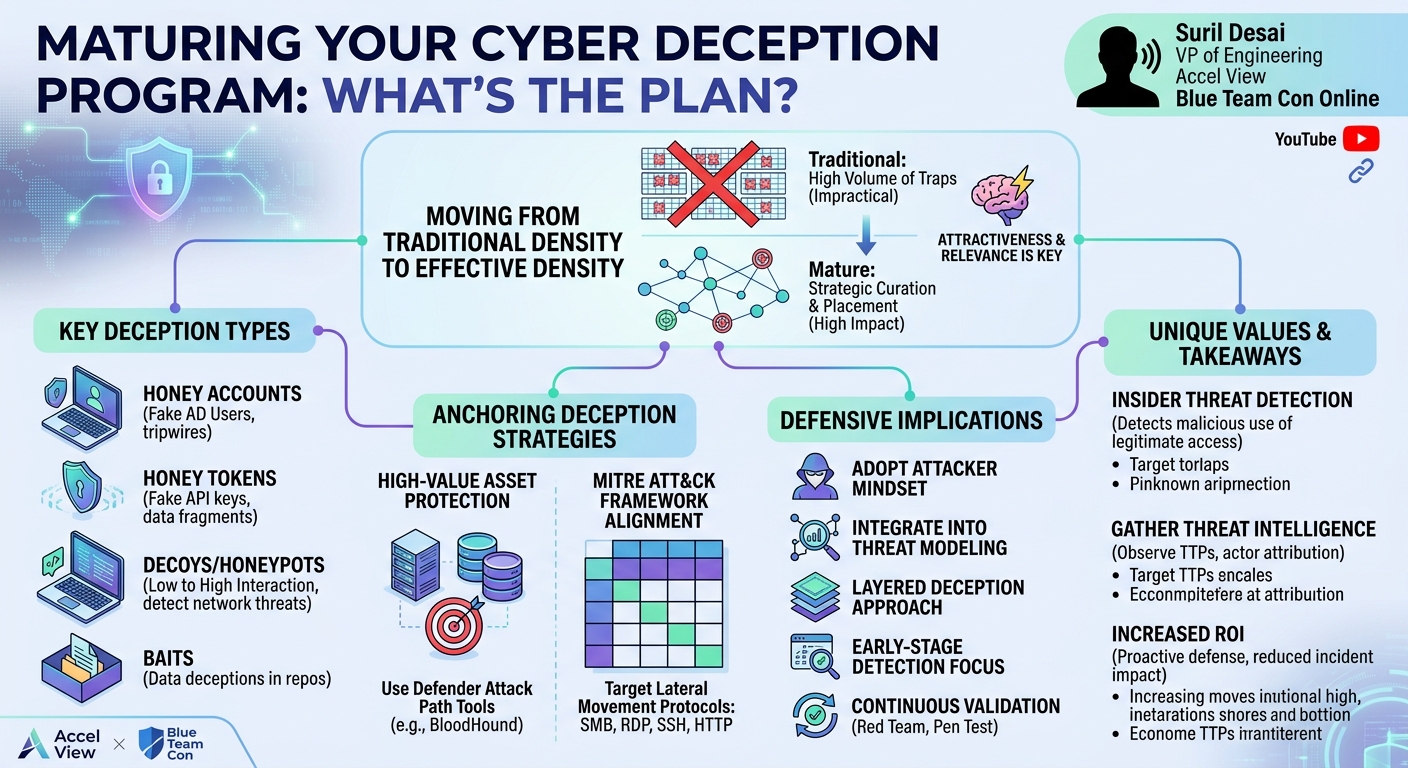
- Effective Density over Absolute Density: The primary finding is that successful deception is not about saturating an environment with traps but rather about effective density. This means placing a sufficient number of carefully curated deceptions at the right locations to influence attacker behavior. It's about quality and strategic placement, not just quantity.
- Attractiveness is Paramount: Deceptions must be inherently attractive to attackers. They need to mimic high-value assets, privileged accounts, or exploitable vulnerabilities that align with typical attacker goals. An attacker should perceive the deception as a more desirable or easier target than legitimate assets, thereby increasing the odds of engagement.
- Anchoring Strategies to Attacker Goals: A mature deception strategy must be anchored in an understanding of the attacker's mindset and objectives. Desai proposes two main anchoring strategies:
- High-Value Asset Protection: Proactively identifying critical infrastructure (e.g., Microsoft Tier Zero assets, production databases, executive workstations) and using defender-side attack path planning tools (like BloodHound for blue teams) to map potential attack pathways. Deceptions are then strategically placed along these paths and around the assets.
- MITRE ATT&CK Framework Alignment: Utilizing the MITRE ATT&CK matrix to identify common lateral movement protocols and techniques (e.g., SMB, HTTP, SSH, RDP). Deception decoys are then tailored and placed in high-risk areas (like user laptops) to detect and stop lateral movement early.
- Multi-Dimensional Deception Design: An effective deception strategy considers multiple dimensions:
- Type: Selecting the right kind of deception (honey accounts, honey tokens, decoys, baits).
- Count: Determining the optimal number, not just maximum.
- Placement: The most critical factor, ensuring deceptions are located where attackers are likely to encounter them.
- Realism: Making deceptions appear authentic and relevant to the specific environment.
- Attractiveness: Designing deceptions to be highly desirable targets.
- Containment: Ensuring deceptions do not create new risks for the organization and safely deflect attackers.
- Dynamism & Refreshment: Regularly changing and updating deceptions to counter returning attackers and evolving TTPs.
- Unique Value for Insider Threat Detection: Deception technology offers a distinct advantage in detecting insider threats, particularly from disgruntled employees who might leverage legitimate access for malicious purposes. Since their actions often appear consistent with normal usage, traditional anomaly-based controls may fail. A well-placed honey account, if targeted by a malicious insider, can trigger an immediate and high-fidelity alert.
These findings collectively advocate for a paradigm shift in deception deployment, transforming it from a static, quantity-driven exercise into a dynamic, intelligent, and integral component of a proactive cyber defense strategy.
Technical Deep Dive
▶ Watch: Challenges and complexities in deploying deception programs (4:30)
Maturing a cyber deception program requires a nuanced understanding of various deception types, strategic deployment methodologies, and an attacker-centric perspective. Desai meticulously breaks down these components, offering a technical blueprint for effective implementation.
Types of Deception
Desai categorizes deception into several core types, each serving a specific purpose:
- Honey Accounts: These are deceptive user or service accounts added to identity stores, such as an on-premise Active Directory (AD) environment. They are designed to appear legitimate but are not used for any existing workflows. Any interaction with a honey account immediately signals malicious activity. A key challenge in creating these is configuring the 100+ attributes of an AD object (e.g.,
userAccountControlbitmask) to be realistic and attractive without being truly functional.
- Honey Tokens: Deceptive credential profiles or sensitive data fragments deployed on endpoints or within data repositories. These can include fake API keys, database credentials, or sensitive documents. They act as tripwires; any attempt to access or use a honey token indicates a compromise or reconnaissance effort. They are particularly useful for detecting endpoint threats, data exfiltration, and insider risk.
- Decoys (Honeypots): These are network-level traps, effectively new targets for an attacker. Originally known as honeypots, decoys can detect network threats, application-specific exploits, and data threats. They can vary in their level of interactivity:
- Low-interaction honeypots: Open ports (e.g., port 22 for SSH) that monitor connection attempts but do not allow attackers to proceed far. Good for initial threat detection.
- Medium-interaction honeypots: Can speak the protocol (e.g., SSH) and allow login attempts or credential exploits but still prevent full system access. Useful for threat detection and some basic threat hunting.
- High-interaction honeypots: Allow successful login and continuous activity in a monitored, isolated environment. These are invaluable for adversary engagement, generating deep threat intelligence, and threat actor attribution, as they allow defenders to observe attacker TTPs in detail.
- Baits: Similar to honey tokens, baits are data deceptions embedded in data repositories and on endpoints. They are specifically designed to lure attackers into interacting with them, revealing their presence and intent. Baits are effective for detecting advanced exploits like data exfiltration and insider risks.
Attacker Mindset and Attack Path Planning
A cornerstone of Desai's strategy is understanding the attacker. An attacker gaining initial access typically aims to compromise a high-value asset (e.g., a critical database, a domain controller). To achieve this, they need to:
- Find the target: Locate the high-value asset within the enterprise network.
- Find a pathway: Identify an attack path leading to the target.
- Lateral movement: Execute lateral movement using stolen credentials or vulnerability exploits.
- Reconnaissance: Perform reconnaissance on endpoints, networks, or catalogs (like Active Directory or DNS) to gather information.
Sophisticated attackers use tools like BloodHound to automate attack path planning. BloodHound leverages graph theory to identify relationships between users, groups, computers, and other AD objects, revealing complex attack paths to privileged targets. This automation allows attackers to quickly find the shortest, stealthiest routes, making random or poorly placed deceptions ineffective.
Defender's Strategic Approach: Effective Density
Given the attacker's sophistication, Desai proposes that defenders adopt an "attacker's mindset" to formulate an effective strategy. The concept of effective density replaces absolute density, focusing on:
- Attractiveness: Deceptions must be designed to be more appealing for exploitation than real assets. This involves careful curation of attributes, naming conventions, and perceived value.
- Placement: This is the most critical dimension. Deceptions must be placed strategically where attackers are most likely to encounter them during reconnaissance or lateral movement.
- Realism: Deceptions must blend seamlessly into the environment, appearing authentic and relevant. This requires deep domain knowledge during setup.
- Containment: Deceptions must be designed to safely deflect attackers away from real assets and into monitored environments without causing harm or creating new vulnerabilities.
- Dynamism and Refreshment: Deceptions should not be static. They must be periodically updated and refreshed to counter persistent attackers who might return or adapt their TTPs.
Anchoring Deception Strategies
Desai outlines two primary ways to anchor a deception strategy:
- High-Value Asset Anchoring:
- Identify Critical Assets: Proactively determine critical infrastructure (Microsoft Tier Zero assets like AD domain controllers, ADFS, Entra Connect; important business applications like ERP/CRM; production databases with sensitive data like PCI; executive laptops).
- Defender-Side Attack Path Planning: Use tools like BloodHound (but from a defender's perspective) to map all possible attack pathways leading to these high-value assets before an attacker does.
- Strategic Trap Placement: Place deceptive traps (honey accounts, honey tokens, decoys) on and around these known attack pathways and the high-value assets themselves. The goal is to detect and safely deflect the attacker before they reach the real target.
- Attack Scenario Example: An attacker performs reconnaissance, finds an "unpatched" database server (which is actually a decoy), and attempts to exploit it. The blue team immediately detects this, isolates the attacker, and prevents them from reaching the real database.
- MITRE ATT&CK Framework Anchoring:
- Focus on Lateral Movement: Recognize that stopping lateral movement significantly reduces the blast radius of a compromise.
- Leverage MITRE ATT&CK Matrix: The matrix provides a well-defined taxonomy of protocols and techniques used for lateral movement (e.g., SMB, HTTP, SSH, RDP).
- Protocol-Specific Decoys: Set up decoys tailored for each of these protocols.
- High-Risk Area Placement: Place these decoys in areas where lateral movement is likely to originate or occur, such as user laptops.
- Count Based on Asset Numbers: Scale the number of deceptions based on the actual asset counts in the environment to maintain realism and relevance.
Real-World Attack Scenarios and Deception Strategies
Desai provides illustrative scenarios:
- Active Directory Attacks: An attacker lands on an endpoint and performs living off the land attacks, such as
set SPNenumeration, looking for a production SQL server. A well-placed decoy honey account SPN (Service Principal Name) that looks like a high-value SQL server will attract the attacker. Any attempt to exploit this decoy immediately alerts the defender.
- Insider Threats: A disgruntled Identity and Access Management (IAM) administrator leverages legitimate access to an AD management server to systematically disable user accounts via an automation script using a privileged service account (potentially managed by a PAM system). Traditional security controls (log analytics, EDR) might not flag this due to the legitimate context. A honey account designed to look like an interesting target for a privileged insider, if disabled, would trigger an immediate alert, allowing the defender to intervene.
- Cloud Environments: Attackers perform living off the cloud attacks, using built-in APIs and SDKs for enumeration and privilege escalation within a cloud workload (e.g., AWS, Azure). They enumerate administrative accounts or roles. A deceptive honey token account placed in the cloud environment with tempting permissions will lure the attacker. Any attempt to interact with or elevate privileges using this token generates an instant alert.
The talk also touches upon the Kerckhoffs' principle in the Q&A, highlighting that while the general implementation of honeypots (e.g., open-source projects like Kippo, Dionaea, Cowrie for SSH honeypots) can be public, the crucial elements that must remain secret are the specific characteristics, naming conventions, and placement tailored to a particular environment. Deceptions must be unique, dynamic, and updated periodically to prevent attackers from easily identifying them as fakes.
Demo / Proof of Concept
▶ Watch: Understanding the attacker's mindset and lateral movement goals (6:30)
The talk describes several illustrative attack scenarios and how deception strategies would counter them, providing a conceptual framework rather than a live demonstration. Specific tools like BloodHound are mentioned in the context of both attacker and defender strategies, and open-source honeypots like Kippo, Dionaea, and Cowrie are referenced as learning resources. However, there was no explicit live demo or proof of concept shown during the presentation. The scenarios effectively serve as theoretical demonstrations of the proposed deception strategies in action.
Defensive Implications
▶ Watch: How attackers use tools like BloodHound for path planning (8:40)
The insights shared by Suril Desai offer profound implications for blue teams seeking to bolster their defenses against sophisticated cyber threats. The core shift is from a reactive, perimeter-focused defense to a proactive, interior-focused strategy that leverages deception to gain an asymmetric advantage over adversaries.
- Re-evaluate Deception Program Design: Organizations must move beyond simply deploying a high volume of generic traps. The focus should be on effective density – strategically placing a smaller number of highly realistic and attractive deceptions. This requires a deep understanding of the organization's critical assets and potential attack paths.
- Adopt an Attacker's Mindset for Planning: Defenders should actively use attacker tools and methodologies, such as BloodHound, to map their own environment for potential attack paths. By identifying these pathways proactively, blue teams can strategically place deceptions to intercept attackers before they reach high-value targets. This "offensive defense" approach is crucial for anticipating adversary movements.
- Integrate Deception into Threat Modeling: Deception placement should be a key component of an organization's threat modeling process. As part of identifying high-value assets and trust boundaries (e.g., between DMZ and data center zones), defenders can identify optimal locations for decoys and honey tokens to provide early warnings when attackers attempt to cross these critical segments or target specific assets.
- Emphasize Realism and Attractiveness: Deceptions are only effective if they appear legitimate and enticing to attackers. This means investing time in crafting realistic naming schemes, configuring appropriate attributes (especially for honey accounts in Active Directory), and ensuring the deceptions resemble actual high-value assets or exploitable vulnerabilities relevant to the environment. Generic, unconvincing traps will likely be bypassed.
- Utilize a Layered Deception Approach: A robust deception program will likely combine different types of deceptions. Starting with honey tokens offers a low-footprint, easy-to-deploy option for initial threat detection. As the program matures, organizations can introduce decoys (honeypots) of varying interactivity – low/medium for broad detection and high-interaction honeypots for deep threat intelligence gathering and adversary engagement. Deploying decoy networks allows for comprehensive study of sophisticated threat actors.
- Focus on Early-Stage ATT&CK Tactics: For early warning, deception strategies should prioritize tactics in the MITRE ATT&CK matrix related to initial reconnaissance, discovery, credential access, and lateral movement. By placing traps aligned with these early-stage activities, defenders can detect attackers before they achieve their primary objectives like data exfiltration or impact.
- Leverage Deception for Insider Threat Detection: Deception technology provides a unique capability to detect insider threats, particularly from disgruntled employees using legitimate access for malicious purposes. Traditional security controls often struggle here because actions appear "normal." A well-placed honey account can act as a specific tripwire for such misuse.
- Continuous Validation and Improvement: Deception programs are not "set-and-forget." They require continuous validation through red teaming and controlled pen testing exercises. Red teams can simulate real attackers, attempting to bypass deceptions. The results inform adjustments to placement, realism, and attractiveness, ensuring the program remains effective and demonstrates ongoing value (ROI). Deceptions must also be dynamically refreshed to counter evolving attacker TTPs and prevent them from being "burned."
- Invest in Offensive Security Knowledge: To design effective deceptions, blue team members need a solid understanding of offensive security techniques. Learning about attack pathways, exploitable risks, and common attacker tools (like BloodHound) helps defenders anticipate adversary moves and craft more potent traps. Practical learning can also come from experimenting with open-source honeypots like Kippo, Dionaea, and Cowrie.
By implementing these defensive implications, organizations can transform their deception capabilities from a supplementary tool into a central, strategic pillar of their cybersecurity architecture, enabling proactive detection, enhanced threat intelligence, and more effective incident response.
Key Takeaways
- Effective Density is Key: Move beyond simply deploying many traps. Focus on strategically placing a sufficient number of carefully curated, attractive deceptions at critical junctures to influence attacker behavior.
- Understand the Attacker's Mindset: Leverage tools like BloodHound (from a defensive perspective) to map potential attack paths to high-value assets, and then place deceptions along these anticipated routes.
- Anchor Deception to High-Value Assets and MITRE ATT&CK: Protect critical infrastructure by surrounding it with deceptions, and use the MITRE ATT&CK framework to target lateral movement protocols and techniques with tailored decoys.
- Vary Deception Types and Interactivity: Utilize honey accounts and honey tokens for lightweight, early detection. Employ decoys (honeypots) with varying levels of interactivity (low, medium, high) to match use cases, from basic threat detection to deep threat intelligence gathering.
- Deception Excels at Insider Threat Detection: Deception offers a unique capability to detect malicious insiders who might use legitimate access, as their interaction with a honey account immediately flags suspicious activity.
- Continuous Improvement and Validation are Essential: Regularly refresh deceptions, integrate them into threat modeling, and validate their effectiveness through red teaming and pen testing to ensure ongoing value and adaptability.
About the Speaker(s)
Suril Desai is the VP of Engineering at Accel View and a recognized subject matter expert on deception technology. His extensive experience in the field allows him to provide deep insights into the practical challenges and strategic solutions for implementing and maturing cyber deception programs. Desai's work focuses on helping organizations build more resilient and proactive defenses by understanding and anticipating attacker behavior.
Reviews
Dr. Zero (Offensive Security Researcher) — SOLID
A competent primer on deception strategy that correctly shifts the conversation from 'how many honeypots' to 'where and why.' Useful for teams standing up their first deception program, but offers nothing practitioners with 2+ years in this space haven't already internalized.
Heather Calloway (CISO) — SOLID
A competent practitioner-level walkthrough of deception program design that correctly identifies the core problem—density without strategy is useless—but stops short of giving defenders the operational specifics they'd need to execute. Worth the time for teams starting a deception program; less useful for mature shops.