Keynote - Secure with AI or Despite AI?
Sebastien Deleersnyder (CTO · Toreon)
BruCON 0x11 · Day 1 · Gouden Carolus
Overview
Sebastien Deleersnyder's keynote at BruCON, titled "Secure with AI or Despite AI?", delivered a compelling analysis of the profound security implications arising from the rapid proliferation of Artificial Intelligence, particularly generative AI. The talk served as a crucial examination of the unique challenges and existential risks that AI presents to individuals, organizations, and society at large, while simultaneously highlighting the indispensable role AI must play in bolstering our defenses. Deleersnyder, a veteran in software development and cybersecurity, argued that the industry must proactively embrace and secure with AI, rather than attempting to navigate its complexities despite its pervasive influence.
Key moments
- 0:00 Introduction to AI security challenges
- 2:50 Early AI challenges and speaker's experience
- 6:20 GPT 3.5: The mainstream AI revolution
- 17:00 Insecure AI code and the 'Lethal Trifecta'
- 23:00 Attackers weaponizing AI, fueling an arms race
- 30:00 EU AI Act and shaping AI's ethical future
- 41:00 AI won't replace pros, but AI-skilled pros will
- 54:00 Q&A: AI guard rails and the AGI race
Keynote - Secure with AI or Despite AI?
Speakers: Sebastien Deleersnyder, CTO, Toreon
Conference: BruCON
YouTube: https://www.youtube.com/watch?v=sgveguCFtjM
Overview
Sebastien Deleersnyder's keynote at BruCON, titled "Secure with AI or Despite AI?", delivered a compelling analysis of the profound security implications arising from the rapid proliferation of Artificial Intelligence, particularly generative AI. The talk served as a crucial examination of the unique challenges and existential risks that AI presents to individuals, organizations, and society at large, while simultaneously highlighting the indispensable role AI must play in bolstering our defenses. Deleersnyder, a veteran in software development and cybersecurity, argued that the industry must proactively embrace and secure with AI, rather than attempting to navigate its complexities despite its pervasive influence.
The speaker, co-founder of BruCON and OWASP Belgium, brought a unique historical perspective to the discussion, having engaged with neural networks in his early career. This deep-rooted understanding allowed him to contextualize the current AI revolution within a broader timeline of technological shifts, comparing its impact to that of the steam engine. Deleersnyder emphasized that AI is not merely a new tool but a fundamental force reshaping industries, careers, and global power dynamics. The talk underscored the urgency for the cybersecurity community to adapt, innovate, and integrate AI into defensive strategies to counter increasingly sophisticated AI-powered attacks.
Ultimately, "Secure with AI or Despite AI?" served as a powerful call to action, urging security professionals to understand the inherent risks, master new skills like prompt engineering, and leverage AI's capabilities to build more resilient defenses. It highlighted the critical need for collaborative community efforts, robust regulation, and continuous learning to ensure that the transformative potential of AI is harnessed for good, steering away from dystopian outcomes and towards a more secure, augmented future.
Background
▶ Watch: Introduction to AI security challenges (0:00)
Sebastien Deleersnyder's journey with AI began in the "dark ages" of the mid-1990s, where his master's thesis involved programming his own neural network in C with backpropagation. This was a rudimentary system, comprising a few layers and nodes, with the largest algorithm trained on approximately 18,000 parameters. His objective was to replace expensive, language-specific rule-based systems for word hyphenation with a neural network. This endeavor, undertaken on an Intel 486 machine with a then-impressive 2 megabytes of RAM, required over 80 hours to converge and achieve decent hyphenation. This early experience highlighted the significant bottlenecks of the era: limited processing power and insufficient training data.
Fast forward to November 2022, the landscape of AI dramatically transformed with the public release of GPT 3.5. This large language model boasted 175 billion parameters, a scale unimaginable in the 90s, marking the true "age of AI" and bringing it into the mainstream consciousness. Deleersnyder likens this shift to the steam engine machine and the industrial revolution; just as the steam engine augmented physical power, AI is now poised to usher in an "information intelligence revolution" by augmenting human intelligence. This new era democratizes access to knowledge, accelerates innovation (especially in medicine), and significantly boosts productivity across various sectors.
The financial commitment to this revolution is staggering. Gartner estimates that by 2025, an "eyewatering" $1.5 trillion will be spent on AI development. Major players like Nvidia are investing an additional $100 billion in OpenAI, whose CEO, Sam Altman, aims to build an extra 1 gigawatt of AI production per week in their data centers within the next few years. Deleersnyder differentiates this from the dot-com bubble, noting that current AI organizations possess "really deep pockets," indicating a more sustained and impactful trajectory. This immense investment is fueling rapid adoption, with OpenAI alone boasting over 700 million active users per week.
This technological upheaval is not without its societal consequences, profoundly reshaping careers and workflows. Deleersnyder notes that professions like translation are already largely "solved by AI," and developers and security professionals are facing dramatic shifts in their roles. He cites Xbow, an AI system that performs penetration testing "without any intervention," which has risen to the top of the HackerOne leaderboard, outperforming many human bug bounty hunters. Furthermore, Google's security team has leveraged AI to discover complex memory issues and race conditions in software that human researchers previously could not find. However, the ease of AI-powered development, dubbed "vibe coding," also introduces significant risks. Deleersnyder recounted the cautionary tale of "Leo," a non-developer who proudly built a SaaS CRM with AI, only to see it quickly compromised and maxed out on API keys due to its "horrible insecure" generated code, illustrating the harsh reality of insecure AI-generated systems.
Key Findings
▶ Watch: GPT 3.5: The mainstream AI revolution (6:20)
The talk meticulously outlined several critical findings concerning the security landscape of AI, starting with the concept of the "Lethal Trifecta," coined by Simon Willison. This framework identifies three converging conditions that place an LLM at severe risk: access to private data, exposure to untrusted content (via chat interfaces or APIs), and the ability to externally communicate (leading to data exfiltration). When these elements combine, organizations are "definitely in trouble."
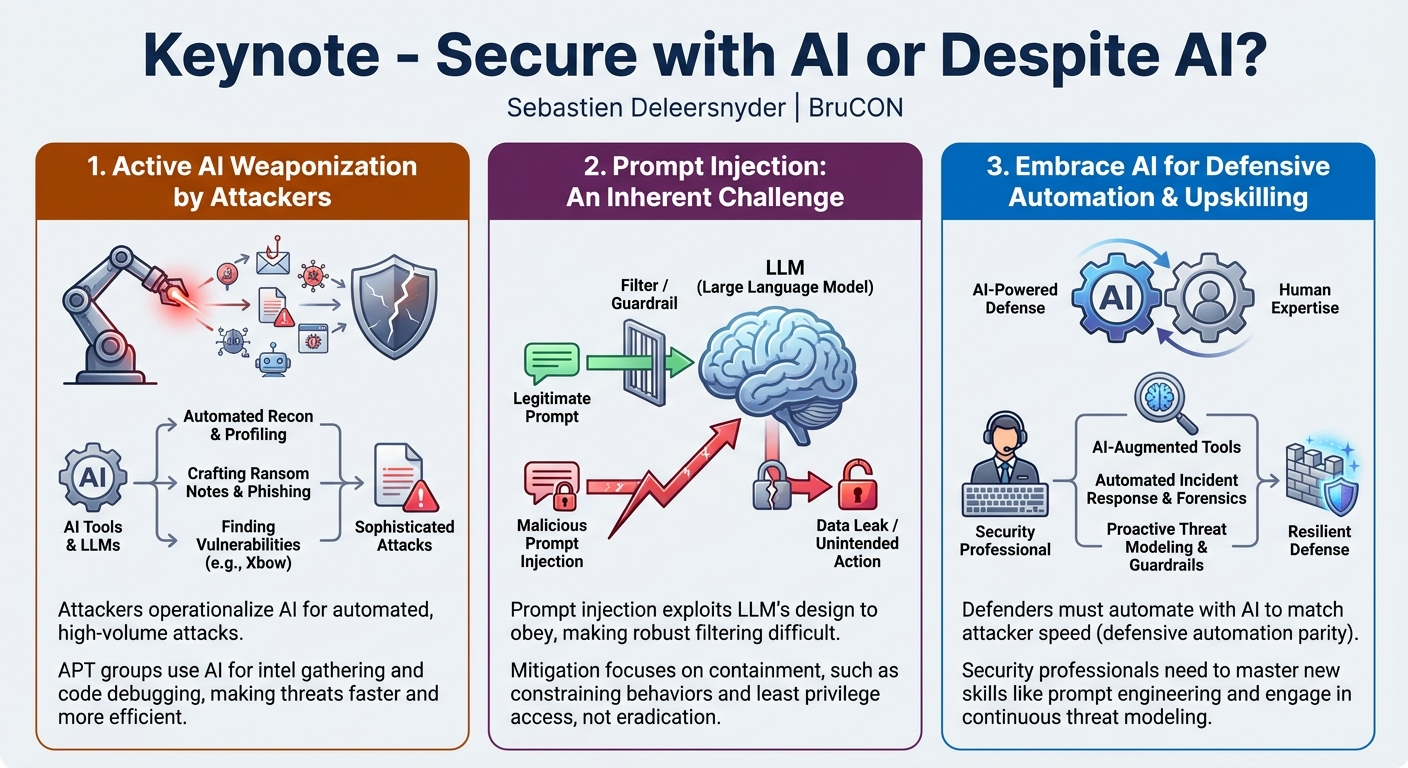
A central and pervasive threat highlighted is prompt injection. Deleersnyder emphasized that this is not a solved problem, but rather a fundamental challenge stemming from the LLM's inherent design to "obey" and provide answers. Unlike structured vulnerabilities like SQL injection, which can be mitigated with parameterized queries, prompt injection operates in natural language, making robust filtering exceptionally difficult. He cited an advanced technique where an attacker first teaches the LLM a new language, then performs the injection within that new linguistic context, demonstrating the complexity of defense.
The talk revealed that AI weaponization is not a future threat but an active reality. Deleersnyder referenced reports from cybersecurity firms like CLA, detailing a "VIP hacking" group utilizing AI for automated reconnaissance, decision-making, profiling, crafting automated ransom notes, and even performing financial analysis to determine a victim's payment capacity – shockingly, some groups initially used public LLMs like Claude for these tasks. OpenAI's own June report corroborated this, identifying Advanced Persistent Threat (APT) groups employing AI techniques for open-source intelligence gathering, code debugging, and port scanning. This operationalization of AI by attackers is leading to a significant increase in the efficiency and volume of phishing attacks.
Beyond cyber warfare, AI is escalating to physical conflicts. Deleersnyder quoted Ukrainian President Volodymyr Zelensky, who described the current situation as "the most destructive arms race in human history." Ukraine is projected to build 4 million AI-powered drones this year, many of which are autonomous, attacking people, infrastructure, and other drones without human piloting. This alarming development has led Zelensky to call for international rules to contain and regulate AI weapons, drawing parallels to the containment of nuclear arms.
Finally, the talk addressed the concerning state of AI regulation. In the US, there's a perceived lack of regulatory interest from the current administration. A $100 million Super PAC, backed by major VCs and "big players," is actively lobbying against AI regulation, a strategy previously successful in shaping crypto policy. This suggests a potential future where "no rules out there to block any organization to build whatever kind of dangerous AI" will exist in the US. In contrast, Europe's EU AI Act was presented as a positive, risk-based framework designed to protect human rights, though it faces pushback, as exemplified by Apple's decision not to launch certain AI-powered features like real-time translation in its AirPods Pro 3 in Europe due to regulatory concerns. Even frontier labs like Google, OpenAI, and Anthropic are developing their own "frontier safety frameworks" (e.g., Google's Frontier Safety Framework v3) with mechanisms to "turn off the AI," raising questions about the safety protocols of less transparent, potentially state-sponsored actors.
Technical Deep Dive
▶ Watch: Attackers weaponizing AI, fueling an arms race (23:00)
The technical core of Deleersnyder's talk revolved around understanding the unique attack surface introduced by AI, particularly Large Language Models (LLMs), and the inadequacy of traditional security controls. He elaborated on prompt injection, not just as a vulnerability, but as an inherent characteristic of LLMs. Unlike classical vulnerabilities like SQL injection, where parameterized queries provide a structural defense, prompt injection exploits the LLM's natural language processing capabilities and its design imperative to "obey" and generate responses. This makes filtering incredibly challenging; an LLM, being a "pleaser," will attempt to fulfill a request, even if it's malicious or attempts to override prior instructions. The speaker cited an advanced technique where an attacker could first instruct an LLM in a new, custom language, then embed a prompt injection within that new linguistic construct, bypassing conventional keyword or pattern-based filters.
The integration of LLMs into common user interfaces, such as web browsers, introduces further complexity. Deleersnyder highlighted the emergence of LLM-powered browsers (e.g., Chrome with Gemini, Perplexity, DIA, Atlassian), which, by design, gain access to personal user data and retain external communication capabilities. This convergence creates a fertile ground for new vulnerabilities, making browser security, already a complex domain, significantly harder. He predicted "lots of vulnerabilities" in these new interfaces. Another critical technical development is the Meta Context Protocol (MCP), designed for agentic development. While MCP facilitates agents requesting capabilities and data from other MCP servers to perform actions, it also introduces a new layer of potential exploits, as evidenced by the "GitHub MCP disaster" referenced in the talk. This agent-to-agent communication, while enabling powerful automation, expands the attack surface.
In response to this evolving threat landscape, Deleersnyder stressed the need for defensive automation parity. Attackers are weaponizing and operationalizing AI to automate reconnaissance, decision-making, and execution at unprecedented speeds. Consequently, blue teams must also leverage AI to automate their defenses, from logging and incident detection to forensics and the implementation of guardrails. He cited China's stringent requirements for network players to report security incidents within an hour (or 30 minutes for severe cases) as an example of how automation will become non-negotiable for rapid response.
For practitioners seeking guidance, Deleersnyder strongly recommended the OWASP AI Exchange and the OWASP GenAI Top 10. The OWASP AI Exchange provides a comprehensive framework for AI threat modeling, categorizing threats across different phases of AI development and runtime (e.g., training phase, inference phase). It covers issues such as data leakage, model theft, and integrity attacks. The OWASP GenAI Top 10, a project rapidly evolving with contributions from "really smart people," identifies Prompt Injection as the number one threat. The speaker noted that "Excessive Agency," another entry, is already becoming somewhat outdated due due to the swift evolution of agentic development and protocols like MCP, underscoring the dynamic nature of AI security.
Mitigation strategies for prompt injection, while challenging, focus on containment rather than eradication. These include:
- Constraining Behaviors: Defining expected formats for LLM output and behavior to limit deviation.
- Filtering: Implementing input and output filters, though acknowledged to be difficult and potentially slow down system performance.
- Least Privilege Access: Applying the principle of least privilege, ensuring LLMs only have the necessary permissions and access to data they require, thereby limiting the impact of a successful injection.
Deleersnyder reiterated that there is "no silver bullet" for prompt injection, emphasizing that these measures are about limiting impact. He also stressed that while AI introduces novel threats, fundamental application security controls should not be neglected, as the scaffolding and pipelines around AI models still rely on traditional infrastructure.
Demo / Proof of Concept
▶ Watch: EU AI Act and shaping AI's ethical future (30:00)
While the keynote did not feature a live technical demonstration or a proof of concept, Sebastien Deleersnyder effectively illustrated his points through vivid real-world examples and references to established security research and incidents. These served as compelling evidence for the immediate and tangible security implications of AI.
One prominent example was the cautionary tale of "Leo," a self-proclaimed non-developer who used AI to rapidly build a SaaS customer relationship management (CRM) system. Despite Leo's initial pride in generating revenue from this "vibe coded" application, it quickly fell victim to security breaches, with API keys maxed out, subscriptions bypassed, and random data injected into the database. This anecdote powerfully demonstrated the inherent insecurity of AI-generated code when deployed without proper security oversight, highlighting that while AI lowers the barrier to entry for development, it simultaneously amplifies security risks for the technically untrained.
Deleersnyder also cited the impressive capabilities of Xbow, an autonomous AI system designed for penetration testing. Xbow's achievement of topping the HackerOne leaderboard by continuously finding vulnerabilities, often without human intervention, served as a potent example of AI's capacity to automate offensive security operations. This showcased not only the efficiency of AI in identifying known vulnerabilities but also its potential to uncover issues that human testers might miss, as corroborated by the Google security team's use of AI to find previously undetected memory issues and race conditions.
Furthermore, the talk referenced concrete reports from leading cybersecurity organizations. Deleersnyder mentioned a CLA report detailing a "VIP hacking" group that leveraged AI for automated reconnaissance, decision-making, profiling, and even financial analysis to determine ransom amounts. He also pointed to a June report from OpenAI itself, which confirmed that Advanced Persistent Threat (APT) groups were actively using AI techniques for open-source intelligence gathering, debugging code, and port scanning. These examples underscore that AI weaponization is not theoretical but a current, operational reality for sophisticated attackers.
These illustrative cases collectively served as the talk's "proof of concept," demonstrating both the defensive and offensive power of AI in the real world, and emphasizing the urgency of the security challenges discussed.
Defensive Implications
▶ Watch: Q&A: AI guard rails and the AGI race (54:00)
The defensive implications of the AI revolution, as articulated by Deleersnyder, necessitate a fundamental shift in mindset and strategy for security professionals. The core message is clear: defenders must embrace AI to counter the increasingly sophisticated, high-volume, and rapid AI-powered attacks. This is not about AI replacing security jobs, but rather about security professionals being replaced by those who are more proficient at leveraging AI, making it a critical skill evolution.
A paramount defensive strategy is proactive threat modeling. Given the unparalleled speed at which AI capabilities and vulnerabilities are evolving, understanding the potential attack surface and vectors becomes an indispensable activity. Deleersnyder highlighted resources like the OWASP AI Exchange as vital tools for this, providing structured guidance on threats across the AI development and runtime lifecycle, including data leakage and model theft.
To keep pace with attacker automation, blue teams must also automate their defenses. AI needs to be integrated into every layer of the security stack, from enhanced logging and real-time incident detection to automated forensics and the implementation of intelligent guardrails. The speaker cited China's stringent incident reporting requirements (within 1 hour, or 30 minutes for severe incidents) as an example of how automation will become essential for regulatory compliance and effective response in the future.
A critical, yet often overlooked, defensive measure is educating developers. Deleersnyder shared a striking anecdote from a GenAI meetup where less than 10% of 100+ developers actively building AI-powered systems were aware of prompt injection. This significant knowledge gap underscores the urgent need for security teams to engage with development teams, explaining the unique risks of AI-generated code and the specific vulnerabilities of LLMs. This proactive education can prevent insecure code from reaching production environments.
Security professionals must also commit to continuous learning and skill development. Understanding the underlying mechanisms of AI, how attackers are weaponizing it, and mastering new competencies like prompt engineering are no longer optional. The talk advocated for moving beyond monolithic LLM interactions to orchestrating collaborative AI agents within workflows, requiring advanced prompt engineering skills to provide the right context at the right time.
While automation is crucial, the importance of a human in the loop remains paramount. Human creativity, nuanced understanding of business logic, ethical considerations, and the ability to validate and verify AI outputs are still indispensable, especially for tackling complex, business-specific vulnerabilities that AI systems may struggle with. This hybrid approach ensures oversight and accountability.
Finally, Deleersnyder encouraged active participation in the security community. Leveraging established resources like the OWASP GenAI Top 10 for up-to-date guidance and joining local OWASP or GenAI meetups are vital. By engaging with both security and developer communities, professionals can share knowledge, improve collective defenses, and directly influence the security posture of emerging AI technologies. This collaborative effort is essential for shaping a safer and more ethical future for AI.
Key Takeaways
- Embrace AI for Defense: Security professionals and organizations must actively adopt and integrate AI into their defensive strategies to counter the escalating sophistication and speed of AI-powered attacks.
- Attackers Automate, Defenders Must Accelerate: While attackers are leveraging AI to build "armies of AI" for offensive operations, defenders possess the advantage of access to powerful tools and the ability to automate defenses faster, sooner, and better.
- Threat Modeling is Paramount: Given the rapid and continuous evolution of AI capabilities and vulnerabilities, proactive and ongoing threat modeling is more critical than ever to understand, anticipate, and mitigate emerging risks.
- Prompt Injection Remains Unsolved: Prompt injection is a fundamental, inherent challenge of LLMs, and current mitigation strategies focus on containment (e.g., constraining behaviors, least privilege) rather than a definitive "silver bullet" solution.
- Upskill in AI and Prompt Engineering: Security professionals must evolve their skill sets to understand AI mechanics, how attackers exploit them, and become proficient in prompt engineering and orchestrating AI agents for more efficient and effective security operations.
- Community and Regulation are Crucial: Collaborative efforts within the security community (e.g., OWASP AI projects) and robust, human-rights-focused regulation (like the EU AI Act) are essential to guide AI development responsibly and defend against its misuse, especially in the face of lobbying efforts against regulation.
About the Speaker(s)
Sebastien Deleersnyder is a distinguished figure in the cybersecurity community, serving as the CTO of Toreon. His extensive career spans over three decades, beginning as a software developer before transitioning to the field of information security, now broadly known as cybersecurity.
Deleersnyder is a proud co-founder of BruCON, the conference where this keynote was delivered, and continues to be an active sponsor. He also played a pivotal role in establishing the OWASP Belgium chapter, where he served as a chapter leader, demonstrating his long-standing commitment to open-source application security initiatives.
His early engagement with AI provides a unique historical perspective on the technology. In the mid-1990s, Deleersnyder completed his master's thesis on neural networks, programming his own network in C to address complex word hyphenation challenges. This foundational experience underpins his deep understanding of AI's evolution and its inherent complexities. Currently, he leads the AppSec focus group within the Cyber Security Coalition in Belgium and has personally developed an AI threat modeling training, further solidifying his expertise and dedication to securing AI.
Reviews
Dr. Zero (Offensive Security Researcher) — WEAK
Seba knows what he's doing, but this is basically a 45-minute recap of my Twitter feed from the last twelve months. It’s a competent, sobering keynote that correctly identifies prompt injection as an architectural flaw rather than a patchable bug, but it doesn't bring any new signal to the table. Good for setting the baseline at a con, but you won't be citing it next month.
Heather Calloway (CISO) — SOLID
Deleersnyder delivers a clear-eyed assessment of how AI is rewriting the enterprise attack surface, bypassing the usual hype to focus on structural vulnerabilities. It is a strong, pragmatic briefing that connects technical realities like prompt injection directly to corporate risk and governance failures. Worth your leadership team's time to establish a baseline for AI deployment guardrails.