Epochalypse Now: The Coming Collapse of Time Integrity
Trey Darley, Pedro Umbelino (Principal Security Researcher · Bitsight)
BruCON 0x11 · Day 1 · Gouden Carolus
Overview
In "Epochalypse Now: The Coming Collapse of Time Integrity," Trey Darley and Pedro Umbelino deliver a sobering wake-up call regarding the impending crisis of time integrity in global distributed systems. This critical presentation, delivered at BruCON, unravels the complex and far-reaching implications of two distinct but converging time-related integer rollovers: the NTP (Network Time Protocol) rollover in 2036 and the Unix epoch rollover in 2038. The speakers, introduced as "apocalyptic prophets," meticulously detail how these seemingly distant events pose an existential threat to the stability and security of our interconnected digital world.
Key moments
- 2:00 The 2036 NTP and 2038 Unix epoch rollovers
- 6:00 Why the 2038 problem is different from Y2K
- 9:00 IPv6 analogy: the challenge of upgrading 32-bit systems
- 18:00 Real-world vulnerabilities and methods for discovering them
- 26:00 Critical infrastructure risks: ATGs and time manipulation today
- 38:00 Y2K paradox and the '800-lb gorilla' of inaction
- 51:00 Technical and policy recommendations for mitigating time integrity risks
Epochalypse Now: The Coming Collapse of Time Integrity
Speakers: Trey Darley; Pedro Umbelino (Principal Security Researcher, Bitsight)
Conference: BruCON
YouTube: https://www.youtube.com/watch?v=L9m9lhx25Gg
Overview
In "Epochalypse Now: The Coming Collapse of Time Integrity," Trey Darley and Pedro Umbelino deliver a sobering wake-up call regarding the impending crisis of time integrity in global distributed systems. This critical presentation, delivered at BruCON, unravels the complex and far-reaching implications of two distinct but converging time-related integer rollovers: the NTP (Network Time Protocol) rollover in 2036 and the Unix epoch rollover in 2038. The speakers, introduced as "apocalyptic prophets," meticulously detail how these seemingly distant events pose an existential threat to the stability and security of our interconnected digital world.
The core of their argument is that time, often taken for granted, acts as the fundamental "glue" holding modern infrastructure together. From TLS certificates and forensic logs to multi-factor authentication and critical industrial control systems, nearly every aspect of our digital lives relies on accurate and consistent time synchronization. The talk highlights that the scale of this impending "predictable digital disaster" far surpasses that of the Y2K problem, with billions of devices across an increasingly fragmented and interdependent global ecosystem facing potential dysfunction or outright failure. Darley and Umbelino stress the urgent need for awareness, coordinated action, and proactive remediation, emphasizing that the consequences of inaction are not merely economic but could impact life safety and national security.
Background
▶ Watch: The 2036 NTP and 2038 Unix epoch rollovers (2:00)
The foundation of modern internet timekeeping traces back to the early 1980s with the advent of NTP, a protocol designed by David Mills. This protocol, initially conceived with a 32-bit unsigned counter, tracks seconds starting from 1900, providing a range of 136 years. While this seemed "virtually infinite" at its inception, the speakers reveal its critical flaw: on February 7, 2036, this counter will wrap around, causing NTP-dependent systems to erroneously revert their clocks to the year 1900. This premature "epochalypse" precedes the more widely discussed 2038 event by two years and threatens the integrity of TLS certificates, system logs, and forensic data across a substantial portion of the internet's backbone.
Compounding this issue is the infamous Unix epoch problem, tied to the time_t struct in C programming. Unlike NTP's unsigned counter, time_t typically uses a 32-bit signed integer to count seconds from January 1, 1970 (the Unix epoch). This design limits its representable range to approximately 2.1 billion seconds, or about 68 years. Consequently, on January 19, 2038, at 03:14:07 UTC, this counter will max out, flip its sign bit, and cause affected systems to roll back to December 1901. The blast radius of this issue extends far beyond traditional Unix systems, impacting any software, operating system, database, file format, protocol, firmware, or development toolchain that directly or indirectly inherits this C struct. While kernels may be patched, the vast userland, toolchains, and existing install base present a monumental remediation challenge.
The speakers draw a stark contrast between these impending events and the Y2K bug. Y2K, a simple calendar rollover, was easily communicated to non-technical leadership and spurred massive, globally coordinated remediation efforts, costing an estimated $900 billion to $1.8 trillion (adjusted for today's dollars). The 2038 problem, however, involves complex concepts like epochs, signed versus unsigned math, and intricate dependency chains, making it difficult for leaders to internalize, advocate for, or budget against. This cognitive load and perceived distance of the problem contribute to a prevailing inertia.
A historical parallel is drawn with IPv4 exhaustion. The collective realization that a 32-bit addressing scheme was insufficient led to the development of IPv6. However, despite decades of effort, IPv6 adoption remains incomplete, with approximately 50% of the internet's "scannable side" still reliant on IPv4. This demonstrates the immense time and effort required to transition a global installed base, even with a clear technical solution. The problem is further exacerbated by the fragmented and rapidly expanding landscape of international standards bodies (IETF, ITU, ISO, ETSI, NIST, 3GPP, etc.), each potentially inheriting vulnerable time representations. The speakers project a 5x growth in IETF RFCs alone by 2038, creating "tens of thousands of potential fault lines" in an interlocking dependency tree that is currently unchecked.
Quantifying the scale, the presentation highlights that there are an estimated 100 to 600 times more connected "Turing nodes" (computers) today than during the Y2K era, largely due to the proliferation of IoT and connected SCADA systems. This vastly larger attack surface underscores the unprecedented magnitude of the 2038 challenge. As a practical heuristic, scans of exposed NTP servers reveal that approximately one-third still exhibit the 2036 rollover vulnerability, years after fixes were available. This indicates a widespread persistence of unpatched systems. Finally, the talk points to Sweden's Netnod and their deployment of NTS (Network Time Security) – a secure, drop-in replacement for NTP – as a validation of the problem's severity and a model for national-level time infrastructure hardening. This initiative, funded by a consortium including research, regulators, and private industry, demonstrates a proactive approach to treating time as critical national infrastructure.
Key Findings
▶ Watch: IPv6 analogy: the challenge of upgrading 32-bit systems (9:00)
The talk uncovers several critical findings that underscore the severity and immediacy of the time integrity crisis:
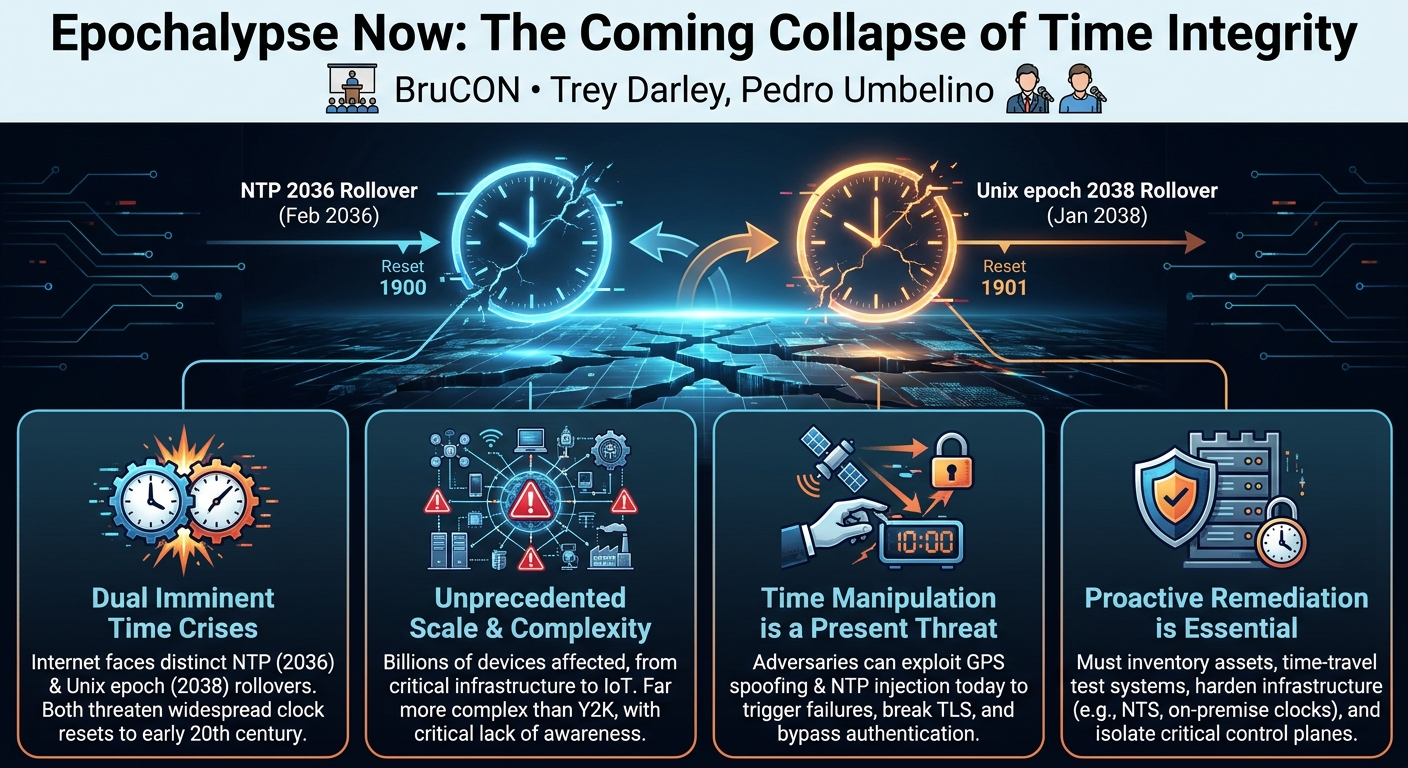
- Dual Time Rollovers: The internet faces two distinct, yet converging, time integrity crises: the NTP 2036 rollover (February 7, 2036) and the Unix epoch 2038 rollover (January 19, 2038, 03:14:07 UTC). Both threaten to reset system clocks to early 20th-century dates, causing widespread chaos.
- Pervasive Vulnerability: The issue is not confined to legacy Unix systems. Any device or software stack that relies on the 32-bit
time_tC struct – including operating systems, databases, file formats, protocols, firmware, and userland applications – is potentially vulnerable, even on modern 64-bit kernels. - Critical Lack of Awareness and Coordination: Unlike Y2K, there is a striking absence of global awareness, political will, and coordinated remediation efforts. The complexity of the problem and its perceived distant timeline contribute to inertia among leadership.
- Demonstrated Real-World Failures: Pedro Umbelino's personal testing revealed immediate crashes and severe dysfunction in industrial control systems (Automatic Tank Gauges - ATGs) and smart TVs when their clocks were advanced. These failures include expired authentication tokens, non-functional leak detection, and persistent denial of service.
- Quantifiable Online Exposure: Through extensive scanning, Bitsight identified a significant number of vulnerable systems. For instance, 14,000 out of 20,000 scannable Linux kernel systems via SNMP were found vulnerable to the 2038 rollover. Furthermore, nearly two-thirds of 200,000 NTP servers scanned are still running 32-bit systems, and one-third are vulnerable to the 2036 rollover, highlighting a failure to adopt existing fixes.
- Hidden Client-Side and IoT Vulnerabilities: Devices like smart TVs, cars, and other "computers that don't look like computers" are widely vulnerable but often not directly scannable. Bitsight's sinkhole operations, for example, identified 127,000 vulnerable smart TV models, indicating a massive, unaddressed attack surface.
- Time as the Root of Trust: The talk emphasizes that time is fundamental to digital trust. Manipulation of time (e.g., via GPS spoofing or NTP injection) can trigger these rollover vulnerabilities today, leading to silent system failures, broken TLS connections, authentication bypasses, and loss of consensus. This transforms a future problem into an immediate, exploitable threat.
- Geopolitical and Supply Chain Risks: The speakers highlight that the nation or entity first to fix this problem could gain a decisive advantage. Furthermore, the heavy reliance on an Asian supply chain (70-90% of critical technology) for components and assembly complicates global remediation efforts, particularly in a fractured geopolitical landscape.
- Belgium as a Global Stress Test: Belgium's role as a choke point for critical European and global infrastructure (ports, grids, banking, NATO, EU, Swift, identity card manufacturing) positions it as a crucial "global stress test" for the 2038 problem. Its response will set a precedent for broader European and international action.
Technical Deep Dive
▶ Watch: Real-world vulnerabilities and methods for discovering them (18:00)
The technical core of the "Epochalypse Now" talk revolves around two distinct integer overflow scenarios. The first, the NTP 2036 rollover, stems from the original NTP specification utilizing a 32-bit unsigned integer to count seconds since January 1, 1900. This counter has a maximum value, and on February 7, 2036, it will wrap around, causing system clocks to reset to 1900. While a 64-bit extension was introduced in NTPv4, the widespread presence of older or unpatched systems means this vulnerability persists, as evidenced by scans showing approximately one-third of exposed NTP servers still exhibiting this issue. If these upstream time sources provide false time, it can propagate throughout dependent networks with severe consequences for security mechanisms like TLS.
The second, more widely known issue, is the Unix epoch 2038 rollover. This problem is rooted in the time_t data type, commonly a 32-bit signed integer in C/C++. It counts seconds from the Unix epoch (January 1, 1970). A 32-bit signed integer can represent values from -2,147,483,648 to +2,147,483,647. When the positive limit is reached on January 19, 2038, at 03:14:07 UTC, adding one more second causes the sign bit to flip, resulting in an overflow that resets the time to December 13, 1901. This is a classic integer overflow (similar to CWE-190) but with systemic implications. The challenge lies in its pervasive impact: not just old Unix systems, but any software, firmware, or embedded device that uses this time_t representation. This includes operating systems (even 64-bit kernels if userland libraries or applications are compiled with 32-bit time_t), databases, file formats, protocols, and development toolchains.
To identify vulnerable systems, Pedro Umbelino detailed several discovery approaches. For server-side systems, SNMP (Simple Network Management Protocol) proved valuable. By querying SNMP agents, researchers could extract version information and architecture details. Bitsight's internal scanning engine, which boasts over 725 million observations, identified 15 million SNMP samples in a month. Of these, 600,000 had versioning information, allowing for architecture derivation in 400,000 systems. Alarmingly, 200,000 were 32-bit, and among 20,000 systems exposing exact Linux kernel versions, 14,000 were found to be vulnerable to the 2038 rollover. Similarly, NTPD mode 6 queries can provide version and processor type information, revealing that almost two-thirds of the 200,000 NTP servers observed were still running 32-bit systems, raising concerns about their 2038 readiness even if patched for 2036.
For client-side devices and IoT, traditional scanning is often ineffective. However, alternative methods exist. For smart TVs, for instance, vendors, advertising companies, and even malware operators often collect telemetry that reveals device models. Leveraging Bitsight's massive sinkhole operations (processing billions of data points), Pedro identified 127,000 vulnerable smart TV models by analyzing connections to old advertising domains or domains used by pre-installed malware. This highlights that "computers that don't look like computers" are a significant blind spot. Firmware analysis is another crucial technique, involving reverse engineering firmware to derive an S-bomb (Software Bill of Materials) and identify time_t dependencies and target architectures.
When direct high-confidence probes are not feasible, heuristics can be employed. For example, correlating system fingerprints (like an FTP fingerprint string from 2003) with historical data on architecture distribution (such as Debian's "popularity contest" statistics, which track 32-bit vs. 64-bit installations since 2004) can help estimate the likelihood of a system being 32-bit and thus vulnerable.
Critically, the talk emphasizes that these rollovers are not just future threats; they can be triggered today through time manipulation attacks. Pedro's lab tests demonstrated that GPS spoofing (which is "fairly cheap") and NTP injection can force systems to experience these time shifts prematurely. State-sponsored adversaries could exploit this by pushing spoofed NTP packets across large parts of the internet, leading to silent failures, broken TLS connections, and compromised authentication mechanisms. The anecdote of the F-22 fighter jet squadron experiencing avionics crashes due to a sign error in firmware when crossing the International Dateline serves as a stark historical precedent for how such coding issues can have immediate, real-world, and potentially catastrophic consequences.
Demo / Proof of Concept
▶ Watch: Y2K paradox and the '800-lb gorilla' of inaction (38:00)
While no formal live demonstration was conducted at the conference, Pedro Umbelino provided compelling evidence of real-world vulnerabilities through personal anecdotes and lab-tested scenarios.
His journey into investigating the 2038 problem began after attending Trey Darley's lightning talk, sparking concern about the pervasive nature of the issue. Pedro decided to conduct his own "proof of concept" by manually advancing the clocks on various devices he owned. He recounted how, within a year of starting his research, an industrial control system (ICS) he was testing "immediately crashed" upon a time advance. Trying a second one, it also crashed. Expanding his tests to consumer devices, he noted that "half of [his] smart TVs also crashed." These personal experiences served as immediate and tangible validations of the problem's reality.
He elaborated on the specific failures observed in Automatic Tank Gauges (ATGs), devices crucial for measuring fuel levels and detecting leaks in large tanks (found in gas stations, hospitals, data centers, military bases). When ATGs were subjected to time rollovers, they exhibited a "remote administration failure" where operators could no longer log in because authentication tokens were erroneously expired, dating back to the 1900s. This rendered the devices uncontrollable, disabled critical leak detection functions, and scrambled login interfaces, effectively creating a "persistent denial of service." He warned of a potential "synchronized colonial pipeline at the worldwide scale" if these widespread devices fail en masse.
For client-side devices like smart TVs, Pedro confirmed vulnerabilities in "the models I have at home," indicating that common consumer electronics are not immune. He further bolstered this with data from Bitsight's sinkhole operations, which detected 127,000 vulnerable smart TV models through telemetry from pre-installed malware and advertising domains.
To engage the audience, Pedro presented a simple, actionable command: find . -newermt "2039-01-01". He encouraged attendees with laptops to run this command in their terminals, asking them to raise their hands if it failed. This served as a live, distributed "demo" for individual verification of potential system-level time_t limitations.
Beyond these personal and crowd-sourced tests, Pedro explicitly stated that "We tested all those methodologies in our labs including, you know, GPS spoofing for for time. It's fairly cheap." This confirms that the ability to manipulate system time, thereby triggering these rollovers prematurely, is a readily achievable and inexpensive attack vector that has been validated in controlled environments. These "demos" underscore that the "Epochalypse" is not merely a theoretical future event but a present and exploitable vulnerability.
Defensive Implications
▶ Watch: Technical and policy recommendations for mitigating time integrity risks (51:00)
The defensive implications of the impending time integrity crisis are profound, demanding a multi-layered, proactive strategy that spans technical, organizational, and policy domains. The speakers emphasize that inaction is not an option and that the time to act is now.
Technical Remediation:
- Treat Time as Critical Infrastructure: Just as Sweden's Netnod has done with NTS (Network Time Security), organizations and nations must recognize time synchronization as a fundamental component of critical infrastructure, deserving of dedicated resources and hardening efforts.
- Proactive System Testing: Silent rollover failures often manifest only in integration tests. Establishing national or company-wide testbeds is crucial for early detection. Organizations should perform time-travel testing on their systems, advancing clocks to 2036 and 2038 to identify cascading failures.
- Comprehensive Asset Inventory: The first half of the battle is knowing what you have. Most organizations have not begun inventorying assets for 2038 vulnerability. This involves identifying all systems (hardware, software, firmware) that rely on time, especially those using 32-bit
time_tor older NTP versions. - Harden in Layers:
- Replace Legacy NTP: Transition from vulnerable NTP implementations to more secure alternatives like NTS.
- On-Premise Clock Anchors: Implement physical, on-premise time sources such as rubidium or cesium clocks as backups. This provides resilience against GPS loss or spoofing, ensuring a sovereign time source.
- Isolate Control Planes: Critical infrastructure should not sync time directly from the public internet. Time synchronization for operational technology (OT) and critical systems should be treated like a secure management band, isolated from external, untrusted sources.
- Authenticated Time Sources: Clean up time synchronization sources. Avoid using unauthenticated "stratum X randos" that could poison your infrastructure. Authenticate time sources and understand their provenance.
- Resiliency as a Discipline: Building resilience against time integrity issues is not a one-time patch for 2037 but an ongoing discipline that must start today.
Policy and Procurement:
- Admit the Scale of the Problem: Leaders must overcome the political toxicity of admitting that billions of devices will fail and cannot all be fixed in time. Silence only exacerbates the problem.
- Triage by Tempo: Prioritize remediation based on the potential impact and speed of failure:
- Life Safety (TLP Red): Medical devices, air traffic control, emergency services. Failures here lead to immediate loss of life.
- Command and Control (TLP Amber): Nuclear deterrence, live operations. False timestamps can instantly escalate crises.
- Critical Infrastructure (TLP Yellow): Power, water, transport, food supply chains. Cascading failures can cause widespread harm and death.
- Economic Systems (TLP Green): Markets, financial services, broader supply chains. These unravel slower but lead to significant financial fallout.
- Ethical Procurement and Disposal: Prevent unscrupulous companies from "dumping" vulnerable equipment in the developing world. Procurement policies should demand proof of 2038 compliance for new devices. It's critical to avoid making the problem worse by purchasing devices today that are known to fail within the decade.
- International Cooperation: While geopolitical tensions complicate a Y2K-style global coordination, the speakers stress that "competition is going to screw us. Coordination and cooperation is the only path forward." Unilateral action or attempts to gain advantage will undermine collective security.
- Empowerment and Advocacy: Individuals within organizations are crucial. As Trey Darley states, "Every resilient system begins with a courageous human who refuses to shut up in a meeting." Security professionals must educate leadership, advocate for budget, and drive action, emphasizing that the problem is "less than 50 quarters" away and "is here today" through time manipulation attacks.
Ultimately, the defensive strategy calls for a shift in mindset: treating time with the same criticality as DNS in infrastructure, coupled with disciplined action, rigorous testing, and assertive advocacy to secure our digital future.
Key Takeaways
- Dual Time Vulnerabilities Are Imminent: The internet faces two distinct, critical time integrity challenges: the NTP 2036 rollover (February 7, 2036) and the Unix epoch 2038 rollover (January 19, 2038, 03:14:07 UTC). Both will cause widespread system clocks to reset, with catastrophic implications.
- Unprecedented Scale and Complexity: The 2038 problem is orders of magnitude larger and more complex than Y2K, affecting billions of devices from critical infrastructure to consumer IoT, and is exacerbated by a lack of global awareness and coordinated remediation efforts.
- Time Manipulation is a Present Threat: Adversaries can exploit time integrity vulnerabilities today through inexpensive methods like GPS spoofing and NTP injection, causing silent system failures, breaking TLS, and bypassing authentication mechanisms well before 2038.
- Proactive Technical Measures are Essential: Defenders must immediately inventory all time-dependent assets, implement rigorous time-travel testing, harden time synchronization infrastructure (e.g., migrating to NTS, deploying on-premise rubidium/cesium clocks), and isolate critical control planes from public time sources.
- Strategic Prioritization is Crucial: Given the impossibility of fixing everything, remediation efforts must be triaged based on impact, prioritizing life safety, command and control, and critical infrastructure before addressing economic systems.
- Advocacy and Coordination are Non-Negotiable: Overcoming political inertia and supply chain dependencies requires courageous individuals to advocate for the problem, secure budgets, and foster international cooperation, as competition will only undermine collective security.
About the Speaker(s)
Trey Darley is introduced as one of the "apocalyptic prophets" of the talk. His background includes helping to define STIX and TAXII standards and extensive experience training CERTs (Computer Emergency Response Teams) around the globe. He is described as having dedicated nearly a decade to casually, then intensely, researching the issues of time integrity, culminating in a year of collaborative work on this specific presentation.
Pedro Umbelino is Trey Darley's partner in prophecy and is a Principal Security Researcher at Bitsight. Known by his handle Krypter, Pedro is passionate about hacking, with a history that includes witnessing the "rise and fall of bulletin boards." He contributes to "hacker day" by night, showcasing a deep engagement with the cybersecurity community and a hands-on approach to investigating system vulnerabilities, as demonstrated by his personal and lab-based testing for the 2038 problem.
Reviews
Dr. Zero (Offensive Security Researcher) — STRONG ACCEPT
Y2K38 isn't a new concept, but Darley and Umbelino drag it out of the theoretical future and turn it into a weaponized attack vector for today. They back up the doom-saying with hard Bitsight sinkhole data and live-fire ICS crashes triggered via NTP injection. It's a sobering, empirical look at exactly how fucked our time dependencies are.
Heather Calloway (CISO) — MUST SEE
This is not a theoretical 2038 problem; it is a present-day architectural vulnerability. The speakers successfully elevate the Unix Epoch and NTP rollovers from distant technical trivia to an immediate governance and capital planning mandate. Required viewing for any leadership team managing OT environments, physical operations, or long-lifecycle IoT fleets.