The internet never forgets: OSINT'ing myself to uncover 30 years of data leakage
Thomas Preece (Lead Architect · BBC)
Security BSides London 2023 · Day 1 · Clappy Monkey Track
Overview
In his compelling BSides London talk, "The internet never forgets: OSINT'ing myself to uncover 30 years of data leakage," Thomas Preece, a Lead Architect at the BBC, embarked on a deeply personal and illuminating journey into the world of Open Source Intelligence (OSINT). Preece, confessing to being a novice in the field, challenged himself to use publicly available OSINT techniques to uncover the digital footprint he had left across the internet over decades, starting with nothing more than his name and a profile picture. The talk serves as both a practical guide to OSINT methodologies and a stark warning about the pervasive and persistent nature of online data.
Key moments
- 2:25 Understanding OSINT dangers: phishing, stalking, swatting
- 7:10 Image metadata can reveal exact home addresses
- 10:30 Discovering old email addresses via Git commit history
- 13:40 Consistent usernames link all your online accounts
- 17:00 Combining small details to find exact home addresses
- 24:40 The Wayback Machine and persistent historical data
- 25:50 Accessing full passwords from historical data breaches
- 37:00 Why speaker started exploring OSINT (low barrier)
The internet never forgets: OSINT'ing myself to uncover 30 years of data leakage
Speakers: Thomas Preece, Lead Architect, BBC
Conference: BSides London
YouTube: https://www.youtube.com/watch?v=PjqUIc786kE
Overview
In his compelling BSides London talk, "The internet never forgets: OSINT'ing myself to uncover 30 years of data leakage," Thomas Preece, a Lead Architect at the BBC, embarked on a deeply personal and illuminating journey into the world of Open Source Intelligence (OSINT). Preece, confessing to being a novice in the field, challenged himself to use publicly available OSINT techniques to uncover the digital footprint he had left across the internet over decades, starting with nothing more than his name and a profile picture. The talk serves as both a practical guide to OSINT methodologies and a stark warning about the pervasive and persistent nature of online data.
Preece's motivation for this self-investigation stemmed from a desire to understand his own online exposure and the potential risks it posed. He highlighted the critical importance of understanding what information exists about oneself in the public domain, not just for personal privacy but as a crucial defense against malicious actors. The insights gleaned from his comprehensive audit underscore how seemingly innocuous pieces of data, when aggregated, can reveal highly sensitive personal information, making individuals vulnerable to targeted phishing, account takeover, stalking, and even the extreme danger of swatting.
This presentation resonated deeply with the audience by demystifying OSINT and demonstrating its accessibility. Preece's candid approach, sharing both his successes and the unexpected challenges, provided a relatable perspective for anyone concerned about their digital legacy. The talk ultimately emphasizes that in an increasingly interconnected world, proactive self-auditing using OSINT is not merely a niche cybersecurity practice but a fundamental aspect of digital self-preservation.
Background
▶ Watch: Understanding OSINT dangers: phishing, stalking, swatting (2:25)
Open Source Intelligence (OSINT) is defined as any information that can be legally obtained from public sources. This encompasses a vast array of data points found on the public internet, including social networks, blogs, news articles, public records, and even content in physical public spaces. Traditionally, OSINT is a critical phase in the reconnaissance stage of an attack, where malicious actors or security professionals gather information about a target (individual or organization) to identify vulnerabilities, craft sophisticated social engineering attacks, or understand infrastructure.
Preece's talk shifts this traditional focus, applying OSINT techniques inward, toward self-investigation. His core challenge was to determine "what can I find out [about myself] with just a name and a profile picture," assuming no prior knowledge. This personal quest was driven by the understanding that anyone, including malicious individuals, can leverage OSINT. The information gathered can be weaponized in various ways:
- Targeted Phishing: Detailed personal information makes phishing emails far more believable and effective.
- Account Takeover: Knowledge of accounts, email addresses, and even old passwords can facilitate unauthorized access.
- Stalking: Addresses, routines, and personal details can be exposed, leading to real-world threats.
- Swatting: The extreme and dangerous act of using fabricated information to call emergency services to a target's address, often leading to armed police response. Preece highlighted this as a "horrendous thing to happen to anyone," noting the low effort required for malicious actors to achieve it through OSINT.
The problem exists because individuals often unknowingly scatter vast amounts of personal data across the internet over many years. Privacy settings change, old accounts are forgotten, and the permanence of digital archives means that even deleted information can persist. Preece's personal journey serves as a powerful demonstration of why understanding and mitigating this data leakage is crucial for anyone navigating the modern digital landscape.
Key Findings
▶ Watch: Discovering old email addresses via Git commit history (10:30)
Thomas Preece's self-OSINT investigation yielded a startling array of personal data, far exceeding his initial expectations. Despite his relative inexperience in OSINT, he uncovered significant data leakage spanning over a decade, with much of his older information fortunately succumbing to "link rot" – the natural disappearance of internet content over time. Had his earlier online activities been more extensively archived, the leakage would likely have stretched back 30 years as the talk title implies.
His key findings included:
- Extensive Personal Identifiable Information (PII): Preece discovered multiple alternative email addresses, including an old university
.ac.ukaddress and BBC-affiliated email addresses, directly linked to his Git commits. He also found previous home addresses, phone numbers, and even his date of birth through various public records and data breaches. - The Power of Metadata: Image metadata proved to be a critical source of leakage. GPS coordinates embedded in old photographs directly led to the exact address of a previous residence. Similarly, device metadata in images within Git repositories could reveal preferred phone brands (e.g., Apple vs. Android), which, while seemingly minor, could be used to build a more complete profile for targeted attacks.
- Unintended Linkages through Account Recovery and Enumeration: Many online services, through their "forgot password" or account recovery mechanisms, inadvertently reveal partial (or sometimes full) email addresses or phone numbers. This allowed Preece to confirm linkages between different accounts and email addresses he had collected through other OSINT methods. Tools like What's My Name quickly identified hundreds of services where his chosen usernames existed, highlighting the vulnerability of consistent usernames.
- Forgotten Social Media Accounts as Goldmines: Preece found that long-abandoned social media profiles, particularly on platforms like Facebook, often had their privacy settings revert to public over time. His own forgotten Facebook account revealed a public friends list, enabling attackers to pivot to less privacy-conscious family members and friends, thereby gleaning even more information about him.
- The "Breadcrumbing" Effect: A central finding was that individually innocuous pieces of information, when pieced together, can form a highly sensitive picture. For example, a photograph of his front door combined with a public mention of the town "Edale" allowed him to use Google Street View to pinpoint his exact address. This demonstrated how seemingly harmless shares can cumulatively lead to significant privacy breaches.
- Persistent Historical Data: Even with modern privacy protections, historical data remains a significant threat. Old WHOIS records for domains registered before 2017/2016 contained his name, address, email, and phone number. Similarly, government records in the UK (Companies House, electoral register, planning applications) contained publicly searchable, often unredacted, sensitive PII.
- Data Breach Vulnerabilities: Using services like Have I Been Pwned and direct access to breach databases, Preece discovered full passwords (or hashes), IP addresses, and even his date of birth (from a Deezer breach) associated with old email addresses. This highlighted the long-term risk of past data breaches.
In summary, Preece's investigation underscored that the internet's memory is indeed long, and the sheer volume and interconnectedness of publicly available data mean that a determined individual can construct a remarkably detailed profile of almost anyone, often with surprisingly low effort.
Technical Deep Dive
▶ Watch: Combining small details to find exact home addresses (17:00)
Preece's investigation employed a systematic and methodical approach to OSINT, leveraging a combination of manual browsing and specialized tools. He emphasized that while tools are helpful, the core of effective OSINT remains manual exploration and diligent note-taking.
Methodology and Note-Taking:
A critical aspect of Preece's methodology was meticulous note-taking. He utilized Maltego, a popular OSINT tool, primarily as a graphing database to map out connections between various data points, rather than its advanced automated querying features. This allowed him to visualize his "complete impact exposure" and avoid getting lost in "rabbit holes" during his extensive manual browsing.
Initial Reconnaissance:
- Multiple Search Engines: Preece began with traditional search engines, stressing the importance of using Google, Bing, DuckDuckGo, and others, as each maintains different databases and yields varying results. This broad approach ensures maximum coverage.
- Reverse Image Search: Profile images and other personal photos were subjected to reverse image searches. This technique, available in most search engines, helps identify instances where the same image has been reused across different platforms, often uncovering additional profiles or articles not found in initial text-based searches.
- Website Crawling: For personal blogs or self-contained websites, Preece used Photon, an OSINT tool designed to crawl a given website. Photon extracts "intel" such as email addresses, potential secrets, and lists all found files, which proved useful for subsequent metadata analysis.
Metadata Extraction and Analysis:
Metadata proved to be a treasure trove of sensitive information:
- Image Metadata: Many online services strip EXIF data (metadata) from images upon upload, but not all. Preece manually downloaded images and inspected their metadata, discovering GPS coordinates that accurately pinpointed the address of a former residence. He also demonstrated the broader implications using PhotoPrism, an offline image viewer with machine learning capabilities, which can automatically map all locations from an image catalog based on GPS data and even cluster images of the same person across different ages, highlighting the power of metadata for tracking individuals.
- Document and Executable Metadata: Preece mentioned a Windows-based tool (unnamed in the talk) that could be pointed at a domain to pull files and perform metadata analysis on documents (PDFs), executables, and other file types, often revealing authors, creation dates, and other internal details.
- Git Repository Analysis: As a former developer, Preece knew the value of Git. Tools were used to analyze Git repositories, extracting commit metadata. This revealed alternative email addresses (e.g., an old university
.ac.ukaddress and BBC corporate emails) that were manually entered during Git configuration and often differed from the GitHub account's primary email. He also warned about the potential for secrets and sensitive files being accidentally committed to public repositories, along with image metadata within those repos.
Account Enumeration and Recovery:
- "Forgot Password" Flows: Preece exploited account recovery mechanisms on various services. For instance, Google might partially mask a recovery email or phone number, but if an attacker has a list of potential contacts, this partial information can confirm linkages. Facebook, at the time of his investigation, was particularly leaky, often revealing full alternative email addresses or phone numbers when an email or phone number was entered into the recovery prompt.
- Username Enumeration: The tool What's My Name was instrumental in checking for the existence of a given username or alias across approximately 600 different social networks and online services. This quickly provided a broad overview of Preece's online presence and highlighted the risk of using consistent usernames across platforms.
Domain Information:
- WHOIS Historical Data: Domain registration records (WHOIS) often contain the registrant's name, address, email, and phone number. While modern GDPR regulations often redact this, historical WHOIS data (pre-2017/2016) remains publicly accessible through services like "Wy" (as mentioned by Preece, likely a specific WHOIS lookup site) or WhoisXMLAPI. Preece demonstrated how this data could be pivoted to find other domains registered by the same individual.
- DNS Records:
- Name Servers (NS records): Reveal the hosting provider, which can be a target for social engineering or phishing.
- TXT Records: Often used for domain verification by third-party services. Preece showed how his domain's TXT records indicated usage of Google and Proton Mail, while Google's TXT records revealed their use of Atlassian products (Jira, Confluence, Bitbucket), DocuSign, and Facebook, providing insights into an organization's tech stack.
- Certificate Transparency Logs: These public logs record every HTTPS certificate issued. They are invaluable for enumerating subdomains for a given domain, expanding the potential attack surface. Preece recommended Mass (likely
Amassby OWASP), a tool that automates subdomain enumeration by querying CT logs, Wayback Machine archives, and various APIs.
UK-Specific Public Data Sources:
- Companies House: For individuals who have registered a company in the UK, Companies House publicly lists director details, including name, date of birth, and a correspondence address (which, for small companies, is often a home address).
- Open Electoral Register: If individuals have not opted out, their details appear in directories like 192.com, providing full addresses.
- Planning Applications: Local council planning portals often contain unredacted planning application forms, revealing names, addresses, and phone numbers of homeowners who have applied for building work.
Archive Data and Password Breaches:
- Wayback Machine (archive.org): This non-profit archives the internet, providing historical snapshots of websites. Preece emphasized that even if content is deleted from a live site, it might persist indefinitely in the Wayback Machine, making true deletion virtually impossible. He noted that the Wayback Machine often archives at a "shallow depth," meaning deeply nested forum posts might be missed, but well-SEO'd personal sites are more likely to be captured.
- Password Breaches: Preece used Have I Been Pwned to check email addresses against known breaches. He then went a step further, accessing breach databases (some publicly available, others through specialized services) to find full passwords (or hashes), names, IP addresses, and even dates of birth associated with his old email addresses. He demonstrated how pivoting on IP addresses or email addresses within these breaches could reveal even more compromised accounts. For instance, a Deezer music streaming service breach contained his (fake, thankfully) date of birth.
Preece concluded this section by noting that a malicious entity would not stop at passive information but would use these findings to attempt active logins, potentially dumping credit card details from compromised e-commerce accounts.
Demo / Proof of Concept
▶ Watch: The Wayback Machine and persistent historical data (24:40)
While Thomas Preece's talk did not feature a live, interactive demonstration of specific tools in real-time, the entire presentation served as a comprehensive proof of concept for the effectiveness of OSINT techniques when applied to a personal investigation. Preece meticulously walked the audience through his own journey of self-discovery, illustrating each methodology and tool with concrete examples of the sensitive data he uncovered about himself.
His "demo" was the narrative itself: a step-by-step account of how he started with minimal information (his name and a profile picture) and systematically built a detailed dossier of his digital footprint. He showed screenshots and described the types of information found from each source – from GPS coordinates in images leading to his old address, to university email addresses exposed in Git commits, to his date of birth found in a breach database.
This approach effectively demonstrated:
- The Accessibility of OSINT: Preece, a self-professed novice, proved that powerful OSINT results are achievable without requiring expert-level skills or expensive proprietary tools. Most techniques involved publicly available search engines, free tools, or basic web browsing.
- The Interconnectedness of Data: He highlighted how seemingly disparate pieces of information could be linked together to form a coherent and deeply personal profile. The "breadcrumbing" effect was a central theme, where minor details combined to reveal highly sensitive data.
- The Persistence of Data: The investigation unequivocally proved that once data enters the public domain, especially if archived, it is incredibly difficult, if not impossible, to truly delete. The Wayback Machine and historical public records served as stark reminders of the internet's long memory.
Therefore, the talk itself was a powerful and extended proof of concept, illustrating the practical application of OSINT for personal privacy auditing and serving as a cautionary tale for anyone with an online presence.
Defensive Implications
▶ Watch: Why speaker started exploring OSINT (low barrier) (37:00)
Thomas Preece's extensive personal OSINT audit provides critical defensive implications for individuals and organizations seeking to mitigate data leakage and enhance their digital privacy. The overarching message is to be proactive and methodical in managing one's online presence.
- Prioritize Account Deletion and Privacy Settings Audits: The first step is to delete old, unused accounts, especially forgotten social media profiles. Preece's experience with Facebook demonstrated how privacy settings can revert to public, exposing friends lists and old posts. Regularly auditing privacy settings on active accounts is crucial.
- Minimize Information Sharing: The most straightforward defense is to simply share less information online. Every piece of data, no matter how innocuous it seems, can become a "breadcrumb" that helps build a more complete profile. Be particularly cautious about sharing location data, images of your home, or details that could link to family members.
- Sever Data Linkages: Since truly deleting historical data is often impossible, the focus shifts to "removing links to that content." This means making it harder for an attacker to connect different aliases, email addresses, or online profiles. Using random, unique usernames for different services can significantly reduce this linkage.
- Metadata Scrubbing: Before uploading any images or documents, ensure sensitive metadata (especially GPS coordinates, device information, and author details) is stripped. Many tools can automate this, or simply use services that are known to strip metadata by default.
- Secure Code Repositories: For developers, regularly review public Git repositories for accidental exposure of secrets, sensitive files, and personal email addresses in commit metadata. Configure Git to use generic or non-personal email addresses for public contributions.
- Enable WHOIS Privacy: For any domains owned, always enable WHOIS privacy services to redact personal contact information from public domain registration records. Modern registrars often offer this for free.
- Opt-Out of Public Registers: Where possible, opt out of public electoral registers and be cautious about the PII provided in public documents like planning applications, advocating for better redaction practices by local authorities.
- Strong, Unique Passwords and Password Managers: Use a robust password manager to generate and store unique, strong passwords for every account. Regularly review the "exposed passwords" reports offered by many password managers to identify and change compromised credentials immediately.
- Monitor for Breaches: Regularly check email addresses against services like Have I Been Pwned to stay informed about data breaches and promptly change passwords for any compromised accounts.
- Educate and Inform: Extend these best practices to family and friends, as their data leakage can inadvertently expose yours, especially through shared social media connections.
- Proactive Self-Auditing: Regularly conduct personal OSINT exercises, using the techniques Preece outlined, to understand your current exposure and identify new sources of leakage. Maintaining detailed notes (perhaps using a tool like Maltego) can help track progress and prioritize remediation efforts.
Ultimately, while the fight against data leakage is an ongoing battle, adopting these defensive strategies can significantly reduce an individual's attack surface and make it considerably more difficult for malicious actors to construct a detailed, exploitable profile.
Key Takeaways
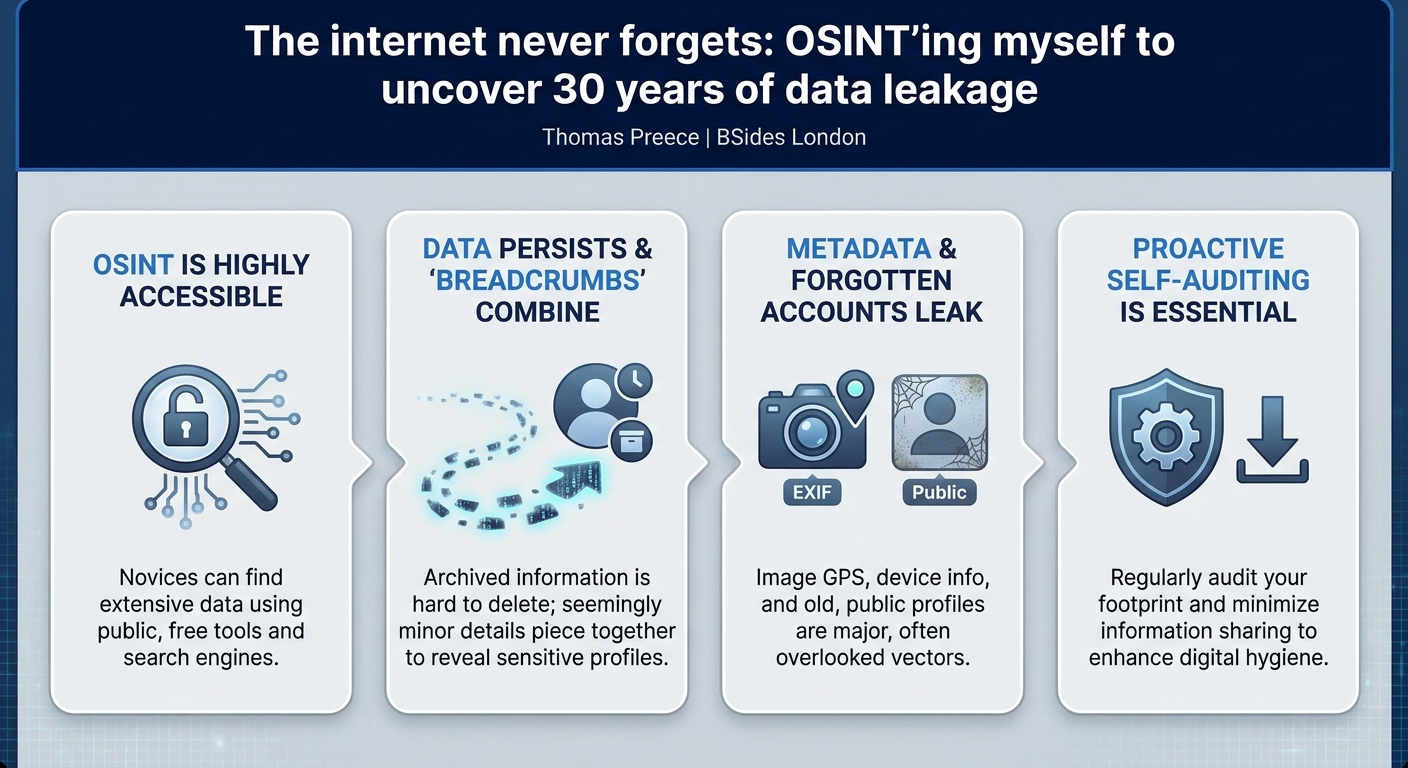
- OSINT is Highly Accessible and Powerful: Even self-proclaimed novices can uncover a surprising amount of personal data using free tools and publicly available information, highlighting the low barrier to entry for both defenders and attackers.
- Data Persistence is a Major Challenge: Once data is online, especially if archived by services like the Wayback Machine or recorded in public registries, it is incredibly difficult to truly delete. The focus should shift from deletion to making data harder to find and link.
- "Breadcrumbing" Turns Innocuous Data into Sensitive Information: Individually harmless pieces of data (e.g., a photo of a door, a town name) can be combined through OSINT to reveal highly sensitive details like an exact home address, emphasizing the cumulative risk of seemingly minor disclosures.
- Metadata is a Significant Leakage Vector: GPS coordinates in images, device information, and email addresses in code commit metadata are often overlooked sources of PII that can reveal precise locations, device preferences, and past affiliations.
- Forgotten Accounts and Changing Privacy Settings are Risky: Old, abandoned social media profiles or services can become significant sources of leakage if privacy settings default to public over time, exposing connections and historical content.
- Proactive Self-Auditing is Essential for Digital Hygiene: Regularly conducting personal OSINT investigations, meticulously documenting findings, and implementing defensive measures are crucial steps for understanding and mitigating one's digital footprint in an ever-forgetting internet.
About the Speaker(s)
Thomas Preece is a Lead Architect at the BBC, bringing a strong technical background to the field of cybersecurity. He transitioned into security after many years as a developer and holds a mathematics degree, which likely contributes to his methodical and analytical approach. Preece candidly admits to only having started his deep dive into Open Source Intelligence (OSINT) about a year prior to this talk, positioning himself as a novice. This perspective makes his findings and advice particularly relatable and encouraging for others looking to explore their own digital footprints, demonstrating that significant insights can be gained without extensive prior expertise. His talk reflects a personal commitment to understanding and improving online privacy and security.
Reviews
Dr. Zero (Offensive Security Researcher) — WEAK
A self-professed OSINT novice discovers EXIF data and WHOIS history exist. It's an honest, well-intentioned exercise in personal data hygiene, but it belongs at a corporate awareness seminar, not a BSides stage. Zero novel techniques, zero advanced tooling, just a basic walkthrough of Have I Been Pwned and the Wayback Machine.
Heather Calloway (CISO) — SOLID
A well-executed, practical primer on self-OSINT and the long tail of data leakage. While framed around individual privacy, it serves as a stark reminder of the attack surface our employees bring to the enterprise.