The (Non)inclusivity of InfoSec - My Experience
Dan Ogleby (Estate Agent)
Security BSides London 2023 · Day 1 · Rookie Track
Overview
Dan Ogleby's talk, "The (Non)inclusivity of InfoSec - My Experience," delivered at BSides London, offers a candid and critical examination of the cybersecurity industry's hiring practices through the lens of a prospective entrant. Ogleby, currently an estate agent with a passion for technology, shares his personal journey and the significant hurdles he encountered while attempting to secure his first role in cybersecurity. This presentation challenges the widely propagated narrative of a severe "talent gap" within the industry, positing that the issue lies not in a lack of interested or capable individuals, but rather in a systemic failure to recognize, cultivate, and integrate diverse talent lacking traditional industry experience.
Key moments
- 0:00 Non-industry perspective on breaking into InfoSec
- 2:55 Self-study and repeated rejections for entry-level roles
- 6:00 “Red Teaming” a cyber expo to network
- 8:00 Exposing the cybersecurity “talent gap” paradox
- 10:00 Call for mindset change and diversification in hiring
- 11:20 Overcoming imposter syndrome when entering the industry
- 14:15 Practical advice: hands-on projects, CTFs, open-source contributions
The (Non)inclusivity of InfoSec - My Experience
Speakers: Dan Ogleby (Estate Agent)
Conference: BSides London
YouTube: https://www.youtube.com/watch?v=HKzs8Go3nTc
Overview
Dan Ogleby's talk, "The (Non)inclusivity of InfoSec - My Experience," delivered at BSides London, offers a candid and critical examination of the cybersecurity industry's hiring practices through the lens of a prospective entrant. Ogleby, currently an estate agent with a passion for technology, shares his personal journey and the significant hurdles he encountered while attempting to secure his first role in cybersecurity. This presentation challenges the widely propagated narrative of a severe "talent gap" within the industry, positing that the issue lies not in a lack of interested or capable individuals, but rather in a systemic failure to recognize, cultivate, and integrate diverse talent lacking traditional industry experience.
The talk serves as a powerful call for introspection and reform, highlighting a profound disconnect between the industry's stated need for more professionals and its actual hiring behaviors. Ogleby's experiences underscore how a rigid focus on direct prior experience often overlooks valuable transferable skills, diverse perspectives, and raw potential. This article will delve into Ogleby's observations, the implications of his findings, and the actionable insights for both individuals seeking to enter the field and organizations committed to fostering a truly inclusive and robust cybersecurity workforce.
Background
▶ Watch: Non-industry perspective on breaking into InfoSec (0:00)
Dan Ogleby's path to cybersecurity is far from conventional, providing a unique vantage point on the industry's accessibility. Hailing from Hereford, Ogleby cultivated an early interest in technology, studying IT at both GCSE and A-level. His initial foray into higher education led him to a Business Information Systems degree at Cardiff University, complete with a placement year. However, Ogleby quickly realized that the traditional academic environment did not align with his preference for hands-on learning and practical application, leading him to leave university. He subsequently completed two apprenticeships, gaining valuable professional experience, before embarking on a 7-8 year career as an estate agent, where he honed significant sales, communication, and client management skills.
The decision to pivot into cybersecurity was influenced by friends already in the industry who introduced him to the concept of a pervasive cybersecurity talent gap. Motivated by this perceived demand and his rekindled interest in technology, Ogleby dedicated his own time and resources to self-study. He leveraged online platforms such as Udemy, Open University, and Cybrary to build foundational knowledge, covering topics like hacking, social engineering, malware, firewalls, viruses, Trojans, and phishing. As his understanding deepened, he gravitated towards the offensive side of security, exploring concepts like penetration testing and red teaming. Armed with this self-acquired knowledge and a wealth of transferable professional skills, Ogleby began his job search at the start of 2023, initiating a process that would ultimately expose the industry's paradoxical hiring landscape.
Key Findings
▶ Watch: “Red Teaming” a cyber expo to network (6:00)
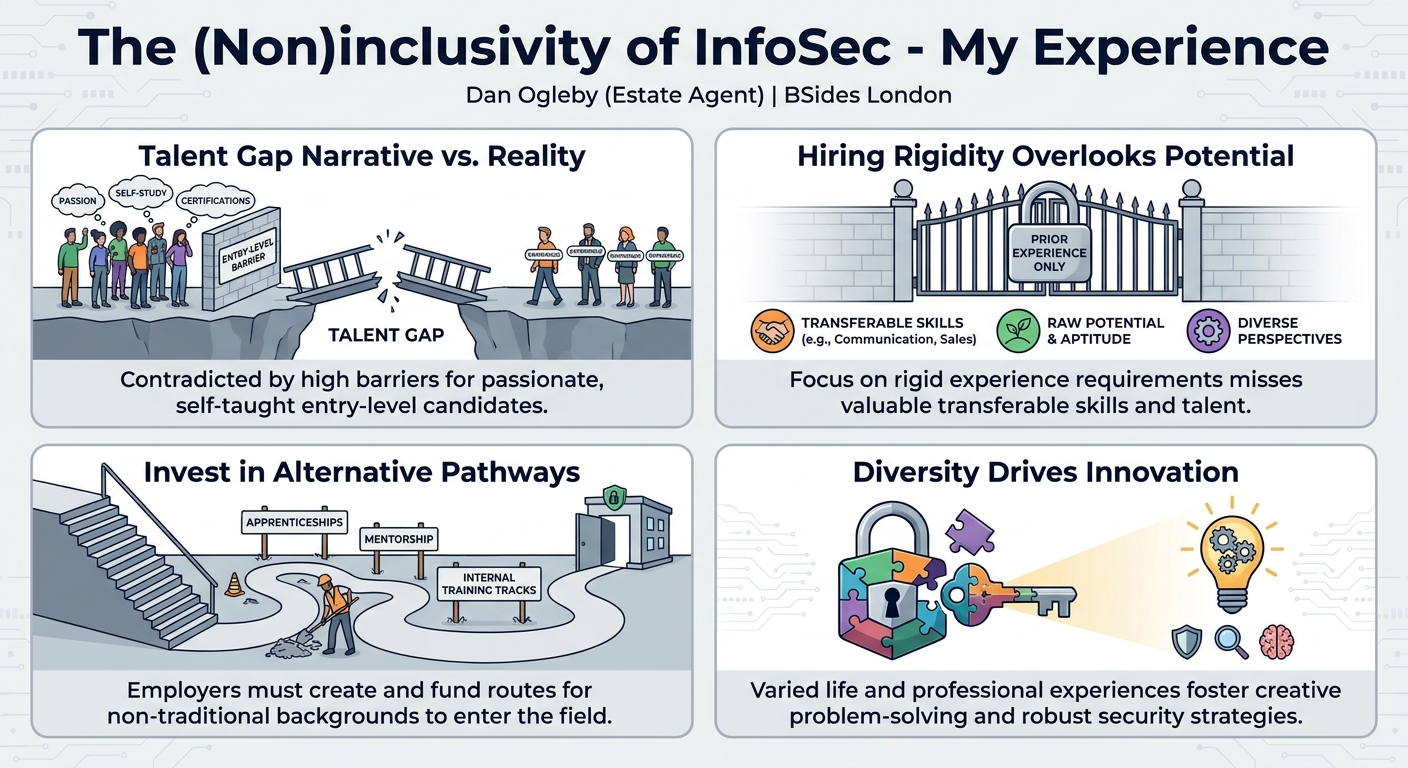
The central and most impactful finding of Dan Ogleby's talk is the stark contradiction between the widely publicized cybersecurity talent gap and the persistent difficulty faced by passionate, self-taught individuals like himself in securing entry-level positions. Ogleby recounted undergoing approximately a dozen interviews throughout 2023, spanning companies from small startups to major industry players. Despite consistently demonstrating passion, a clear understanding of the industry's objective (reducing risk, increasing resilience), and strong communication skills, he was repeatedly passed over. The feedback consistently pointed to a lack of direct industry experience, with roles invariably going to candidates possessing as little as "12 months experience in the industry."
This experience directly challenges the narrative aggressively promoted by prominent media outlets and industry bodies. Ogleby cited articles from Forbes, CSO, and Pinsent Mason, all published in 2023, which underscore the severity of the talent shortage:
- Forbes highlighted "the quest to close the cybersecurity talent gap."
- CSO reported a global shortage reaching "4 million" despite recruitment drives.
- Pinsent Mason even labeled the skills gap as a "ticking time bomb for the industry."
- Gartner predicted that "by 2025, more than half of significant cyber incidents will come from a lack of talent as well as general human error."
The discrepancy Ogleby experienced suggests that while the industry acknowledges a critical shortage, its hiring mechanisms are often too rigid to effectively absorb new talent from non-traditional backgrounds. His struggle illustrates a systemic preference for pre-existing industry experience, even for roles where foundational knowledge and transferable skills could be leveraged and developed. This creates a self-perpetuating cycle where entry-level roles demand experience that can only be gained within the industry, effectively barring new entrants and exacerbating the very talent gap the industry claims to be addressing. The talk posits that this narrow focus misses out on the diverse perspectives and problem-solving approaches that individuals with varied backgrounds (like Ogleby's sales and customer-facing experience) could bring, as explicitly noted in articles advocating for diversification to solve complex cyber issues.
Technical Deep Dive
▶ Watch: Exposing the cybersecurity “talent gap” paradox (8:00)
While Dan Ogleby's talk is not a traditional "technical deep dive" into a specific vulnerability or security mechanism, it offers a crucial technical commentary on the sociotechnical systems governing talent acquisition within the cybersecurity industry itself. The "technical" aspect here shifts from dissecting code or network protocols to analyzing the systemic flaws in how the industry identifies, evaluates, and integrates human capital.
Ogleby's self-study journey provides insight into the foundational technical competencies he acquired. He engaged with online learning platforms such as Udemy, Open University, and Cybrary, which are widely recognized for delivering structured content on core cybersecurity concepts. His curriculum included:
- Fundamentals of Hacking: Understanding basic attack vectors and methodologies.
- Social Engineering: Recognizing psychological manipulation techniques used to gain unauthorized access.
- Malware Analysis (Basic): Familiarity with different types of malicious software like viruses and Trojans.
- Network Security: Concepts related to firewalls and network segmentation.
- Application Security: Understanding vulnerabilities exploited through phishing campaigns.
Beyond these fundamentals, Ogleby delved into the more offensive security disciplines, specifically mentioning penetration testing and red teaming. These areas require a sophisticated understanding of system weaknesses, exploitation techniques, and the ability to simulate real-world attacks. While the talk did not detail specific tools (e.g., Nmap, Metasploit, Burp Suite) or methodologies (e.g., OWASP Top 10), Ogleby's engagement with these fields indicates a commitment to acquiring practical, hands-on technical skills relevant to a proactive security posture.
The "technical debt" the industry incurs, as highlighted by Ogleby, is its inability to effectively "patch" its own hiring processes. The "architecture" of current recruitment often prioritizes a narrow set of credential-based filters (e.g., specific certifications like CISSP for entry-level roles, as mentioned in the Q&A) and direct experience over a holistic assessment of an applicant's potential, transferable skills, and learning agility. This creates a bottleneck in the talent pipeline, preventing a diverse influx of new "nodes" into the network. The "protocol" for evaluating candidates is often rigid, failing to account for alternative "configurations" of experience such as self-study, open-source contributions, or non-traditional career paths. The "vulnerability" lies in the industry's collective blind spot to its own internal operational inefficiencies in talent acquisition, which, ironically, mirrors the very human error and lack of diverse perspectives that Gartner predicts will drive significant cyber incidents.
Demo / Proof of Concept
▶ Watch: Overcoming imposter syndrome when entering the industry (11:20)
While Dan Ogleby did not present a traditional technical demonstration of a software exploit or a security tool, he did execute a compelling social engineering proof of concept that subtly underscored his point about industry accessibility and the disjuncture between perceived and actual security. Ogleby recounted his attendance at the International Cyber Expo in London, where he deliberately registered himself as a "trainee in cybersecurity."
His objective was not to cause harm but to metaphorically "red team" the event's access control mechanisms. He successfully gained entry to a major international cybersecurity conference as someone "outside the industry with no experience and no screening." This act, which he jokingly described as his "first red team of an international cyber event," served as a powerful, albeit anecdotal, demonstration of a security lapse in event access control. It highlighted how easily an individual with no verifiable industry credentials could penetrate a high-profile gathering of cybersecurity professionals and decision-makers, including CEOs, heads of sales teams, and even senior MPs.
This "demo" reinforced Ogleby's central argument: if an individual lacking formal industry ties can navigate and gain access to such a significant industry event with relative ease, it calls into question the very barriers that prevent similar individuals from entering the workforce. It showcased his ability to identify and exploit a procedural vulnerability, albeit in a non-malicious context, and ironically, demonstrated a form of adversarial thinking — a highly valued skill in cybersecurity — in a real-world scenario. The experience of being "chuffed with myself that I basically pulled off my first red team" serves as a poignant illustration of his innate aptitude for security, even as the industry's formal channels continued to reject him.
Defensive Implications
▶ Watch: Practical advice: hands-on projects, CTFs, open-source contributions (14:15)
Dan Ogleby's talk offers critical defensive implications for the cybersecurity industry, urging a significant shift in strategy to protect its own talent pipeline and future resilience. The "defense" here is not against external threats, but against internal systemic weaknesses that prevent effective talent acquisition and diversity.
- Rethink Hiring Paradigms: Employers must move beyond an exclusive focus on direct industry experience. This requires a mindset change to actively seek out and value transferable skills from diverse backgrounds. Ogleby's sales background, for instance, offers strong communication, negotiation, and problem-solving abilities that are crucial for roles in security awareness, client engagement, and even incident response. Job descriptions should be reviewed to remove unnecessary experience requirements (e.g., CISSP for entry-level roles) and emphasize aptitude and learning potential.
- Invest in Potential and Training: The industry must actively invest in potential rather than solely purchasing established experience. This means establishing robust internal apprenticeship programs, mentorship schemes, and dedicated entry-level training tracks. Companies should allocate resources to upskill new hires, acknowledging that technical skills can be taught on the job, while intrinsic qualities like passion, work ethic, and diverse thinking are harder to cultivate.
- Diversify Recruitment Channels: Relying solely on traditional recruitment agencies or industry-specific job boards can perpetuate existing biases. Employers should actively engage with non-traditional talent pools, collaborate with career changers' networks, and explore partnerships with educational institutions that emphasize practical, hands-on learning rather than just theoretical degrees.
- Acknowledge and Mitigate Imposter Syndrome: New entrants, particularly those from non-traditional backgrounds, often battle imposter syndrome. The industry needs to create welcoming and supportive environments that validate diverse experiences and encourage individuals to feel they belong, even if they don't yet possess all the "traditional" qualifications. Ogleby's own experience at the expo highlights this internal struggle.
- Value and Promote Alternative Learning Paths: Self-study, online courses (Udemy, Cybrary, Open University), certifications, and contributions to open-source projects (as suggested in the Q&A) are valid and often highly effective ways to acquire skills. Employers should recognize these alternative credentials and encourage candidates to showcase their practical learning through CTFs, personal projects, and technical blogs, demonstrating conceptual understanding and practical application. Documenting learned concepts or contributing to security documentation within open-source projects can be a powerful signal of competence.
- Address the "Job Hopping" Culture: Ogleby hinted at a culture of "job hopping" within the existing talent pool, where experienced professionals move between roles, potentially exacerbating the perceived talent gap without truly expanding the overall workforce. By investing in new talent, companies can cultivate loyalty and long-term growth, reducing reliance on a limited pool of experienced individuals.
By adopting these defensive strategies, the cybersecurity industry can move towards genuine inclusivity, effectively close its talent gap, and build a more resilient, diverse, and innovative workforce capable of addressing the complex threats of the future.
Key Takeaways
- The Talent Gap Narrative is Flawed: The widely cited "cybersecurity talent gap" is often contradicted by the reality of entry-level candidates struggling to secure roles, indicating a systemic issue in hiring rather than a true scarcity of interested individuals.
- Prioritize Potential and Transferable Skills: The industry must shift its mindset to value passion, work ethic, and transferable skills from diverse backgrounds (e.g., sales, communications) over rigid requirements for direct, prior industry experience.
- Invest in Non-Traditional Talent: Employers should actively create and fund pathways like apprenticeships, mentorship programs, and internal training to onboard and upskill individuals from non-traditional educational or career backgrounds.
- Diverse Perspectives Drive Innovation: Bringing in individuals with varied life and professional experiences is crucial for fostering innovative problem-solving and developing more robust, comprehensive security strategies that account for a wider range of human factors.
- Validate Alternative Learning Paths: Self-study, online courses, and contributions to open-source projects are legitimate and valuable forms of learning that demonstrate initiative and practical skill acquisition, and should be recognized by hiring managers.
- Industry Must Practice What It Preaches: For the cybersecurity sector to truly address its talent needs and promote inclusivity, it must critically examine and reform its own hiring practices to align with its stated values and long-term strategic goals.
About the Speaker(s)
Dan Ogleby is a passionate individual from Hereford, currently working as an estate agent, a role he has held for the past 7-8 years. This background has equipped him with strong sales, communication, and client management skills. Ogleby's journey into the cybersecurity domain is a testament to his self-driven nature; he holds two apprenticeships from earlier in his career and is an A-level German speaker. His early interest in technology led him to study IT at GCSE and A-level. While he briefly pursued a Business Information Systems degree at Cardiff University, he ultimately opted for a more hands-on, practical learning approach. Driven by a desire for a career change and inspired by the perceived talent gap in cybersecurity, Ogleby embarked on extensive self-study using platforms like Udemy, Open University, and Cybrary, focusing on both fundamental and offensive security concepts. He is also the frontman of a punk covers band, reflecting his comfort and experience in front of crowds. Ogleby's talk at BSides London is a courageous sharing of his personal experience, aiming to spark a much-needed discussion about inclusivity and hiring practices within the InfoSec community.
Reviews
Dr. Zero (Offensive Security Researcher) — WEAK
Another year, another BSides talk complaining about the entry-level hiring paradox. The speaker points out that the 'talent shortage' is mostly an HR fabrication, which is true, but we've been having this exact conversation since 2012. It's an honest vent from a frustrated applicant, but it brings zero new solutions to a problem we all already know exists.
Heather Calloway (CISO) — SOLID
A candid, entry-level perspective on the structural failure of cybersecurity hiring pipelines. While the speaker diagnoses the symptom correctly—that our entry-level filters are broken—the talk lacks the institutional realism of why those barriers exist and how leadership can safely absorb the risk of untrained headcount.