Exploring the Dark Web: Forums, Markets, and Scam Insights
Stefan Bargan (Threat Intelligence Analyst Intern · Searchlight Cyber)
Security BSides London 2023 · Day 1 · Rookie Track
Overview
In this insightful talk at BSides London, Stefan Bargan, a Threat Intelligence Analyst Intern at Searchlight Cyber, provided a comprehensive tour of the dark web, dissecting its primary components: forums, markets, and prevalent scam methodologies. Drawing from his extensive experience and academic focus on dark web actors, Bargan illuminated the dual nature of this concealed part of the internet, showcasing both its illicit underbelly and its legitimate applications as a tool for privacy and censorship circumvention.
Key moments
- 0:00 Talk Introduction and Agenda Overview
- 1:57 Popular Dark Web Forums: Dread and Sinisterly
- 3:55 Dark Web Markets: Vendor Shops and Goods
- 5:25 Common Dark Web Scams: Hackers & Hitmen
- 6:30 Tor User Statistics and Privacy Use Cases
- 10:00 Q&A: Germany's High Tor Usage Explained
- 10:55 Q&A: Origins and Ownership of Tor
Exploring the Dark Web: Forums, Markets, and Scam Insights
Speakers: Stefan Bargan, Threat Intelligence Analyst Intern, Searchlight Cyber
Conference: BSides London
YouTube: https://www.youtube.com/watch?v=M7utLbWDKCQ
Overview
In this insightful talk at BSides London, Stefan Bargan, a Threat Intelligence Analyst Intern at Searchlight Cyber, provided a comprehensive tour of the dark web, dissecting its primary components: forums, markets, and prevalent scam methodologies. Drawing from his extensive experience and academic focus on dark web actors, Bargan illuminated the dual nature of this concealed part of the internet, showcasing both its illicit underbelly and its legitimate applications as a tool for privacy and censorship circumvention.
The presentation offered a pragmatic perspective, moving beyond sensationalism to provide a data-driven analysis of dark web activity, including statistics on Tor usage. Bargan meticulously detailed the operational dynamics of prominent dark web forums like Dread and Sinisterly, and marketplaces such as WeTheNorth and Roker's Market. He also exposed the mechanics behind common dark web scams, such as "Hackers for Hire" and "Hitman for Hire," providing crucial context for understanding the threats lurking within these hidden corners of the internet.
This talk is particularly vital for cybersecurity professionals, threat intelligence analysts, and anyone seeking to understand the evolving landscape of cybercrime. By demystifying the dark web and highlighting the motivations behind its diverse user base, Bargan equipped the audience with a clearer understanding of the challenges and complexities involved in monitoring and mitigating threats originating from these anonymous networks. His emphasis on the "good side" of Tor—its role in protecting privacy and enabling free speech in oppressive regimes—underscored the nuanced nature of this powerful technology.
Background
▶ Watch: Talk Introduction and Agenda Overview (0:00)
The dark web represents a subset of the internet that is not indexed by traditional search engines and requires specific software, configurations, or authorizations to access. While often sensationalized as a haven for illicit activities, it is fundamentally an anonymous network designed to protect user identities and activities from surveillance. The primary gateway to the dark web discussed in this talk is Tor (The Onion Router), a free and open-source software that enables anonymous communication. Tor operates by directing internet traffic through a worldwide volunteer overlay network, consisting of thousands of relays, to conceal a user's location and usage from anyone conducting network surveillance or traffic analysis.
Bargan briefly touched upon other anonymity networks like I2P and Freenet, noting the key distinction that Tor employs onion routing, while I2P utilizes garlic routing. While both aim for anonymity, their technical implementations and network structures differ. For the purposes of this talk, the focus remained on Tor due to its widespread accessibility and ease of use, requiring only a browser download to get started. Historically, Tor was initially developed by the U.S. Naval Research Laboratory in 2002 before becoming an open-source project, highlighting its origins in protecting sensitive communications.
The problem addressed by this talk stems from the inherent anonymity offered by such networks. While crucial for dissidents, journalists, and privacy-conscious individuals, this anonymity also creates an environment conducive to criminal enterprises. The dark web facilitates the operation of forums for discussion and coordination, markets for illicit goods and services, and various scam operations, all while providing a layer of protection to their operators and users. Understanding this dual nature—where a tool designed for freedom can also be exploited for crime—is critical for developing effective defensive strategies and threat intelligence. Bargan's presentation aimed to contextualize these elements, moving beyond abstract concepts to concrete examples of dark web activities and their implications.
Key Findings
▶ Watch: Dark Web Markets: Vendor Shops and Goods (3:55)
Stefan Bargan’s exploration of the dark web yielded several key findings, illustrating the diverse and dynamic nature of its forums, markets, and scam operations, alongside crucial insights into Tor usage:
Dark Web Forums: Hubs of Information and Illicit Activity
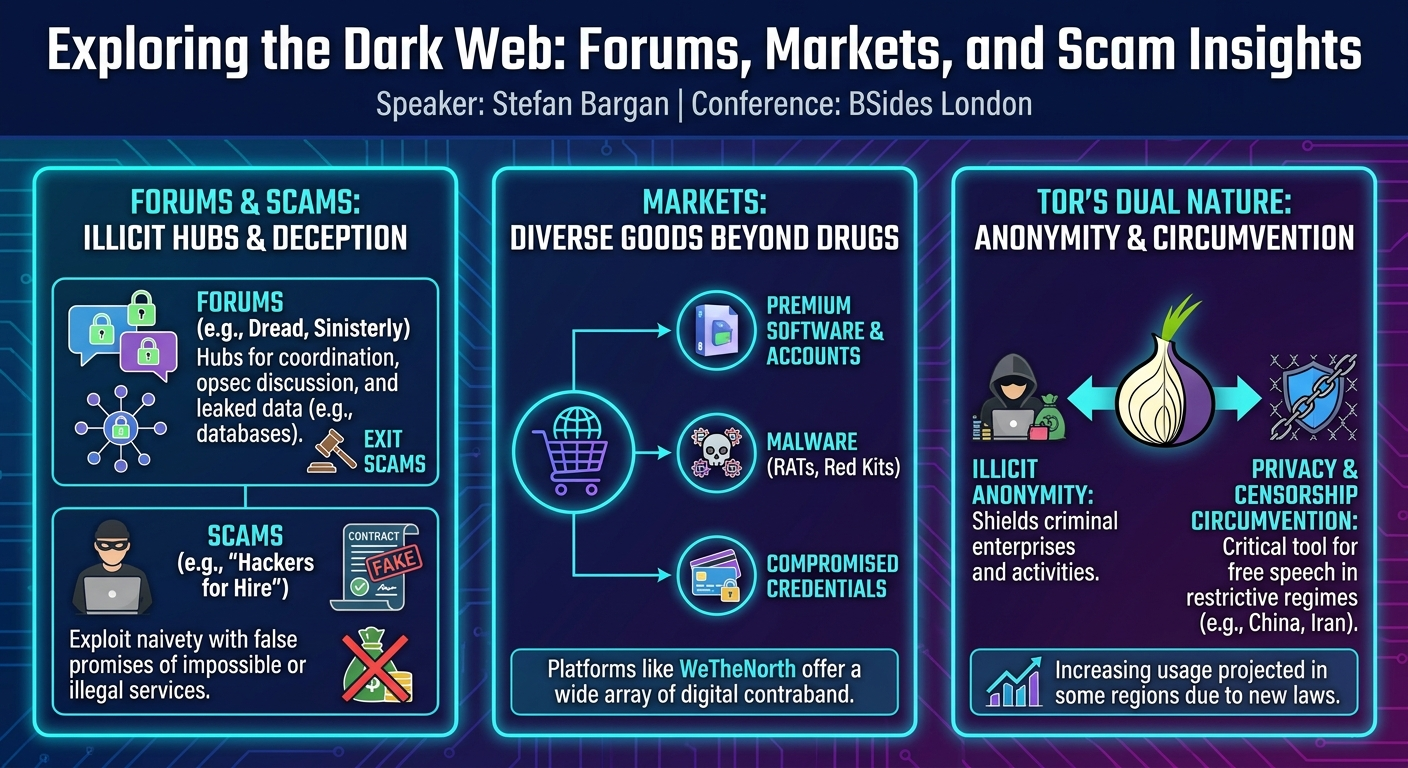
- Dread: Identified as one of the most popular dark web forums in 2023, Dread recorded nearly 300,000 posts within the last 12 months. Bargan likened it to Reddit, featuring sub-communities discussing a wide array of topics including markets, exit scamming, drug-related inquiries, hacking techniques, and operational security (opsec). Notably, Dread served as the platform where ASAP Market announced its closure in July, a rare occurrence as markets typically perform exit scams without warning.
- Sinisterly: An exceptionally old forum, with posts dating back to 2008, making it approximately 15 years old. Sinisterly experienced a significant surge in users during the pandemic, reaching nearly 41,000 users online at one point. It is particularly known for hosting leaked databases, with one example cited showing over 159,000 records available.
Dark Web Markets: Diverse Offerings and Operational Models
- Roker's Market: Showcased as an example of a vendor-type market, which gained popularity in 2023. Unlike full marketplaces, vendor-type markets are typically smaller, focused on a single vendor's products, and often serve to promote a vendor's reputation across multiple platforms.
- WeTheNorth: A Canadian-focused marketplace launched in 2021 (formerly Canada HQ). While heavily focused on drugs and fraud, its inventory is notably diverse. Beyond typical illicit substances, WeTheNorth offers premium software (such as the "Adobe Suite" or copies of Windows), premium accounts (often at half price), and various forms of malware, including RATs (Remote Access Trojans) and Red Kits. A peculiar finding mentioned was the sale of an ounce of silver.
Prevalent Dark Web Scams: Exploiting Naivety
- Hackers for Hire: These services falsely promise to hack almost anything, from credit scores and emails to social media accounts, all for a fee. Bargan emphasized that genuine hacking is far more complex than these services suggest, often preying on individuals unfamiliar with the realities of cyber intrusion.
- Hitman for Hire: These scams often involve sophisticated social engineering, such as citing fabricated legal frameworks. Bargan highlighted the "Hitman Information Privacy and Protection Act of 1964" as a prime example of a fake act. He linked the notion of such bogus websites to Boba Fett, who created a similar site around 2005 to assist law enforcement in gathering intelligence on individuals seeking such services.
Tor Usage Statistics: Beyond Illicit Activities
- Global Usage: The presentation included statistics for Tor usage in 2023, showing the daily average of users in the top 12 countries, distinguishing between relay and bridge connections. The combined top three countries accounted for almost 2 million users.
- Germany's High Usage: Germany exhibited a remarkably high number of Tor users, particularly relay users, more than the US. Bargan attributed this to a strong cultural emphasis on privacy among German citizens, citing examples like blurred buildings on Google Maps to protect personal data.
- Censorship Circumvention: A significant finding was the legitimate use of Tor in countries like China, Iran, and Turkmenistan. These nations were not in the top 12 Tor users in 2020 but have since seen increased adoption, primarily by citizens seeking to circumvent government censorship and avoid tracking by internet service providers, highlighting Tor's crucial role as a tool for freedom of information.
- UK Online Safety Act: Bargan predicted an increase in Tor usage within the UK following the introduction of the Online Safety Act, suggesting that individuals might turn to anonymous networks to avoid potential tracking or surveillance concerns arising from the new legislation.
These findings collectively underscore that the dark web is a complex ecosystem with diverse motivations and operations, necessitating a nuanced approach to threat intelligence and cybersecurity.
Technical Deep Dive
▶ Watch: Common Dark Web Scams: Hackers & Hitmen (5:25)
The technical aspects of Bargan's talk centered on the operational mechanics of the dark web's infrastructure, the methods of achieving anonymity, and the characteristics of the illicit services offered. While not delving into low-level code, it provided a functional understanding of how these systems operate and the technologies that underpin them.
At its core, access to the dark web, as presented, relies primarily on Tor (The Onion Router). Tor facilitates onion routing, a technique where internet traffic is encapsulated in multiple layers of encryption, much like the layers of an onion. This encrypted traffic is then relayed through a series of volunteer-operated servers, known as Tor nodes or relays, around the world. Each relay decrypts one layer of encryption to reveal the next relay's address, until the final relay decrypts the innermost layer and sends the traffic to its destination. This multi-hop process makes it extremely difficult to trace the original source of the connection, providing strong anonymity for users. Bargan briefly contrasted this with I2P's garlic routing, which, while also providing anonymity, uses a different message-oriented approach and an end-to-end encrypted tunnel.
Dark Web Forums like Dread and Sinisterly function as decentralized communication platforms. Technically, they are websites hosted on Tor hidden services (identified by .onion addresses), making their physical location and hosting provider difficult to ascertain. These forums support standard web functionalities such as user registration, threaded discussions, private messaging, and content moderation. The "Reddit-like" nature of Dread implies a robust system for categorization, upvoting/downvoting, and user-generated content, fostering distinct sub-communities. From a technical perspective, the threat intelligence value lies in analyzing the chatter – discussions on operational security (opsec), methods for exit scamming, and the exchange of information about vulnerabilities or exploits. The presence of leaked databases on Sinisterly, with over 159,000 records, highlights the technical mechanism of data exfiltration and subsequent monetization or distribution within these anonymous networks.
Dark Web Markets like WeTheNorth operate as e-commerce platforms, also typically hosted as Tor hidden services. Their technical architecture supports vendor registration, product listings, shopping carts, and a review system. The transaction mechanism often involves cryptocurrencies (e.g., Bitcoin, Monero) to further enhance anonymity, though the talk did not delve into the specifics of cryptocurrency use beyond its implicit presence. The "vendor-type market" such as Roker's Market signifies a simpler technical setup, often a storefront for a single entity, whereas larger markets like WeTheNorth feature a more complex multi-vendor architecture akin to mainstream e-commerce sites. The products themselves, like premium software (e.g., Adobe Suite, Windows copies), premium accounts, and various forms of malware (RATs, Red Kits), represent digital goods that can be transferred or accessed directly after purchase. These tools are often technically sophisticated, designed to facilitate further cybercrime, from data theft to system compromise.
The scam operations, particularly "Hackers for Hire" and "Hitman for Hire," technically leverage psychological manipulation and a lack of technical understanding. These sites are often simple web pages, again hosted on Tor, designed to appear legitimate. The "Hitman Information Privacy and Protection Act of 1964" example illustrates the use of fabricated legal frameworks to create an illusion of credibility. The technical simplicity of these scam sites belies their effectiveness in defrauding individuals who are either desperate or naive about the true nature of hacking and illicit services. The mention of Boba Fett's bogus website for law enforcement suggests a counter-technical measure: creating honeypots or decoy sites to gather intelligence on potential criminals, analyzing their contact information, payment methods, and intentions.
Finally, the discussion on Tor usage data involves technical metrics. Distinguishing between relays and bridges is crucial: relays are publicly listed Tor servers, while bridges are unlisted relays used to bypass censorship in countries that attempt to block direct connections to the Tor network. Monitoring the daily average of users, their geographic distribution, and connection methods (direct vs. bridge) provides technical insights into censorship effectiveness and user behavior trends, which are vital for understanding the global landscape of anonymity and information access.
Demo / Proof of Concept
▶ Watch: Q&A: Germany's High Tor Usage Explained (10:00)
While Stefan Bargan's presentation did not feature a live, interactive technical demonstration or a real-time proof of concept involving hacking or dark web transactions, it effectively served as a visual demonstration of the dark web's landscape. Bargan meticulously showcased various dark web entities through screenshots and visual aids, providing concrete examples of forums, markets, and scam sites.
Specifically, the talk presented:
- Forum Interfaces: Screenshots of Dread and Sinisterly, highlighting their layouts, typical discussion topics, user counts, and post volumes. This visual evidence underscored their function as community hubs for illicit and privacy-focused discussions.
- Marketplace Listings: Visuals from WeTheNorth and Roker's Market, illustrating the types of goods and services offered, from drugs and fraud tools to premium software, accounts, and malware. These examples provided a tangible sense of the marketplace's inventory and operational models.
- Scam Site Designs: Images of "Hackers for Hire" and "Hitman for Hire" websites, exposing the deceptive language and fabricated legal claims (such as the "Hitman Information Privacy and Protection Act of 1964") used to defraud unsuspecting individuals.
Through these visual examples, Bargan effectively demonstrated the types of content and modes of operation found on the dark web. He used these visuals to support his analysis of user behavior, market trends, and scam tactics, allowing the audience to see firsthand the digital environments he was describing. This approach, while not a live technical demo, served as a powerful evidentiary presentation, making the abstract concepts of dark web activity tangible and understandable for the audience. The "proof of concept" was in the existence and functionality of these sites, as evidenced by the screenshots and the data Bargan presented.
Defensive Implications
▶ Watch: Q&A: Origins and Ownership of Tor (10:55)
Stefan Bargan’s deep dive into the dark web provides critical insights for defenders, highlighting actionable strategies to mitigate risks associated with this anonymous frontier. Understanding the dynamics of forums, markets, and scams is paramount for any organization or individual striving to enhance their cybersecurity posture.
For Organizations:
- Enhanced Threat Intelligence Gathering: Organizations must actively monitor dark web forums and marketplaces. The sheer volume of posts on platforms like Dread (nearly 300,000 in 2023) indicates a constant flow of information relevant to threat intelligence. This includes tracking mentions of company data, credentials, zero-day exploits, or specific vulnerabilities affecting their software or infrastructure. Forums like Sinisterly, known for leaked databases (e.g., 159,000 records), serve as crucial indicators of potential data breaches or compromised assets.
- Proactive Data Breach Monitoring: Given the prevalence of leaked databases and compromised accounts on dark web markets (e.g., premium accounts sold at half price on WeTheNorth), organizations should implement continuous monitoring for their employees' credentials and corporate data. This includes dark web scanning services that can alert them if their data appears in illicit marketplaces.
- Awareness of Evolving TTPs (Tactics, Techniques, and Procedures): Dark web forums are hotbeds for discussions on new hacking methodologies, malware (RATs, Red Kits), and operational security (opsec) practices. By analyzing these discussions, security teams can gain early warnings about emerging threats and adapt their defensive strategies accordingly. For example, understanding how attackers coordinate or share tools can inform defensive controls.
- Employee Education and Awareness: The "Hackers for Hire" and "Hitman for Hire" scams underscore the need for comprehensive employee education on social engineering tactics and the realities of cybercrime. Employees should be aware that promises of impossible feats for a fee are almost certainly scams. This also extends to educating about the risks of purchasing "premium software" or "premium accounts" from unofficial sources, as these often originate from compromised systems and can introduce malware or backdoors.
- Supply Chain Risk Management: The sale of "premium software" on markets like WeTheNorth can indicate compromise within the software supply chain. Organizations should verify the integrity of all software used within their environment and be wary of any discounted or unofficial versions.
- Incident Response Preparedness: Understanding how markets operate, including phenomena like exit scams, can help incident response teams anticipate the lifecycle of specific threats. If a market specializing in certain malware suddenly disappears, it might signify a shift in attacker tools or a law enforcement takedown.
For Individuals:
- Critical Thinking and Skepticism: The most crucial defensive measure against dark web scams is critical thinking. If an offer seems too good to be true (e.g., hacking a credit score, hiring a hitman), it almost certainly is. Individuals should be highly skeptical of any service promising illegal or impossible outcomes for a fee on anonymous networks.
- Privacy Awareness: While Tor offers anonymity, its use for illicit activities necessitates a clear understanding of its dual nature. Individuals using Tor for legitimate privacy concerns (e.g., in countries with censorship like China, Iran, Turkmenistan) should still practice good digital hygiene and be aware of the risks associated with navigating untrusted parts of the internet.
- Secure Online Habits: The existence of leaked databases emphasizes the importance of strong, unique passwords, multi-factor authentication, and vigilance against phishing attempts, as compromised credentials often end up on these forums.
In conclusion, Bargan's talk underscores that the dark web is not merely a sensationalized concept but a dynamic ecosystem with tangible implications for cybersecurity. Proactive threat intelligence, continuous monitoring, and robust educational programs are essential for defenders to navigate and mitigate the risks originating from this hidden internet layer.
Key Takeaways
- The Dark Web is a Multifaceted Ecosystem: It serves as both a haven for illicit activities, including the trade of drugs, fraud tools, and malware, and a critical tool for privacy and censorship circumvention, particularly in restrictive regimes like China, Iran, and Turkmenistan.
- Forums Drive Information Exchange and Coordination: Platforms like Dread (with nearly 300,000 posts in 2023) and Sinisterly (known for hosting over 159,000 leaked records) are central hubs for discussions on operational security, market dynamics, and the distribution of compromised data.
- Darknet Markets Offer Diverse Illicit Goods: Marketplaces such as WeTheNorth (a Canadian-focused market launched in 2021) extend beyond traditional drug sales to include premium software (e.g., Adobe Suite, Windows copies), compromised accounts, and various malware (RATs, Red Kits), highlighting the breadth of cybercriminal offerings.
- Scams Prey on Naivety and Misinformation: Services like "Hackers for Hire" and "Hitman for Hire," often employing fabricated legal frameworks like the "Hitman Information Privacy and Protection Act of 1964," are designed to defraud individuals by promising impossible or illegal outcomes.
- Tor Usage is Geographically and Motivationally Diverse: Tor usage is significantly influenced by privacy concerns (e.g., Germany's high adoption due to anti-surveillance culture) and the need to bypass government censorship, with projected increases in regions like the UK following new online safety legislation.
- Proactive Threat Intelligence is Essential: Understanding the evolving dark web landscape—including market trends, new malware, and scam tactics—is crucial for organizations to implement effective defensive strategies, monitor for data breaches, and educate users on emerging threats.
About the Speaker(s)
Stefan Bargan is a Threat Intelligence Analyst Intern at Searchlight Cyber, where he has been contributing to projects and expanding his knowledge of the dark web for almost a year. Prior to his role at Searchlight Cyber, Stefan worked as a first-line IT support analyst for the University of Portsmouth. He is currently pursuing a Master's degree in cybercrime, terrorism, and security, with a specialized focus on dark web actors. Stefan is active on X (formerly Twitter) and Medium, where he regularly publishes his insights and blogs related to his research.
Reviews
Dr. Zero (Offensive Security Researcher) — HARD PASS
This is a 101-level guided tour of Tor hidden services that we've seen at every conference since Silk Road got seized in 2013. Showing screenshots of Dread and explaining that 'Hitman for Hire' sites are actually scams is not threat intelligence—it's a Wikipedia article translated into PowerPoint.
Heather Calloway (CISO) — SOLID
This is a competent 101-level primer on dark web operations, but it is not for your leadership team. It covers standard threat intelligence territory—forums, markets, and known scams—without introducing new risk paradigms. Send your junior analysts if they need a baseline, but keep this off your risk committee agenda.