Red Teaming on Critical Infrastructure
Granit Beka (Security Engineer · KPMG)
Security BSides London 2023 · Day 1 · Rookie Track
Overview
In this insightful talk from BSides London, Granit Beka, a Security Engineer at KPMG, delves into the intricate and high-stakes world of red teaming on critical infrastructure. Beka highlights the stark differences between traditional penetration testing and the specialized, long-term engagements required for systems vital to national security and daily life, such as power grids, water supplies, financial institutions, and transportation networks. His presentation underscores the unique challenges, methodologies, and severe implications associated with simulating advanced persistent threats (APTs) against these sensitive environments.
Key moments
- 0:00 Introduction: Red Teaming vs. Penetration Testing
- 2:30 Defining Critical Infrastructure and its Importance
- 3:30 Red Teaming Methodology for Critical Infrastructure
- 6:00 Understanding SCADA Systems and Components
- 8:00 Stuxnet: A Landmark Critical Infrastructure Attack
- 11:30 Latest CNI Vulnerabilities and Exploits
- 12:45 Q&A: Challenges of Gaining Physical Access
- 14:50 Q&A: Performing High-Risk Exploits Safely
Red Teaming on Critical Infrastructure
Speakers: Granit Beka, Security Engineer, KPMG
Conference: BSides London
YouTube: https://www.youtube.com/watch?v=STAmnwKjt8k
Overview
In this insightful talk from BSides London, Granit Beka, a Security Engineer at KPMG, delves into the intricate and high-stakes world of red teaming on critical infrastructure. Beka highlights the stark differences between traditional penetration testing and the specialized, long-term engagements required for systems vital to national security and daily life, such as power grids, water supplies, financial institutions, and transportation networks. His presentation underscores the unique challenges, methodologies, and severe implications associated with simulating advanced persistent threats (APTs) against these sensitive environments.
The talk provides a comprehensive look at the specific attack vectors and vulnerabilities prevalent in critical infrastructure, emphasizing the paramount role of physical access and the ever-present risk of human error. Beka draws on real-world examples, most notably the Stuxnet worm, to illustrate the devastating potential of targeted attacks on industrial control systems. This article will dissect the key components of Beka's presentation, offering a detailed analysis of the technical approaches, defensive strategies, and crucial takeaways for anyone involved in securing our most vital assets.
Background
▶ Watch: Introduction: Red Teaming vs. Penetration Testing (0:00)
To understand red teaming on critical infrastructure, it's essential to first differentiate it from standard penetration testing. While a penetration test typically aims to identify as many vulnerabilities as possible within a defined scope (e.g., a web application or mobile app) to meet compliance requirements, red teaming operates at an enterprise level. Its primary objective is to test the efficacy of an organization's Security Operation Center (SOC) and blue team in detecting and responding to a sophisticated cyberattack. Pentests are often short-term, lasting one to three weeks, whereas red team engagements, especially for critical infrastructure, can span from six months to a year due to their complexity and depth. Red teams actively mimic Advanced Persistent Threats (APTs), employing frameworks like MITRE ATT&CK to simulate real-world adversary tactics, techniques, and procedures (TTPs), often without the blue team's prior knowledge, making detection a key metric of success.
Critical infrastructure encompasses all systems and assets crucial to the functioning of society and the economy. This includes vital sectors such as energy (power grids, nuclear facilities), water supplies, transportation systems, government services, banking and financial services, and the entire supply chain. The disruption or destruction of these systems can lead to widespread panic, chaos, and catastrophic societal consequences. Unlike typical IT environments, critical infrastructure often relies on Operational Technology (OT) and Industrial Control Systems (ICS), which present unique security challenges due to their legacy nature, specialized protocols, and stringent availability requirements.
The methodology for red teaming on critical infrastructure typically begins with reconnaissance and Open-Source Intelligence (OSINT), though this phase is often limited due to the isolated nature of many OT networks. The crucial differentiating factor, as Beka highlights, is the necessity of physical access. Traditional pentests rarely include this, but for critical infrastructure, gaining physical entry is often the initial foothold. Once inside, the red team focuses on establishing an initial access point, which could involve exploiting zero-days, known CVEs, or leveraging social engineering. This is followed by lateral movement to compromise internal systems and eventually reach the crown jewels – the most critical components of the infrastructure, such as SCADA systems. This entire process is significantly more challenging in isolated, specialized OT networks that lack the typical web interfaces or common network services found in enterprise IT.
Key Findings
▶ Watch: Red Teaming Methodology for Critical Infrastructure (3:30)
Granit Beka's talk illuminates several critical findings specific to red teaming on critical infrastructure. Foremost among these is the undeniable importance of physical access. Unlike conventional IT environments where external network vulnerabilities might offer an entry point, many critical infrastructure systems are deliberately isolated from the internet. This necessitates physical infiltration, employing techniques such as tailgating, masquerading, lock picking, or introducing unauthorized devices like rubber ducky USBs or Flipper Zero devices. Beka notes that external reconnaissance is often fruitless, making physical presence a prerequisite for many engagements. The challenge of gaining physical access is so significant that red teams often operate with a "get out of jail card" to avoid legal repercussions if caught by security personnel or law enforcement.
Another central finding is the pervasive and often underestimated vulnerability of human error. Beka asserts that "humans are made to make mistakes" and that this remains the "biggest vulnerability" across all cybersecurity domains, particularly in critical infrastructure. Social engineering, therefore, becomes a potent weapon for red teams seeking initial access or information.
The talk also identifies SCADA (Supervisory Control and Data Acquisition) systems as the ultimate "crown jewels" within critical infrastructure environments. These systems are the centralized hubs that monitor and control industrial processes, making them prime targets for adversaries. Beka emphasizes that these systems are often comprised of older hardware and software, are costly to upgrade, and are consequently isolated from external networks to compensate for inherent vulnerabilities. This isolation, while a defensive measure, also means that when an attacker does gain access, the systems are often less resilient to exploitation due to a lack of patching and modern security controls.
Technical Deep Dive
▶ Watch: Stuxnet: A Landmark Critical Infrastructure Attack (8:00)
The technical core of red teaming on critical infrastructure revolves around understanding and exploiting the unique architecture of Industrial Control Systems (ICS). Granit Beka detailed the primary components of a typical SCADA system:
- Human Machine Interface (HMI): This is the visual dashboard and control panel that operators use to monitor and manage industrial processes. HMIs display critical data like temperature, pressure, flow rates, and sensor readings, translating complex machine data into a human-readable format. In the context of an attack, compromising the HMI can allow an adversary to display false information, masking real-world disruptions or damage.
- Remote Terminal Units (RTUs): These are field devices that connect to sensors and actuators in the physical environment. RTUs gather data from Programmable Logic Controllers (PLCs) and other sensors, converting analog signals into digital data, and then transmitting this information to the SCADA server. They also receive commands from the SCADA system to control physical processes.
- Programmable Logic Controllers (PLCs): These are specialized industrial computers that directly control automated processes, such as opening valves, starting motors, or adjusting temperatures. PLCs operate at the lowest level of the control system, executing specific logic based on inputs from sensors and commands from RTUs or the SCADA server. They are often the ultimate target for disruptive attacks, as seen in Stuxnet.
Beka highlighted the existence of MITRE ATT&CK for ICS, a specialized framework distinct from the general MITRE ATT&CK. This ICS-specific framework details TTPs relevant to industrial control environments, including unique categories like "Firmware Update Mode" and exploits targeting specific industrial protocols or hardware. Red teams leverage this framework to accurately simulate threat actor behavior against critical infrastructure.
A pivotal technical example discussed was the Stuxnet worm, which Beka aptly titled "the 500 kilobytes that changed the world." This sophisticated cyberweapon, discovered in 2010, targeted Iran's nuclear facility, specifically Siemens PLCs controlling uranium centrifuges. Stuxnet gained initial access via a USB flash drive, exploiting the air-gapped nature of the facility. Once inside, the worm autonomously propagated, checking for specific system configurations (Windows Server, Siemens PLCs) and exploiting a litany of zero-days and known vulnerabilities. It established TCP connections to a Command and Control (C2) server for further exploitation. The most technically advanced aspect was its "time-frame attacks" on the centrifuges: Stuxnet manipulated the centrifuges' rotation speeds, causing them to heat up and cool down rapidly over specific intervals, leading to physical damage and destruction. Crucially, it simultaneously fed false signals to the HMI, making operators believe everything was normal, thus delaying detection until it was too late. This sophisticated blend of physical damage, stealth, and autonomous operation represents the pinnacle of ICS-focused cyber warfare.
Beka also pointed to recent CVEs that pose significant risks to critical infrastructure, emphasizing that many systems are old and unpatched. He mentioned a Delta Electronics vulnerability allowing Remote Code Execution (RCE), potentially without needing physical access. Another specific example provided was CVE-2023-5885 affecting FFS Caliber, a fuel inventory system. These vulnerabilities are attractive targets for attackers, acting as "honeypots" due to their criticality and often remote accessibility. The speaker reiterated that checking CVE directories should be a primary step for red teams, as patching is often delayed in these environments due to cost and the need for high availability.
Finally, a key technical vulnerability Beka mentioned during the Q&A was the misconfiguration of communication protocols, specifically Modbus. Modbus is a serial communication protocol widely used by PLCs and RTUs to transfer data. Misconfigurations in Modbus connections, or vulnerabilities allowing Man-in-the-Middle (MiTM) attacks, can enable an attacker to intercept or manipulate data flowing between control devices, potentially leading to system disruption or control takeover.
Demo / Proof of Concept
▶ Watch: Latest CNI Vulnerabilities and Exploits (11:30)
Granit Beka's presentation was conceptual and methodological, focusing on the strategies, challenges, and historical context of red teaming on critical infrastructure. While the talk extensively referenced real-world examples like Stuxnet and recent CVEs, it did not include a live demonstration or a technical proof-of-concept performed by the speaker. The technical details were conveyed through explanations of historical events, system architectures, and hypothetical attack scenarios.
Defensive Implications
▶ Watch: Q&A: Performing High-Risk Exploits Safely (14:50)
The insights shared by Granit Beka offer critical guidance for defenders of critical infrastructure. Given the emphasis on physical access, organizations must bolster their physical security measures. This includes stringent access controls, robust perimeter security, surveillance, and regular security awareness training for personnel to identify and report suspicious activities like tailgating or individuals attempting to introduce unauthorized devices. Lock picking resistance and secure entry points are also vital.
Addressing the pervasive issue of human error requires comprehensive and continuous security awareness training. This training should specifically cover social engineering tactics, the dangers of unauthorized USB devices, and the importance of adhering to security protocols. Cultivating a strong security culture where employees feel empowered to report potential threats without fear of reprimand is paramount.
For SCADA and ICS environments, several technical and operational defenses are crucial:
- Network Segmentation and Isolation: Implementing models like the Purdue Model to logically segment OT networks from enterprise IT networks, and isolating critical control systems from external internet access, is fundamental. This limits the blast radius of a breach.
- Secure Configuration Management: Ensuring that industrial protocols like Modbus are securely configured, with proper authentication and encryption where possible, can prevent Man-in-the-Middle attacks and unauthorized data manipulation.
- Vulnerability Management and Patching: Despite the challenges of cost and availability, a robust vulnerability management program is essential. While full patching may not always be feasible immediately for legacy systems, organizations must identify, assess, and mitigate known vulnerabilities, potentially through compensating controls or virtual patching. Prioritizing patches for publicly disclosed CVEs (like CVE-2023-5885) that affect their specific systems is critical.
- Anomaly Detection and Monitoring: Implementing specialized monitoring solutions for ICS environments that can detect unusual operational parameters, anomalous network traffic, or deviations from normal process behavior (as Stuxnet did by sending false HMI signals) is vital for early detection of sophisticated attacks.
- Incident Response Planning: Developing and regularly testing incident response plans tailored to OT environments is crucial. These plans must account for the unique operational constraints and potential physical impacts of an ICS incident.
- Secure Development and Acquisition: Ensuring that new ICS components and software are developed or acquired with security in mind, incorporating secure-by-design principles and rigorous testing.
- Assumed Breach Scenarios and Test Environments: As Beka mentioned, red teams often use lab environments to simulate attacks. Defenders should also leverage such test environments to validate security controls and practice incident response without risking disruption to live production systems. This allows for safe exploration of potential exploits and the development of effective countermeasures.
Key Takeaways
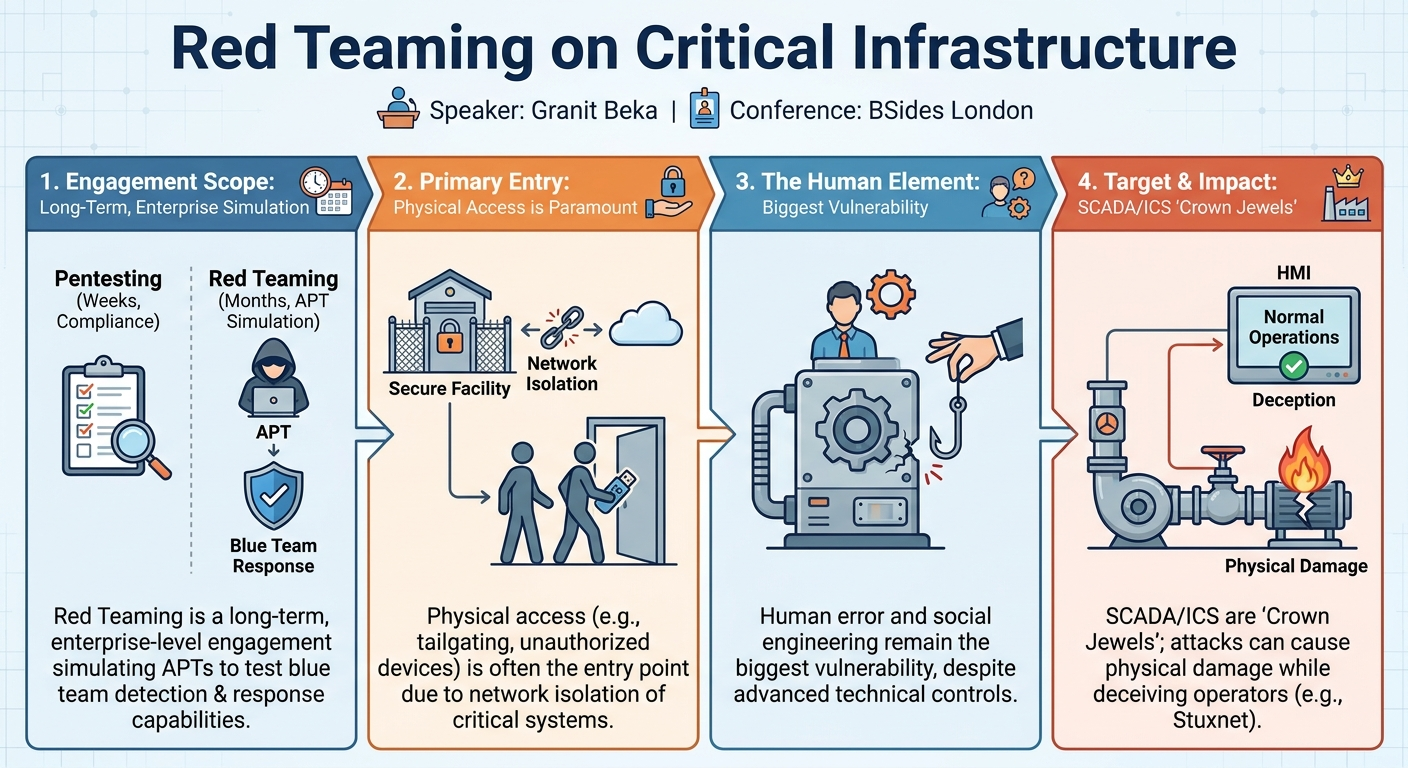
- Critical Infrastructure Red Teaming is Distinct: It's a long-term, enterprise-level engagement focused on testing blue team detection and response capabilities against APTs, vastly different from compliance-driven penetration testing.
- Physical Access is Paramount: Due to network isolation, gaining physical access through social engineering, tailgating, or unauthorized device introduction is often the primary entry point for critical infrastructure attacks.
- Human Error Remains the Biggest Vulnerability: Despite advanced technical controls, human mistakes and susceptibility to social engineering are consistently the weakest link in critical infrastructure security.
- SCADA Systems are the Crown Jewels: Industrial Control Systems, particularly SCADA, HMIs, RTUs, and PLCs, are the ultimate targets, often comprising legacy, unpatched hardware vulnerable to specialized exploits.
- Stuxnet Serves as a Blueprint: The Stuxnet worm demonstrated the devastating potential of sophisticated, multi-stage attacks that combine zero-days, physical access, and manipulation of operational data to cause physical damage while deceiving operators.
- ICS-Specific Vulnerabilities and Frameworks are Key: Defenders and red teams must be aware of ICS-specific CVEs (e.g., CVE-2023-5885) and frameworks like MITRE ATT&CK for ICS to understand and defend against unique threats.
About the Speaker(s)
Granit Beka is a Security Engineer at KPMG, specializing in red teaming and penetration testing. With six years of experience in the field, he brings practical knowledge of offensive security techniques. Having recently moved to the UK, Granit is passionate about making complex cybersecurity topics accessible and understandable.
Reviews
Dr. Zero (Offensive Security Researcher) — WEAK
This is an introductory ICS 101 lecture wearing a red team trench coat. Reciting the Stuxnet Wikipedia page and warning people about Flipper Zeros doesn't constitute research. If you've worked in OT security for more than ten minutes, you already know every single thing in this deck.
Heather Calloway (CISO) — SOLID
This is a standard consulting primer on OT red teaming that relies on 15-year-old case studies like Stuxnet to explain the basics of physical access and SCADA risk. It is a competent introduction for junior analysts new to industrial control systems, but it offers no new strategic or tactical value for a mature security organization. If you already operate an OT environment, your leadership team can skip this.