The simple approach to security risk management
Asher Selman (Senior IT Security Analyst)
Security BSides London 2023 · Day 1 · Rookie Track
Overview
In his BSides London talk, "The simple approach to security risk management," Senior IT Security Analyst Asher Selman addresses a pervasive challenge within cybersecurity: the often-complex and frequently misunderstood process of preliminary risk assessment. Selman, drawing from a diverse background spanning databases, infrastructure, data security, and Governance, Risk, and Compliance (GRC), argues that a fundamental disconnect exists between technical security teams and their non-technical GRC counterparts. This gap often leads to insufficient context, poor communication, and a failure to translate critical technical vulnerabilities into tangible business risks that resonate with decision-makers.
Key moments
- 0:00 Introduction: The challenge of overcomplicating risk assessment.
- 2:00 Bridging the disconnect between technical and non-technical teams.
- 4:00 Vulnerability management: translating technical issues to business risk.
- 8:00 Three key components for a preliminary risk assessment.
- 11:00 Working example: Assessing risk for end-of-life servers.
- 12:00 Key takeaways: Shared vision, business value, and repeatability.
The Simple Approach to Security Risk Management
Speakers: Asher Selman, Senior IT Security Analyst
Conference: BSides London
YouTube: https://www.youtube.com/watch?v=IWoFyYUlm54
Overview
In his BSides London talk, "The simple approach to security risk management," Senior IT Security Analyst Asher Selman addresses a pervasive challenge within cybersecurity: the often-complex and frequently misunderstood process of preliminary risk assessment. Selman, drawing from a diverse background spanning databases, infrastructure, data security, and Governance, Risk, and Compliance (GRC), argues that a fundamental disconnect exists between technical security teams and their non-technical GRC counterparts. This gap often leads to insufficient context, poor communication, and a failure to translate critical technical vulnerabilities into tangible business risks that resonate with decision-makers.
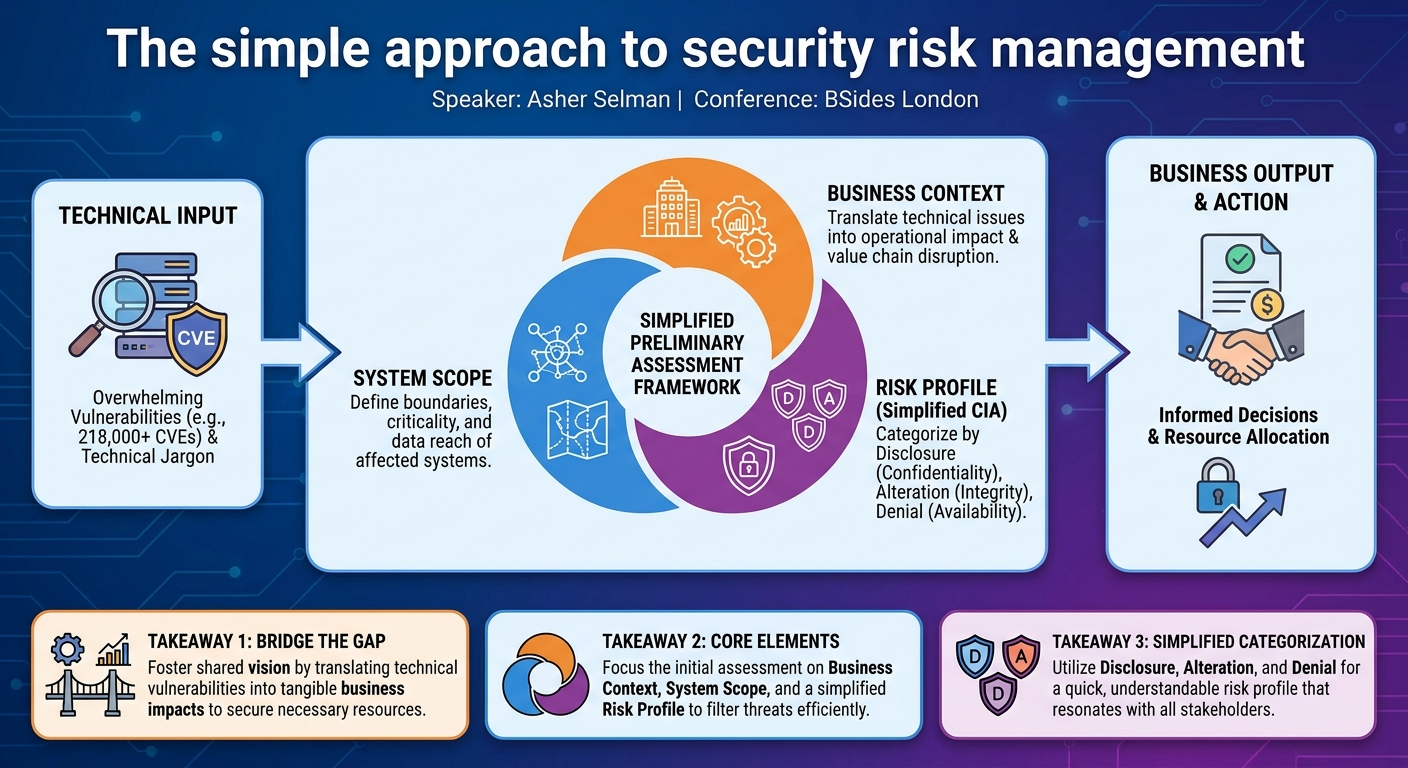
Selman's presentation advocates for a streamlined, repeatable methodology for conducting preliminary risk assessments. He posits that by focusing on three core elements—Business Context, System Scope, and a simplified Risk Profile—organizations can cut through the complexity often associated with traditional risk management frameworks. This "simple approach" is designed to facilitate clearer communication, ensure risks are understood in terms of their business impact, and ultimately secure the necessary resources for effective risk treatment, thereby fostering a more robust risk management culture across the enterprise.
The talk provides practical guidance for security professionals, particularly those bridging the technical and GRC divide, on how to articulate security problems in a way that aligns with organizational priorities. By simplifying the initial assessment phase, Selman aims to empower teams to better filter and prioritize the overwhelming volume of potential threats, ensuring that valuable time and resources are directed towards the most impactful risks. His insights are particularly relevant in an era where the rapid proliferation of vulnerabilities and the increasing sophistication of threats demand agile and effective risk communication strategies.
Background
▶ Watch: Introduction: The challenge of overcomplicating risk assessment. (0:00)
The landscape of modern cybersecurity is characterized by an ever-evolving array of threats, vulnerabilities, and regulatory pressures. Organizations are constantly barraged with new CVEs (Common Vulnerabilities and Exposures), sophisticated attack techniques, and the imperative to maintain compliance with a myriad of standards. As Asher Selman highlighted, the sheer volume of identified vulnerabilities is staggering; at the time of his talk, the CVE database alone contained over 218,000 records. Each of these records represents a potential security flaw that could translate into a business risk, underscoring the monumental challenge faced by security teams in identifying, assessing, and prioritizing these threats.
Traditionally, risk management has been framed as a comprehensive, multi-faceted process involving identification, analysis, evaluation, and treatment of risks. This process is often guided by complex frameworks such as NIST, ISO 27001, or COBIT, which, while robust, can be daunting to implement, especially for preliminary assessments. Selman points out that while these frameworks provide essential structure, they can also inadvertently lead to overcomplication, particularly at the initial stages of risk identification. The speaker's experience across various security domains—from databases and infrastructure to data security and GRC—has given him a unique vantage point to observe where these complexities often lead to breakdowns.
A critical underlying issue, as Selman meticulously detailed, is a perceived disconnect between technical security teams (e.g., application security, product security, SOC analysts) and non-technical GRC teams. Technical teams are inherently focused on vulnerability management, delving into attack trees, specific exploits, and intricate control mechanisms. Their language is precise, often filled with jargon, and deeply rooted in technical specifics. Conversely, GRC teams, while vital for policy, compliance, and overall risk governance, often operate from a "tick-box," policy-driven, and business-focused perspective. The lack of sufficient cross-training between these groups exacerbates this divide, leading to "insufficient context, communication, and missing information" when technical risks need to be translated into a language that business stakeholders can understand and act upon. This communication gap is the fundamental problem Selman's "simple approach" seeks to address, aiming to ensure that the message about critical risks is not lost in translation as it moves up the organizational hierarchy.
Key Findings
▶ Watch: Vulnerability management: translating technical issues to business risk. (4:00)
Asher Selman's talk centers on a core finding: the prevailing complexity of preliminary risk assessment often hinders effective security outcomes, and a simplified, focused approach can significantly improve risk understanding and treatment. His primary contribution is the articulation of a three-pronged methodology for this crucial initial phase, designed to bridge the communication chasm between technical and non-technical stakeholders.
The key findings and proposed solutions are:
- The Communication Disconnect: Selman identifies a significant "disconnect" between technical security teams, who are deeply immersed in vulnerability management and attack tree analysis, and non-technical GRC teams, who are more focused on policy, compliance, and business impact. This gap is attributed to limited cross-training and differing perspectives, leading to technical problems being poorly translated into business risks. The result is often a lack of context and actionable information for decision-makers.
- Overwhelming Vulnerability Data: The sheer volume of vulnerabilities, exemplified by the over 218,000 CVE records, presents an insurmountable challenge if every vulnerability is treated with equal weight. The speaker highlights that technical teams excel at identifying these problems, but the process of conveying their true risk to the business is often inefficient, leading to potential paralysis or misprioritization.
- The Necessity of Preliminary Assessment: Selman emphasizes that preliminary risk assessment is the foundational step in any effective risk management program. However, he notes that this stage is often overlooked or unnecessarily complicated by the myriad of existing frameworks and methodologies. His finding suggests that simplification at this initial stage is not a compromise but a strategic imperative.
- The Simple Methodology: The central finding is a proposed, repeatable framework for preliminary risk assessment, comprising three essential components:
- Business Context: Understanding what the technical vulnerability means for the organization's operations, objectives, and value chains. This translates technical jargon into business impact.
- System Scope: Clearly defining the boundaries of the affected system or service. Is it internal or external? What services does it support? What is its reach and criticality?
- Risk Profile: A simplified categorization of the potential impact, using a modified CIA Triad focusing on Disclosure (confidentiality), Alteration (integrity), and Denial (availability). This provides a quick, understandable assessment of the primary risk type.
By focusing on these three elements, Selman argues that organizations can generate a concise, actionable decision summary that effectively communicates the essence of a technical risk to all stakeholders, thereby fostering a shared understanding and facilitating more informed risk treatment decisions. This approach enables a more efficient filtering process, allowing teams to quickly discern which issues truly warrant further attention and resources, and which do not.
Technical Deep Dive
▶ Watch: Three key components for a preliminary risk assessment. (8:00)
While Asher Selman's talk emphasizes a "simple approach" to preliminary risk assessment rather than delving into the intricacies of specific exploits or code, the underlying technical processes and concepts that feed into this assessment are crucial to understanding its value. The "technical deep dive" in this context refers to the systematic process of identifying, categorizing, and initially evaluating technical vulnerabilities and how these are then translated into actionable risk information.
The foundation of any cybersecurity risk management program, as Selman correctly points out, lies in vulnerability management. This is the domain where technical teams operate, utilizing various tools and methodologies to uncover flaws. Key components include:
- Comprehensive Scanning: Organizations deploy a suite of tools for continuous monitoring and scanning, including vulnerability scanners (e.g., Nessus, Qualys, Tenable.io), static application security testing (SAST), dynamic application security testing (DAST), and software composition analysis (SCA). These tools identify weaknesses in networks, applications, and third-party libraries.
- Threat Frameworks: Technical teams often leverage frameworks like MITRE ATT&CK to understand potential adversary tactics and techniques. This helps contextualize vulnerabilities within a broader threat landscape, informing potential attack paths.
- Controls: Adherence to security controls, often guided by standards like CIS Controls or those within the NIST Cybersecurity Framework, is a technical endeavor. Implementing and validating these controls is a direct measure to mitigate known vulnerabilities.
- CVEs (Common Vulnerabilities and Exposures): This standardized list of publicly disclosed cybersecurity vulnerabilities forms the bedrock of vulnerability identification. Each CVE is assigned a unique identifier, along with a description and references. Selman's mention of over 218,000 CVE records underscores the scale of this data.
- Scoring Systems: To manage the deluge of CVEs, technical teams rely on scoring systems like CVSS (Common Vulnerability Scoring System). CVSS provides a numerical score reflecting the severity of a vulnerability based on factors such as exploitability, impact, and privileges required. This quantitative assessment helps in initial prioritization.
The challenge, Selman highlights, is not in identifying these technical problems, but in translating them. A high CVSS score, while technically significant, might not immediately convey its business impact to a non-technical executive. This is where the "simple approach" to preliminary risk assessment becomes a critical bridge.
Selman's methodology requires the technical team (or the GRC team acting as an interpreter) to structure the vulnerability information around three key areas:
- Business Context: This involves understanding the value chain of the organization. What critical business processes, services, or data does the affected system support? A technical vulnerability in an externally facing e-commerce platform has a different business context than one in an internal HR system. The goal is to articulate the potential financial, reputational, or operational impact in terms accessible to business leaders. For example, an "end-of-life production server" (Selman's example) isn't just a technical problem; its business context is potential service disruption, non-compliance, or data breach affecting revenue-generating operations.
- System Scope: This defines the boundaries and characteristics of the affected technical asset. Is it a single server, a microservice, an entire application, or a network segment? Is it internet-facing or internal? What data does it process (e.g., PII, financial data, intellectual property)? Understanding the scope helps in assessing the blast radius and the potential for lateral movement in an attack.
- Risk Profile (Simplified CIA Triad): Instead of a deep, multi-faceted risk analysis at the preliminary stage, Selman proposes a high-level categorization based on a simplified version of the CIA Triad (Confidentiality, Integrity, Availability):
- Disclosure: Relates to Confidentiality. Is the primary risk unauthorized access to sensitive information?
- Alteration: Relates to Integrity. Is the primary risk unauthorized modification or corruption of data or systems?
- Denial: Relates to Availability. Is the primary risk the disruption of service or access to systems/data?
By framing the technical issue within these three simplified categories, the preliminary assessment quickly establishes the fundamental nature of the threat from a business perspective. For instance, a SQL injection vulnerability might primarily be a "disclosure" risk if it leads to data exfiltration, or an "alteration" risk if an attacker can modify database records. An unpatched web server vulnerable to a DoS attack would be a "denial" risk.
This structured approach transforms raw technical data (like a high CVSS score for a CVE affecting a specific system) into a concise narrative that answers the crucial "why" for business stakeholders: "Why does this technical problem matter to us?" This translation is the critical technical-to-business interface that Selman's methodology aims to streamline, ensuring that the 218,000+ CVEs don't just sit as technical alerts but become understood, prioritized business risks.
Demo / Proof of Concept
▶ Watch: Working example: Assessing risk for end-of-life servers. (11:00)
Asher Selman's presentation, "The simple approach to security risk management," focuses on a methodological framework and a communication strategy rather than a specific technical tool or exploit. Therefore, the talk did not include a live demonstration or a proof of concept in the traditional sense of showcasing code, an attack, or a software solution. Instead, the speaker used a conceptual "working example" to illustrate his methodology.
The example provided was the issue of end-of-life (EOL) production servers. Selman walked the audience through how his three-part preliminary risk assessment would apply to this common scenario. He explained that for an EOL server, the Business Context would involve understanding what critical services or data it hosts, and the potential impact of its failure or compromise on business operations, revenue, or compliance. The System Scope would define the specific server(s) in question, their network placement (internal/external), and the criticality of the applications running on them. Finally, the Risk Profile would categorize the primary risk types, likely falling under "Denial" (service disruption due to unpatched vulnerabilities or hardware failure) and "Disclosure" (data breach due to lack of security updates).
This conceptual walk-through served as the practical demonstration of how the "simple approach" translates a common technical problem into a concise, business-relevant risk summary. While not a code-based demo, it effectively illustrated the application of the framework.
Defensive Implications
▶ Watch: Key takeaways: Shared vision, business value, and repeatability. (12:00)
Asher Selman's "simple approach" to preliminary risk assessment carries significant defensive implications for organizations striving to bolster their cybersecurity posture. By streamlining the initial risk identification and communication process, defenders can achieve several critical advantages:
- Improved Risk Prioritization and Resource Allocation: With a clear, business-centric preliminary assessment, security teams can move beyond simply reacting to high CVSS scores. They can effectively filter the overwhelming volume of vulnerabilities (e.g., the 218,000+ CVEs) and prioritize those that pose the most significant threat to the organization's Business Context and System Scope. This allows for more strategic allocation of limited security budgets and personnel towards risks that genuinely impact the business, ensuring that remediation efforts are focused on high-value targets.
- Enhanced Communication and Collaboration: The methodology directly addresses the communication gap between technical and non-technical teams. By providing a standardized, understandable framework for preliminary assessments, it fosters a shared vision of risk. Technical teams gain a clearer understanding of what information business stakeholders need, while GRC and management can quickly grasp the implications of technical vulnerabilities. This improved dialogue can lead to faster decision-making and more cohesive security strategies.
- Securing Funding for Remediation: Selman explicitly states that without clear business context, it's challenging to "get the money to resolve the problem." Defenders can leverage this approach to articulate the business value of security investments. By explaining a technical vulnerability not just as a flaw, but as a risk of "Disclosure" leading to regulatory fines, "Denial" causing revenue loss, or "Alteration" damaging data integrity, they can make a compelling case for budget approvals for patches, upgrades, or new security tools.
- Proactive Risk Management Culture: A repeatable, simple preliminary assessment process enables organizations to embed risk awareness into their operational DNA. It encourages continuous assessment and discussion of risks, shifting from a reactive "firefighting" mode to a more proactive risk management culture. This means security is considered earlier in project lifecycles and operational changes, rather than being an afterthought.
- Effective Filtering and Escalation: The preliminary assessment acts as an essential filter. Not every vulnerability is a critical risk requiring immediate executive attention. This methodology allows teams to quickly identify what "is a risk" and what "is not a risk" for their specific organization, based on its unique context. Only the truly significant risks, clearly articulated through the framework, are escalated up the chain, preventing alert fatigue and ensuring leadership focuses on what truly matters.
- Empowering GRC Teams: For GRC professionals, this approach provides a practical tool to translate complex technical reports into actionable insights. It empowers them to ask the right questions about System Scope and Business Context, enabling them to effectively fulfill their role in governance and compliance without needing deep technical expertise in every domain.
In essence, Selman's simple approach empowers defenders to move beyond technical problem-solving in isolation and become strategic partners in business resilience. By clarifying the "why" and "what" of security risks in a language that resonates across the organization, it strengthens the overall defensive posture against an ever-growing threat landscape.
Key Takeaways
- Bridge the Technical-Non-Technical Divide: Effective security risk management hinges on fostering a shared vision and overcoming the communication gap between technical security teams and non-technical GRC/business stakeholders through improved context and cross-training.
- Business Context is Paramount: Translating technical vulnerabilities into their direct impact on business operations, value chains, and objectives is crucial for securing resources and buy-in for risk treatment. Without understanding "what this means" for the business, risks often go unaddressed.
- Simplify Preliminary Risk Assessment: Overcomplicating the initial assessment phase with extensive frameworks can hinder progress. A focused methodology centered on Business Context, System Scope, and a simplified Risk Profile (Disclosure, Alteration, Denial) is more effective for initial filtering and communication.
- The Methodology is Repeatable and Scalable: A simple, consistent process for preliminary risk assessment allows organizations to efficiently filter and prioritize the vast number of potential threats (e.g., over 218,000 CVEs), ensuring that resources are directed towards the most impactful risks.
- Understand System Scope for Accurate Risk: Clearly defining the boundaries, criticality, and data handled by affected systems is essential for accurately assessing the potential impact and reach of a vulnerability.
- A Simplified Risk Profile for Clarity: Utilizing a high-level risk profile based on Disclosure (confidentiality), Alteration (integrity), and Denial (availability) provides a quick, understandable categorization of risk types for all stakeholders.
About the Speaker(s)
Asher Selman is a Senior IT Security Analyst with a comprehensive background that uniquely positions him to address the challenges of security risk management. His career journey has provided him with diverse perspectives across various facets of information technology and security. Selman's experience began in databases, where he spent several years, providing him with a foundational understanding of data structures and integrity. He then transitioned into infrastructure, gaining insights into system architecture and operational resilience. Subsequently, he moved into data security, focusing on protecting sensitive information, before ultimately specializing in Governance, Risk, and Compliance (GRC). This multi-faceted background has allowed him to observe and understand the intricacies and potential disconnects between technical implementation and strategic risk oversight, making him a credible voice in advocating for streamlined communication in cybersecurity.
Reviews
Dr. Zero (Offensive Security Researcher) — WEAK
This is GRC 101 masquerading as a novel methodology. Telling analysts to 'add business context' and rebranding the CIA triad isn't a framework, it's the first chapter of a CISSP study guide. Complete lack of novelty.
Heather Calloway (CISO) — SOLID
Selman proposes a basic three-step framework to translate technical vulnerabilities into business risk. It is a competent primer for junior practitioners, but senior leaders will find the core concepts—business context, scope, and impact—elementary.