In space; everyone can hear your downlink
minus (Engineering Student)
Security BSides London 2023 · Day 1 · Rookie Track
Overview
In the talk "In space; everyone can hear your downlink," minus, an engineering student, delves into the often-overlooked security vulnerabilities inherent in satellite communications. Drawing from his experiences in amateur radio and academic studies, minus illuminates how widely used protocols like Digital Video Broadcast (DVB) transmit sensitive data, often unencrypted, across vast geographical regions. The core premise of the talk is that with readily available and relatively inexpensive equipment, anyone can establish a ground station capable of intercepting and analyzing this traffic.
Key moments
- 0:29 Pirates using old US government satellites
- 2:20 High latency challenges for satellite internet
- 3:45 Why unencrypted satellite traffic is viewable
- 6:00 Essential hardware for a satellite ground station
- 8:05 Comparing different Software Defined Radios (SDRs)
- 10:15 Finding and exploiting vulnerable ship networks
- 12:10 Opportunities in amateur satellite radio
- 13:00 University team building a satellite ground station
In space; everyone can hear your downlink
Speakers: minus, Engineering Student
Conference: BSides London
YouTube: https://www.youtube.com/watch?v=TOYQDQ0luA4
Overview
In the talk "In space; everyone can hear your downlink," minus, an engineering student, delves into the often-overlooked security vulnerabilities inherent in satellite communications. Drawing from his experiences in amateur radio and academic studies, minus illuminates how widely used protocols like Digital Video Broadcast (DVB) transmit sensitive data, often unencrypted, across vast geographical regions. The core premise of the talk is that with readily available and relatively inexpensive equipment, anyone can establish a ground station capable of intercepting and analyzing this traffic.
The presentation highlights the critical security gaps in satellite internet, particularly for remote and maritime users, where the convenience of connectivity often overrides robust security practices. Minus illustrates how geostationary satellites, designed to broadcast signals over continental areas, inadvertently create a massive eavesdropping opportunity. This talk serves as a stark reminder that in the realm of satellite communications, the concept of a private downlink is often an illusion, underscoring the urgent need for enhanced encryption and secure configurations to protect data in transit.
Beyond the technical exposition, minus also touches upon the intriguing history of satellite usage, including the unauthorized repurposing of vintage military satellites by Brazilian cartels for illicit communications. This anecdote underscores the long-standing and often unaddressed security challenges in space-based infrastructure, adding a fascinating layer to the broader discussion of satellite security.
Background
▶ Watch: Pirates using old US government satellites (0:29)
The evolution of satellite communications, particularly the Digital Video Broadcast (DVB) protocol, forms the foundational context for understanding the vulnerabilities discussed. Originally conceived in the 1980s for transmitting digital television signals over expansive areas, DVB has undergone numerous extensions. By the 1990s, it supported audio calls, news bulletins, and even fax transmissions. A significant turning point arrived in 2003 with the integration of Internet Protocol (IP) over DVB, enabling satellite internet connectivity.
However, this technological leap introduced inherent challenges, especially for satellites in geostationary orbit. These satellites, positioned approximately 35,786 kilometers (22,236 miles) above the Earth's equator, appear stationary from the ground. While ideal for continuous coverage, the immense distances involved lead to substantial latency. As minus explains, a signal traversing to and from a geostationary satellite incurs a round-trip delay of roughly 160 milliseconds. This delay, while seemingly minor, significantly impacts real-time applications, making it "ungameable" even for older titles.
Compounding the latency issue is the prevalent practice of intentionally disabling or simply not implementing encryption in many satellite communication systems. For Very Small Aperture Terminals (VSATs), commonly used in maritime and remote locations, every millisecond counts. Adding encryption layers introduces further latency and can reduce the already low bit rates, making it a performance trade-off that many operators choose to forgo. The consequence is clear: "anyone who can receive the signals can view the traffic."
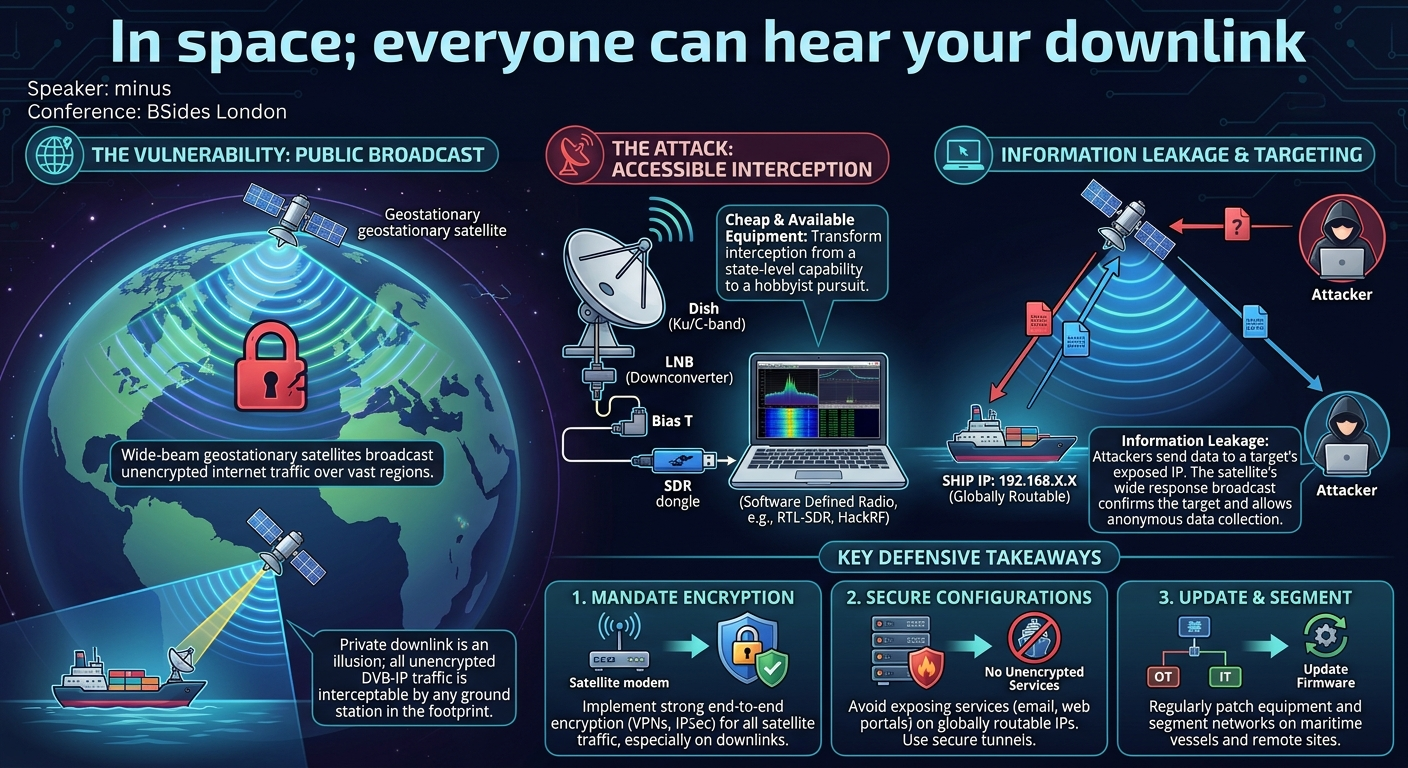
The architecture of geostationary satellite communication further exacerbates this vulnerability. These satellites typically employ large, wide-beam antennas that broadcast signals across vast geographical regions, sometimes encompassing multiple continents. While users on Earth communicate with the satellite via small, highly directional dishes that send narrow, focused beams upwards (the uplink), the satellite's downlink to these users is a broad, undiscriminating broadcast. This means that if a satellite transmits internet traffic to a ship in the Atlantic, every other ground station within that satellite's expansive coverage footprint receives the exact same signal. This fundamental design choice, driven by the need for wide-area coverage, transforms every unencrypted downlink into a public broadcast, ripe for interception.
Adding a historical dimension, minus also recounts how US government satellites launched in the 1960s and 1970s, designed with analog systems and no authentication mechanisms, are now reportedly used by Brazilian cartels for free, untraceable communication. This anecdote highlights that the challenges of securing space-based assets are not new, but rather persistent issues that evolve with technology.
Key Findings
▶ Watch: Why unencrypted satellite traffic is viewable (3:45)
The central revelation of the talk is the pervasive and easily exploitable insecurity of satellite internet communications, particularly those utilizing the DVB protocol for IP traffic. Minus demonstrates that the combination of wide-beam geostationary satellite downlinks and the intentional absence of encryption creates a massive, open channel for anyone with the right equipment to intercept sensitive data.
Specifically, the talk identifies several critical findings:
- Widespread Unencrypted Traffic: A significant portion of satellite internet traffic, especially for remote and maritime users, is transmitted without encryption. This decision is often driven by a perceived need to minimize latency and maximize throughput over inherently high-latency, low-bandwidth links, making security a secondary concern.
- Ease of Interception: Setting up a basic ground station capable of receiving and decoding this unencrypted traffic is surprisingly accessible. The necessary components – a satellite dish, a downconverter, and a Software Defined Radio (SDR) – are relatively inexpensive and widely available, transforming the act of satellite eavesdropping from a state-level capability into a hobbyist pursuit.
- Vulnerable Targets: Maritime Vessels: Ships at sea are presented as prime targets for interception. They frequently operate with legacy systems and often expose services like email servers (e.g., POP3) and unencrypted web portals directly to the internet. Minus notes that these vessels often use globally routable IP addresses, making them discoverable and directly addressable.
- Asymmetric Visibility and Information Leakage: While a ship's uplink (its requests to the internet) is typically narrow and directed towards the satellite, the internet's responses back to the ship (the downlink traffic) are broadcast widely across the satellite's entire coverage area. This means an attacker can "see all of the traffic coming back on a satellite to ships all across your Continental area." A particularly ingenious finding is the potential for an "information leak": by identifying a ship's globally routable IP address and sending any data to it, an attacker can then observe the widespread downlink of that data (and any subsequent responses) across the entire satellite beam. This allows for the collection of data that, if traced, would only point to a vast geographical region (e.g., "somewhere in Europe or North America"), providing significant anonymity for the interceptor.
These findings collectively paint a picture of a critical infrastructure segment operating with alarming security deficiencies, where the very design intended for broad coverage facilitates widespread passive interception.
Technical Deep Dive
▶ Watch: Comparing different Software Defined Radios (SDRs) (8:05)
Establishing a ground station to intercept satellite communications, as outlined by minus, involves a combination of readily available hardware and specialized software. The core principle revolves around capturing the faint, high-frequency signals from orbit and converting them into a format that can be processed digitally.
The essential components of a ground station include:
- Satellite Dishes: These are parabolic dishes, designed to magnify and focus incoming radio signals from a satellite onto a single focal point. The parabolic shape ensures that parallel waves hitting the dish are reflected to this precise point, concentrating the energy.
- Downconverter (Low-Noise Block-downconverter or LNB): Positioned at the focal point of the dish, the LNB is a critical component. It receives the very high-frequency satellite signal (e.g., Ku-band or C-band) and converts it to a much lower intermediate frequency (IF) that can be easily transmitted through standard coaxial cables. This conversion is necessary because high-frequency signals experience significant reactive losses when traveling long distances through typical cables, degrading rapidly. The LNB also amplifies the weak signal while adding minimal noise.
- Bias T: The LNB requires power to operate. A Bias T is an electronic component that injects DC power onto the coaxial cable carrying the IF signal without interfering with the radio frequency transmission. This allows the LNB to be powered remotely from the receiver unit.
- Coaxial Cable: Standard coaxial cables are then used to transmit the lower-frequency IF signal from the LNB to the receiving equipment.
The heart of the signal processing lies in the Software Defined Radio (SDR). An SDR is a radio communication system where components traditionally implemented in hardware (such as mixers, filters, modulators, and demodulators) are instead implemented by software on a personal computer or embedded system. Essentially, an SDR takes an analog radio frequency signal and translates it into the digital domain using an Analog-to-Digital Converter (ADC). Once digitized, the signal can be manipulated, filtered, and decoded using software, offering immense flexibility compared to fixed-function hardware radios.
Minus highlights several SDR options, catering to different budgets and capabilities:
- RTL-SDR: This is the "budget choice," typically costing around £25. Originally designed as a DVB-T (digital terrestrial television) dongle, it was discovered that its underlying chip could be repurposed as a general-purpose SDR. Its primary limitation is a relatively narrow bandwidth, meaning it can only "see" a small slice of the radio spectrum at any given time. While suitable for basic signal hunting, it may struggle with wideband satellite signals.
- HackRF: A significant step up, the HackRF is a popular choice for researchers and hobbyists, often mentioned in security conferences. While a genuine HackRF One can be hundreds of dollars, minus notes that knock-off versions can be acquired for about £60. Its advantages include a much higher bandwidth, allowing it to capture larger chunks of the radio spectrum simultaneously, and a lower noise floor, which enables the detection of weaker signals that an RTL-SDR might miss.
- PlutoSDR: Priced around £300, the PlutoSDR offers reasonable bandwidth but distinguishes itself with its receive and transmit capabilities. This bi-directional functionality is crucial for prototyping more complex communication systems and for interacting with modern satellites that require active transmission, not just passive reception.
Once the signal is digitized by the SDR, specialized software (though not explicitly named in the talk, common tools include SDR# for Windows, GQRX for Linux, and various DVB-S/S2 decoders like DVB-S2 Demodulator or DVB-S2-RX) is used to demodulate the DVB-S/S2 signal, extract the IP packets, and reconstruct the underlying data streams. The lack of encryption means that once the IP packets are extracted, their contents are immediately readable, revealing email traffic, web browsing data, and other communications destined for the target.
Demo / Proof of Concept
▶ Watch: Finding and exploiting vulnerable ship networks (10:15)
While the talk did not feature a live, real-time demonstration of intercepting satellite traffic, minus thoroughly outlined the methodology and the observed vulnerabilities, effectively serving as a conceptual proof of concept for the audience. He described the process of setting up a ground station and detailed the types of unencrypted traffic that can be readily captured.
The speaker vividly illustrated the practical implications of these vulnerabilities by describing how one "can see all of the traffic coming back on a satellite to ships all across your Continental area." This refers to the ability to intercept the downlink traffic from geostationary satellites, which often includes communications destined for maritime vessels. He specifically mentioned finding "email servers" and "unencrypted web portals" running on these ships, accessible via "globally rootable IP addresses."
The most compelling aspect of the "demonstrated" concept was the information leakage technique. Minus explained that by identifying a ship's IP address, an attacker could send any data to it. Because the satellite's downlink is a wide broadcast, the responses to that data (and the original data itself, if reflected) would then be widely received by any ground station within the satellite's coverage area. This effectively turns the satellite's broadcast into a mechanism for an attacker to verify and collect information about a target, with the source of the initial probe being virtually untraceable beyond a broad geographical region.
Furthermore, minus shared images of the amateur satellite built by his university's radio society, illustrating the hands-on experience and capability in constructing and operating radio systems. Although this specific satellite was for amateur radio and not for intercepting DVB traffic, it underscored the accessibility of the underlying principles and the practical skills required for such endeavors. The talk, therefore, provided a comprehensive blueprint for how such interception is not only possible but actively observed in the field.
Defensive Implications
▶ Watch: University team building a satellite ground station (13:00)
The insights presented by minus in "In space; everyone can hear your downlink" carry significant defensive implications for anyone relying on satellite communication, particularly in remote or maritime environments. The core message is that without explicit security measures, satellite internet should be considered an inherently insecure medium, especially on the downlink.
Here are the key defensive strategies and considerations:
- Mandate and Implement Strong Encryption: The most critical defense is universal encryption for all satellite traffic. If available, users and operators should configure their satellite modems and ground terminals to use the strongest possible encryption protocols. Where modem-level encryption is absent or intentionally disabled, users must implement end-to-end encryption at the application layer or through Virtual Private Networks (VPNs). All data sent over satellite links should traverse a secure tunnel (e.g., IPsec, OpenVPN, WireGuard) to a trusted endpoint before reaching the public internet. This ensures that even if the satellite signal is intercepted, the content remains unintelligible.
- Avoid Exposing Unencrypted Services: Maritime vessels and remote sites should rigorously avoid exposing unencrypted services (such as mail servers, web portals, or administrative interfaces) directly to the internet via globally routable IP addresses. If these services are essential, they should be placed behind firewalls, accessible only via secure, authenticated VPN tunnels, or protected with strong HTTPS/TLS configurations. Relying on the obscurity of a remote location for security is a dangerous misconception.
- Regularly Update and Patch Equipment: The talk mentions "very old equipment" being common on ships. Legacy systems often lack modern security features, including robust encryption capabilities or patching mechanisms for known vulnerabilities. Organizations should prioritize upgrading to newer, more secure satellite modems and network infrastructure that support contemporary encryption standards and regular security updates.
- Network Segmentation and Least Privilege: Implement robust network segmentation on vessels and remote sites. Critical operational technology (OT) networks should be isolated from IT networks and public internet access. Apply the principle of least privilege to all network access and exposed services, limiting what can be accessed and by whom.
- Awareness and Training: Users and administrators of satellite communication systems must be educated about the inherent risks of unencrypted satellite links. Understanding that their "private" internet connection is effectively a public broadcast is crucial for adopting secure practices. Training should cover the importance of VPNs, strong passwords, and recognizing phishing attempts that might exploit exposed services.
- Monitor for Anomalies: While passive interception is hard to detect, monitoring network traffic for unusual patterns, unauthorized access attempts (even if blocked by firewalls), or unexpected data flows can provide early warnings of potential targeting.
In essence, defenders must assume that all unencrypted downlink traffic is compromised and build security layers on top of this assumption. The convenience of satellite connectivity must be balanced with a proactive and robust security posture to protect sensitive data from widespread interception.
Key Takeaways
- Satellite internet, particularly DVB-S/S2, frequently lacks encryption: For performance reasons (latency, bit rate), encryption is often intentionally disabled or not built into satellite modems, leaving data exposed.
- Geostationary satellites broadcast unencrypted downlink traffic widely: The design of geostationary satellites with wide-beam antennas means that unencrypted internet traffic destined for a single user is broadcast across vast geographical regions, making it susceptible to widespread interception.
- Ground stations for interception are cheap and accessible: With readily available and relatively inexpensive components like satellite dishes, LNBs, and Software Defined Radios (e.g., RTL-SDR, HackRF), anyone can set up a ground station to intercept satellite communications.
- Maritime vessels are common targets due to legacy systems and exposed services: Ships often use older equipment and expose services like unencrypted email servers and web portals on globally routable IP addresses, making them prime targets for data interception.
- "Information leakage" is possible by targeting ship IPs: An attacker can send data to a ship's globally routable IP address and then widely receive the subsequent downlink traffic (including the data and responses) across the satellite's entire coverage area, making the source of the probe difficult to trace.
- Strong encryption and secure network configurations are crucial: To mitigate these risks, users and operators of satellite internet must prioritize end-to-end encryption (e.g., VPNs), avoid exposing unencrypted services, update legacy equipment, and implement robust network segmentation.
About the Speaker(s)
The speaker for "In space; everyone can hear your downlink" is minus, an engineering student. His passion for the subject stems from his extensive involvement in amateur radio over the past year and a half, coupled with his academic studies in radio and communications. His practical experience extends to actively building and experimenting with satellite technology, including his participation in building a satellite with the university's radio society. This blend of academic knowledge, hands-on experience, and amateur radio enthusiasm forms the foundation of his insights into satellite communication security.
Reviews
Dr. Zero (Offensive Security Researcher) — WEAK
Unencrypted DVB-S downlink sniffing was a neat parlor trick ten years ago, but presenting it today without any novel protocol breaks or tooling is just a history lesson. A student figuring out how to plug an RTL-SDR into an LNB is great for their personal development, but it's 101-level filler that doesn't belong on a modern conference schedule.
Heather Calloway (CISO) — SOLID
This presentation demonstrates how easily unencrypted satellite downlinks—particularly those used by maritime and remote operations—can be intercepted using cheap radio hardware. It is a competent, practical reminder that satellite connectivity is a wide-area public broadcast, not a secure private line. Worth reviewing if your organization manages remote fleets or off-grid infrastructure.