Wires gone Rogue: IoT security at the cable level
Aunart Grajqevci (Cyber Security Student · Manchester Metropolitan University)
Security BSides London 2023 · Day 1 · Rookie Track
Overview
In his compelling BSides London talk, "Wires gone Rogue: IoT security at the cable level," Aunart Grajqevci, a third-year cybersecurity student at Manchester Metropolitan University, shed light on a often-overlooked yet critical aspect of modern security: the physical layer vulnerabilities inherent in cabled IoT devices and network infrastructure. Grajqevci argues that despite the rapid proliferation of devices like Ring doorbells, CCTV systems integrated with mobile apps, and Voice over IP (VoIP) technology, a significant lack of industry standards and regulations leaves these foundational connections exposed to a range of attacks.
Key moments
- 0:00 Introduction: Cabled IoT devices and vulnerabilities
- 1:30 Personal story: How the talk idea originated
- 3:30 Key vulnerabilities: DoS, eavesdropping, man-in-the-middle
- 4:00 Severe implications for businesses and homeowners
- 5:30 Practical mitigations: Concealment, capping, encryption
- 8:00 Q&A: How easy is it to eavesdrop on a cable?
- 12:00 Q&A: Are these attacks happening in the wild?
Wires gone Rogue: IoT security at the cable level
Speakers: Aunart Grajqevci (Cyber Security Student, Manchester Metropolitan University)
Conference: BSides London
YouTube: https://www.youtube.com/watch?v=OCtMOfzj85U
Overview
In his compelling BSides London talk, "Wires gone Rogue: IoT security at the cable level," Aunart Grajqevci, a third-year cybersecurity student at Manchester Metropolitan University, shed light on a often-overlooked yet critical aspect of modern security: the physical layer vulnerabilities inherent in cabled IoT devices and network infrastructure. Grajqevci argues that despite the rapid proliferation of devices like Ring doorbells, CCTV systems integrated with mobile apps, and Voice over IP (VoIP) technology, a significant lack of industry standards and regulations leaves these foundational connections exposed to a range of attacks.
The presentation serves as a stark reminder that even the most sophisticated digital defenses can be undermined by weaknesses at the physical level. Grajqevci's research underscores how easily accessible and poorly protected cables can lead to severe consequences, ranging from service disruptions to data breaches. The talk aims to raise awareness among both homeowners and businesses about the tangible risks associated with inadequate physical security for their wired infrastructure and proposes practical, often low-cost, mitigations.
This discussion is particularly pertinent in an era where Internet of Things (IoT) deployments are expanding into every facet of life, from smart homes to critical industrial control systems. By focusing on the "wires gone rogue," Grajqevci challenges the audience to consider the holistic security posture of their environments, emphasizing that cybersecurity extends beyond software and network configurations to the very cables that carry our data.
Background
▶ Watch: Introduction: Cabled IoT devices and vulnerabilities (0:00)
The genesis of this talk stems from a personal experience that highlighted the widespread issue of poor cabling practices. As a student in accommodation, Grajqevci encountered difficulties when network technicians attempted to establish a fiber optic connection. Initially, the most convenient connection point at the front of the house proved unfeasible. This led to the fiber optic box being placed in the garden, out of public view. This seemingly minor incident sparked a broader investigation into how businesses and homeowners manage their own cables, revealing a pervasive problem.
Grajqevci's subsequent observations, including images taken within a 30-second walk from his university, illustrate the gravity of the situation. These images depicted visible and easily accessible cables, despite "some sort of attempt" to cover the lower half, which he deemed "not adequate." These exposed cables were identified as carrying crucial services such as network connections, fire alarm systems, and camera system feeds. Similarly, on domestic properties, a fiber optic connection was observed placed "just beside the front door on the front of the property," presenting an immediate and obvious vulnerability.
The core problem, as Grajqevci articulates, lies in the "lack of standards and regulations" governing the installation and protection of these physical connections. While significant attention is often paid to software vulnerabilities, network protocols, and cloud security, the fundamental physical layer is frequently overlooked. This oversight creates a fertile ground for attackers, as the path of least resistance often involves targeting the most exposed and unprotected components of an infrastructure. The talk posits that this problem exists because the physical layer is often taken for granted, and its security implications are not fully appreciated until a compromise occurs.
Key Findings
▶ Watch: Key vulnerabilities: DoS, eavesdropping, man-in-the-middle (3:30)
The presentation identifies several critical findings regarding the security of cabled IoT and network infrastructure:
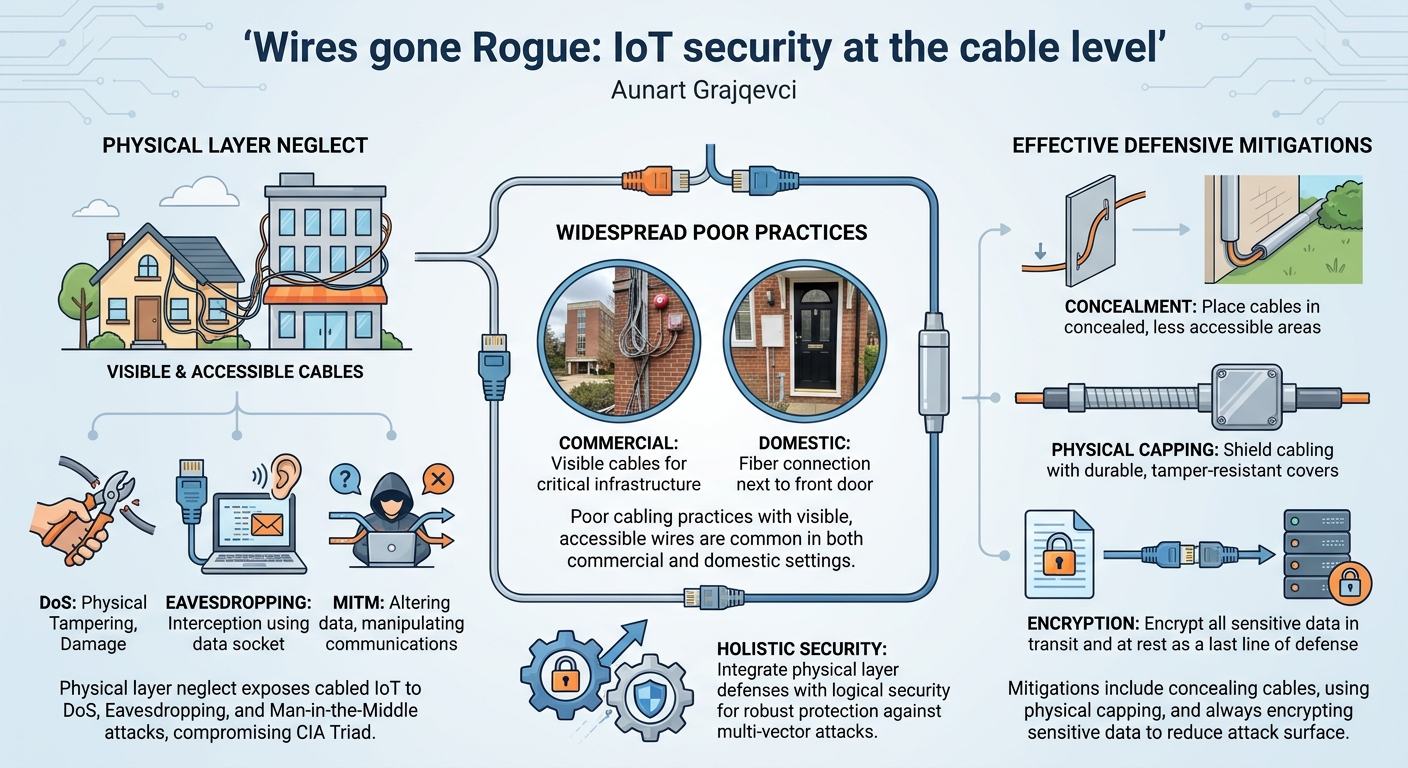
- Widespread Poor Cabling Practices: Grajqevci's observations confirm that visible and easily accessible cables are a common occurrence in both commercial and domestic settings. This includes critical infrastructure like network connections, fire alarm systems, and camera systems, indicating a systemic lack of physical security awareness.
- Identifiable Vulnerabilities: Poor cabling directly exposes systems to three primary attack types:
- Denial of Service (DoS): Physical tampering, damage, or cutting of cables.
- Eavesdropping: Interception of data traffic using a data socket or similar tools.
- Man-in-the-Middle (MitM): Altering intercepted data to manipulate communications or systems.
- Severe Implications for Businesses and Homeowners: The consequences of these physical layer attacks are substantial. For businesses, they can lead to significant downtime (averaging $3.6 million annually), data breaches, financial losses, and operational chaos, potentially forcing closure. For homeowners, a cut cable can result in weeks of service disruption.
- Impact on the CIA Triad: All three identified vulnerabilities directly compromise the fundamental principles of information security:
- Confidentiality: Eavesdropping and MitM attacks reveal sensitive data.
- Integrity: MitM attacks allow data alteration.
- Availability: DoS attacks disrupt service.
- Effectiveness of Combined Attack Vectors: Grajqevci highlights that a physical layer attack is most effective when combined with other attack vectors. For instance, compromising the physical layer of a "safe department" within a university or hospital could be leveraged to launch more impactful attacks in other departments, bypassing logical security controls.
- Lack of Public Awareness and Statistics: Despite the critical nature of these vulnerabilities, Grajqevci notes a significant absence of public statistics or widespread discussion about physical layer attacks in the wild. This suggests that such incidents may go unnoticed, unreported, or simply not be attributed to their physical root cause.
These findings collectively underscore that physical security for network and IoT cables is not a peripheral concern but a fundamental requirement that demands immediate attention to safeguard against potentially devastating real-world impacts.
Technical Deep Dive
▶ Watch: Severe implications for businesses and homeowners (4:00)
The technical core of Grajqevci's talk dissects the specific vulnerabilities arising from poor cabling and explains the mechanisms through which they can be exploited, along with their far-reaching implications.
The presentation begins by illustrating common "bad cabling practices" with real-world examples. On commercial properties, such as those near his university, cables for network connections, fire alarm systems, and camera systems were observed to be "visible and easily accessible." While some superficial attempts at concealment were noted, they were deemed "not adequate" due to the continued exposure. Similarly, domestic fiber optic connections were shown placed directly beside front doors, making them prime targets. This physical exposure forms the bedrock for subsequent attacks.
Grajqevci then details the three primary vulnerabilities:
- Denial of Service (DoS) Attack: This is the most straightforward physical layer attack. If cables are visible and accessible, an attacker can simply "tamper, damage, or cut the cables to deny your service." This could be as simple as a pair of wire cutters, leading to immediate and complete disruption of connectivity. The implications are severe, particularly for businesses, where downtime costs an average of $3.6 million every year. For homeowners, it translates into "weeks of waiting for a new connection to be established," causing significant inconvenience and potentially impacting remote work or essential services.
- Eavesdropping Vulnerability: This attack vector allows an adversary to intercept data flowing through a cable. Grajqevci explains that an attacker could use a data socket to "intercept the traffic passing through the wire." He elaborates on the theoretical process: "a matter of getting the data socker splicing the wires getting those wires into the data socket and then connecting it to the laptop to some sort of software that can analyze that traffic." While acknowledging the practical difficulties of performing such an attack outdoors unnoticed, he emphasizes that the "difficulty of it I would say it's not too difficult" in terms of technical execution. The primary challenge is the physical act of gaining access covertly. This vulnerability directly compromises confidentiality, as sensitive data can be read in plain text if not properly encrypted.
- Man-in-the-Middle (MitM) Attack: Building upon the eavesdropping capability, an MitM attack takes the interception a step further. Grajqevci states, "if you're able to intercept that data then you're most likely able to alter the data." This allows an attacker to not only read traffic but also modify it before it reaches its intended destination, or inject malicious data. This compromises both confidentiality and, critically, integrity, as the authenticity and trustworthiness of communications are undermined. An MitM attack at the physical layer could lead to unauthorized access, command injection into IoT devices, or manipulation of critical system parameters.
The impact of these vulnerabilities is clearly mapped against the CIA Triad (Confidentiality, Integrity, Availability). Grajqevci presents a table (visually in the slides, described verbally) demonstrating how more or less every area of the CIA Triad is covered by just these three physical layer vulnerabilities. This highlights that physical layer compromises are not isolated incidents but can have cascading effects across an organization's entire information security posture.
Furthermore, Grajqevci emphasizes that physical layer attacks are "most effective when it's combined with other attack vectors." He provides the example of targeting a "safe department's physical layer" within a larger organization like a university or hospital. By gaining initial access or causing disruption at this seemingly less critical point, an attacker could then launch a more effective, multi-pronged attack against other departments, potentially bypassing more robust logical security controls that assume the physical layer is secure. This underscores the need for a holistic security strategy that integrates physical and logical defenses.
Demo / Proof of Concept
▶ Watch: Q&A: How easy is it to eavesdrop on a cable? (8:00)
While Aunart Grajqevci's presentation effectively details the theoretical and practical aspects of physical layer vulnerabilities, it did not include a live demonstration or proof-of-concept during the talk. Instead, Grajqevci described the methodology for an eavesdropping attack in detail, outlining the steps involved in splicing wires into a data socket and connecting it to a laptop with analysis software. He also mentioned having "a reference on the next slide which gives you a very good walk through on how to do it," indicating that the technical steps for such an attack are well-documented and accessible. Therefore, the talk focused on explaining how these attacks could be carried out rather than performing one live.
Defensive Implications
▶ Watch: Q&A: Are these attacks happening in the wild? (12:00)
Grajqevci concludes his presentation by outlining practical and actionable mitigations that can significantly reduce the risk of physical layer attacks. These defensive strategies are applicable to both domestic and commercial environments, emphasizing a layered approach to security.
The first and often most cost-effective mitigation is placing cables in concealed areas. Drawing from his personal anecdote, Grajqevci explains how placing the fiber optic connection in the garden, out of public view, "lowered that attack surface." This simple measure reduces accessibility and visibility, making it harder for opportunistic attackers to identify and tamper with cables. For homeowners, this can be achieved with "near enough no cost" by simply communicating with network technicians to request a less exposed installation point. While commercial properties may not always have private or concealed areas readily available, the principle remains: prioritize locations that are difficult for unauthorized individuals to access.
The second crucial mitigation is the use of cable capping. Grajqevci illustrates this with an image, describing it as "shielding the cablin with some sort of cover." These covers can be made from various durable materials such as plastic, metal, or rubber, all of which are "very adequate" for providing a physical barrier against tampering and environmental damage. Cable capping adds a layer of protection that deters casual attackers and makes any attempt at access more difficult and noticeable. This solution directly addresses the problem of exposed and easily accessible cables in areas where full concealment is not possible.
As a "last little line of defense," Grajqevci strongly advocates for encrypting sensitive data in transit and at rest. He states that "this should be done regardless to be honest with you," highlighting its fundamental importance in any security strategy. Even if an attacker manages to overcome physical protections and intercept data, encryption ensures that the intercepted information remains unreadable and unintelligible. The speaker points out that "there's still a lot of data breaches where the data being stored is in plain text," underscoring the critical need for universal encryption practices to protect confidentiality, even in the event of a physical compromise.
During the Q&A, additional defensive considerations emerged. The concept of tamper-evident solutions was raised, where protective measures would clearly indicate if a cable or its capping had been interfered with. Grajqevci acknowledged this as a "good idea" and suggested that installing cameras on the property could also help identify attackers or detect tampering. He also distinguished between what individuals and businesses can control (their own property's cabling) versus external infrastructure like "switch boxes at the end of each street," which are typically "out of your control." This distinction reinforces the focus on immediate, actionable steps within one's sphere of influence.
In summary, the defensive implications emphasize a multi-faceted approach: proactive concealment, physical reinforcement, and robust data encryption, all contributing to a stronger overall security posture against physical layer threats.
Key Takeaways
- Physical Layer Security is Critical but Overlooked: Despite the proliferation of cabled IoT devices, the physical security of their connections is often neglected, creating significant vulnerabilities.
- Widespread Poor Cabling Practices: Both domestic and commercial properties exhibit visible and easily accessible cables for critical services, indicating a systemic lack of awareness and standards.
- Diverse Attack Vectors with Serious Consequences: Poor cabling enables Denial of Service (DoS), eavesdropping, and Man-in-the-Middle (MitM) attacks, leading to costly downtime, data breaches, and compromise of the CIA Triad.
- Simple, Cost-Effective Mitigations Exist: Strategies like placing cables in concealed areas and employing physical cable capping can significantly reduce the attack surface and deter adversaries.
- Data Encryption is the Ultimate Fallback: Encrypting sensitive data in transit and at rest is an indispensable "last line of defense" that protects confidentiality even if physical access is achieved.
- Physical Attacks Enhance Other Attack Vectors: Compromising the physical layer can be combined with other attack methods to achieve greater impact, underscoring the need for integrated security strategies.
About the Speaker(s)
Aunart Grajqevci is a third-year cybersecurity student at Manchester Metropolitan University. He has a keen interest in network security and artificial intelligence. In his spare time, he is actively working towards becoming a top 1% ethical hacker (on platforms like Hack The Box) and pursuing various Cisco certifications, demonstrating a strong commitment to practical cybersecurity skills and knowledge. His talk at BSides London reflects his dedication to exploring often-underestimated areas of security, such as physical layer vulnerabilities.
Reviews
Dr. Zero (Offensive Security Researcher) — WEAK
A university student discovers that cables live outside and scissors exist. It's a decent first swing for a BSides stage, but spending a whole slot explaining that cutting a wire causes a denial-of-service is physical security 101, not novel research.
Heather Calloway (CISO) — WEAK
This is a student presentation on physical cable security, demonstrating that exposed outdoor wires can be cut or spliced. While a well-intentioned reminder of physical security fundamentals, the findings are elementary and not worth your leadership team's time.