Cloudy with a chance of security
Sascha Bharath (Computer Science Student · Burberry (placement))
Security BSides London 2023 · Day 1 · Rookie Track
Overview
In the BSides London talk "Cloudy with a Chance of Security," Sascha Bharath, a computer science student currently on placement with Burberry, delivered a compelling analysis of the promises and perils of cloud computing. The presentation meticulously dissects the common motivations driving organizations towards cloud adoption while simultaneously unearthing the significant security risks that often accompany such migrations. Bharath challenges the prevailing notion that cloud is a universal panacea, advocating for a more nuanced and context-aware approach to IT infrastructure decisions.
Key moments
- 0:15 Key characteristics and service models of cloud
- 4:45 Real-world examples of major cloud security breaches
- 6:00 Common issues leading to cloud security vulnerabilities
- 10:00 Why on-premise might be a better choice
- 11:00 Framework for choosing cloud, on-prem, or hybrid
- 12:15 Key strategies for securing your cloud environment
Cloudy with a Chance of Security
Speakers: Sascha Bharath, Computer Science Student (on placement with Burberry)
Conference: BSides London
YouTube: https://www.youtube.com/watch?v=gPAEdp5L7u0
Overview
In the BSides London talk "Cloudy with a Chance of Security," Sascha Bharath, a computer science student currently on placement with Burberry, delivered a compelling analysis of the promises and perils of cloud computing. The presentation meticulously dissects the common motivations driving organizations towards cloud adoption while simultaneously unearthing the significant security risks that often accompany such migrations. Bharath challenges the prevailing notion that cloud is a universal panacea, advocating for a more nuanced and context-aware approach to IT infrastructure decisions.
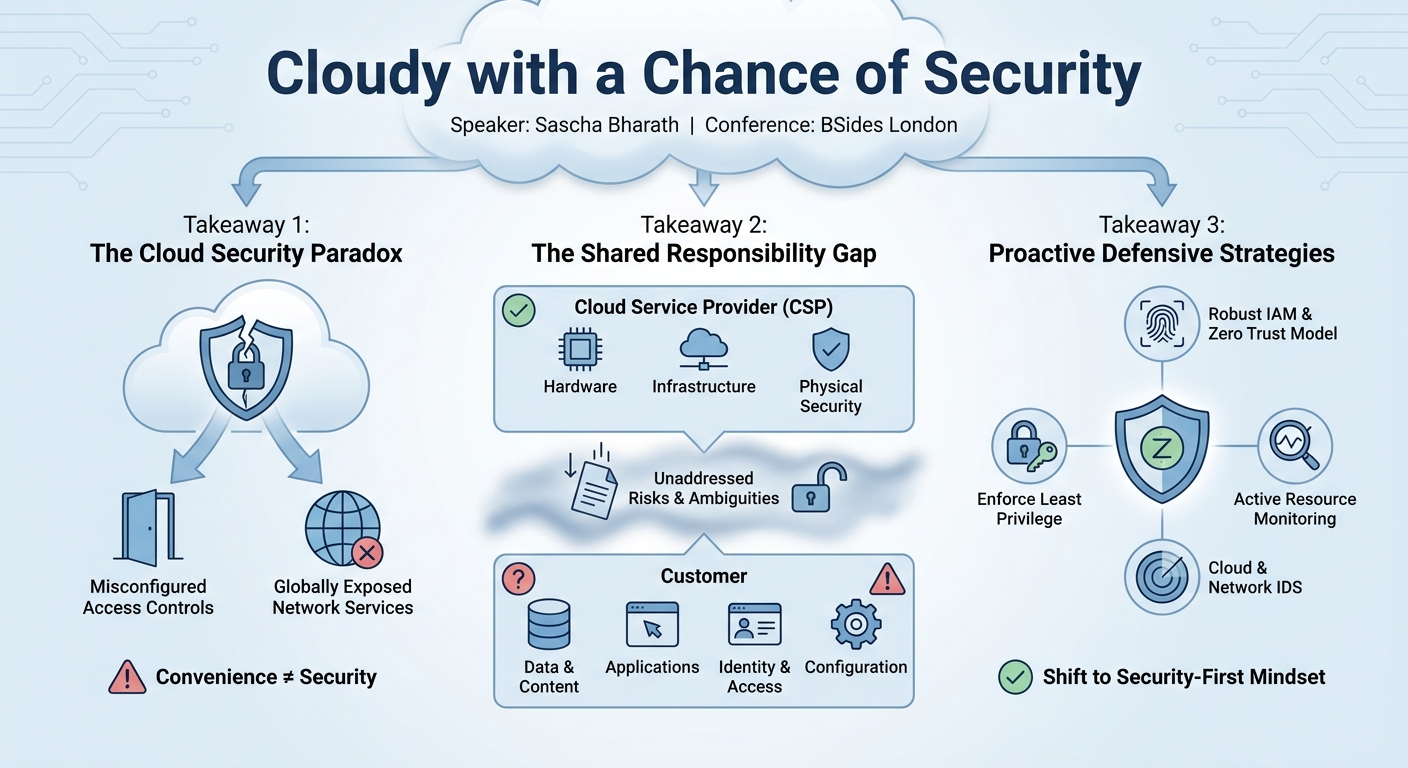
The core of the talk revolves around a critical evaluation of the trade-offs involved in relinquishing control to a Cloud Service Provider (CSP). Bharath systematically outlines the inherent vulnerabilities that emerge, from misconfigured access controls and exposed network attack surfaces to the ambiguities of the shared responsibility model. Through real-world examples, he illustrates how even major CSPs and their clients can fall victim to sophisticated attacks, underscoring the necessity for organizations to critically assess their security posture and strategic needs beyond mere convenience or perceived cost savings.
Ultimately, Bharath's presentation serves as a vital reminder that while the cloud offers undeniable advantages, it is not without its storms. He encourages a balanced perspective, exploring scenarios where on-premise solutions might still be superior, and providing a robust framework for making informed decisions. The talk culminates in actionable defensive strategies, emphasizing the importance of a proactive, security-first mindset, including robust Identity and Access Management (IAM), continuous monitoring, Intrusion Detection Systems (IDS), and the adoption of a Zero Trust security model.
Background
▶ Watch: Key characteristics and service models of cloud (0:15)
The journey into cloud computing typically begins with an understanding of its foundational characteristics and service models. Bharath commenced his talk by referencing the five key characteristics identified by NIST (National Institute of Standards and Technology): on-demand self-service, where users provision resources automatically without direct CSP interaction; elasticity, allowing dynamic scaling of resources up or down based on demand; broad network access, making services globally accessible via the internet; resource pooling, where CSPs manage and allocate resources to customers without concern for physical location; and measured service, ensuring efficient usage monitoring and billing only for what is consumed.
These characteristics underpin the three primary cloud service models: Software as a Service (SaaS), exemplified by Office 365 and Dropbox, where consumers use cloud-based software without managing underlying infrastructure; Platform as a Service (PaaS), seen in AWS Elastic Beanstalk and Google App Engine, providing a complete development environment for building and running applications; and Infrastructure as a Service (IaaS), such as AWS Elastic Compute Cloud (EC2) and Microsoft Azure, where users manage virtual machines, operating systems, and applications, but not the physical hardware. The umbrella term XaaS (Anything as a Service) captures the broader family of cloud solutions. Deployment models further define infrastructure construction, including private cloud (internal, controlled resources), public cloud (CSP offers services to any customer via subscription), and hybrid cloud (combining elements of other models).
Organizations are drawn to cloud migration for a multitude of compelling reasons. Bharath highlighted several key drivers: flexibility through on-demand self-service, enabling rapid resource procurement and operational efficiency; global reach facilitated by broad network access and CSP footprints, enhancing low-latency access even with geographically dispersed customers (further boosted by Content Delivery Networks); ease of maintenance due to resource pooling, eliminating manual allocation and capacity estimation; rapid deployment afforded by elasticity, ensuring applications access resources instantly during peak demand; lower costs through measured service (paying only for what's used) and CSPs benefiting from economies of scale; and a perceived security offload, where organizations believe they can delegate security responsibility to the CSP. While these advantages are significant, Bharath's subsequent analysis meticulously dissects the often-overlooked security implications that challenge this optimistic outlook.
Key Findings
▶ Watch: Common issues leading to cloud security vulnerabilities (6:00)
Sascha Bharath's presentation critically examines the widespread assumption that cloud migration is an unequivocally superior solution for all organizations. His key finding is that despite the numerous benefits, a "full sky cloud migration" is rarely the perfect solution and introduces a distinct set of major security risks that demand careful consideration. The talk effectively debunks the myth of inherent cloud security, demonstrating that the very advantages of cloud computing can also become its biggest liabilities if not managed with vigilance.
Bharath identifies several critical areas where security vulnerabilities frequently emerge: improper Access Control configurations, often stemming from knowledge gaps or a lack of transparency between organizations and CSPs; the inherent exposure of network-accessible cloud services which create a 24/7 global attack vector; the persistent ambiguity in the division of security responsibility between CSPs and customers, leading to unaddressed risks; and fundamental concerns regarding data security, including encryption, backup strategies, and the overall measures CSPs take to protect sensitive information. He also points out the limitations of inbuilt monitoring and threat detection, which can be reactive rather than proactive, and the potential for misplaced trust in CSP reputation over their actual security guarantees.
Crucially, the talk highlights that the consequences of these security failures extend far beyond technical issues, leading to severe reputational damage, costly Regulatory Compliance penalties (e.g., GDPR, Data Protection Act, ISO 27k standards), devastating data loss, extensive damage to the cloud estate (potentially requiring complete rebuilding), and significant difficulty in recovery time. Bharath's findings ultimately advocate for a strategic re-evaluation, suggesting that on-premise solutions can, in many cases, offer superior control, visibility, and customizability for critical assets, challenging the default assumption that cloud is always the most cost-effective or secure option when all potential costs and risks are factored in.
Technical Deep Dive
▶ Watch: Why on-premise might be a better choice (10:00)
The technical core of "Cloudy with a Chance of Security" meticulously unpacks the mechanisms and implications of cloud security risks, building upon the foundational understanding of cloud models. Bharath elaborates on how the very characteristics that make the cloud attractive can be exploited, illustrating with specific examples and real-world incidents.
The inherent issues with Access Control are a primary concern. In complex cloud environments, ensuring that individuals and services have precisely the correct permissions – no more, no less – is challenging. Bharath notes that "improper configuration can lead to vulnerabilities" and that organizations often "depend upon the CSP or some other reporting tool to pick up these inconsistencies." This reliance, coupled with potential "knowledge gaps or lack of transparency," creates significant opportunities for attackers to gain unauthorized access or elevate privileges.
The convenience of network access for cloud services simultaneously creates a globally accessible 24/7 attack vector. While beneficial for legitimate users, this constant availability means malicious actors have perpetual opportunities to probe and exploit vulnerabilities, making robust perimeter and application security paramount.
A critical, often misunderstood, aspect is the division of responsibility of security. The shared responsibility model dictates that while CSPs secure the "cloud itself," customers are responsible for security in the cloud. Bharath emphasizes that this "blurred line between who's responsible for securing what" inevitably leads to "misunderstandings and ultimately no one addresses the risk." This gap can leave critical assets exposed, as each party assumes the other is handling specific security controls.
Concerns surrounding data security are also profound. Organizations entrust CSPs with sensitive data, assuming adequate protection. However, Bharath urges deeper scrutiny: "what exact measures are they taking? Is the data encrypted? Are the sec backups in place?" Without explicit answers, organizations operate with a blind trust that may be unwarranted. Similarly, while CSPs offer monitoring and threat detection, Bharath questions its comprehensiveness. He notes that "logs for admins to review" are often a "reactive rather than proactive preventative measure," potentially detecting breaches after significant damage has occurred.
The illusion of security based on trusting the CSP is another critical point. Bharath states, "we do consider their reputation, their size, their brand visibility, but we often conflate these for security." He cautions against assuming that large, reputable providers are impervious to attack. This point is powerfully illustrated by two major incidents:
- Code Spaces DDoS and AWS Compromise: This incident involved Code Spaces, an IaaS solution integrated with GitHub. Attackers launched a Distributed Denial of Service (DDoS) attack, which served as a diversion. In reality, the attackers had already compromised AWS accounts. When Code Spaces attempted to regain control, the attackers had established "backup loggings in the EC2 panel to ensure that they had persistent access." Upon realizing Code Spaces would not pay the ransom, the attackers proceeded to "delete random artifacts," demonstrating the devastating impact of compromised access and persistence. The attacker even left contact details in the EC2 control panel, highlighting a brazen disregard for detection due to perceived control.
- Microsoft and the US Government (Storm-0558): A hacking team, Storm-0558, breached an "unidentified number of email accounts," including those of the US and other Western European government agencies. The attackers used forged authentication tokens to access email accounts via Outlook web access, Exchange Online, and outlook.com. This attack remained undetected for "almost a month," showcasing the sophistication of the threat actor and the potential for stealthy, long-term compromise even within major CSP environments.
The consequences of such breaches are manifold and severe:
- Reputational Damage: Irreparable harm to business reputation and stakeholder trust.
- Regulatory Compliance: Failure to comply with standards like GDPR, the Data Protection Act, or ISO 27k standards can lead to "legal repercussions from governing bodies as well as possibly fines."
- Data Loss: Potentially devastating for modern organizations reliant on data, incurring "additional costs in data recovery" and damaging customer trust.
- Damage to the Cloud Estate: Requiring "redesign, reconfiguration, or in an extreme case be rendered completely unusable and just require rebuilding."
- Difficulty in Recovery: Recovery time can be challenging, especially if lateral movement is possible due to improperly isolated cloud environments or unsecured containers, leading to more widespread damage.
Bharath then pivots to argue for the continued relevance, and sometimes superiority, of on-premise solutions. He highlights that keeping critical data on-premise offers complete control and visibility over storage, access, and retention, enabling refined security approaches and easier Regulatory Compliance. It also removes the ambiguity of multi-cloud environments, which introduce complexity and resource demands for consistent data protection and access control policies. Furthermore, on-premise environments often allow for smoother integration with Legacy systems that typically perform poorly or pose security risks when migrated to the cloud. This nuanced perspective challenges the prevailing narrative, advocating for a balanced decision-making process based on asset criticality, regulatory requirements, and technical compatibility.
Demo / Proof of Concept
▶ Watch: Framework for choosing cloud, on-prem, or hybrid (11:00)
The talk "Cloudy with a Chance of Security" provided a comprehensive analytical and conceptual overview of cloud security challenges and solutions. It did not include a live demonstration or a proof of concept of any specific vulnerability or defensive tool. The speaker relied on real-world case studies and theoretical frameworks to illustrate the points made.
Defensive Implications
▶ Watch: Key strategies for securing your cloud environment (12:15)
For organizations navigating the complexities of cloud adoption, Bharath's talk provides crucial defensive implications, urging a strategic and proactive approach to security. The first step involves a comprehensive decision framework before committing to any cloud model. Organizations must rigorously assess:
- What kind of data and assets they possess and the appropriate level of security for each.
- The regions of operation and associated regulations.
- A thorough cost analysis that moves beyond simple CapEx/OpEx to include potential Disaster Recovery (DR) costs resulting from a cyber attack.
- The compatibility and future of any Legacy systems.
- Future ventures of the organization, as new business directions (e.g., high-security government contracts) will significantly impact IT infrastructure requirements.
Bharath acknowledges that a blended approach, combining both on-premise and cloud infrastructure in a hybrid cloud model, can often be the most effective solution for meeting diverse requirements. However, for those adopting the cloud, specific security measures are paramount:
- IAM Control: Establishing a robust IAM strategy is fundamental. This involves "setting up carefully planned groups, roles, and users with the least privileged principle enforced." This ensures individuals and services only have the access permissions absolutely necessary for their function, significantly reducing the attack surface.
- Actively Monitoring Resources: While CSPs monitor for billing, organizations must implement their own active monitoring. The goal is to "detect regular resource usage behavior" that could signify "early stages of an attack." This proactive detection goes beyond reactive log review and focuses on identifying anomalies.
- Deploying IDSs: Implementing appropriate Cloud IDS solutions is essential for detecting threats within the cloud environment. Additionally, deploying Network IDS can help identify "attempt spreading across the network that could eventually impact your Cloud estate," providing an early warning system for lateral movement or external attacks targeting cloud resources.
- Adopting a Zero Trust Security Model: This is a critical philosophical shift. Bharath advocates for assuming "all users of services aren't trusted at all times regardless of whether they're internal or external to the network." This necessitates "enforcing strict authentication and authorization rules" for every access request, irrespective of origin, leading to a much stronger overall security posture.
By meticulously evaluating these factors and implementing these defensive strategies, organizations can significantly mitigate the inherent risks of cloud computing, transforming a potentially "cloudy" forecast into a more secure and resilient operational environment.
Key Takeaways
- Cloud migration is not a universally superior solution; it introduces significant security risks that must be carefully evaluated against its benefits.
- The shared responsibility model often creates ambiguity, leading to security gaps where neither the CSP nor the customer fully addresses specific risks.
- Critical data and sensitive assets may be better protected in on-premise environments due to enhanced control, visibility, and custom security measures.
- A robust IAM strategy, active resource monitoring, deployment of Cloud and Network IDSs, and adopting a Zero Trust security model are essential for securing cloud environments.
- Organizations must conduct a thorough cost-benefit analysis, including potential disaster recovery costs and regulatory compliance implications, before committing to cloud adoption.
- A hybrid cloud approach, blending on-premise and cloud infrastructure, can often provide a balanced and flexible solution tailored to specific organizational needs.
About the Speaker(s)
Sascha Bharath is a computer science student. At the time of this talk, he was on placement with Burberry, working within their network and infrastructure team. His insights into cloud security reflect both academic understanding and practical exposure to enterprise IT environments.
Reviews
Dr. Zero (Offensive Security Researcher) — HARD PASS
The speaker spent stage time explaining the NIST definitions of SaaS, PaaS, and IaaS in the year 2024. It is a well-spoken university essay on basic cloud hygiene, completely devoid of novel research or actionable signal for anyone who has ever provisioned an EC2 instance.
Heather Calloway (CISO) — WEAK
This is a textbook recitation of cloud fundamentals, suitable for university students but irrelevant for anyone running an enterprise security program. We do not need another recap of the shared responsibility model.