An Abridged History of Malware
Olivia Betts (Computer Science Student · University of York)
Security BSides London 2023 · Day 1 · Rookie Track
Overview
In "An Abridged History of Malware," Olivia Betts, a computer science student at the University of York, delivers a concise yet comprehensive journey through 74 years of malware evolution in just 15 minutes. The talk emphasizes that while the cybersecurity landscape is constantly evolving with new threats and vulnerabilities, understanding the historical trajectory of malicious software is crucial for anticipating future challenges. Betts argues that the industry's intense focus on the "new" often neglects the foundational knowledge gained from studying past developments.
Key moments
- 0:00 Introduction and why study malware history
- 1:30 Von Neumann's self-reproducing automata concept
- 4:40 Morris Worm: First widespread internet malware
- 5:30 Key malware terms: Malware, Ransomware, Spyware coined
- 6:00 Green Caterpillar: Malware shifts from annoyance to damage
- 7:40 I Love You Worm: Global impact, legal loopholes
- 8:50 Stuxnet: The rise of cyber warfare
- 10:30 Modern malware: Geopolitics, complexity, and scale
An Abridged History of Malware
Speakers: Olivia Betts, Computer Science Student, University of York
Conference: BSides London
YouTube: https://www.youtube.com/watch?v=tGewVrw1LaY
Overview
In "An Abridged History of Malware," Olivia Betts, a computer science student at the University of York, delivers a concise yet comprehensive journey through 74 years of malware evolution in just 15 minutes. The talk emphasizes that while the cybersecurity landscape is constantly evolving with new threats and vulnerabilities, understanding the historical trajectory of malicious software is crucial for anticipating future challenges. Betts argues that the industry's intense focus on the "new" often neglects the foundational knowledge gained from studying past developments.
The presentation serves as a vital reminder that current sophisticated attacks are built upon decades of experimentation and innovation in the realm of digital threats. By tracing malware's origins from theoretical concepts to early proofs-of-concept, and then to tools of annoyance, financial gain, and ultimately, cyber warfare, Betts illuminates the underlying patterns and persistent themes in cybersecurity. This historical perspective is not merely an academic exercise; it provides essential context for modern defenders to better understand the motivations, mechanisms, and societal impacts of contemporary malware.
This article delves into the key milestones and technical shifts presented by Betts, exploring how malware has transformed from simple self-reproducing automata into complex, geopolitical instruments. From the advent of the first worms and viruses to the rise of ransomware and nation-state sponsored attacks, the narrative highlights the escalating stakes and the continuous cat-and-mouse game between attackers and defenders.
Background
▶ Watch: Introduction and why study malware history (0:00)
The genesis of malware, as presented by Betts, predates the widespread availability of personal computers, rooting itself in theoretical computer science. The foundational concept emerged in 1949 when John Von Neumann, renowned for the Von Neumann architecture, delivered lectures at the University of Illinois on the idea of a "self-reproducing autometer." This wasn't merely a machine that could create things, but one capable of making an exact or even more complex copy of itself, akin to biological evolution. While Von Neumann's seminal paper was published posthumously in the 1960s, it laid the intellectual groundwork for what would become malicious self-replicating code.
The 1970s saw these theoretical concepts begin to materialize, with science fiction authors coining terms that would become central to the cybersecurity lexicon. Gerald's 1972 book "When Harley Was One" featured computer viruses, and Brunner's 1975 "The Shockwave Rider" introduced worms. These early literary mentions reflected a burgeoning awareness of the potential for self-replicating code. However, at this stage, a universal term like "malware" was still absent, leading to fragmented discussions about various forms of "malicious software."
The problem that this early work inadvertently highlighted was the inherent vulnerability of interconnected systems and the potential for code to operate autonomously, often without the explicit intent or full understanding of its creators. The early decades of computing were largely focused on functionality and connectivity, with security considerations often an afterthought. This environment provided fertile ground for the development of rudimentary malware, initially conceived as experiments or proofs-of-concept, but quickly evolving into tools for disruption and eventually, damage. The lack of an established legal framework and a nascent understanding of digital hygiene further exacerbated these early challenges, setting the stage for the complex threat landscape we navigate today.
Key Findings
▶ Watch: Morris Worm: First widespread internet malware (4:40)
Olivia Betts's talk distills several key findings from the history of malware, primarily focusing on its evolution in purpose, sophistication, and impact.
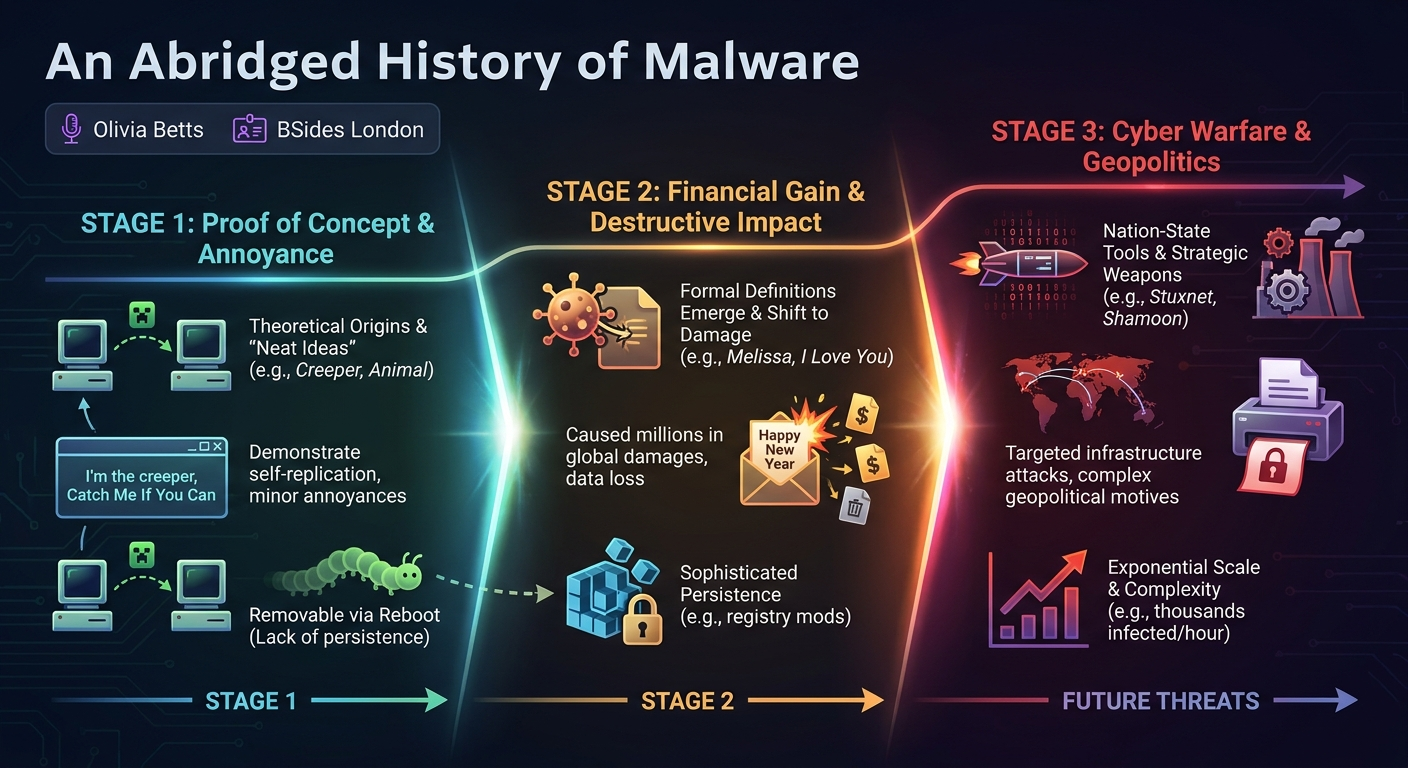
- From Concept to Annoyance: Early malware, such as Creeper (1971) and Animal (1974), were primarily proofs-of-concept or "neat ideas." Their goal was to demonstrate self-replication or novel program behavior, often resulting in minor annoyances like displaying messages or copying files without causing significant damage. The speaker highlights the Green Caterpillar Virus (1991) as an "end of an era," marking the decline of purely annoying malware as MS-DOS faded.
- The Emergence of Defined Terminology: The 1980s and 90s were crucial for formalizing the language of cybersecurity. Fred Cohen academically defined a computer virus in the 1980s as a program that infects other programs to modify and include a copy of itself. The term malware itself was coined by Yisrael Radai in the 1990s, providing a much-needed umbrella term. Simultaneously, Young and Yung created the term "crypto-viral attacks" (which would later evolve into ransomware), and the concept of spyware also emerged, initially referring to Microsoft hardware before encompassing software.
- Escalation to Damage and Persistence: A significant turning point occurred in the 1990s and early 2000s, where malware transitioned from mere annoyance to actively causing damage. The Melissa Worm (1999), for instance, modified registry keys for persistence, a stark contrast to earlier worms like Morris (1988) that could often be removed by a simple reboot. The I Love You Worm (2000) exemplified this shift, causing millions in damages by deleting and hiding files globally. This era also saw the first instances of ransomware, albeit without the contemporary terminology, such as the AIDS virus Trojan in the 1980s.
- The Dawn of Cyber Warfare and Geopolitics: The 2010s marked a dramatic escalation, with malware becoming a tool for nation-state actors and geopolitical conflict. Stuxnet (2010) is presented as a seminal example, demonstrating highly targeted attacks against industrial control systems, moving beyond simple financial gain or disruption into the realm of cyber warfare. The Shamoon virus (2012), which targeted Saudi Aramco, further solidified this trend, highlighting the destructive potential of sophisticated malware in international conflicts.
- Increasing Complexity and Scale: The talk underscores the exponential growth in malware complexity and scale. Early attacks like the Morris Worm infected about 6,000 machines (an estimated one-tenth of the internet at the time). By contrast, the LockerGoga ransomware (2016) infected 5,000 computers per hour at its peak. This rapid increase in volume, speed, and sophistication means that analyzing modern malware often requires delving into complex geopolitical motivations, a far cry from the simple "can we do it?" motivations of early malware creators.
These findings collectively illustrate a clear evolutionary path for malware: from academic curiosity, through disruptive annoyance, to financially motivated crime, and finally, to a strategic weapon in global conflicts, each stage building upon the technical and conceptual innovations of its predecessors.
Technical Deep Dive
▶ Watch: Green Caterpillar: Malware shifts from annoyance to damage (6:00)
The history of malware is a chronicle of escalating technical sophistication and changing attack methodologies, meticulously detailed by Betts through a series of landmark examples.
The journey begins in 1971 with Creeper, widely considered the first worm. Developed by Bob Thomas, Creeper was initially designed to move between computers on ARPANET. It was subsequently updated in 1972 by Ray Tomlinson to create copies of itself, rather than just moving. Its sole function was to display the message "I'm the creeper, Catch Me If You Can," serving purely as a proof-of-concept for self-replicating network code. In a thrilling early example of cybersecurity defense, Tomlinson also created Reaper, the first anti-worm software, specifically designed to seek out and remove Creeper from systems. This early "worm vs. worm" dynamic foreshadowed the continuous arms race in cybersecurity.
1974 saw the emergence of Animal, a 20 Questions game that copied itself into every directory on a user's computer. Its creator described it as a "neat idea," but it's frequently cited as one of the earliest examples of a Trojan horse, a term that had been used in the context of malware since the 1972 Anderson Report, credited to computer scientist DJ Edwards. Trojans, unlike worms or viruses, rely on deception, masquerading as legitimate software to gain access or perform malicious actions.
The 1980s brought formal definitions and the first widespread, albeit primitive, destructive malware. Fred Cohen provided an academic definition for a computer virus as a program that infects other programs to modify them and include a copy of itself. Towards the end of the decade, the AIDS virus Trojan (1980s) made an appearance, considered the first precursor to ransomware, encrypting files and demanding payment, though the term "ransomware" would not be coined for many years.
1988 was a pivotal year, introducing two significant pieces of malware. The Cascade virus was a DOS virus known for causing text on the screen to "fall" down. Interestingly, it was coded specifically not to infect IBM machines, though every known variant eventually proved capable of infecting them. More famously, the Morris Worm, created by Robert Tappan Morris, achieved widespread media attention. It infected an estimated one-tenth of the internet, roughly 6,000 of 60,000 major units machines. However, the speaker notes that this number is debated, with figures like Paul Vixie suggesting it was an estimate plucked as a "reasonable best guess" and that the common remediation method of "turning things off and on again" made accurate infection counts difficult. The Morris Worm also resulted in the first conviction under the USA 1986 Computer Fraud and Abuse Act. A key technical characteristic of the Morris Worm was its lack of sophisticated persistence; a system reboot could often remove it.
The 1990s marked a significant evolution in malware capabilities, particularly in persistence and attack vectors. The Melissa Worm (1999) was one of the first email attachment worms. It spread rapidly by emailing itself to everyone in a user's address book and modified registry keys for persistence, ensuring it would survive system reboots—a crucial advancement over earlier worms. It also displayed fireworks and a "happy new year" message, demonstrating a blend of annoyance and more serious underlying malicious behavior.
The early 2000s continued this trend with the devastating I Love You Worm (2000). This worm, also spread via email attachments, hit millions globally, deleting random files and hiding MP3 files. Its creator, a Filipino national, was not prosecuted due to the absence of specific anti-malware laws in the Philippines at the time. 2003 saw a historical echo with the Blaster worm appearing in August, quickly followed by the Welchia worm five days later. Welchia exploited the very same vulnerability as Blaster, but its intent was to try and remove Blaster and patch the system, showcasing another "worm to catch a worm" scenario, though its effectiveness is debated. This period also saw the first malware specifically targeting Apple's operating system, the Leap or Implantworm, as Apple's market share grew sufficiently to become an attractive target.
The 2010s ushered in the era of cyber warfare. Stuxnet (2010) is highlighted as a landmark event, representing a highly sophisticated, nation-state-sponsored attack targeting industrial control systems, specifically Iranian nuclear facilities. This marked a profound shift from financially motivated or disruptive malware to tools of geopolitical strategy. The Shamoon virus (2012) further underscored this, famously wiping data from Saudi Aramco computers, again demonstrating the destructive potential of state-backed or state-aligned actors.
Betts also touched upon more recent developments, such as Ink Ransomware, which uniquely seeks out unsecured printers on a network and prints out ransom notes, serving as a physical manifestation of a digital threat. Betts briefly mentioned the rapid proliferation of attacks in 2016, including LockerGoga ransomware (infecting 5,000 computers per hour at its peak, compared to Morris's 6,000 total), Pegasus spyware, and the Mirai botnet DDoS attack. These examples illustrate the exponential increase in attack scale, complexity, and the intricate geopolitical motives now intertwined with malware development. The shift from simple, self-contained viruses to highly distributed, multi-vector attacks highlights the continuous arms race in cybersecurity.
Demo / Proof of Concept
▶ Watch: I Love You Worm: Global impact, legal loopholes (7:40)
The talk itself did not feature a live demonstration or proof of concept in the traditional sense. Instead, the speaker presented historical screenshots and discussed the observed effects of early malware, such as the Cascade virus's distinctive falling text animation. Olivia Betts explicitly referenced external resources, specifically highlighting the YouTube channel "danot one," which is known for infecting virtual machines with various historical viruses. This approach allowed the audience to visualize the impact of these early threats without the speaker needing to execute potentially harmful code during the live presentation, effectively using documented historical evidence as a substitute for a real-time demo.
Defensive Implications
▶ Watch: Modern malware: Geopolitics, complexity, and scale (10:30)
Understanding the abridged history of malware offers critical insights for modern cybersecurity defenders, illuminating recurring patterns and the evolution of attack methodologies.
Firstly, the progression from simple self-replicating code to sophisticated, persistent threats underscores the imperative for multi-layered security architectures. Early malware like the Morris Worm could often be eradicated by a simple reboot, but the introduction of registry key modifications by the Melissa Worm demonstrated the need for robust persistence detection and removal mechanisms. Defenders must assume that once a system is compromised, attackers will prioritize maintaining access, necessitating advanced endpoint detection and response (EDR) solutions that monitor for suspicious registry changes, scheduled tasks, and other persistence techniques.
Secondly, the historical shift in malware's purpose—from annoyance to damage and then to cyber warfare—highlights the need for proactive threat intelligence and risk-based defense. The transition from the Green Caterpillar Virus to Stuxnet and Shamoon shows that the stakes have dramatically increased. Defenders are no longer just protecting against data loss or system downtime; they are often on the front lines against espionage, sabotage, and financially crippling attacks. This requires understanding not just technical vulnerabilities but also the motivations and capabilities of various threat actors, including nation-states, organized crime, and hacktivists.
Thirdly, the recurring theme of vulnerability exploitation (e.g., Blaster and Welchia exploiting the same flaw) emphasizes the foundational importance of patch management and vulnerability remediation. Rapid patching cycles are crucial to close known attack vectors before they can be widely exploited. Beyond patching, implementing security best practices such as securing often-overlooked devices like printers (as targeted by Ink Ransomware) and educating users about common attack vectors like email attachments (as seen with Melissa and I Love You worms) remain evergreen defensive strategies.
Finally, the talk implicitly stresses the importance of legal and policy frameworks. The case of the I Love You Worm creator escaping prosecution due to a lack of specific laws in the Philippines highlights the need for dynamic legal systems that can adapt to rapidly evolving cyber threats. While directly influencing legislation might not be a defender's primary role, awareness of these broader contexts can inform incident response strategies, data retention policies, and international collaboration efforts. In essence, history teaches that the arms race is continuous, demanding constant vigilance, adaptation, and a holistic understanding of the threat landscape.
Key Takeaways
- History informs the future: Understanding the evolution of malware from its theoretical origins to modern cyber warfare tools provides crucial context for anticipating and defending against future threats.
- Malware's purpose has escalated: Threats have evolved from simple proofs-of-concept and annoyances (e.g., Creeper, Green Caterpillar) to financially damaging attacks (e.g., I Love You Worm, LockerGoga) and instruments of geopolitical conflict (e.g., Stuxnet, Shamoon).
- Persistence mechanisms became critical: Early malware was often removed by a reboot, but later threats like the Melissa Worm introduced sophisticated persistence techniques (e.g., modifying registry keys), requiring advanced defensive measures.
- Terminology evolved with the threats: The formalization of terms like "virus" (Fred Cohen, 1980s), "malware" (Yisrael Radai, 1990s), and "crypto-viral attacks" (Yun & Yun, 1990s) reflected a growing understanding and categorization of diverse digital threats.
- The scale and complexity are exponential: From the Morris Worm infecting ~6,000 machines to LockerGoga infecting 5,000 per hour, modern malware operates at an unprecedented scale, often intertwined with complex geopolitical motivations.
- Foundational defenses remain relevant: Basic security practices like patching vulnerabilities (as highlighted by Blaster/Welchia), securing all network devices (e.g., Ink Ransomware targeting printers), and user education are still vital, despite the increasing sophistication of attacks.
About the Speaker(s)
Olivia Betts is a computer science student at the University of York who enjoys Wikipedia rabbit holes and data protection standards. In this talk, they focus on the historical side of cybersecurity, arguing that understanding past developments helps the field navigate future challenges.
Reviews
Dr. Zero (Offensive Security Researcher) — HARD PASS
A 15-minute speedrun of the Wikipedia 'Computer Virus' page. Reciting the timeline from Creeper to Stuxnet isn't research, and it doesn't belong at a professional con. If you've been in security for more than a week, you already know every word of this.
Heather Calloway (CISO) — SOLID
This is a capable 15-minute historical primer from an undergraduate student tracing malware's evolution from the 1970s to the 2010s. It provides good foundational context for early-career analysts, but it contains no net-new research or strategic takeaways. Your leadership team and senior practitioners can safely skip it.