Physical Intrusion - Access Un-Controlled
Iain Parkes (Senior Security Consultant · Rootshell Security)
Security BSides London 2023 · Day 1 · Clappy Monkey Track
Overview
In "Physical Intrusion - Access Un-Controlled," Iain Parkes, a Senior Security Consultant at Rootshell Security, exposes critical vulnerabilities arising from the integration of fire alarm and access control systems. Drawing upon 18 years of experience in the fire and security industry, Parkes demonstrates how these essential safety and security mechanisms, when improperly configured or misunderstood, can be leveraged by attackers for covert physical intrusions. The talk highlights a pervasive blind spot in enterprise security, where the focus on digital defenses often overshadows fundamental physical security weaknesses.
Key moments
- 0:00 Introduction: Fire alarms as a security hole
- 3:30 Physical pentest methodology: Recon to execution
- 16:00 Live demo: Fire alarm and access control integration
- 18:30 Reconnaissance: Abusing fire alarm zone charts
- 24:30 Real-world example: Multi-tenant office intrusion
- 31:00 Key mitigations for improving physical security
- 38:00 Q&A: How to get into physical pentesting
- 42:00 Q&A: The 'Get Out of Jail' card strategy
Physical Intrusion - Access Un-Controlled
Speakers: Iain Parkes, Senior Security Consultant, Rootshell Security
Conference: BSides London
YouTube: https://www.youtube.com/watch?v=Tc4S2XYiF70
Overview
In "Physical Intrusion - Access Un-Controlled," Iain Parkes, a Senior Security Consultant at Rootshell Security, exposes critical vulnerabilities arising from the integration of fire alarm and access control systems. Drawing upon 18 years of experience in the fire and security industry, Parkes demonstrates how these essential safety and security mechanisms, when improperly configured or misunderstood, can be leveraged by attackers for covert physical intrusions. The talk highlights a pervasive blind spot in enterprise security, where the focus on digital defenses often overshadows fundamental physical security weaknesses.
Parkes argues that while cyber defenses receive significant attention, physical security breaches can be equally, if not more, devastating. Once an attacker gains physical access to a building, they can plant keyloggers, access sensitive infrastructure, or even directly use employees' computers, bypassing layers of digital safeguards. This presentation reveals that the very systems designed to protect occupants during emergencies—specifically, fire alarms that mandate fail-safe door releases—create predictable windows of opportunity for unauthorized entry, a risk that many organizations fail to recognize or adequately mitigate. The insights shared are not novel techniques but rather a deep dive into long-standing design and operational flaws that continue to be exploited.
Background
▶ Watch: Introduction: Fire alarms as a security hole (0:00)
Iain Parkes' extensive background in commissioning and ensuring compliance within the fire alarm and security industry provides a unique perspective on physical penetration testing. He defines physical penetration testing as the process of attempting to gain unauthorized access to a building, reaching critical areas like server rooms, planting devices, or accessing network infrastructure. Parkes emphasizes that unlike cybersecurity, where patches can quickly fix vulnerabilities, physical security demands continuous awareness and training to remain effective over time.
The methodology for a physical penetration test, as outlined by Parkes, involves several critical phases:
- Information Gathering: This initial phase involves online research using tools like Google Maps to identify building entrances, social media to glean details from employee photos (e.g., lanyards, ID cards), and public planning offices for building layouts, which can reveal locations of sensitive areas like server rooms. Identifying contractors or maintenance companies can also provide valuable pretexting opportunities.
- Onsite Reconnaissance: Physical observation of the target building helps understand employee movements, security routines, and potential entry points (often favoring less-secured back doors). This phase aims to photograph badges or lanyards and assess overall security posture.
- Planning and Preparation: Based on gathered intelligence, attackers create fake ID cards, lanyards, and develop a pretext—a believable cover story for their presence. Parkes stresses that thorough preparation significantly increases the likelihood of a successful execution, though a "luck element" always remains due to unpredictable human factors.
- Execution: The actual physical intrusion, where the attacker leverages their preparation to gain entry.
At the heart of Parkes' analysis are two interconnected systems:
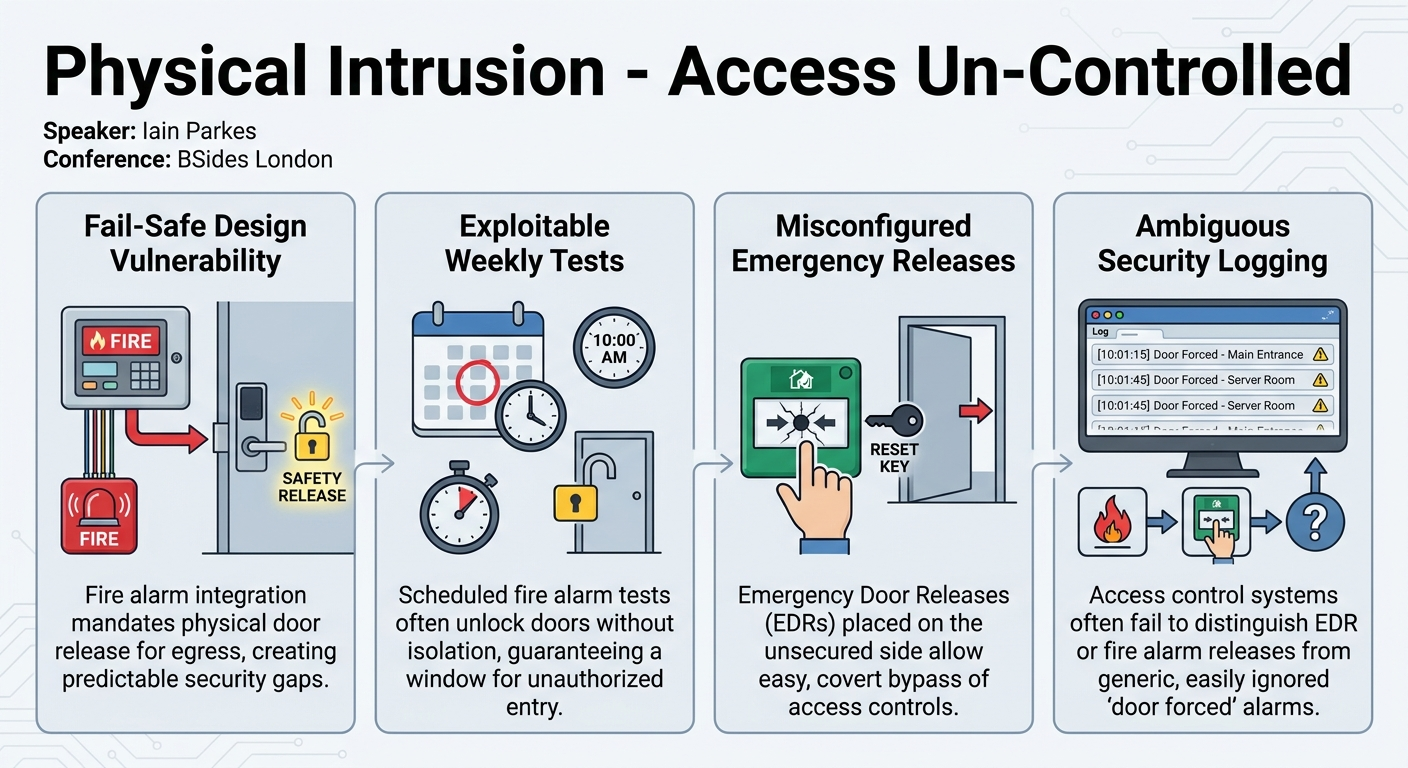
- Fire Alarm Systems: These are often older, expensive to upgrade, and designed with a fail-safe principle. This means that in an emergency, components like doors must automatically release to ensure safe evacuation. This critical safety feature relies on physical disconnection of power to locks via interfaces (small white boxes), rather than software commands. Weekly tests are legally mandated, creating predictable events where the system activates, and doors may unlock.
- Access Control Systems (ACS): Comprising readers, door controllers, and locks (e.g., magnetic locks or latch locks), ACS manage entry. Locks can be fail-safe (release on power loss, common for fire exits) or fail-secure (remain locked on power loss). A crucial component is the Emergency Door Release (EDR), often a green break glass unit, designed to provide immediate egress. Parkes highlights that EDRs and fire alarm interfaces are typically wired in-line with the door lock's power supply. This means they physically interrupt power, releasing the door, without the access control system necessarily being aware of the specific release mechanism, only registering a "door forced" event if the door is subsequently opened. British standards, unlike some other regulations, mandate this physical disconnection for fire safety, leading to the widespread use of dedicated interfaces at every controlled door.
Key Findings
▶ Watch: Live demo: Fire alarm and access control integration (16:00)
Iain Parkes' investigation reveals several critical vulnerabilities stemming from the design, installation, and operational practices surrounding fire alarm and access control systems:
- Publicly Accessible Fire Alarm Zone Charts: Often mandated to be displayed near the main fire alarm panel (usually by the front door), these charts provide invaluable intelligence. They act as free building layouts, detailing fire zones, door locations, and crucially, the precise locations of sensitive areas like server rooms and cash offices. They can also reveal the names of installation or maintenance contractors, providing further pretexting material.
- Vulnerable Fire Alarm Panels:
- Information Disclosure: Panels display their make and model, aiding in prop selection for a fire alarm engineer pretext. Fault messages can also be exploited as a pretext for "investigating a fault."
- "Level Two" Access: Some panels can be left in an unlocked "level two" mode, granting access to menu systems where an attacker could potentially command doors to open directly.
- Company Branding: Panels sometimes feature the building owner's or a maintenance company's logo, providing contact details or further pretext information.
- Exploitation of Weekly Fire Alarm Tests:
- Predictable Schedule: These mandatory tests occur weekly at a known time (often disclosed via social engineering calls, e.g., "fire officer updating records"). This creates a predictable window where doors are guaranteed to unlock due to the fail-safe design of fire alarm integration.
- Lack of Isolation: Most sites lack isolation key switches on fire alarm panels, meaning that during tests, access control systems will release doors, creating an open invitation for intruders.
- Auditory Cover: The loud fire alarm sound provides an excellent cover for an intruder's presence and actions, masking any door forced alarms.
- Relock Delay: Even after the alarm stops, addressable fire alarm systems can take 20-30 seconds to fully reset and relock doors, providing a significant time window for entry.
- Misconfigured Emergency Door Release (EDR) Units:
- Improper Placement: EDRs (green break glass units) are frequently installed on the unsecured or unprotected side of a door, allowing anyone to bypass access control by simply activating the release.
- Bypass with Reset Key: A cheap, universal reset key can be used to activate and reset these plastic "break glass" units without causing any damage or leaving evidence of tampering, making the bypass undetectable.
- Ignored Door Forced Alarms:
- Auditory Ambiguity: The sound for a "door forced" alarm is often identical to a "door held open" alarm, leading to staff desensitization and dismissal.
- Insufficient Monitoring: These alarms are commonly logged only within the access control system itself, which is rarely actively monitored by security personnel in real-time. Unlike an intruder alarm, it doesn't trigger a high-priority response, making it easy for an intruder to operate unnoticed.
- Social Engineering and Visual Cloning:
- Lanyard/ID Card Replication: Information from social media photos (e.g., birthday parties with lanyards visible) allows attackers to visually clone ID cards and lanyards, which can be custom-printed easily.
- Effective Pretexting: Leveraging knowledge of fire alarm systems, an attacker can convincingly pose as a fire officer or engineer. Even without technical knowledge, general pretexts like "IT engineer" are effective, especially when combined with a cloned ID and the element of surprise during a fire alarm test.
- Tailgating: Remains a highly effective method, often preceding or combined with other techniques to gain initial access.
Technical Deep Dive
▶ Watch: Real-world example: Multi-tenant office intrusion (24:30)
The core vulnerability discussed by Iain Parkes lies in the fundamental design and integration of fire alarm systems and access control systems (ACS). Fire alarm systems, driven by strict safety regulations, are designed to be fail-safe. This means that in an emergency, doors must release to allow safe egress. This is achieved not through software commands from the ACS, but through a physical interruption of power to the door locks.
A typical access-controlled door setup involves a door controller which receives signals from a reader (e.g., for an access card) and controls the power to the door lock (e.g., a magnetic lock or latch lock). For fire safety, two key components are wired in-line with the door lock's power supply:
- Fire Alarm Interface: This is a small relay module connected to the fire alarm panel. When the fire alarm activates, this interface physically breaks the power circuit to the door lock.
- Emergency Door Release (EDR): Often a green "break glass" unit, this device also physically interrupts the power circuit when activated.
The critical point is that these physical breaks mean the door controller is "none the wiser" about why the power was cut. It doesn't receive a specific "fire alarm release" or "EDR activated" signal that it would log as a deliberate action. Instead, if the door is subsequently opened while the lock is de-energized, the door controller might register a "door forced" alarm. However, as Parkes demonstrates, this "door forced" alarm often produces the same sound as a "door held open" alarm, leading to staff desensitization and a lack of urgency. Furthermore, this event is typically logged only within the ACS itself, rather than triggering a more robust intruder alarm system which would alert security personnel.
Parkes highlights a conflict in standards: while some access control standards might permit software-based door release in a fire event, British standards (and good practice) mandate a physical disconnection. This is because relying on software would require all cabling to meet fire-rated standards (e.g., withstanding an hour of fire) and the ACS to have robust battery backup, which is rarely the case. Consequently, dedicated fire alarm interfaces are installed at virtually every access-controlled door, presenting a physical point of bypass.
The demonstration vividly illustrates this technical flow:
- Normal Access: An access card is scanned. The reader sends a data signal to the door controller, which then briefly cuts power to the lock, allowing the door to open. This event is logged by the ACS.
- Emergency Door Release (EDR) Activation: The green break glass is pressed (or bypassed with a reset key). This immediately cuts power to the magnet lock. The door controller remains oblivious to the cause of the power loss. If the door is then opened, a "door forced" alarm sounds, but the ACS log merely shows a "door forced" and then "door relocked," without indicating the EDR was used.
- Fire Alarm Activation: The fire alarm system is triggered (e.g., by smoke detector). The fire alarm interface cuts power to the magnet lock. Again, the door controller is unaware of the specific fire alarm event. The door releases, and if opened, may trigger the same "door forced" alarm.
This "ignorance" of the door controller is a significant weakness. Security logs provide no granular detail on how the door was opened during a fire alarm or EDR activation, making post-incident analysis difficult and allowing unauthorized entry to go unnoticed. The lack of tamper protection on fire alarm interfaces, combined with their potential accessibility (e.g., above ceiling tiles or on the unsecured side of a door), makes them easy targets for direct wire disconnection, bypassing the entire access control mechanism.
Demo / Proof of Concept
▶ Watch: Key mitigations for improving physical security (31:00)
Iain Parkes provided a compelling live demonstration of the integrated fire alarm and access control system vulnerabilities using a portable setup. The demonstration included:
- An access control reader
- A door controller unit
- A magnet lock (simulating a secured door)
- A "fake" fire alarm system (comprising a smoke detector and a sounder)
- A green break glass emergency door release unit
- An exit button
The speaker systematically illustrated various scenarios:
- Standard Access: Scanning an access card successfully released the door, accompanied by an audible beep, and the access control unit's light confirmed the lock was de-energized. This represents legitimate access.
- Door Held Open Alarm: When the door was held open for an extended period, the system generated an annoying buzzer sound, indicating a "door held open" event. This sound proved crucial for later comparison.
- Exit Button Use: Pressing the internal exit button also released the door, as expected.
- Emergency Door Release (Green Break Glass) Bypass: Using a universal test key (a small black plastic tool), Parkes activated the green break glass unit. The magnet lock immediately released, and the speaker emphatically noted that the door controller remained "none the wiser." When the door was then opened, the system emitted the exact same "door forced" buzzer sound as the "door held open" alarm. Crucially, this demonstrated that the AC system doesn't log the EDR activation itself, only a subsequent "door forced" event, which is easily ignored due to its commonality with "door held open" alerts. The reset key also allowed the break glass to be reset without visible damage.
- Fire Alarm Activation: Parkes activated the smoke detector, triggering the fire alarm sounder. Immediately, the door's magnet lock released. Similar to the EDR, the door controller had no specific knowledge that the fire alarm system had caused the release. If the door was opened during the alarm, the same "door forced" buzzer sounded.
The demonstration concluded by showing typical log messages from an access control system. These logs would simply show "door forced" or "wrong card used," lacking any specific indication that an EDR or fire alarm had released the door. This critical lack of specific logging, combined with the ambiguous alarm sounds, creates a significant blind spot for security personnel, allowing physical intrusions to occur without immediate detection or proper forensic analysis. The ease with which the green break glass could be reset without leaving evidence further exacerbates the problem, enabling covert re-entry or undetected breaches.
Defensive Implications
▶ Watch: Q&A: The 'Get Out of Jail' card strategy (42:00)
The vulnerabilities highlighted by Iain Parkes demand a multi-faceted approach to bolster physical security, combining technical mitigations with robust staff training and awareness.
- Information Control and Disclosure:
- Social Media Policy: Implement strict policies against posting photos on social media that reveal company ID cards, lanyards, or internal building layouts. Attackers use these for visual cloning.
- Fire Alarm Test Information: Train staff, especially reception or administrative personnel, not to disclose weekly fire alarm test schedules or responsible person details over the phone without rigorous verification. Attackers commonly use pretexting (e.g., "fire officer updating records") to obtain this critical timing information.
- Zone Chart Placement: While fire alarm zone charts must be accessible, efforts should be made to conceal them from casual external view. Placing them behind a door, at a reception desk, or in a less conspicuous location can deter attackers from easily obtaining building blueprints.
- Technical System Hardening:
- Isolation Key Switches: Install isolation key switches on fire alarm panels. These switches should be used during weekly fire alarm tests to temporarily disable the automatic door release function for access-controlled doors. This prevents the predictable weekly test from becoming a guaranteed entry window.
- Door Release Delay: For doors not requiring immediate, instantaneous release (e.g., internal doors or certain external exits), implement a delay of 10-15 seconds on the door release during a fire alarm event. This measure, compliant in retail environments to prevent "smash and grab" incidents during alarms, can significantly reduce the window of opportunity for intruders.
- Correct EDR and Interface Placement: Critically, Emergency Door Release (EDR) units and fire alarm interfaces must only be installed on the secure/protected side of a door. If they are accessible from the unsecured side, they negate the entire access control system, allowing anyone to bypass it with minimal effort. This requires a thorough review of existing installations.
- Robust Door Forced Alarms: Connect door forced alarms directly to the intruder alarm system, rather than just the access control system. This ensures that a forced entry generates a high-priority, monitored security alert, prompting an immediate response from security personnel, rather than being a low-priority log entry that sounds like a "door held open" event.
- Proper Lock Installation: Ensure all magnetic locks are correctly installed to their specified Newton rating, preventing them from being easily pushed open. Similarly, ensure they cannot be unscrewed or tampered with from the unsecured side.
- Ongoing Staff Training and Awareness:
- Continuous Awareness: Physical security training should not be a one-time event. It requires ongoing reinforcement and awareness campaigns to keep staff vigilant.
- Questioning Unfamiliar Individuals: Employees must be empowered and trained to question unfamiliar individuals, especially during unusual events like fire alarms or "door held open" alerts. They should ask for credentials and verify identity, even if it feels awkward.
- Anti-Tailgating: Reinforce policies against tailgating and holding doors open for strangers, even if they appear to be employees.
- Pretexting Recognition: Educate staff about common pretexting scenarios (e.g., "fire officer," "IT engineer," "contractor") and the importance of verifying identities against known contacts or official directories.
- Beyond the First Barrier: Instill the understanding that passing the main entrance does not automatically grant legitimacy. Security measures and vigilance must extend throughout the entire building, including internal secure areas.
By addressing these points, organizations can significantly reduce their exposure to physical intrusion and ensure that systems designed for safety do not inadvertently become gateways for attackers.
Key Takeaways
- Physical Security is Critical but Overlooked: Many organizations prioritize cyber defenses, leaving physical vulnerabilities unaddressed, which can lead to equally damaging breaches.
- Fire Alarm and Access Control Integration is a Major Weakness: The fail-safe design of fire alarm systems, requiring physical door release, often creates predictable and exploitable windows for intruders.
- Social Engineering is Highly Effective: Attackers leverage information gathering (online, onsite recon) and pretexting (e.g., posing as a fire engineer) to bypass security and gain trust.
- Predictable Events Create Opportunities: Weekly fire alarm tests, mandatory and often unisolated, provide a guaranteed time when doors unlock, offering attackers an easy entry point, often covered by loud alarms.
- Installation Errors and Misconfigurations are Common: Emergency door release buttons on the unsecured side, unmonitored "door forced" alarms, and accessible fire alarm interfaces are widespread issues that fundamentally undermine access control.
- Ongoing Awareness and Training are Essential: Effective physical security requires continuous staff education on recognizing threats, questioning strangers, and understanding the risks associated with tailgating and information disclosure.
About the Speaker(s)
Iain Parkes is a Senior Security Consultant at Rootshell Security. He brings a unique and invaluable perspective to the field of penetration testing, having spent 18 years in the fire alarm and security industry prior to transitioning into his current role. During his time in the fire and security sector, he focused on commissioning and ensuring compliance of systems. This extensive hands-on experience has equipped him with deep technical knowledge of the very systems he now targets in physical intrusion engagements. Parkes has performed numerous physical intrusions, both domestically and abroad, leveraging his understanding of building security systems and human behavior. He humorously alluded to a past "UN bargain hun" phase where he lost 15 pounds, adding a touch of personal anecdote to his professional background.
Reviews
Dr. Zero (Offensive Security Researcher) — STRONG ACCEPT
Parkes spent two decades wiring these exact systems before breaking them, and it shows. This isn't a flashy 0-day, but a structural teardown of how mandatory fire safety regulations hardcode physical bypasses into enterprise access control. It’s a grounded, highly actionable physical security talk that proves digital logs lie when the physical layer gets cut.
Heather Calloway (CISO) — MUST SEE
Parkes exposes a structural conflict between life safety systems and physical access control that creates predictable, weekly breach windows for enterprise facilities. By demonstrating how fail-safe fire alarms blindly drop door power without generating actionable audit logs, he highlights a massive blind spot in physical security architecture. I'd mandate this for anyone managing physical risk or facilities integration.