Off the Hinge: Dating with OSINT
Taylor Rhoades (Senior Sales Director · Graylog)
Security BSides London 2023 · Day 1 · Rookie Track
Overview
In "Off the Hinge: Dating with OSINT," Taylor Rhoades, a Senior Sales Director at Graylog with a background in blue team operations, delves into the unexpected intersections of personal online dating profiles and professional digital footprints. The talk, inspired by her experience alongside Trace Labs at 44CON, explores how readily available Open-Source Intelligence (OSINT) tools and techniques can bridge the gap between an individual's private life and their professional identity, often without their explicit knowledge or consent. Rhoades, a self-proclaimed "3-month OSINTer," embarked on a personal experiment, creating profiles on popular dating apps like Bumble and Hinge to analyze the type of information users inadvertently expose.
Key moments
- 0:00 Introduction: Using dating apps for OSINT research
- 2:00 Demonstrating PimEyes: Facial recognition to find online photos
- 4:15 Unexpected data sources: Wedding, corporate, and old club photos
- 5:40 Exposing personal info via race bib numbers
- 6:40 Real-world implications: Deepfake scams and blackmail potential
- 9:00 Recommended OSINT tools and learning resources
Off the Hinge: Dating with OSINT
Speakers: Taylor Rhoades, Senior Sales Director, Graylog
Conference: BSides London
YouTube: https://www.youtube.com/watch?v=2LI-mlZnpac
Overview
In "Off the Hinge: Dating with OSINT," Taylor Rhoades, a Senior Sales Director at Graylog with a background in blue team operations, delves into the unexpected intersections of personal online dating profiles and professional digital footprints. The talk, inspired by her experience alongside Trace Labs at 44CON, explores how readily available Open-Source Intelligence (OSINT) tools and techniques can bridge the gap between an individual's private life and their professional identity, often without their explicit knowledge or consent. Rhoades, a self-proclaimed "3-month OSINTer," embarked on a personal experiment, creating profiles on popular dating apps like Bumble and Hinge to analyze the type of information users inadvertently expose.
This presentation is highly relevant in an era where digital privacy is increasingly scrutinized, yet personal data remains widely accessible. Rhoades's findings highlight the critical importance of understanding one's digital footprint, not just for personal safety but also for professional reputation and organizational security. The talk serves as a stark reminder that the lines between our personal and professional lives are constantly blurring, and seemingly innocuous details shared on dating apps or through public event participation can be aggregated to form a comprehensive, potentially compromising, profile. It underscores the need for individuals and organizations alike to adopt a more proactive and cautious approach to online presence, recognizing the pervasive capabilities of OSINT.
Background
▶ Watch: Introduction: Using dating apps for OSINT research (0:00)
The genesis of this research stemmed from Taylor Rhoades's exposure to Trace Labs, an organization that utilizes OSINT technology to locate missing persons, during a CTF event at 44CON. This sparked a curiosity about the vast amount of data available online and how it intertwines with individuals' lives, particularly in the context of dating applications. Rhoades's motivation was not to engage in catfishing or social engineering, but rather to conduct an observational study on the data people willingly, or unknowingly, expose about themselves. Her objective was clear: "Can I tie someone's personal life with their professional life?"
The problem at hand is the ever-expanding digital footprint and the increasing ease with which disparate pieces of information can be linked. In today's interconnected world, individuals often maintain separate personas for their personal and professional lives, yet the underlying data infrastructure frequently allows for cross-referencing. Rhoades's experiment sought to quantify this leakage, specifically focusing on dating profiles as a rich source of personal information. The talk also contextualizes this issue with real-world examples, such as the deepfake scam incident involving Gary, an American who was targeted by fraudsters using a synthetic voice of his son. This incident, which led Gary to testify before Congress, illustrates the tangible dangers of personal information being leveraged for malicious purposes, even when no money is initially exchanged. The blurring of lines between personal data and professional vulnerability is a critical concern, as seemingly innocent details on a dating app could be exploited for blackmail, social engineering, or corporate espionage if linked to an individual's professional identity at a prestigious firm.
Key Findings
▶ Watch: Unexpected data sources: Wedding, corporate, and old club photos (4:15)
Taylor Rhoades's three-month investigation, involving the analysis of over 500 Bumble and Hinge profiles and detailed examination of approximately 50 selected images, yielded several profound and often unsettling key findings regarding the interconnectivity of personal and professional data through OSINT.
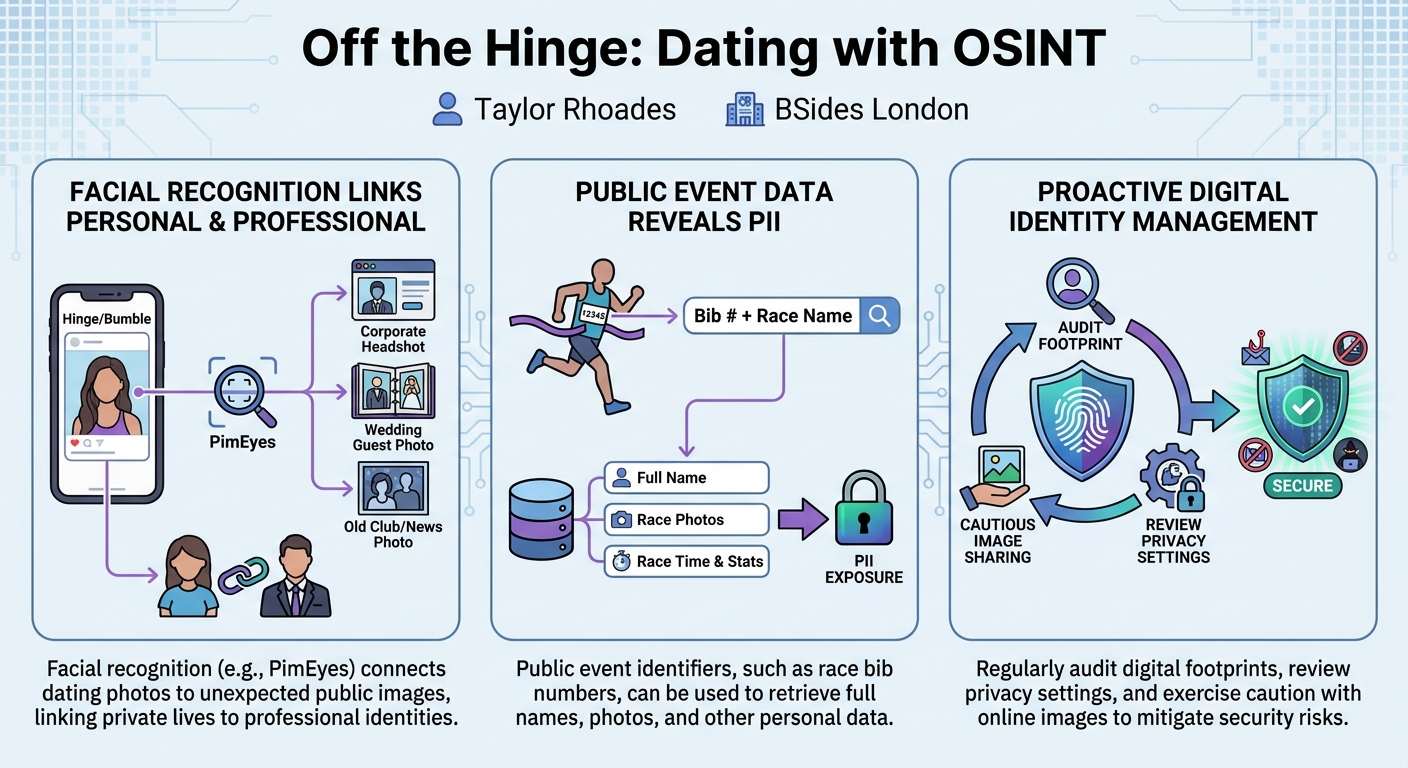
The primary discovery centered on the efficacy of PimEyes, a facial recognition search engine. By uploading a profile picture from a dating app, PimEyes could scrape the internet to find other instances of that individual's face. Rhoades demonstrated this capability using her own images, revealing a picture from a Galway scooter launch she had forgotten about and a less flattering photo of her eating a bagel during a London flood, published in the Metro newspaper. These personal examples underscored how widely and unexpectedly images can circulate online, often without an individual's awareness.
From the analyzed dating profiles, PimEyes consistently matched individuals across four key, often unexpected, categories:
- Wedding Sites: Many amateur photographers or photography businesses upload extensive galleries from weddings. PimEyes was able to identify individuals, even those in the background of large wedding parties, by matching their faces from dating profiles. This means a casual dating app photo could lead to an individual's presence at a specific wedding, potentially revealing their social circle or even familial connections.
- Corporate Photos: For individuals in professions like finance, medicine, or technology entrepreneurship, their dating profile photos frequently matched images on their corporate websites. This direct link immediately bridges the personal and professional, making it straightforward to ascertain an individual's employer and role from a dating app.
- Old Club Photos: Perhaps the most embarrassing finding, PimEyes unearthed photos from clubs individuals frequented in their 20s, some dating back as far as 2014. These clubs often no longer exist, yet the images persist online, potentially depicting individuals in compromising or unprofessional situations that could be leveraged for blackmail or reputational damage, especially if linked to their current professional standing.
- Racing Results: While not directly using PimEyes, Rhoades discovered that approximately 60% (six out of ten) of the profiles she analyzed belonged to individuals who had participated in races (e.g., half marathons). By obtaining a bib number from a publicly available race photo and knowing the race city or name, she could access detailed results, including the individual's full first and last name, and a gallery of their race photos. Rhoades demonstrated this with her own past half-marathon results, highlighting how easily a seemingly innocuous bib number could lead to personally identifiable information and unflattering public images.
These findings collectively illustrate the alarming ease with which an individual's personal life, as presented on dating applications, can be inextricably linked to their professional identity and a broader digital footprint. The talk emphasized that this correlation doesn't even require access to private social media accounts like Facebook or Instagram; public-facing data, often considered benign, is sufficient. The example of a finance professional whose dating profile background revealed computer monitors, and whose photo then linked to "adult club photos" via PimEyes, powerfully demonstrated the potential for reputational damage and blackmail when these worlds collide.
Technical Deep Dive
▶ Watch: Exposing personal info via race bib numbers (5:40)
The core of Taylor Rhoades's investigation relies on a combination of widely accessible Open-Source Intelligence (OSINT) tools and methodologies, demonstrating how seemingly disparate pieces of information can be correlated to construct a comprehensive profile of an individual.
The primary tool leveraged in this research was PimEyes, a specialized facial recognition search engine. Unlike general image search engines, PimEyes is designed to scrape the internet for instances of a specific face. Users upload an image, and the service utilizes advanced facial recognition algorithms to identify matches across various websites, including news articles, blogs, public photo galleries (like those from events or professional photographers), and even defunct websites. Rhoades's personal examples vividly illustrated its power: an uploaded photo led to an image from a scooter launch in Galway and another from a news article about a London flood where she was seen eating a bagel. This demonstrates PimEyes's ability to uncover images from diverse, often unexpected, online sources, tying them back to an individual's face.
Beyond facial recognition, Rhoades explored the wealth of information available through publicly shared event data, specifically race results. Many running events, from local 5Ks to international marathons, publish participant data and photos online. The key identifier here is the bib number, a unique identifier assigned to each participant. By knowing an individual's bib number and either the specific race they participated in or the city where the race occurred, one can often access a plethora of personal information. This includes:
- Full Name: Race results typically list participants' first and last names.
- Race Time/Performance: Detailed statistics about their performance.
- Event Photos: Professional photographers at these events capture numerous images of participants, often linked directly to their bib numbers. As Rhoades humorously noted, these are rarely flattering but are definitively linked to the individual.
This technique highlights how an individual's participation in a public event, coupled with a unique identifier like a bib number, can serve as a conduit to sensitive personal information and a visual record of their activities.
Another fundamental OSINT technique mentioned was Google Dorking, also known as Google Hacking. This involves using advanced search operators and syntax within Google (or other search engines) to refine queries and discover specific, often hidden, information. Examples of dorking operators include site:, filetype:, intitle:, inurl:, and Boolean operators like AND, OR, NOT. By crafting precise queries, investigators can unearth documents, directory listings, configuration files, or other data that might not be easily discoverable through standard searches. While not extensively detailed in the context of dating apps, Google Dorking serves as a foundational skill in OSINT, enabling deeper dives into an individual's online presence or an organization's exposed assets.
The overarching technical implication is the correlation of seemingly disparate data points. A picture from a dating app, often considered a personal sphere, can be the initial pivot point. This image, run through PimEyes, might reveal corporate headshots, linking the individual to their employer. Simultaneously, a hobby mentioned or implied on the dating profile (e.g., running) could lead to public race results, providing full names and additional photos. This intricate web of interconnected data, facilitated by specialized OSINT tools and techniques, demonstrates how a comprehensive profile can be constructed from publicly available information, blurring the lines between personal and professional identities with significant implications for privacy and security. Rhoades also mentioned the broader OSINT Frameworks as a starting point for those interested in exploring these capabilities further, indicating a structured approach to utilizing a wide array of tools and resources for information gathering.
Demo / Proof of Concept
▶ Watch: Real-world implications: Deepfake scams and blackmail potential (6:40)
While Taylor Rhoades did not conduct a live demonstration using attendees' or third-party profiles during her talk, she effectively presented a compelling proof of concept by using herself as the primary subject. This self-demonstration served to illustrate the power and invasiveness of the OSINT tools and techniques she discussed, making the findings relatable and impactful without compromising anyone else's privacy.
The core of her demonstration involved showcasing the capabilities of PimEyes. She described uploading her own photograph to the facial recognition search engine. The results were immediate and surprising, even to her. PimEyes returned an image of her participating in a scooter launch event in Galway, a photo she was completely unaware had been uploaded to the internet. Another result was a photo from a news article in the Metro newspaper, depicting her eating a bagel during a London flood, again, a public image she had no recollection of. These personal examples vividly illustrated how widely and unexpectedly one's image can circulate online, often without explicit consent or even knowledge, forming part of an individual's accessible digital footprint.
Further reinforcing the proof of concept, Rhoades detailed her experiment with race results. She recounted how she took her own past half-marathon bib number and, knowing the city where the race occurred, was able to navigate to the race results website. By simply inputting her bib number (without even needing her first name), the system returned her full first and last name, her race time, and a gallery of photos taken during the event. This practical demonstration highlighted how a seemingly innocuous piece of information – a bib number – can be directly linked to personally identifiable information and public visual records.
Through these self-demonstrations, Rhoades effectively conveyed the core message: the ease with which OSINT tools can connect seemingly disparate pieces of personal data. She described how, in her research of dating profiles, she would apply these same techniques: taking a profile picture, running it through PimEyes, and then cross-referencing any leads (like corporate websites, wedding photo galleries, or mentions of hobbies like running) to build a more complete profile. The illustrative example of the finance professional whose dating profile led to "adult club photos" via PimEyes, and whose professional background could be inferred, served as a powerful, albeit hypothetical, demonstration of the potential for reputational damage and blackmail. By focusing on her own data, Rhoades maintained ethical boundaries while still providing concrete, actionable examples of how these techniques function in practice.
Defensive Implications
▶ Watch: Recommended OSINT tools and learning resources (9:00)
The findings from "Off the Hinge: Dating with OSINT" carry significant defensive implications for both individuals and organizations in an increasingly interconnected digital world. The ease with which personal dating profiles can be linked to professional identities underscores a critical need for enhanced awareness and proactive security measures.
For individuals, the primary defensive strategy is to cultivate a heightened awareness of their digital footprint. This involves:
- Auditing Online Presence: Regularly search for your own name, images, and other identifiable information using tools like PimEyes and Google Dorking. Understand what information about you is publicly accessible.
- Privacy Settings Review: Scrutinize privacy settings on all social media platforms, dating apps, and any service where personal information or photos are shared. Be mindful of who can view your content and how it can be shared or indexed.
- Image Sharing Caution: Exercise extreme caution when sharing photos online, especially those that could be used for facial recognition. Consider the long-term implications of photos uploaded by others (e.g., wedding photographers, club photographers, event organizers). Once an image is online, it is exceedingly difficult to remove permanently.
- Professional/Personal Segregation: While complete segregation is challenging, be mindful of how personal details (hobbies, locations, social circles) shared on dating apps could be correlated with professional information. Avoid using the same profile pictures across professional and personal platforms.
- Event Participation Awareness: Understand that participating in public events like races often means your name, bib number, and photos will be publicly available. Consider the implications before signing up or if using an alias is an option.
- Deepfake and Social Engineering Vigilance: The Gary deepfake incident serves as a stark reminder that personal information, once correlated, can be used to craft highly convincing social engineering attacks or deepfake scams. Be skeptical of unusual requests, even from seemingly familiar sources.
For organizations, the defensive implications revolve around protecting their employees and their corporate reputation from these types of OSINT attacks:
- Employee Education: Implement comprehensive security awareness training that specifically addresses the risks of OSINT. Educate employees about the blurring lines between personal and professional online presence and the potential for their personal data to be used in targeted attacks against the organization.
- Reputational Risk Management: Understand that an employee's personal online activities, if exposed and linked to their professional role, can reflect poorly on the company. Develop policies and guidance for employees regarding online conduct, while respecting personal privacy.
- Insider Threat Mitigation: OSINT can be a precursor to insider threats, where individuals are blackmailed or coerced using compromising personal information. Organizations should have robust insider threat programs that consider external vulnerabilities.
- Vulnerability Assessment: Conduct regular OSINT assessments on key personnel, especially those in sensitive roles, to identify potential personal data exposures that could be exploited by adversaries. This is not about surveillance but about understanding external attack vectors.
- Data Leakage Prevention: While focused on personal data, the talk implicitly highlights broader data leakage concerns. Organizations should reinforce controls around what information their employees can publicly share, even inadvertently, that might reveal internal systems, projects, or intellectual property (e.g., computer monitors visible in backgrounds).
Ultimately, the talk serves as a powerful call to action for a more proactive and holistic approach to cybersecurity, extending beyond traditional network perimeters to encompass the vast and often uncontrolled landscape of open-source intelligence. Defenders must equip individuals with the knowledge and tools to manage their digital identities responsibly, recognizing that every piece of public information can be a potential pivot point for a targeted attack.
Key Takeaways
- Your Digital Footprint is Extensive and Persistent: Seemingly innocuous personal details shared on dating apps or participating in public events can be easily linked to your professional identity and broader online presence. Once data is online, it is incredibly difficult to erase.
- Facial Recognition Tools are Powerful: Services like PimEyes can rapidly scan the internet for your face, uncovering images you may not even know exist, from wedding photos to old club pictures or news articles.
- Public Event Data Reveals PII: Information from public events, such as race bib numbers, can be used to easily retrieve your full name, photos, and other personal details, directly linking a hobby to your identity.
- The Personal and Professional Blur: The lines between your personal and professional online lives are increasingly porous. Information from dating profiles can be correlated with corporate websites, potentially leading to reputational damage or blackmail scenarios.
- OSINT is a Potent Threat Vector: Open-Source Intelligence techniques are not just for finding missing persons; they are powerful tools that adversaries can use for social engineering, deepfake scams, targeted attacks, and corporate espionage.
- Proactive Digital Identity Management is Crucial: Individuals must regularly audit their online presence, review privacy settings, and exercise caution when sharing any personal information or images online. Organizations must educate employees about these risks to protect both individuals and the company.
About the Speaker(s)
Taylor Rhoades is a Senior Sales Director at Graylog, a company specializing in centralized log management. With a professional background spanning seven and a half years in the STEM industry, Rhoades primarily identifies with the Blue Team side of cybersecurity. However, for this talk, she embraced a "personal Taylor" persona, revealing a keen interest in offensive security techniques through a self-proclaimed "3-month OSINTer" experiment. Her experience at BSides London, particularly her interaction with the Trace Labs team at 44CON, inspired her deep dive into the intersection of dating apps and open-source intelligence. Rhoades is also known for her humorous self-awareness regarding mispronunciations, adding a lighthearted touch to a serious topic.
Reviews
Dr. Zero (Offensive Security Researcher) — WEAK
A sales director spent three months using public facial recognition websites to tell us that the internet has photos of people. This is an OSINT 101 awareness seminar, not conference-grade research. If you've never heard of PimEyes, you might learn something; if you actually work in security, this is pure filler.
Heather Calloway (CISO) — SOLID
This is a competent, if entry-level, demonstration of how easily OSINT tools can link personal dating profiles to corporate identities. While the technical techniques are basic, the business implication is clear: the boundary between private exposure and corporate risk no longer exists. It is worth reviewing for teams building out executive protection or insider threat programs, though not required reading for leadership.