The art of cyber deception
Joshua Wardle (Graduate Consultant · Logiq Consulting)
Security BSides London 2023 · Day 1 · Rookie Track
Overview
In "The art of cyber deception," Joshua Wardle, a Graduate Consultant at Logiq Consulting (with a Q), presents a compelling case for leveraging cyber deception as a proactive and intelligent security strategy. The talk moves beyond traditional reactive security measures, advocating for engagement with adversaries earlier in the attack kill chain. Wardle argues that by strategically introducing fabricated assets into a network, organizations can not only detect sophisticated threats, including elusive insider threats, but also actively manipulate adversary behavior, generate high-fidelity real-time threat intelligence, and ultimately disrupt attacks.
Key moments
- 0:00 Introduction: Why we need cyber deception
- 2:00 Understanding cyber deception and its psychological effects
- 6:00 Key building blocks for a deception campaign
- 8:00 Designing campaigns with the 'See, Think, Do' method
- 10:00 Practical example: Designing a legal bid data deception
- 12:30 Prerequisites for successful cyber deception implementation
- 15:00 Q&A: Mitigating reputational risk from deceptive incidents
The art of cyber deception
Speakers: Joshua Wardle, Graduate Consultant, Logiq Consulting
Conference: BSides London
YouTube: https://www.youtube.com/watch?v=LJNVAcRiQY8
Overview
In "The art of cyber deception," Joshua Wardle, a Graduate Consultant at Logiq Consulting (with a Q), presents a compelling case for leveraging cyber deception as a proactive and intelligent security strategy. The talk moves beyond traditional reactive security measures, advocating for engagement with adversaries earlier in the attack kill chain. Wardle argues that by strategically introducing fabricated assets into a network, organizations can not only detect sophisticated threats, including elusive insider threats, but also actively manipulate adversary behavior, generate high-fidelity real-time threat intelligence, and ultimately disrupt attacks.
The core premise of cyber deception, as articulated by Wardle, lies in its ability to exploit the cognitive processes of human adversaries. By creating believable yet fake environments, attackers can be overwhelmed, sidetracked, or even tricked into revealing their tactics, techniques, and procedures (TTPs). This approach offers a significant paradigm shift from merely blocking attacks to actively engaging and learning from them, providing an invaluable layer of defense that complements, rather than replaces, existing security tooling.
This detailed article explores Wardle's "whistle-stop tour" of cyber deception, delving into its psychological underpinnings, essential building blocks, and a practical, reverse-engineered methodology for campaign design. It highlights the critical prerequisites for successful implementation and underscores the profound defensive implications for organizations mature enough to embrace this advanced security discipline.
Background
▶ Watch: Introduction: Why we need cyber deception (0:00)
Traditionally, cybersecurity efforts have largely focused on the right-hand side of the cyber kill chain – that is, detecting and stopping attacks once they are already in progress, often at the point of exploitation or post-exploitation activities like command and control (C2) or data exfiltration. Tools like antivirus software exemplify this reactive posture, primarily kicking in when an exploit is executed. While network intrusion detection systems (NIDS) can sometimes detect early-stage reconnaissance, Wardle points out that not all forms of reconnaissance are detectable by conventional means. For instance, insider threats conducting in-person social engineering fall entirely outside the purview of such tools. This limitation creates a significant impetus to engage adversaries earlier, on the left-hand side of the kill chain, especially given the rapid evolution of attacker TTPs.
The concept of using deception in cybersecurity is not new. Wardle acknowledges the long-standing practice of deploying honeypots, which are classical forms of cyber deception. These decoy assets, often placed near network boundaries (e.g., in a demilitarized zone or DMZ), are designed to attract attackers and signal their presence. Wardle references Cliff Stoll's 1990s book "The Cuckoo's Egg" as a historical example of using fake systems to track a hacker. While honeypots have served as a foundational detection capability, recent years have seen the emergence of sophisticated deception platforms. These cloud-backed solutions offer enhanced automation capabilities, making it easier to extract threat intelligence, and leverage the economies of scale inherent in cloud infrastructure to orchestrate numerous deceptive machines in parallel. This evolution allows for dynamic responses to adversary behavior, marking a significant advancement over static honeypot deployments.
Key Findings
▶ Watch: Key building blocks for a deception campaign (6:00)
Wardle's talk highlights several key findings and benefits associated with implementing cyber deception:
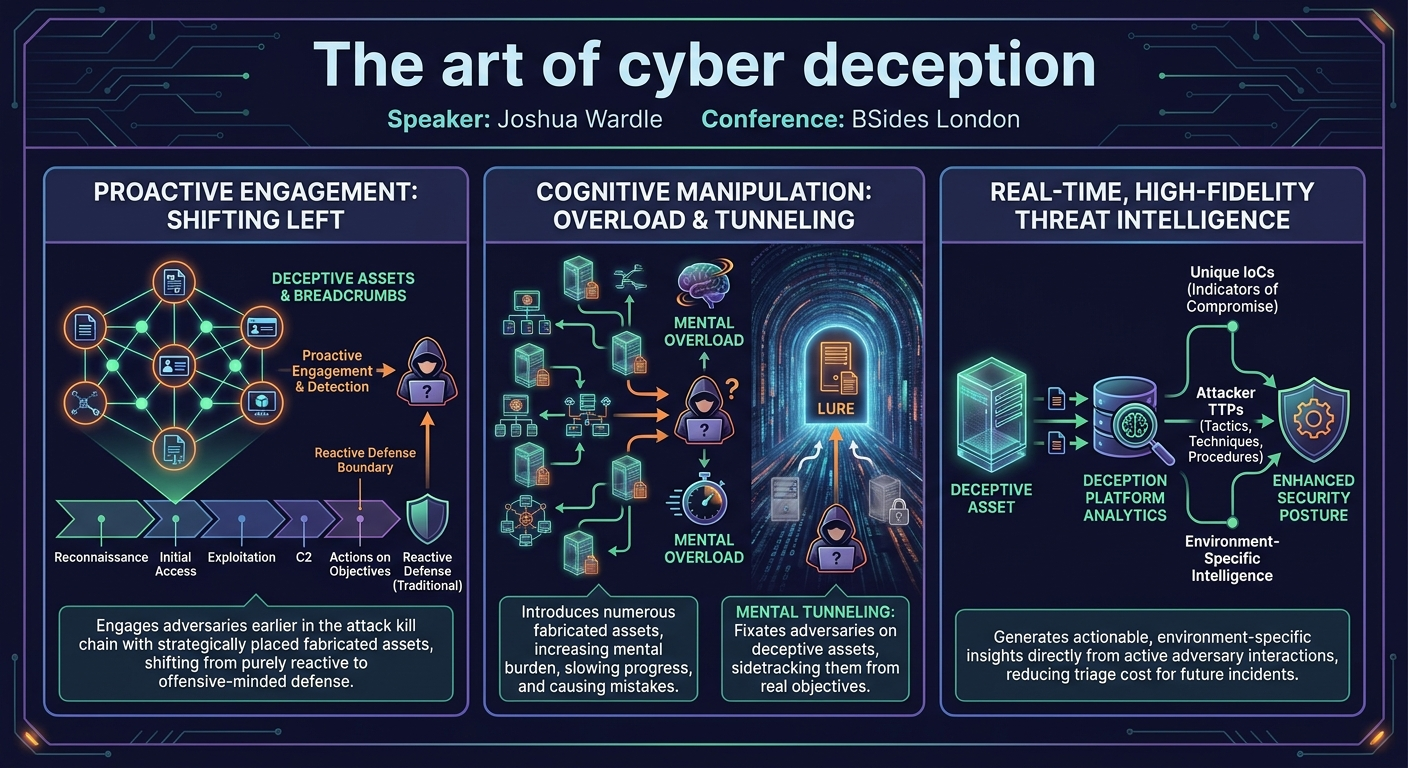
- Cognitive Manipulation: Properly designed deception campaigns can trigger specific cognitive and emotional responses in adversaries. Wardle identifies two primary effects:
- Mental Overload: Adversaries, often humans, have limited cognitive capacity. By introducing numerous fabricated assets and complex scenarios, deception increases the mental burden on attackers. They must not only evade traditional defenses and achieve their objectives but also discern real assets from fake ones, leading to distraction, slower progress, and a higher probability of making mistakes, such as dismissing a real asset as fake or forgetting to adjust tool settings (e.g., Nmap), thus triggering alarms.
- Mental Tunneling: Adversaries might become fixated on a deceptive asset, spending inordinate amounts of time and resources trying to exploit or analyze it. For example, an attacker might "spend ages trying to write these formulas to figure out if it's deceptive" in a fake Excel spreadsheet, losing track of their actual objectives. This sidetracking effectively stalls their progress toward real assets.
- Real-Time Threat Intelligence Generation: Deceptive assets, when properly monitored, act as invaluable sensors. Any interaction with these fake systems indicates the presence of an adversary. By analyzing the TTPs and indicators of compromise (IoCs) observed on these assets, organizations can generate highly specific, real-time threat intelligence. This intelligence is unique because it's derived directly from active engagements with attackers targeting your specific environment, offering a significant advantage over generic threat feeds. It "reduces the cost of triage for future incidents" by providing actionable insights tailored to potential future attacks.
- Attack Disruption and Deterrence: Beyond detection, deception actively disrupts attacks. Mental overload can cause adversaries to make incorrect decisions, while mental tunneling diverts their attention and resources away from critical systems. This disruption can significantly prolong the attack timeline, provide more opportunities for defenders to intervene, and potentially deter attackers who realize they are operating in a highly monitored and manipulated environment.
- Proactive Engagement: Cyber deception allows organizations to engage adversaries much earlier in the kill chain, often during reconnaissance or initial access phases, before any real damage is done. This proactive stance shifts the defensive posture from purely reactive to a more strategic, offensive-minded defense.
- Methodological Approach to Design: Wardle introduces a practical, reverse-engineered approach to designing deception campaigns based on the military's see-think-do methodology. By starting with the desired outcome ("what you want your adversary to do"), organizations can construct credible attack paths and place appropriate lures, ensuring the campaign yields relevant intelligence and achieves its objectives.
Technical Deep Dive
▶ Watch: Designing campaigns with the 'See, Think, Do' method (8:00)
Cyber deception, at its core, involves the strategic introduction of fabricated assets into a network to trick adversaries. These assets can range from simple fake documents or credentials (breadcrumbs) to complex virtualized servers, laptops, or even entire copies of production systems. The effectiveness of deception hinges on its ability to appear authentic and to elicit specific cognitive responses from attackers.
The building blocks of a successful deception campaign are:
- Breadcrumbs: These are the initial lures designed to attract an adversary's attention and guide them towards deceptive assets. Breadcrumbs can be any piece of data an attacker might find valuable, such as:
- Credentials: Fake usernames and passwords.
- Code Snippets and Secrets: Potentially revealing bits of application code or API keys.
- Honey Tokens: Documents, files, or database entries specifically designed to send an alert to a Security Operations Center (SOC) team upon access.
- Physical Lures: Even a USB stick "surreptitiously leave[d] on the ground in the car park" can serve as a breadcrumb.
The placement of breadcrumbs is critical and depends entirely on the target threat actors. For insider threats, breadcrumbs might be placed on network shares or SharePoint sites. For external threat actors, they could be found on public platforms like Pastebin or even on the dark web, with some deception platforms supporting such advanced deployments.
- Deceptive Assets: These are the underlying infrastructure components that host the fake services and data. They can be physical or virtualized machines (e.g., VMs, laptops) designed to mimic legitimate systems within the organization's network. Merely deploying a vanilla Windows VM is insufficient; it must be made to appear real.
- Services: To make deceptive assets seem authentic and to generate interaction, services must be deployed on them that mimic those found on production systems. If an organization uses Nginx web servers and MySQL databases, then deceptive assets should run Nginx and MySQL. These services are crucial for stalling adversaries and generating real-time threat intelligence through their interactions.
- Telemetry: Underpinning the entire deception framework is the collection of real-time threat intelligence. This involves gathering IoCs such as network activity, file activity, and application-level logs. The method of collection is similar to that on normal devices, but with a critical difference: the agent collecting this information must be hidden from adversaries. This is typically achieved using techniques like rootkits or other simple process hiding mechanisms.
Wardle emphasizes a specific methodology for designing effective deception campaigns, derived from the military's Joint Publication 33.4 and adapted for cybersecurity: the see-think-do model, applied in reverse.
- 1. DO (Define Objective): Start by clearly defining what you want the adversary to do. Is it to compromise a specific service, exfiltrate certain data, or simply dwell within the environment for a period to reveal their TTPs? This objective dictates the entire campaign design.
- 2. THINK (Formulate Path): Once the objective is set, use tools like attack trees to formulate a credible and realistic path for the adversary to follow to achieve that objective. The goal is to manipulate the adversary's thinking so that the next step you want them to take appears to be their logical next move. This requires placing the right kind of assets in the right places – for example, not putting "a bunch of printers on your deceptive environment" if you're a power plant.
- 3. SEE (Place Assets and Lures): Finally, based on the credible path, determine what the adversary needs to see to follow that path. This involves strategically placing breadcrumbs and configuring deceptive assets with services that align with the established attack tree. Wardle stresses the "law of diminishing returns" in deception design: only include elements relevant to your objective. Irrelevant details not only waste resources but also increase the risk of revealing the deception due to inconsistencies.
Example Campaign Walkthrough:
Wardle illustrates this methodology with a practical example: a small business performing legal bid work wants an external adversary to exfiltrate sensitive data from an internal web app.
- Objective (DO): An external adversary exfiltrates legal bid data. The campaign must end with a deceptive database (e.g., a MySQL server) storing this fake data.
- Path (THINK):
- To reach the database, the adversary would likely access it through an internal web app. So, the step before the database is a web app server (e.g., running Nginx) containing fake bid data, potentially configured as honey tokens to trigger alerts. This establishes a clear relationship between the web app and the database.
- To reach the internal web app, given it's an internal application, the adversary would likely need to compromise an on-premises device. A developer's laptop running Windows with Office installed is chosen as a plausible entry point.
- An entry point into this environment is needed for an external adversary.
- Lures (SEE):
- Database: MySQL server with fake bid data.
- Web App: Nginx server with fake bid data (honey tokens) establishes a path to the database.
- Developer's Laptop: Two sets of breadcrumbs:
- Credentials to the web app: Clearly establish the relationship between the laptop and the web app.
- Code snippets and secrets: A "plan B" to expose the database directly if the adversary deviates, helping to pull them back on track.
- Entry Point: RDP credentials for the developer's laptop, published on a platform like Pastebin, to attract external adversaries.
This campaign design provides multiple points for telemetry: file discovery on the laptop, application-level logs in the database and web app, and general network monitoring. The key is to keep it lean and focused on the objective, avoiding unnecessary complexities that could both reveal the deception and waste resources.
Demo / Proof of Concept
▶ Watch: Prerequisites for successful cyber deception implementation (12:30)
While Joshua Wardle's presentation did not include a live demonstration of a cyber deception platform or a specific proof-of-concept execution during the talk, he provided a detailed and practical example campaign walkthrough. This hypothetical scenario, outlined in the "Technical Deep Dive" section, serves as a conceptual proof-of-concept for how the reverse see-think-do methodology would be applied in a real-world context.
The example illustrated how an organization could design a multi-stage deception campaign, from initial breadcrumbs (RDP credentials on Pastebin) to a final objective (exfiltration of fake legal bid data from a deceptive MySQL database), meticulously detailing the intermediate steps and the types of deceptive assets and services involved (developer's laptop, Nginx web app). This allowed the audience to understand the practical application of the concepts without needing a live demo.
Furthermore, Wardle explicitly mentioned tools and frameworks relevant to adversary engagement and deception. He referred to MITRE ENGAGE as a framework for understanding adversary engagement and highlighted MITRE Caldera as a tool that "you can spin that up on a couple VMs" for adversary emulation and engagement. These references indicate the availability of open-source and commercial solutions that enable organizations to build and test their own deception campaigns and proof-of-concepts, aligning with the principles discussed in his talk.
Defensive Implications
▶ Watch: Q&A: Mitigating reputational risk from deceptive incidents (15:00)
Implementing cyber deception has profound implications for an organization's defensive posture, but it comes with critical prerequisites and considerations:
- Complements, Not Replaces, Traditional Security: Wardle emphatically states that deception "doesn't replace traditional tooling; it complements it." Organizations must first establish a strong foundation of general cybersecurity hygiene, including robust defense-in-depth, comprehensive auditing, and standard security practices. Without this baseline, deception becomes akin to "the kid in Home Alone put[ting] all those traps around the house... but then left the front door unlocked and the windows open." It's an advanced layer, not a silver bullet.
- Threat Intelligence Maturity is Paramount: A more specific and crucial prerequisite is threat intelligence maturity. If an organization lacks the processes and capabilities to effectively handle and operationalize threat intelligence, the real-time IoCs generated by deception campaigns will be underutilized. In such cases, deception risks regressing into "a very expensive and complicated detection capability," for which cheaper alternatives like the NCSC's Early Warning Service exist.
- Basic Maturity: An organization might have a SIEM and perform automated analysis on tactical intelligence.
- Advanced Maturity: A more mature organization will be "creating and ingesting lots of type of intelligence," have clear objectives for their threat intelligence campaigns (mirroring the
DOstep of deception design), and continuously improve their processes.
- Proportionality: Cyber deception is not suitable for every organization. Wardle suggests it's "out the question" for a small charity focused on Cyber Essentials. Instead, it's best suited for "large organization[s] good security posture robust threat intelligence practices." The investment in design, deployment, and analysis requires significant resources and a mature security program.
- Legal and Reputational Risks (Addressed in Q&A):
- Public Perception of a "Hack": A common concern is the reputational risk if attackers believe they've successfully breached the organization and then publicize it. Wardle notes that organizations typically "would just go out and say yeah you fell for it" if it was a deceptive environment. Some platforms might even subtly indicate the presence of deception (e.g., "proudly partnered with say CounterCraft") to sow doubt in the attacker's mind. However, this would necessitate designing a new campaign afterward.
- Leaking Deceptive Data: The legal risks associated with attackers exfiltrating deceptive data and publishing it (e.g., on the dark web) were also raised. Wardle's critical advice is to never put real data on deceptive assets. While military contexts might mix real and fake data, this is generally outside the scope for corporate deception. If entirely fake data is leaked, an organization can "just even ignore it." To mitigate this risk, strict business processes are essential:
- Complete Separation: Deception environments must be completely separate from production systems (e.g., a "completely separate AWS tenant").
- Process Segregation: Personnel responsible for accessing sensitive production data should not necessarily be involved in the design or management of deception environments. This ensures a clear delineation and minimizes the chance of accidental data exposure.
In summary, cyber deception offers a powerful means to gain intelligence, disrupt adversaries, and enhance an organization's security posture. However, its successful implementation demands a high level of cybersecurity maturity, a clear understanding of threat intelligence, and careful consideration of the operational and legal implications.
Key Takeaways
- Proactive Engagement: Cyber deception shifts security from reactive defense to proactive engagement, allowing organizations to detect and interact with adversaries earlier in the attack kill chain, including elusive insider threats.
- Cognitive Manipulation: Deception campaigns exploit human adversary psychology through "mental overload" (distracting and overwhelming) and "mental tunneling" (fixating on fake assets), slowing down and disrupting attacks.
- Real-Time, High-Fidelity Threat Intelligence: Deceptive assets generate unique, real-time indicators of compromise (IoCs) and TTPs specific to your environment, significantly reducing the cost and effort of triaging future incidents.
- Structured Campaign Design: The reverse
see-think-domethodology (start with the adversary's desired action, then plan their path, then place lures) is crucial for designing effective, intelligence-generating, and credible deception campaigns. - Prerequisites for Success: Successful cyber deception requires a strong foundation in general cybersecurity (defense-in-depth, auditing) and, critically, high maturity in threat intelligence capabilities to properly leverage the generated insights.
- No Real Data on Deceptive Assets: To mitigate legal and reputational risks, it is paramount to never place actual sensitive data on deceptive assets and to ensure complete segregation of deception environments from production systems.
About the Speaker(s)
Joshua Wardle is a Graduate Consultant at Logiq Consulting, a firm based in Bristol. In his role, he focuses on providing expertise in various aspects of cybersecurity. His presentation at BSides London demonstrates his deep understanding of advanced security concepts, particularly in the domain of cyber deception and adversary engagement. Wardle showcases a practical, analytical approach to security challenges, combining theoretical models with real-world application.
Reviews
Dr. Zero (Offensive Security Researcher) — WEAK
A graduate consultant's 101-level rehash of honeypots dressed up in military framework buzzwords. There's no novel research, no live deployment data, and no real-world threat actor telemetry—just hypothetical scenarios about fake MySQL servers.
Heather Calloway (CISO) — SOLID
This is a clear, sober look at cyber deception that rightly frames it as an advanced capability rather than a substitute for security fundamentals. The speaker explicitly warns against deploying deception before an organization has the threat intelligence maturity to operationalize the resulting telemetry. I’d have my security engineering director watch this before bringing me a budget request for a new deception platform.