The Antisocial Engineer's Guide to Community Building: Deploying a Neighborhood Honeypot
John Ford (Former Microsoft Engineer / Mental Health Counselor)
BSides Seattle 2026 · Day 1 · Track 1
Overview
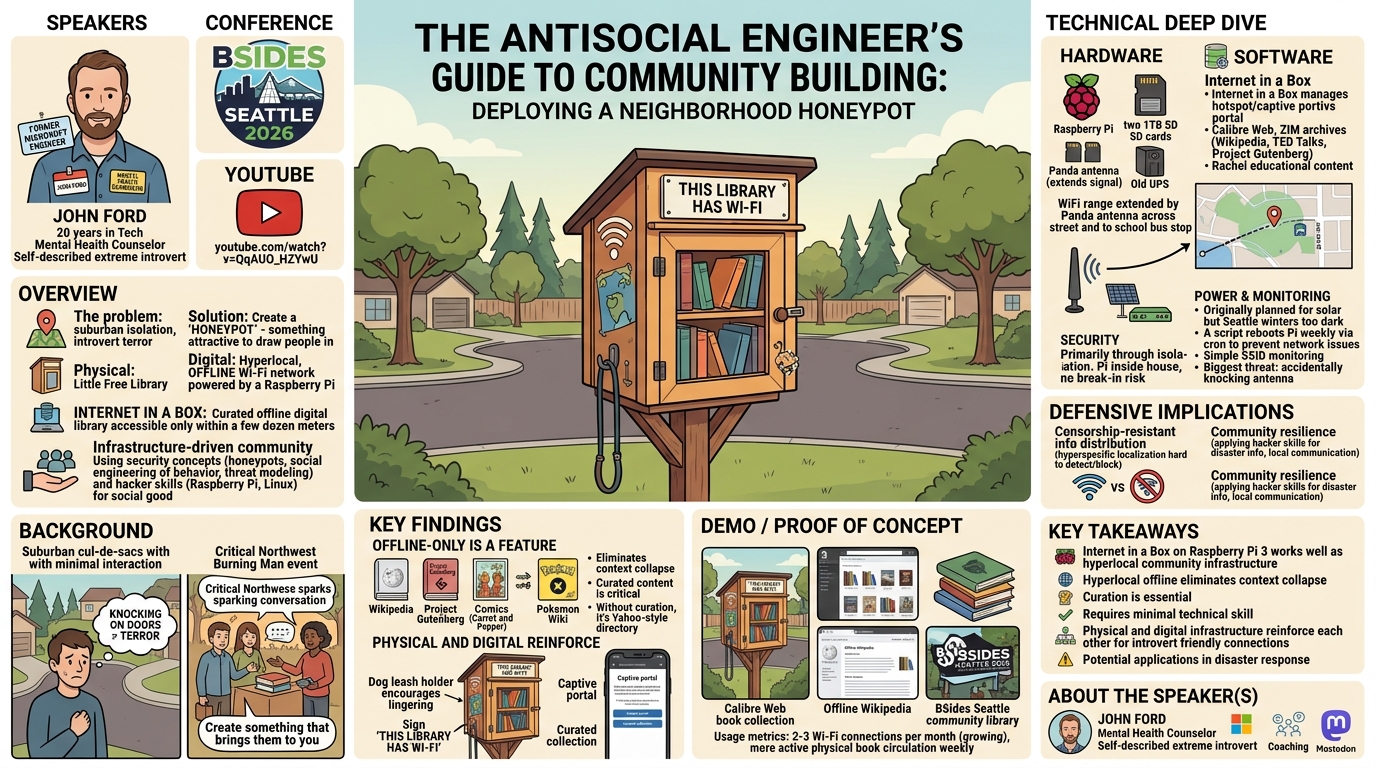
John Ford, a self-described extreme introvert with 20 years in the tech industry (mostly at Microsoft) who left to become a mental health counselor, presents a deeply personal project: building a neighborhood "honeypot" -- a Little Free Library enhanced with a hyperlocal, offline Wi-Fi network powered by a Raspberry Pi. The project applies the security concept of a honeypot (something attractive that draws people in) to the social problem of suburban isolation, using the Internet in a Box platform to create a curated offline digital library accessible only within a few dozen meters.
Key moments
- 0:00 The problem: suburban isolation and introvert terror
- 2:00 Honeypot concept: bringing neighbors to you
- 4:00 Hyperlocal Wi-Fi design and why offline-only matters
- 6:00 Internet in a Box and available content platforms
- 10:00 Backups, monitoring, and the weekly cron reboot
- 14:00 BSides community library installation
- 16:00 Open Street Map bookcases and future plans
- 18:00 Censorship resistance and community use cases
The Antisocial Engineer's Guide to Community Building: Deploying a Neighborhood Honeypot
Speakers: John Ford, Former Microsoft Engineer / Mental Health Counselor
Conference: BSides Seattle 2026
YouTube: https://www.youtube.com/watch?v=QqAUO_HZYwU
Overview
John Ford, a self-described extreme introvert with 20 years in the tech industry (mostly at Microsoft) who left to become a mental health counselor, presents a deeply personal project: building a neighborhood "honeypot" -- a Little Free Library enhanced with a hyperlocal, offline Wi-Fi network powered by a Raspberry Pi. The project applies the security concept of a honeypot (something attractive that draws people in) to the social problem of suburban isolation, using the Internet in a Box platform to create a curated offline digital library accessible only within a few dozen meters.
This is not a security research talk in the traditional sense. It is a community-building project that uses security concepts (honeypots, threat modeling, social engineering of human behavior) and hacker infrastructure skills (Raspberry Pi, Linux, network configuration) to address loneliness and disconnection in suburban neighborhoods. Ford frames the project through the lens of infrastructure-driven community: good infrastructure breeds community without requiring constant socialization, just as neighborhood parks create gathering without scheduled meetings.
Background
▶ Watch: The problem: suburban isolation and introvert terror (0:00)
Ford lives in a suburban neighborhood near Microsoft's campus -- the kind with cul-de-sacs, sidewalks nobody used pre-COVID, and minimal neighbor interaction. COVID lockdowns actually improved things by getting people walking, but meaningful community connection remained elusive. Ford wanted the neighborhood to feel more like an eclectic, connected community but faced a fundamental obstacle: as an extreme introvert, the idea of knocking on neighbors' doors generated genuine terror.
The solution: instead of going to neighbors, create something that brings them to you -- a honeypot. The inspiration came from a friend's Little Free Library project at Critical Northwest, a regional Burning Man event north of Seattle, where a physical book exchange sparked rich spontaneous conversations. Ford decided to enhance the concept with technology, reasoning that a neighborhood full of tech workers near Microsoft would respond to a quirky digital component.
Key Findings
▶ Watch: Hyperlocal Wi-Fi design and why offline-only matters (4:00)
The core technical discovery is that Internet in a Box, a platform originally designed for rural schools without internet access, works remarkably well as a hyperlocal community resource in suburban settings. The system creates a Wi-Fi hotspot with a captive portal that serves curated offline content -- essentially a tiny, local, offline internet.
Key design decisions that emerged from the project:
- Offline-only is a feature, not a limitation. Everyone already has cellular internet. The value is in hyper-locality: content is only accessible within a few dozen meters, eliminating the context collapse of the broader internet (where your mom, boss, coworker, and neighbors all occupy the same space).
- Curation is critical. Internet in a Box can host an overwhelming amount of content (the speaker scrolled through the available ZIM archives for over a minute to demonstrate the volume). Without curation, the experience becomes a Yahoo-style directory without Google. Ford selected: Calibre Web for books and local info, Creative Commons comics (Carrot and Pepper), Pokemon wiki (signaling "all ages and fun"), Wikipedia, Project Gutenberg, Appropedia (solar punk / developing-world focused wiki), and iFixit/Restarters (seeding right-to-repair culture).
- Physical and digital reinforce each other. The physical library box has a sign saying "This Library Has Wi-Fi," and the captive portal displays the digital collection. A dog leash holder encourages lingering.
Ford also deployed a version at the BSides Seattle community library loaded with wellness content, technical books, and right-to-repair resources.
Technical Deep Dive
▶ Watch: Backups, monitoring, and the weekly cron reboot (10:00)
Hardware: Raspberry Pi 3 or higher with 2GB RAM minimum, two 1TB SD cards (though 128GB would suffice), a Panda antenna ($80) to extend the signal across the street, and an old UPS for power resilience through outages.
Software: Internet in a Box manages the hotspot, captive portal, and content serving. It includes Calibre Web for ebook management (a fork of the Calibre book system with a nicer frontend), ZIM archives from Kiwix for compressed offline versions of Wikipedia, Project Gutenberg, TED Talks, and hundreds of other sites, and Rachel content packages focused on educational materials.
Power considerations: Ford originally wanted the Pi outside with solar panels, but Seattle's winters made the battery and panel requirements too large. Instead, the $80 Panda antenna solved the problem by extending Wi-Fi from inside the house to the library box across the street and to the school bus stop.
Monitoring: A simple script on Ford's laptop checks for the Wi-Fi SSID and pops a notification if it disappears. A weekly cron job reboots the Pi to prevent networking stack issues that appeared after ~1.5 weeks of continuous operation.
Backups: Full SD card clones -- copy the entire card to a new one. Ford acknowledged that backup and monitoring professionals would be "horrified."
Security: Primarily through obscurity and isolation. The Pi is physically inside the house (no break-in, no theft). The Wi-Fi adapter was originally connected to Ford's home network for content loading, then that connection was deleted so the Pi operates as a completely isolated network. The biggest actual threat: accidentally knocking off the antenna while dusting, which causes the networking stack to fail on the next cron reboot.
Customization: CSS editing to smooth out Internet in a Box's rough UI edges. A projector traced branding onto the physical library box.
Demo / Proof of Concept
▶ Watch: BSides community library installation (14:00)
The project itself is the proof of concept. Ford showed the physical library installation, the captive portal interface, screenshots of the Calibre Web book collection (including a local phone book and digital fridge), the offline Wikipedia and Pokemon wiki interfaces, and the BSides-specific installation at the conference's community library. Usage metrics show approximately 2-3 Wi-Fi connections per month (growing as people discover and trust it), with more active physical book circulation on a weekly basis.
Defensive Implications
▶ Watch: Censorship resistance and community use cases (18:00)
This talk does not address defensive security directly. However, it demonstrates a model for censorship-resistant information distribution -- the hyperlocal Wi-Fi is extremely difficult to detect, monitor, or block since you must be physically adjacent to find it. Ford notes this as a future consideration without elaborating on threat models. The Open Street Map bookcases feature for advertising public resource boxes could also be relevant for disaster preparedness and resilient local communication networks.
From a broader security culture perspective, Ford's project demonstrates that hacker skills (Linux administration, network configuration, creative problem-solving) have direct applications in community resilience -- a theme that aligns with BSides' grassroots ethos.
Key Takeaways
- Internet in a Box (designed for rural schools) works well as hyperlocal community infrastructure in suburban settings, running on a Raspberry Pi 3 with minimal configuration
- Hyperlocal offline Wi-Fi eliminates context collapse -- content stays within the immediate neighborhood, creating a safer space for local interaction
- Curation is essential: the available content library is enormous, and an uncurated installation will overwhelm users
- The project requires minimal technical skill ("if you can follow a knitting pattern or have googled an error message") and the Internet in a Box maintainers are extremely responsive to GitHub issues
- Physical and digital infrastructure reinforce each other: the library box draws people in, the Wi-Fi gives them something novel to explore, and both create conversation starters for an introvert who otherwise couldn't approach neighbors
- The system has potential applications for disaster information distribution and censorship-resistant local communication
About the Speaker(s)
John Ford spent 20 years in the tech industry, the majority at Microsoft, before leaving approximately four years ago to become a mental health counselor. He describes himself as an incredibly awkward, extreme introvert. He gives talks about burnout and impostor syndrome through O'Reilly Media and does coaching and counseling through SelfWit. He attends Critical Northwest (a regional Burning Man event) and is active on Mastodon. This was his first time using a Raspberry Pi.
Reviews
Dr. Zero (Offensive Security Researcher) — HARD PASS
John Ford built a Raspberry Pi neighborhood library with offline Wi-Fi using Internet in a Box. It is a genuine community project from someone who openly admits minimal technical chops. There is no security research here — no vulnerability disclosure, no novel attack surface analysis, no defensive technique. The 'honeypot' in the title is a metaphor for luring neighbors into conversation, not a security tool. BSides community track material, not a security talk.
Heather Calloway (CISO) — WEAK
A likeable maker project deploying a Raspberry Pi with Internet in a Box as a neighborhood Little Free Library with offline Wi-Fi. Ford is transparent about his skill level and the project's scope. The talk briefly touches on censorship resistance and disaster preparedness but develops neither into anything a security leader can act on. Does not address organizational risk, regulatory compliance, incident response, or threat modeling. A good community talk that does not cross into governance or defender territory.