The Algorithm of Deception: Inside AI-Powered Social Engineering
Amamira Muhammad (IT Specialist · Smithsonian Institution)
BSides Seattle 2026 · Day 1 · Track 1
Overview
Amamira Muhammad, an IT specialist at the Smithsonian Institution in Washington DC, delivered an accessible and engaging talk on how artificial intelligence is supercharging social engineering attacks. Drawing on real-world case studies, personal anecdotes from her undergraduate cybersecurity program at Towson University, and a practical defense framework she has been teaching at schools and colleges, Muhammad made the case that AI-powered deception represents a qualitative leap in social engineering capability.
Key moments
- 0:00 Introduction and speaker background
- 2:00 AI voice deepfake triggers global security alert
- 4:00 CEO tricked into $243K wire transfer by voice clone
- 6:00 The technical pipeline: data, models, messages, manipulation
- 8:00 Pre-AI vs post-AI phishing: real email comparison
- 10:00 Five psychological triggers: authority, urgency, familiarity, scarcity, emotion
- 14:00 Recognize, Verify, Defend framework introduction
- 20:00 Using AI defensively: filters, detectors, and assistants
The Algorithm of Deception: Inside AI-Powered Social Engineering
Speakers: Amamira Muhammad, IT Specialist, Smithsonian Institution
Conference: BSides Seattle 2026
YouTube: https://www.youtube.com/watch?v=T8FMQw2DMrk
Overview
Amamira Muhammad, an IT specialist at the Smithsonian Institution in Washington DC, delivered an accessible and engaging talk on how artificial intelligence is supercharging social engineering attacks. Drawing on real-world case studies, personal anecdotes from her undergraduate cybersecurity program at Towson University, and a practical defense framework she has been teaching at schools and colleges, Muhammad made the case that AI-powered deception represents a qualitative leap in social engineering capability.
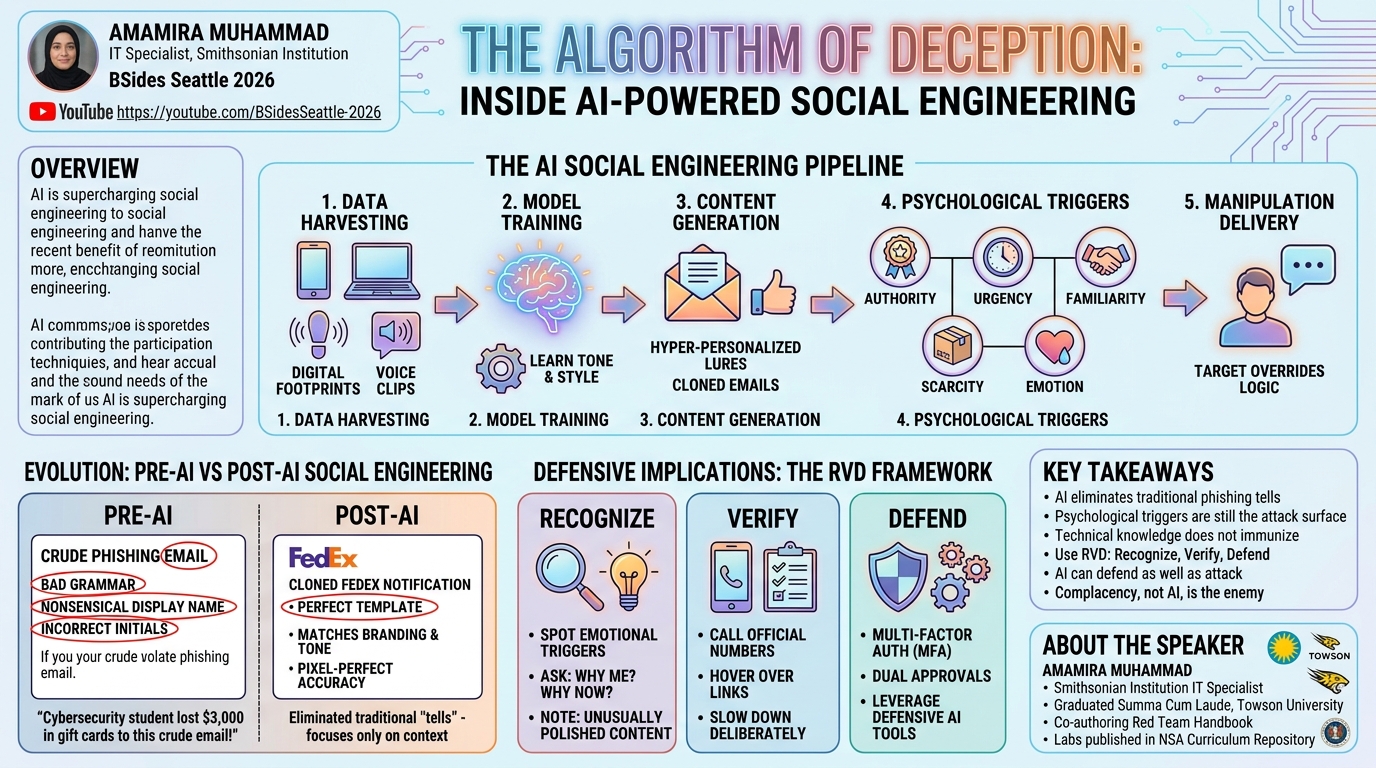
The talk examines the full pipeline of AI-assisted social engineering: from data harvesting of digital footprints, through AI model training on voice and facial patterns, to the generation of hyper-personalized manipulative content. Muhammad frames the problem not as a technology failure but as a human vulnerability amplified by technology, arguing that complacency rather than AI itself is the real enemy.
Muhammad is co-authoring an upcoming Red Team Handbook with labs published in the NSA Cybersecurity Curriculum Repository, positioning her as an emerging voice bridging offensive security education and practical awareness training.
Background
▶ Watch: Introduction and speaker background (0:00)
Social engineering predates AI by millennia, but the convergence of deepfake video, voice cloning, and large language models has eliminated many of the tells that previously allowed targets to identify deception. Muhammad outlined three recent case studies that illustrate the escalating threat:
An AI voice deepfake of a US Secretary of State triggered a global security alert, demonstrating that AI social engineering extends beyond financial fraud into national security and diplomacy. An LA woman lost her life savings and sold her home after a scammer used hyperrealistic facial deepfakes and voice modulators to impersonate actor Steve Burton in sustained video calls. A CEO was convinced by a voice clone of his German-accented boss to transfer $243,000 to a Hungarian supplier; by the time the CEO noticed the call originated from an Austrian number rather than his boss's expected number, the money had been dispersed across multiple accounts in multiple countries.
These cases illustrate how AI removes the historical friction points in social engineering: poor grammar, inability to do live video calls, and lack of contextual knowledge about targets.
Key Findings
▶ Watch: CEO tricked into $243K wire transfer by voice clone (4:00)
Muhammad's central thesis is that AI social engineering exploits five fundamental human psychological triggers: authority (compliance with perceived power), urgency (pressure to act immediately), familiarity (trust in known relationships), scarcity (fear of limited-time consequences), and emotion (bypassing logic through personal feelings). She presented a key observation: as emotional intensity increases, logical reasoning capacity decreases proportionally, creating a window of vulnerability that AI-generated content is specifically designed to exploit.
The comparison between pre-AI and post-AI phishing was particularly striking. Muhammad showed an actual phishing email she received in her undergraduate cybersecurity program, purportedly from "Professor Willie Sanders." The email was trivially identifiable as fraudulent: wrong sender format, nonsensical display name ("#treat asurgent_"), incorrect initials as the profile picture, and absurd demands. Yet a classmate in the same cybersecurity degree program fell for it, purchasing $3,000 in iTunes gift cards and handing them over. If crude phishing already works on educated targets, AI-generated content that clones legitimate email templates with pixel-perfect accuracy and injects malicious links into familiar formatting represents a qualitative escalation.
Technical Deep Dive
▶ Watch: Pre-AI vs post-AI phishing: real email comparison (8:00)
The technical pipeline Muhammad described operates in four stages. First, data harvesting: public posts, voice clips, profile pictures, and any digital footprint feed the system. Second, model training: AI tools learn the target's tone, emotional patterns, and contextual communication style. Third, message generation: using prompt engineering, attackers generate polished, contextually appropriate lures in seconds with no grammatical errors or stylistic tells. Fourth, manipulation delivery: the crafted message exploits emotional triggers to override rational evaluation.
Muhammad demonstrated how AI email cloning tools can produce near-identical replicas of legitimate emails (she showed a FedEx notification example), with all links replaced by malicious URLs. Unlike the crude phishing of the past, these cloned emails match the original formatting, branding, and tone precisely, leaving only contextual awareness (e.g., "Did I actually order a FedEx package?") as a defense.
The talk also covered common social engineering prompt patterns that trigger emotional responses: "Update needed: verify your payment information" (triggers responsibility and anxiety), "You've been hacked, please change your password" (triggers fear and urgency), "Your message wasn't delivered" (triggers curiosity and doubt), and "Your mailbox is almost full, increase capacity" (triggers operational concern).
Demo / Proof of Concept
▶ Watch: Five psychological triggers: authority, urgency, familiarity, scarcity, emotion (10:00)
This talk did not include a technical demo or proof of concept. The focus was on awareness and framework education rather than tool demonstration. The real-world case studies served as the evidentiary foundation for the claims made.
Defensive Implications
▶ Watch: Using AI defensively: filters, detectors, and assistants (20:00)
Muhammad presented a three-pillar defense framework she calls Recognize, Verify, Defend (RVD), which she has been teaching at schools and colleges:
Recognize: Identify emotional triggers in incoming communications. Ask "Why me? Why now?" to break the urgency cycle. Note that AI-crafted messages often feel unusually polished or overly personal.
Verify: Test before trusting. Call official numbers directly rather than using contact information provided in suspicious messages. Hover over links before clicking. Slow down deliberately, since AI-powered scams rely on speed and impulse.
Defend: Build friction into workflows through dual approvals and multi-factor authentication on separate devices. Report and share suspicious activity within communities. Leverage AI defensively through Gmail's AI phishing filters, AI language models to evaluate suspicious messages, password managers with AI threat detection, voice clone and deepfake detection tools, and AI-based cybersecurity assistants like Microsoft Copilot.
Muhammad emphasized that the Smithsonian uses multiple devices for authentication, and that organizations should adopt similar friction-based approaches. She also noted that defensive AI tools, including voice clone detectors and deepfake analyzers, can identify fraudulent content similarly to how academic AI detectors flag AI-generated text.
Key Takeaways
- AI eliminates traditional phishing tells like poor grammar, inability to do video calls, and lack of personal context, making deception dramatically harder to detect
- The five psychological triggers (authority, urgency, familiarity, scarcity, emotion) remain the attack surface; AI just exploits them more effectively
- Even cybersecurity students fall for crude phishing, highlighting that technical knowledge alone does not immunize against social engineering
- Recognize, Verify, Defend is a practical framework: spot the emotional trigger, verify through independent channels, build friction into workflows
- AI can defend as well as attack: use AI-powered filters, deepfake detectors, and assistants as force multipliers for defense
- Complacency, not AI, is the enemy: maintaining skepticism and slowing down are the most effective countermeasures
About the Speaker(s)
Amamira Muhammad is an IT specialist at the Smithsonian Institution in Washington, DC. She is from Silver Spring, Maryland and graduated summa cum laude from Towson University in Baltimore, Maryland with a focus in cybersecurity. She holds multiple security certifications and is currently co-authoring a Red Team Handbook, with labs already published in the NSA Cybersecurity Curriculum Repository. She actively teaches her defense framework at schools and colleges.
Reviews
Dr. Zero (Offensive Security Researcher) — WEAK
An awareness-level talk on AI-powered social engineering that covers familiar territory without introducing novel techniques, tools, or research. The case studies are drawn from public news articles, the psychological framework is well-established, and the defensive recommendations are standard hygiene. Muhammad is an engaging presenter with genuine passion for the topic, but there is no original technical contribution here for an experienced practitioner.
Heather Calloway (CISO) — STRONG
Muhammad delivers exactly the kind of awareness talk that security programs need for non-technical audiences. The Recognize-Verify-Defend framework is simple, memorable, and deployable in corporate training. The real-world case studies — especially the $243K CEO wire fraud and the cybersecurity student who fell for obvious phishing — illustrate why even educated populations remain vulnerable. While this won't surprise seasoned CISOs, it's valuable material for building organizational resilience.