Securing Space: The Next Frontier for Security Engineers
Ankush Gupta (Enterprise Architect · Major U.S. Telecom Organization)
BSides Seattle 2026 · Day 2 · Track 1
Overview
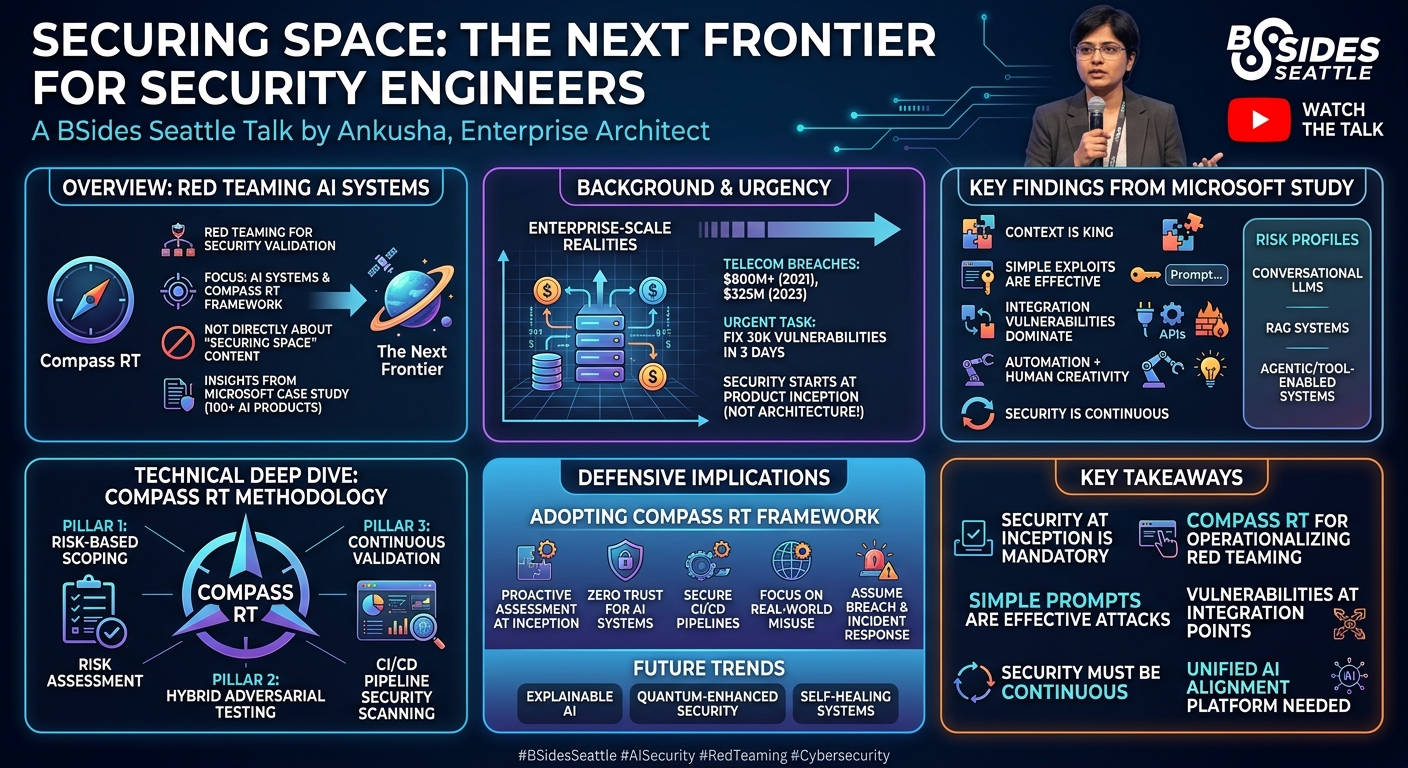
Ankusha, an enterprise architect at one of the largest telecom organizations in the United States, presented on red teaming AI systems for security validation. Despite the session title referencing "Securing Space," the actual content focused on the Compass RT unified red teaming framework and its application to AI systems, drawing on Ankusha's experience managing security across large-scale enterprise environments with mission-critical transactions.
Key moments
- 0:30 Introduction: security must start at product inception, not architecture
- 2:00 $325M and $800M telecom breaches — the cost of reactive security
- 4:00 30,000 vulnerabilities fixed in 3 days — enterprise-scale urgency
- 8:00 Microsoft case study: red teaming 100+ Gen AI products
- 10:00 Key findings: simple prompts as effective as sophisticated attacks
- 18:00 Compass RT methodology: three pillars of AI red teaming
- 24:00 Risk profiles across conversational LLMs, RAG systems, and agentic AI
- 28:00 Key takeaways: proactive assessment, zero trust, continuous validation
Securing Space: The Next Frontier for Security Engineers
Speakers: Ankusha, Enterprise Architect, Major U.S. Telecom Organization
Conference: BSides Seattle
YouTube: https://www.youtube.com/watch?v=RsQnNBsAu1U
Overview
Ankusha, an enterprise architect at one of the largest telecom organizations in the United States, presented on red teaming AI systems for security validation. Despite the session title referencing "Securing Space," the actual content focused on the Compass RT unified red teaming framework and its application to AI systems, drawing on Ankusha's experience managing security across large-scale enterprise environments with mission-critical transactions.
The talk covered the urgency of proactive AI security testing, referencing major telecom data breaches costing $325 million (2023) and over $800 million (2021 during COVID), and positioned red teaming as a mandatory practice rather than an optional exercise. Ankusha walked through the Compass RT methodology's three pillars — risk-based scoping, hybrid adversarial testing, and continuous validation — and presented findings from a Microsoft red teaming case study that tested over 100 generative AI products.
The presentation aimed to provide a comprehensive overview of how red teaming practices must evolve to address AI-specific vulnerabilities including prompt injection, RAG poisoning, retrieval manipulation, and agentic tool misuse across conversational LLMs, RAG systems, and agentic AI architectures.
Background
▶ Watch: Introduction: security must start at product inception, not architecture (0:30)
Ankusha framed the urgency of AI security through the lens of enterprise-scale operations. At the telecom organization, the team was required to fix 30,000 vulnerabilities in 3 days — a mandate that illustrates the velocity and scale at which large enterprises must address security issues. The speaker is a senior member of IEEE and Sigma Xi, with research interests spanning cybersecurity, AI, and cognitive science (specifically converting human behavior understanding into machine instructions).
The broader context is that AI is now embedded in mission-critical systems across financial, telecom, e-commerce, and manufacturing domains. The speaker emphasized that security must begin at product inception — during the product design phase before architecture — rather than being bolted on later. This proactive approach is driven by the catastrophic financial consequences of breaches in high-transaction environments where platforms like Amazon and Stripe process millions of transactions per second.
Key Findings
▶ Watch: 30,000 vulnerabilities fixed in 3 days — enterprise-scale urgency (4:00)
The talk presented findings primarily through the lens of a Microsoft red teaming case study that tested over 100 generative AI products:
Context is King: Red teaming must be tailored to the specific use case of each AI system. Generic testing approaches miss domain-specific vulnerabilities.
Simple Exploits Are Effective: Basic prompt engineering can be as effective as more sophisticated attack techniques against AI systems, lowering the barrier for attackers.
Integration Vulnerabilities Dominate: Many vulnerabilities stem from system integration issues rather than the AI model itself — authentication endpoints, plugins, and external data flows are primary attack surfaces.
Automation Plus Human Creativity: Automated tools like PyRIT are essential for scale, but human creativity is required for nuanced, domain-specific flaws.
Responsible AI Harms Resist Quantification: Measuring responsible AI harms requires delicate frameworks and remains difficult to standardize across organizations and industries.
Security Is Continuous: AI security requires frequent retesting and updates, not one-time assessments.
The talk also categorized AI system risk profiles: conversational LLMs face prompt injection and guardrail bypass; RAG systems face corpus poisoning and retrieval manipulation; and agentic/tool-enabled systems face unauthorized tool invocation and workflow abuse. The highest risk finding was that small prompt changes can produce large real-world consequences.
Technical Deep Dive
▶ Watch: Key findings: simple prompts as effective as sophisticated attacks (10:00)
The primary technical framework discussed was Compass RT, a unified red teaming methodology with three pillars:
Risk-Based Scoping: Assessment of the entire product development lifecycle from development through architecture, testing, non-production, and production elevation. This involves creating a checklist of security checkpoints with quantified risk assessments and mitigation plans. The key requirement is that this scoping happens before product development, not after.
Hybrid Adversarial Testing: Testing conducted during product development (not just after completion), using tools for unit-level security testing on a component-by-component basis. This includes both automated tools and expert-driven creative methods. The approach tests incrementally during development, then consolidates for final testing before production deployment.
Continuous Validation: Ongoing regression testing, post-market monitoring through dashboards (Grafana, Splunk), statistical analysis of product performance in production, ROI measurement, and defense mechanism toggling comparisons. This pillar ensures security validation continues throughout the product lifecycle.
The talk referenced CI/CD security practices including code scanning for secrets, credentials, and PII data at every step from non-production to production environments in GitHub and GitLab pipelines. The organization migrated from Okta (covering 150+ domains and 3,000+ applications) to Microsoft Entra for single sign-on, completing the migration in 3 months.
Ankusha also mentioned building a custom RAG model that required 3 weeks of consistent development with 3 million lines of code, with 60-70% generated by Microsoft Copilot and refined to meet business requirements.
Demo / Proof of Concept
▶ Watch: Compass RT methodology: three pillars of AI red teaming (18:00)
The talk included a brief video presentation of the Microsoft red teaming case study, though technical difficulties with the display setup interrupted the presentation. The video covered Microsoft's study testing over 100 generative AI products using a hybrid approach combining automated tools (PyRIT) with expert-driven creative methods. No live technical demonstration or proof-of-concept exploit was performed during the session.
Defensive Implications
▶ Watch: Key takeaways: proactive assessment, zero trust, continuous validation (28:00)
The talk's defensive recommendations center on adopting the Compass RT framework for structured AI red teaming:
Organizations should implement security at the product inception phase, before architecture design begins. Zero trust frameworks should be applied to all AI systems. CI/CD pipelines must include security scanning at every stage, from development through production deployment.
The Microsoft study's recommendations include: focusing on real-world implications of AI misuse rather than abstract threats, concentrating on worst-case outcomes, scrutinizing authentication endpoints and plugins alongside models, adopting an iterative break-fix mindset, and assuming that AI applications will eventually be breached with robust incident response plans including containment strategies.
The speaker advocated for a unified AI alignment platform to manage legal compliance, reputational risk, and cybersecurity rather than siloed tooling. Future trends identified include explainable AI for transparent risk decisions, quantum-enhanced security analysis, fully autonomous self-healing security systems, collaborative AI-driven threat intelligence, and expanded red teaming coverage for multi-agent systems.
Key Takeaways
- Proactive security assessment at product inception is a mandate, not an option; organizations that defer security to later phases face catastrophic financial exposure as demonstrated by $325M and $800M+ telecom breaches
- The Compass RT framework provides a structured three-pillar approach (risk-based scoping, hybrid adversarial testing, continuous validation) for operationalizing AI red teaming at scale
- Simple prompt engineering attacks can be as effective as sophisticated techniques against AI systems, meaning the barrier to attacking AI products is lower than many assume
- AI vulnerabilities concentrate at system integration points (authentication, plugins, external data flows), not just in the model itself
- AI security must be continuous and iterative, not a one-time exercise, with monitoring dashboards and regression testing throughout the product lifecycle
- Organizations need unified AI alignment platforms spanning legal, compliance, reputational, and cybersecurity concerns rather than siloed tools
About the Speaker(s)
Ankusha is an enterprise architect at one of the largest telecom organizations in the United States. A senior member of IEEE and Sigma Xi, Ankusha has been researching cybersecurity, AI, and cognitive science for several years, with a particular focus on converting human behavior understanding into machine instructions. The speaker's practical experience includes managing security across environments processing millions of daily transactions, coordinating the remediation of 30,000 vulnerabilities in 3 days, and overseeing a migration from Okta to Microsoft Entra covering 150+ domains and 3,000+ applications.
Reviews
Dr. Zero (Offensive Security Researcher) — WEAK
A broad overview of AI red teaming concepts and the Compass RT framework that stays at the surface level throughout. The talk references impressive numbers (30,000 vulnerabilities in 3 days, $325M breaches) but never goes deep on any specific vulnerability, exploit chain, or red teaming technique. The Microsoft case study findings are sourced from a pre-recorded video rather than original research, and the Compass RT framework is described at a high level without demonstrating how it concretely differs from existing security testing methodologies.
Heather Calloway (CISO) — USEFUL
The talk correctly identifies the urgency of proactive AI security and the need for structured red teaming frameworks, but the Compass RT methodology is presented at too high a level to be directly implementable. The financial impact framing ($325M and $800M breach costs) effectively communicates board-level risk, and the Microsoft case study findings provide reasonable guidance, but the talk lacks the specificity that security leaders need to actually build or improve their AI red teaming programs.