Threat Actor Branding: The Strange World of APT Marketing
Simona David (Security Researcher · Orange Services), Stefan Mihalache (Security Engineer · Orange Services)
DefCamp 2025 · Main Stage
Overview
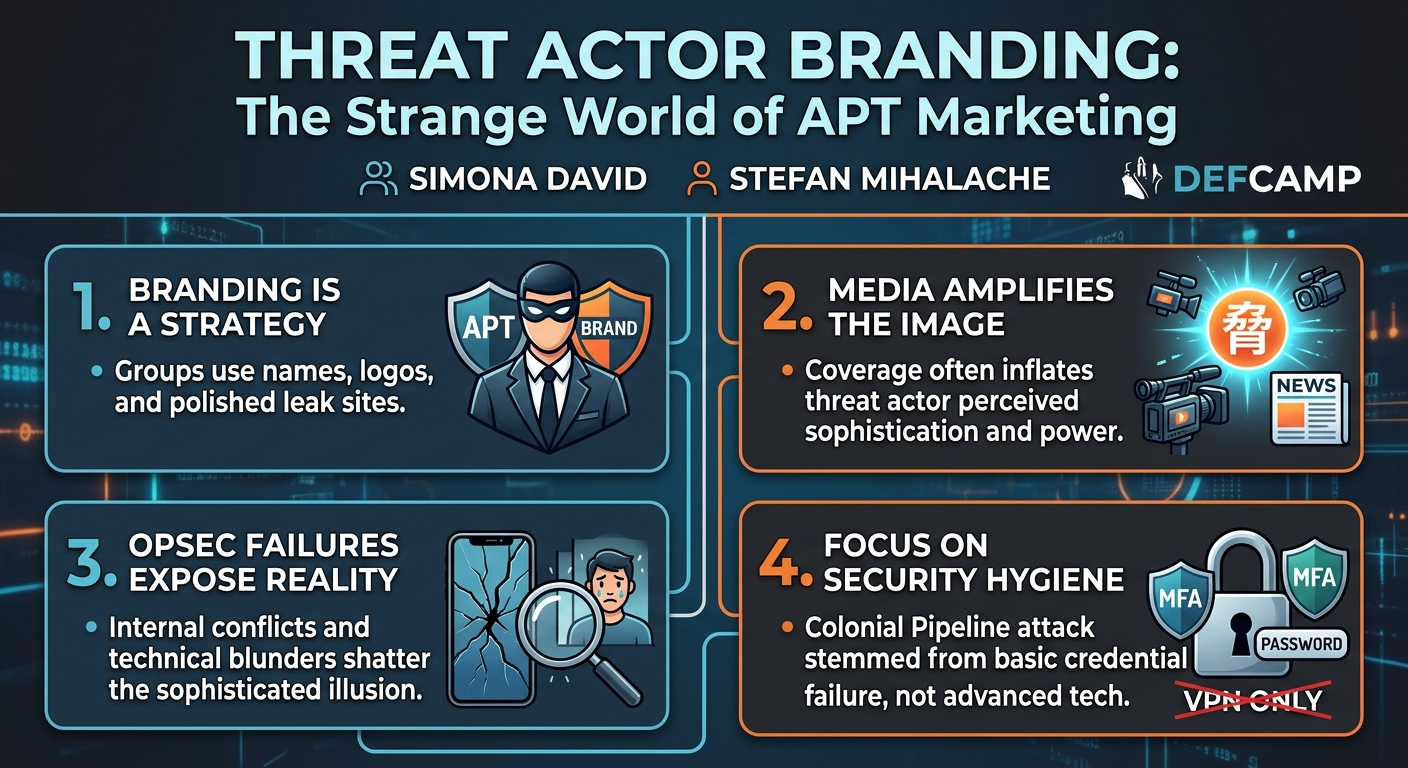
In an increasingly professionalized cybercrime landscape, threat actors have begun to adopt sophisticated branding strategies traditionally associated with legitimate businesses. Simona David, a Security Researcher, and Stefan Mihalache, a Security Engineer, both from Orange Services, explored this fascinating phenomenon in their DefCamp talk, "Threat Actor Branding: The Strange World of APT Marketing." Their presentation delved into how advanced persistent threats (APTs) and ransomware groups meticulously craft public personas, leveraging names, logos, and polished websites to project an illusion of legitimacy, power, and even ethical principles.
Key moments
- 0:00 Introduction to threat actor branding and talk agenda.
- 2:05 Concrete elements forming a threat actor's brand.
- 3:10 How media coverage fuels threat actor branding.
- 5:50 Examples of polished threat actor leak portals.
- 8:50 How threat actor branding can backfire.
- 12:40 Colonial Pipeline case: media narrative vs. technical reality.
- 18:00 Audience Q&A: Motivations for threat actor branding.
Threat Actor Branding: The Strange World of APT Marketing
Speakers: Simona David (Security Researcher, Orange Services); Stefan Mihalache (Security Engineer, Orange Services)
Conference: DefCamp
YouTube: https://www.youtube.com/watch?v=5-177pfjz_o
Overview
In an increasingly professionalized cybercrime landscape, threat actors have begun to adopt sophisticated branding strategies traditionally associated with legitimate businesses. Simona David, a Security Researcher, and Stefan Mihalache, a Security Engineer, both from Orange Services, explored this fascinating phenomenon in their DefCamp talk, "Threat Actor Branding: The Strange World of APT Marketing." Their presentation delved into how advanced persistent threats (APTs) and ransomware groups meticulously craft public personas, leveraging names, logos, and polished websites to project an illusion of legitimacy, power, and even ethical principles.
The speakers highlighted that this deliberate branding serves multiple strategic objectives for threat actors, including increasing perceived legitimacy during extortion attempts, facilitating recruitment of affiliates, and establishing a formidable reputation within the cybercriminal ecosystem. Paradoxically, this pursuit of a professional facade is often amplified by media coverage, inadvertently lending credibility and widespread recognition to these malicious entities. However, David and Mihalache also revealed the inherent fragility of this branding, demonstrating how operational security (OpSec) failures, internal conflicts, and technical missteps frequently shatter the illusion, exposing the often chaotic and amateurish reality behind the sophisticated marketing.
This talk is crucial for security researchers, incident responders, and decision-makers, as it challenges conventional perceptions of threat actor sophistication. By dissecting the elements of threat actor branding and showcasing its frequent spectacular failures, the speakers provided a critical lens through which to interpret public narratives about cyberattacks. Understanding the strategic intent behind threat actor branding, as well as its inherent vulnerabilities, empowers defenders to look beyond the hype and focus on the fundamental security hygiene that often mitigates even the most "sophisticated" threats.
Background
▶ Watch: Introduction to threat actor branding and talk agenda. (0:00)
The evolution of cybercrime has seen a significant shift from individual hackers to highly organized, often state-sponsored or financially motivated groups operating with a business-like structure. This professionalization has led to the emergence of Ransomware-as-a-Service (RaaS) models, where core developers provide ransomware tools and infrastructure to affiliates in exchange for a percentage of the ransom payments. In such an ecosystem, reputation, trust, and perceived capability become crucial currencies. Affiliates are more likely to join a well-known, seemingly reliable RaaS operation, and victims are more likely to comply with extortion demands from a group they perceive as highly organized and powerful.
Historically, threat actors operated in the shadows, prioritizing anonymity above all else. However, as the financial stakes grew, and the need for recruitment and intimidation increased, a new paradigm emerged: the deliberate cultivation of a public image. This problem exists because, much like legitimate businesses vying for market share, cybercriminal groups compete for victims, talent, and influence. A strong "brand" can differentiate them, instill fear, and even dictate terms. The media, in its effort to report on significant cyber incidents, often inadvertently plays a role in amplifying these brands by repeatedly publishing group names, logos, and descriptions of their alleged sophistication, thereby creating a feedback loop that legitimizes the threat actor's self-proclaimed persona.
Prior work in cybersecurity intelligence has focused heavily on Tactics, Techniques, and Procedures (TTPs), malware analysis, and attribution. While essential, these analyses sometimes overlook the psychological and marketing dimensions that influence victim behavior and public perception. The talk by David and Mihalache addresses this gap by scrutinizing the deliberate branding efforts of threat actors and the often-overlooked OpSec failures that betray their carefully constructed facades, providing a more holistic understanding of the modern cyber threat landscape.
Key Findings
▶ Watch: How media coverage fuels threat actor branding. (3:10)
The core findings of Simona David and Stefan Mihalache's presentation revolve around the dual nature of threat actor branding: its strategic utility and its inherent fragility. They assert that branding is a deliberate strategy employed by cybercriminal groups to achieve specific operational goals, rather than an accidental byproduct of their activities. This branding manifests through various concrete elements, including chosen names, distinctive logos, polished public-facing websites or leak portals, and even formal press statements.
The speakers identified that this branding is designed to project a sense of legitimacy and power, particularly in the context of extortion, where victims are more likely to comply if they believe they are dealing with a highly organized and capable entity. Furthermore, a strong brand aids in the recruitment of new affiliates and fosters connections within the broader cybercriminal underworld. This perceived legitimacy is often amplified by media coverage, which frequently reuses threat actor logos, names, and narratives, inadvertently extending their reach and inflating their perceived expertise.
However, a critical finding of the talk is that this sophisticated facade is frequently undermined by the threat actors' own operational security (OpSec) failures, internal conflicts, and technical blunders. These missteps inadvertently expose real-world identities, internal workings, and a lack of the very professionalism they strive to project. Examples ranged from reused infrastructure and debug strings in malware to disgruntled members leaking internal communications and source code. These failures serve as crucial intelligence for defenders, allowing them to pierce through the branding and understand the true capabilities and vulnerabilities of these groups. The speakers concluded that while branding creates an illusion of control and sophistication, the reality often points to chaotic, sometimes amateurish, operations, with the most dramatic instances of public disruption often stemming from basic security hygiene failures rather than advanced technical prowess.
Technical Deep Dive
▶ Watch: Examples of polished threat actor leak portals. (5:50)
Threat actor branding, as detailed by David and Mihalache, is a multifaceted strategy encompassing various technical and psychological components designed to create a professional and intimidating persona. This section delves into the specific elements and case studies presented, illustrating both the meticulousness of their branding and the fragility of their OpSec.
Elements of a Threat Actor Brand
- Names: A name is foundational for instant recognition and persona building. Examples include the official-sounding APT28 versus the more playful Fancy Bear, both referring to the same state-sponsored group. Conti built a formidable brand around its name, ensuring victims immediately recognized the entity they were dealing with, which increased compliance rates during extortion attempts. This instant recognition acts as a "logo in words."
- Logos: Visual branding provides immediate impact and memorability.
- Logbit utilized a bold red logo and even borrowed political slogans like "Make ransomware great again" to resonate with certain narratives.
- Revel opted for a minimalist, sleek logo, designed to appear like a "tech startup" or a legitimate "tool for math," projecting professionalism and technical prowess.
- Anonymous, perhaps the most famous, transformed its Guy Fawkes mask into a global symbol of protest, transcending hacking into broader culture. This demonstrates the power of visual identity to extend beyond its initial context.
- Websites and Leak Portals: These platforms serve as the operational hub for branding, where threat actors publish announcements, proof of compromise, victim lists, and countdowns.
- Logbit maintained a polished portal with multi-language support, a dark mode UI, and even sections for "Twitter" and "press about us," mimicking legitimate corporate communication.
- BlackCat (also known as ALPHV) featured a sleek theme, high-resolution logos, and a practical "how to buy Bitcoin" tab, simplifying the ransom payment process for victims. Their use of countdowns, with victim entries grayed out until a deadline, was a psychological pressure tactic.
- Hive utilized a CMS-style site, described as one of the most structured ransomware portals, showcasing a high degree of organization. Some portals even displayed the time in different major cities, presumably to emphasize the global reach and urgency of the ransom demand.
- Packaging Tactics as Features: Threat actors market their capabilities like legitimate software products to affiliates or victims.
- Logbit advertised its ransomware with claims of "encryption speed" and a "bug-free ransomware engine."
- DarkSide marketed itself as "ethical ransomware," claiming to avoid certain targets.
- BlackCat boasted "superior data leak automation" and a "multilingual platform," appealing to a wider range of affiliates.
- Public Statements and Press Releases: Some groups go as far as issuing formal press releases to clarify their involvement, state their principles, or manage their public image, akin to corporate PR.
- Conti famously released a public statement supporting the Russian government after the invasion of Ukraine, declaring retaliation against Western targets. This political stance, however, backfired spectacularly when a disgruntled Ukrainian member, furious at the declaration, published internal chats and source code, leading to the group's overnight disruption.
Branding Failures and OpSec Blunders
The speakers emphasized that despite these elaborate branding efforts, threat actors frequently make critical OpSec mistakes that betray their identities and undermine their perceived professionalism.
- Reused Infrastructure and Debug Strings:
- Obscar researchers discovered reused email addresses, time zones, and even Russian local paths embedded in malware builds, linking seemingly disparate attacks despite attempts at anonymity.
- PDF ransom notes from Hades ransomware were found to contain metadata that matched known aliases, exposing developer connections.
- Public Self-Exposure:
- Groups like LULC and others publicly posted on Twitter or social media sites, allowing governmental agencies to tie their aliases back to personal accounts.
- FIN7 developers were caught using LinkedIn profiles or Slack invites in spear phishing setups, inadvertently exposing their real-world identities.
- Internal Conflicts and Leaks:
- The Conti incident, where a disgruntled member leaked internal communications and source code, is a prime example of how internal disunity can destroy a powerful brand.
- The Lapsus$ group, prominent in 2022, openly bragged about stolen data and engaged in public fights over ownership and internal hierarchy. Their young members' noisy online presence and internal squabbles drew significant attention from investigators, ultimately leading to arrests later that year.
- Unexpected Disruption:
- The case of TeslaCrypt in 2016 is particularly bizarre. After a researcher contacted their payment server requesting a universal decryption key, the group unexpectedly provided it, stating they were ceasing operations and wanted to look "polished and nice" by releasing the key. This unplanned disruption, whether accidental or an insider leak, shattered their ongoing extortion model.
Case Study: Colonial Pipeline Attack (DarkSide)
The attack on Colonial Pipeline on May 7, 2021, by the DarkSide ransomware group serves as a critical illustration of how media amplification can inflate the perceived sophistication of an attack rooted in basic security failures.
- Initial Compromise: The entry vector was a simple compromised VPN login that lacked multi-factor authentication (MFA). The password was likely reused and found in another data breach.
- Technical Reality vs. Perceived Impact: Colonial Pipeline paid 75 Bitcoin (approximately $4.4 million at the time), though most was later recovered by US authorities. The pipeline was shut down for six days as a precaution, creating fuel shortages and panic buying.
- Media Amplification: Headlines focused on an "infrastructure meltdown" and portrayed DarkSide as a "geopolitical threat," naming it a "critical infrastructure attack." This narrative obscured the root cause: basic credential hygiene failure.
- DarkSide's Response: DarkSide itself released a statement framing their motive as purely financial, explicitly stating they "didn't intend to create problems for society," directly contradicting the media narrative.
- Conclusion: The incident demonstrated that even when the technical reality is a simple OpSec failure, if a highly visible system is impacted, the resulting public panic, political reaction, and media framing can inflate the threat actor's image into something far more sophisticated than it actually is.
Logbit's "Customer Service" Moment
Another striking example of branding's paradoxical nature was Logbit's public statement regarding an affiliate who attacked a children's hospital. Logbit issued an apology, stating they did not endorse such actions and that the affiliate had violated their "principles." They removed the partner and even provided the hospital with a decryption key. This incident highlighted their attempt to appear rational and ethical, like a legitimate business managing customer complaints, despite their core criminal activities.
In summary, the technical and operational aspects of threat actor branding reveal a complex interplay between deliberate image cultivation and frequent, often amateurish, OpSec failures. Understanding these dynamics is crucial for discerning the true nature of cyber threats.
Demo / Proof of Concept
▶ Watch: Colonial Pipeline case: media narrative vs. technical reality. (12:40)
This presentation focused on analytical observations and detailed case studies rather than a live technical demonstration or proof of concept. The speakers provided extensive evidence through numerous screenshots of threat actor leak sites, ransom notes, and instances of internal communications and OpSec failures, all serving as concrete examples to support their findings on branding strategies and their eventual breakdowns.
Defensive Implications
▶ Watch: Audience Q&A: Motivations for threat actor branding. (18:00)
Understanding the dynamics of threat actor branding offers several critical implications for cybersecurity defenders, allowing for a more informed and effective defense strategy.
- Prioritize Fundamental Security Hygiene: The most significant takeaway is to not be swayed by the perceived sophistication of a threat actor's brand. The Colonial Pipeline incident starkly illustrates that even "critical infrastructure attacks" can stem from basic security lapses like a lack of Multi-Factor Authentication (MFA) and password reuse. Defenders must double down on core security principles: strong, unique passwords, MFA everywhere, regular patching, robust network segmentation, and comprehensive backup strategies. These foundational controls are often the most effective deterrents, regardless of how polished a threat actor's website appears.
- Deconstruct Media Narratives: Defenders should develop a critical eye towards media coverage of cyberattacks. Public narratives often amplify the "sophistication" and "power" of threat actors, which can lead to misallocation of resources or unnecessary panic. Instead, focus on the actual technical details of an attack, the root cause analysis, and confirmed Tactics, Techniques, and Procedures (TTPs), rather than the brand-driven hype. This analytical approach helps in distinguishing between genuine advanced threats and those magnified by branding and media.
- Leverage Threat Actor OpSec Failures for Intelligence: The numerous examples of OpSec blunders (reused infrastructure, debug strings, exposed identities, internal leaks) provide invaluable intelligence. Defenders should actively monitor for these failures, as they can reveal attribution clues, internal group dynamics, tools used, and even provide opportunities for disruption (e.g., obtaining decryption keys from disgruntled insiders or exposed infrastructure). This intelligence can inform threat modeling, improve detection capabilities, and aid in proactive defense.
- Understand Psychological Manipulation: Threat actor branding is inherently psychological, designed to instill fear, create perceived legitimacy, and increase victim compliance. Defenders, particularly those involved in incident response and crisis communication, should understand these psychological tactics. By recognizing that the polished facade is often an illusion, organizations can better resist extortion attempts and make rational decisions during a crisis, rather than succumbing to the pressure exerted by a seemingly formidable adversary.
- Monitor Public-Facing Threat Actor Communications: Tracking threat actor leak sites, social media activity, and "press releases" can yield critical intelligence. These platforms often provide early warnings of new victims, insights into their operational methodologies, and even reveal internal conflicts or policy shifts (like Logbit's apology). This active monitoring can enhance threat intelligence feeds and provide context for evolving threats.
In essence, defenders must look beyond the "marketing" of cybercriminals and focus on the technical realities and vulnerabilities. While threat actor branding aims to project an image of invincibility, a disciplined, fundamentals-first approach, combined with intelligent monitoring of their inevitable failures, remains the most potent defense.
Key Takeaways
- Deliberate Branding: Threat actors, including APTs and ransomware groups, employ sophisticated branding strategies—names, logos, polished websites, and public statements—to project legitimacy, power, and ethical principles, primarily to facilitate extortion, recruit affiliates, and establish reputation.
- Media Amplification: Media coverage frequently and inadvertently amplifies threat actor brands, often inflating their perceived sophistication and reach by reusing their chosen identities and narratives.
- OpSec Failures are Inevitable: Despite meticulous branding, threat actors are prone to significant operational security (OpSec) failures, internal conflicts, and technical blunders that expose their real identities, internal workings, and often chaotic, amateurish realities.
- Hype vs. Reality: High-profile incidents, such as the Colonial Pipeline attack, demonstrate how basic security hygiene failures can be magnified into critical infrastructure threats by public panic and media framing, overshadowing the actual, often less sophisticated, technical root cause.
- Defensive Focus: Defenders should prioritize fundamental security hygiene (e.g., MFA, unique passwords, patching) over being swayed by perceived threat actor sophistication, and critically analyze media narratives to discern technical realities from branding-driven hype.
- Intelligence from Failures: Threat actor OpSec failures and internal disputes provide invaluable intelligence for defenders, offering insights into attribution, TTPs, and potential opportunities for disruption or mitigation.
About the Speaker(s)
Simona David is a Security Researcher at Orange Services. She is deeply fascinated by the psychological underpinnings of cybersecurity work, particularly how communication strategies and public perception can wield as much influence and power as technical coding expertise.
Stefan Mihalache is a Security Engineer also at Orange Services. His curiosity was particularly sparked by the elaborate methods threat actors employ to construct professional and trustworthy facades, a phenomenon he and Simona explored in detail during their presentation.
Reviews
Dr. Zero (Offensive Security Researcher) — SOLID
Entertaining tour through ransomware group PR stunts and OpSec faceplants, but it's observation, not research. You'll leave with good cocktail-party anecdotes and a sharper eye for media hype, not a new detection capability or an attribution methodology.
Heather Calloway (CISO) — SOLID
Useful framing for executives and comms teams on why threat actor branding matters and why it shouldn't drive panic. The Colonial Pipeline deconstruction is the strongest segment — a clean reminder that 'critical infrastructure attack' often means 'missing MFA.' But the talk stays observational; it doesn't give defenders or leadership concrete tools beyond 'don't believe the hype.'