AI-Powered Threat Intelligence: A Game Changer for Cyber Crisis Management
George Dobrea (Cybersecurity Strategist, CEO · XEDUCO Institute)
DefCamp 2025 · Main Stage
Overview
In an era where cyber threats are increasingly sophisticated and intertwined with broader geopolitical landscapes, the distinction between a mere security incident and a full-blown cyber crisis has become critically important. George Dobrea, a seasoned cybersecurity strategist and CEO of XEDUCO Institute, delivered a compelling talk at DefCamp, asserting that AI-powered threat intelligence is not just an enhancement but a fundamental game changer in navigating these complex cyber crises. His presentation meticulously connected three pivotal domains: crisis management, cyber threat intelligence (CTI), and artificial intelligence (AI), demonstrating their synergistic potential.
Key moments
- 0:00 Introduction: Connecting Crisis Management, CTI, and AI
- 4:00 Distinguishing Cyber Incidents from Major Crises
- 7:00 Major Cyber Incidents Escalating to National Crisis
- 16:00 Demonstration: AI-Powered Cyber Crisis Simulator
- 19:00 The Role of AI in Cyber Threat Intelligence
- 24:00 How AIdriven CTI Analyzed Past Cyber Crises
- 32:00 Limits of AI Autonomy in Cyber Crisis Decisions
- 37:00 Q&A: AI Hallucinations and Cyber Resilience Act
AI-Powered Threat Intelligence: A Game Changer for Cyber Crisis Management
Speakers: George Dobrea, Cybersecurity Strategist, CEO, XEDUCO Institute
Conference: DefCamp
YouTube: https://www.youtube.com/watch?v=tQ5gWoN3ovA
Overview
In an era where cyber threats are increasingly sophisticated and intertwined with broader geopolitical landscapes, the distinction between a mere security incident and a full-blown cyber crisis has become critically important. George Dobrea, a seasoned cybersecurity strategist and CEO of XEDUCO Institute, delivered a compelling talk at DefCamp, asserting that AI-powered threat intelligence is not just an enhancement but a fundamental game changer in navigating these complex cyber crises. His presentation meticulously connected three pivotal domains: crisis management, cyber threat intelligence (CTI), and artificial intelligence (AI), demonstrating their synergistic potential.
Dobrea highlighted that while many organizations are adept at technical incident response, they often falter when an incident escalates into a crisis, which demands a multi-faceted approach involving diverse stakeholders beyond the technical team. Modern attacks, particularly those associated with hybrid warfare, combine cyber exploitation with information warfare, impacting not just systems but also public trust and organizational reputation. AI-driven CTI emerges as a vital tool, offering unprecedented capabilities for faster detection, proactive defense, reduced human error in critical decision-making, and a more comprehensive understanding of the threat landscape, thereby empowering organizations to better prepare for and respond to high-impact cyber events.
The core message of the talk resonated with the urgent need for organizations to evolve their defensive strategies. As cyberattacks grow in scale and sophistication, the ability to rapidly identify, analyze, and mitigate threats at a strategic level becomes paramount. Dobrea presented a compelling case for how AI, when integrated thoughtfully into CTI processes, can bridge the gap between technical response and strategic crisis management, transforming reactive measures into proactive resilience.
Background
▶ Watch: Introduction: Connecting Crisis Management, CTI, and AI (0:00)
George Dobrea, with over three decades of experience in the cybersecurity field, set the stage by emphasizing the evolution of defensive strategies. His extensive background includes preparing cybersecurity specialists in over 40 countries and assisting the Iraqi government in establishing its first national CERT team. He detailed his involvement in training various security teams: the blue team (defenders), the red team (attack simulators), and critically, the purple team. The purple team, a virtual construct, brings together top talent from both red and blue teams, along with crucial non-technical stakeholders such as legal, human resources, risk management, and, most importantly, business decision-makers. This holistic approach is essential because, as Dobrea stressed, in a complex ransomware attack, the ultimate decision to pay or restore often rests with the business board, not the technical experts.
A central theme of the talk was the critical differentiation between a cyber incident and a cyber crisis. While organizations typically have well-defined procedures and technical workflows for handling incidents, they are often ill-prepared for crises. Crises involve a broader array of stakeholders, activate special procedures, and demand responses that extend far beyond technical remediation. Dobrea categorized crises into hidden, creeping, sudden, and bizarre, noting that most cyberattacks fall under the "sudden crisis" category, catching organizations off guard. He shared examples of recent major incidents that escalated into crises due to their significant impact:
- Microsoft SharePoint zero-day breach: A vulnerability exploited by criminal groups, leading to ransomware deployment and substantial losses for government organizations globally.
- Soul Typhoon: A state-sponsored attack (attributed to China's Ministry of State Security) compromising US telecom providers and British critical infrastructure, officially declared a national cybersecurity crisis by the US government.
- Collins Aerospace (Muse platform): A cloud-based platform, acting as a single point of failure, leading to flight cancellations at major European airports (Heathrow, Berlin, Brussels) due to a ransomware attack by Scatter Spider.
These cases underscore that modern attacks frequently combine technical exploitation with information warfare, which, as Dobrea noted, is arguably more dangerous as it erodes trust, a critical societal resource. Effective crisis management, therefore, relies on four pillars: preparedness and flexibility, stakeholder engagement, leadership and decision-making, and strategic communication. Dobrea particularly stressed the importance of a well-crafted communication plan, outlining how messages must adapt to different stages of a crisis – from providing clear facts during initial confusion to presenting a new vision post-recovery. He pointed out the scarcity of specific crisis management guidance for individual industries, with existing frameworks like those from ENISA primarily focusing on national-level responses. This gap highlights the necessity for organizations to conduct frequent simulations, such as purple team scenarios and tabletop exercises, to ensure business executives and technical teams are aligned and prepared.
Key Findings
▶ Watch: Major Cyber Incidents Escalating to National Crisis (7:00)
The talk's core contribution was its assertion that AI-driven CTI is not merely an optional enhancement but an indispensable tool for navigating the complexities of modern cyber crises. Dobrea presented several key findings demonstrating its transformative potential:
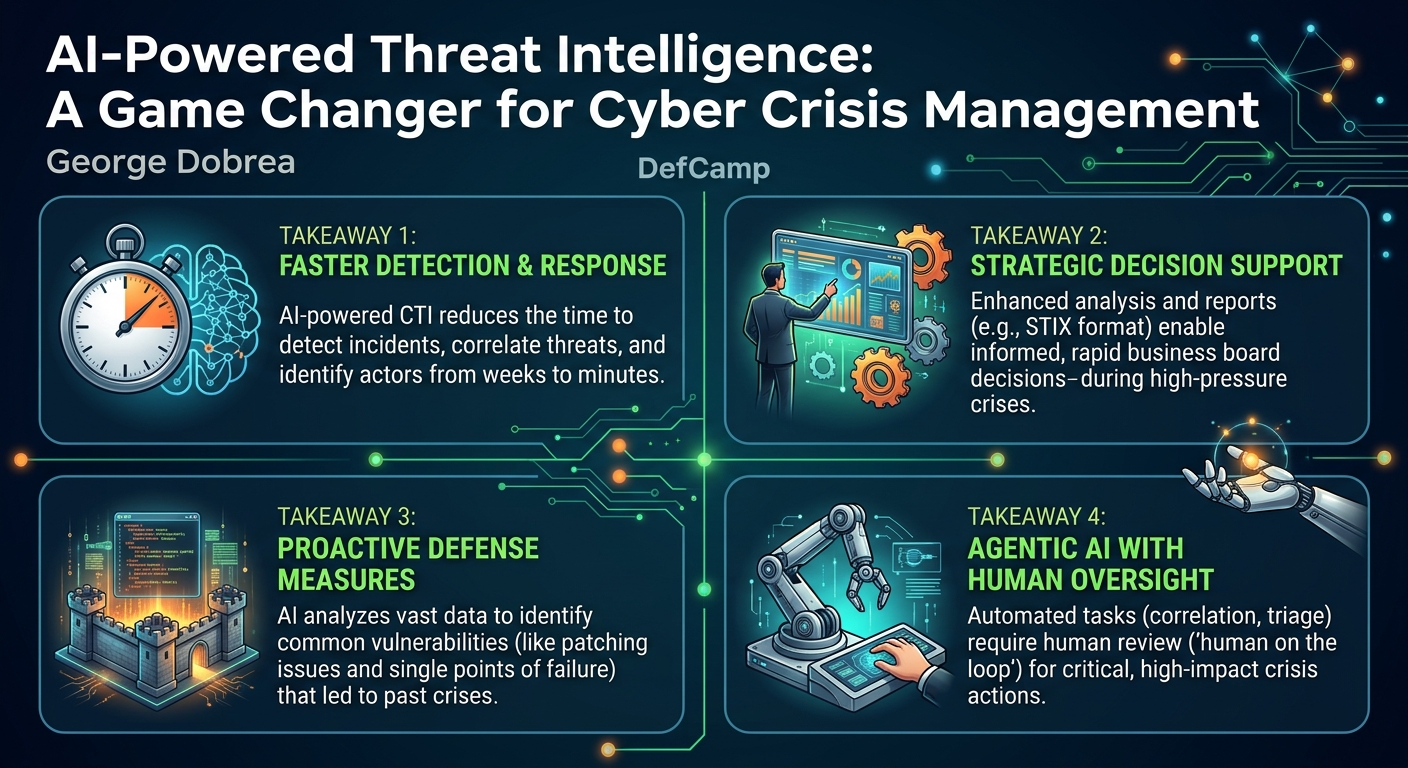
- Accelerated Crisis Detection and Root Cause Analysis: AI-powered CTI platforms significantly reduce the time needed to detect large-scale incidents, correlate disparate threats, and identify the actors behind them. In cases like the multi-country critical service disruption, tools from vendors like Mandiant and Recorded Future were instrumental in quickly attributing attacks to groups such as APT44 (Sandworm), a task that would traditionally take weeks of human analysis.
- Proactive Identification of Mitigation Failures: AI-driven CTI can analyze vast amounts of data to highlight common vulnerabilities and systemic weaknesses that led to past crises. This includes issues like insufficient patching, unpatched internet-facing servers, long dwell times, lack of network segmentation, and over-reliance on single points of failure, providing actionable intelligence for defenders.
- Enhanced Decision Support: By rapidly processing and correlating threat data, AI reduces human error and provides insightful reports (e.g., strategic reports for management) that are crucial for informed decision-making during high-pressure crisis situations.
- Revolutionized Threat Intelligence Consumption: New AI-based platforms like Defend CAD offer interactive, visual ways to explore attack scenarios, identify countermeasures, and understand complex relationships between agents and vulnerabilities, moving beyond static databases.
- Machine-Readable Reports for Seamless Integration: AI tools can generate machine-readable CTI reports in standardized formats like STIX, enabling rapid sharing and integration with existing security platforms such as SIEMs, thus streamlining defensive operations.
- Agentic AI for Automation with Human Oversight: While AI agents can autonomously perform tasks like threat data correlation and alert triage, Dobrea emphasized that critical crisis decisions (e.g., credential revocation, national infrastructure response) still require human oversight ("human on the loop") due to the potential for high-impact false positives and the current limitations of AI reliability in such sensitive contexts.
These findings collectively paint a picture of AI-powered CTI as a strategic asset that empowers organizations to move from reactive incident handling to proactive, resilient, and informed crisis management.
Technical Deep Dive
▶ Watch: The Role of AI in Cyber Threat Intelligence (19:00)
George Dobrea delved into the technical underpinnings of how AI transforms Cyber Threat Intelligence, emphasizing its role in crisis management. He defined CTI as the process of "connecting the dots" and transforming "unknown unknowns" into "known knowns" by gathering and processing information from diverse sources, including the dark web, external reports, and internal logs. CTI typically produces four categories of reports, each tailored for different organizational levels:
- Technical: Focuses on Indicators of Compromise (IoCs) and Indicators of Attack (IoAs), vital for security analysts.
- Operational: Provides details on specific incoming attacks, useful for security operations teams.
- Tactical: Addresses campaigns and Tactics, Techniques, and Procedures (TTPs), relevant for IT and security management.
- Strategic: The most critical for crisis management, offering high-level insights for executive boards to make informed business decisions.
While many commercial CTI platforms claim to use AI, Dobrea noted the proprietary nature of their algorithms often obscures the exact methodologies. However, he highlighted the undeniable advantages of AI-driven CTI: faster detection, proactive defense, reduced human error, and enhanced decision-making.
He illustrated these benefits through the aforementioned crisis examples:
- For the Microsoft SharePoint zero-day, AI-driven CTI enabled accelerated detection and faster containment of high-risk exploits, helping organizations prioritize patching efforts.
- In the Soul Typhoon incident, AI facilitated threat correlation, identifying the coordinated attacks on US telecom and British critical infrastructure, ultimately attributing them to China's Ministry of State Security.
- For the Collins Aerospace (Muse platform) crisis, AI contributed to automated response and rapid analysis, significantly reducing service disruption from potentially weeks to just a few days.
Crucially, AI-powered CTI also provided insights into the mitigation failures that exacerbated these crises:
- Microsoft SharePoint: Issues included insufficient patching, internet-facing unpatched servers, lack of forensic containment guidance, and challenges in rapid mitigation.
- Soul Typhoon: Identified long dwell times, unpatched network devices, insufficient monitoring and segmentation in telco environments, and extensive vendor supply chain exposure.
- Collins Aerospace: Highlighted a third-party cloud service (Muse) as a single point of failure, absence of backups or alternative vendors, lack of isolation/segmentation, and insufficiently tested manual procedures for check-in.
Dobrea then presented specific tools and platforms leveraging AI. He contrasted the widely known MITRE ATT&CK (focused on adversary tactics) and MITRE DEFEND (focused on countermeasures) frameworks with Defend CAD. He showcased Defend CAD as a more interactive, AI-based platform that allows users to monitor attacks, consider countermeasures, and identify agents and vulnerability conditions through powerful, interactive graphs. This open-source tool offers a dynamic way to build and visualize attack scenarios.
Beyond interactive platforms, Dobrea demonstrated how AI tools, often available on GitHub, can process extensive threat intelligence reports (e.g., Microsoft Threat Intelligence reports, sometimes hundreds of pages long) to quickly generate insightful graphs. These graphs, built using standards like the STIX (Structured Threat Information Expression) format, visualize connections between different cyber actors, enabling rapid understanding and mitigation planning. He also mentioned the Microsoft Threat Intelligence Briefing Agent, integrated with Microsoft Security Copilot, which collects incident information from various sources to generate concise briefings for crisis management stakeholders.
A significant portion of the deep dive focused on agentic AI, where AI systems autonomously execute tasks. While acknowledging the theoretical potential for full autonomy (likening it to "Iron Man vs. Cyber Cop"), Dobrea stressed the current need for human oversight. He presented a spectrum of reliability for agentic AI in CTI:
- High Reliability (more autonomy feasible): Threat data ingestion and correlation, alert triage and severity scoring, predictive attack simulation.
- Medium Reliability: Endpoint quarantine in non-critical zones, patch deployment, configuration management, network segmentation suggestions.
- Low Reliability (human oversight crucial): Credential revocation, access control (due to high impact of false positives), hybrid attack containment, and, critically, crisis decisions and national infrastructure response actions.
Dobrea concluded this section by reiterating that while AI provides invaluable information and automates many CTI tasks, humans must remain "on the loop" for critical decisions, particularly during high-stakes cyber crises, to mitigate the risks of erroneous autonomous actions.
Demo / Proof of Concept
▶ Watch: How AIdriven CTI Analyzed Past Cyber Crises (24:00)
During his presentation, George Dobrea provided a live demonstration of an online platform designed to simulate cyber crisis scenarios: AIcrisissimulatorsolution.com. This interactive tool allows individuals and organizations to test their preparedness for various AI-related crises.
Dobrea navigated to the website, explaining that users are presented with a crisis scenario, such as "data overflow" where a customer service AI accidentally logs and stores sensitive information like credit card numbers. Another scenario involved AI platforms operating autonomously without human oversight, handling business processes in potentially unexpected ways.
For each scenario, the simulator provides a description of the critical context and a time limit (e.g., three minutes) to respond. Users must choose from several predefined options, such as "controller disclosure," "full transparency," "minimum disclosure," or "negotiate silence." After selecting an option, the platform evaluates the choice based on factors like stakeholder trust, risk management, and ethical leadership, providing feedback on the potential outcomes. Dobrea noted that achieving 100% in these simulations is challenging due to the inherent risks and complexities of real-world crisis management.
While this specific demo focused on AI-related crisis scenarios, Dobrea also mentioned the existence of other, more complex commercial platforms that offer comprehensive cyber crisis exercises and simulations for organizations, emphasizing the value of such tools in preparing for and practicing crisis response in a controlled environment. The demonstration served to underscore the practical application of simulations in bridging the gap between theoretical knowledge and actionable crisis preparedness.
Defensive Implications
▶ Watch: Q&A: AI Hallucinations and Cyber Resilience Act (37:00)
The insights shared by George Dobrea offer several critical implications for cybersecurity defenders aiming to bolster their crisis management capabilities in the age of AI-powered threats:
- Elevate Crisis Management Beyond Incident Response: Organizations must recognize that cyber crisis management is distinct from technical incident response. It requires a dedicated framework involving a broader array of stakeholders, including legal, human resources, risk management, and executive leadership. Defenders should advocate for and participate in the creation of comprehensive crisis management plans that extend beyond the SOC.
- Prioritize Regular Simulations and Exercises: The importance of purple team exercises and tabletop simulations cannot be overstated. Tools like
AIcrisissimulatorsolution.comand other complex simulation platforms should be regularly utilized to test crisis plans, identify weaknesses, and ensure that both technical teams and business decision-makers are aligned and prepared for high-stress scenarios. This includes practicing strategic communication plans for different stages of a crisis. - Invest in and Integrate AI-Powered CTI Platforms: Organizations should actively seek out and integrate advanced AI-driven CTI platforms (e.g., Mandiant, Recorded Future, or emerging open-source solutions like Defend CAD). These platforms are crucial for accelerated detection, proactive defense, threat correlation, and root cause analysis, significantly reducing the time to understand and respond to complex attacks.
- Address Systemic Mitigation Failures Proactively: Leverage CTI insights to identify and remediate common vulnerabilities highlighted in past crises. This includes ensuring timely patching, securing internet-facing assets, implementing robust network segmentation, diversifying critical services to avoid single points of failure (e.g., third-party cloud platforms), and thoroughly testing manual backup procedures for critical services.
- Adopt "Human on the Loop" for AI in Critical Decisions: While AI can automate many CTI tasks and provide invaluable analysis, defenders must maintain human oversight for high-impact crisis decisions. Actions like credential revocation, access control changes, or national infrastructure response should always involve human review and approval to mitigate the risks associated with potential AI false positives or misinterpretations.
- Enhance CTI Integration with Security Operations: Ensure that AI-generated, machine-readable CTI reports (e.g., in STIX format) are seamlessly integrated with Security Information and Event Management (SIEM) systems, Security Orchestration, Automation, and Response (SOAR) platforms, and other security tools. This integration facilitates faster information sharing, automated responses, and more effective threat hunting.
- Develop Strategic Communication Protocols: Implement clear, stage-specific communication plans to manage internal and external messaging during a crisis. This ensures that accurate, non-speculative information is conveyed to employees, customers, partners, and the public, maintaining trust and controlling narratives.
- Foster Cross-Functional Collaboration: Encourage and facilitate collaboration between technical security teams and other departments such as legal, human resources, public relations, and executive management. The "purple team" concept, as described by Dobrea, is a vital model for effective crisis management.
By adopting these defensive implications, organizations can transform their approach to cybersecurity, moving from a reactive stance to a proactive, resilient, and strategically informed posture capable of navigating even the most challenging cyber crises.
Key Takeaways
- Cyber crisis management requires a distinct and holistic approach: Unlike technical incident response, crises demand the coordinated involvement of diverse stakeholders, including business leaders, legal, HR, and risk management, alongside technical teams.
- AI-powered Cyber Threat Intelligence (CTI) is a critical enabler for crisis preparedness and response: It significantly accelerates threat detection, correlation, and root cause analysis, transforming weeks of manual effort into minutes, and providing strategic insights for informed decision-making.
- Simulations are indispensable for validating crisis readiness: Utilizing platforms like
AIcrisissimulatorsolution.comand complex organizational simulators, coupled with purple team exercises, helps organizations test their plans, identify weaknesses, and align technical and business leadership. - AI provides crucial insights into past mitigation failures: By analyzing incidents like Microsoft SharePoint, Soul Typhoon, and Collins Aerospace, AI-driven CTI identifies common vulnerabilities such as insufficient patching, single points of failure, and lack of segmentation, guiding proactive defensive measures.
- Agentic AI offers automation benefits but requires human oversight for critical decisions: While AI can enhance tasks like threat data correlation and alert triage, high-impact decisions (e.g., credential revocation, national infrastructure response) must retain "human on the loop" involvement due to the potential for severe consequences from false positives.
- Strategic communication is a cornerstone of effective crisis management: Organizations must develop adaptable communication plans to provide clear, factual messages to different audiences at various stages of a crisis, maintaining trust and managing public perception.
About the Speaker(s)
George Dobrea is a highly experienced Cybersecurity Strategist and the CEO of XEDUCO Institute. With over 30 years of experience in the cybersecurity field, he is deeply involved in managing projects focused on preparing cybersecurity specialists globally, having delivered training programs in more than 40 countries. Dobrea is dedicated to helping individuals and organizations enhance their asset protection. His extensive background includes assisting the government of Iraq in building its first CERT team for national-level incident handling. He is renowned for preparing various security teams, including blue teams (defenders), red teams (attack testers), and especially purple teams—virtual teams that unite the best talent from red and blue teams with critical stakeholders from legal, human resources, risk management, and business leadership to address complex cyber crisis scenarios.
Reviews
Dr. Zero (Offensive Security Researcher) — WEAK
A strategic-level awareness talk that strings together three real incidents, waves at 'AI-powered CTI,' and lands on 'humans should stay in the loop.' Nothing here that a CISO couldn't absorb from vendor marketing collateral and a MITRE ATT&CK browser tab. The crisis management framing is reasonable but the AI angle is pure hand-waving.
Heather Calloway (CISO) — WEAK
A governance talk that promises a framework for AI-powered crisis management but delivers vendor-adjacent generalities and surface-level crisis taxonomy. The examples are real, but the analysis stays at altitude without giving a CISO anything they couldn't get from a 2023 Gartner overview.