Fake Jobs, Real Malware. How Cybercriminals are Exploiting the Employment Market
Ionuț-Alexandru Baltariu (Software Engineer · Bitdefender)
DefCamp 2025 · Main Stage
Overview
In an increasingly remote and digitally connected world, the professional landscape has become a fertile ground for sophisticated cyberattacks. Ionuț-Alexandru Baltariu, a Software Engineer and Technical Lead at Bitdefender, illuminated one such pervasive threat in his DefCamp talk, "Fake Jobs, Real Malware. How Cybercriminals are Exploiting the Employment Market." Baltariu meticulously detailed how advanced persistent threat (APT) groups are leveraging seemingly legitimate job offers and coding assessments to ensnare developers and software engineers, ultimately compromising their systems with complex, multi-stage malware.
Key moments
- 0:00 Introduction and Talk Overview
- 2:00 Anatomy of a Fake Job Offer
- 9:20 Clever Malware Hiding: VS Code Slider Trick
- 14:30 Malware Variants: Beavertail, Invisible Ferret, Tsunami
- 21:00 Tsunami Malware: Advanced Crypto Miner & Stealer
- 29:00 Latest Threat Evolutions: Live Interviews, AI, Extensions
- 34:00 Q&A: Evasion of Endpoint Security Solutions
Fake Jobs, Real Malware. How Cybercriminals are Exploiting the Employment Market
Speakers: Ionuț-Alexandru Baltariu, Software Engineer, Bitdefender
Conference: DefCamp
YouTube: https://www.youtube.com/watch?v=a9TIcO9e0PU
Overview
In an increasingly remote and digitally connected world, the professional landscape has become a fertile ground for sophisticated cyberattacks. Ionuț-Alexandru Baltariu, a Software Engineer and Technical Lead at Bitdefender, illuminated one such pervasive threat in his DefCamp talk, "Fake Jobs, Real Malware. How Cybercriminals are Exploiting the Employment Market." Baltariu meticulously detailed how advanced persistent threat (APT) groups are leveraging seemingly legitimate job offers and coding assessments to ensnare developers and software engineers, ultimately compromising their systems with complex, multi-stage malware.
This presentation is crucial for anyone involved in software development, recruitment, or cybersecurity, as it unmasks the elaborate tactics employed by notorious groups like the Lazarus Group (also known as APT38 or Stardust Chola). The talk not only dissects the technical intricacies of the malware, including families like Beavertail, Invisible Ferret, and Tsunami, but also highlights the social engineering elements that make these campaigns exceptionally effective. By understanding the full lifecycle of these "Contagious Interview" attacks, individuals and organizations can better defend against a threat that targets trust, professional ambition, and the very tools of modern software development.
Background
▶ Watch: Introduction and Talk Overview (0:00)
The problem addressed by Baltariu stems from the burgeoning demand for skilled technical talent and the widespread use of online professional platforms like LinkedIn, Upwork, and Fiverr. Cybercriminals exploit the trust inherent in these networks, impersonating recruiters or hiring managers to initiate contact with developers. The motivation behind these attacks is multifaceted but primarily driven by financial gain, often linked to nation-state objectives, as is characteristic of the Lazarus Group. This group, notorious for its involvement in high-profile cyber robberies and cryptocurrency theft, seeks to exfiltrate sensitive data, credentials, and financial information, as well as to harness compromised systems for cryptomining.
The modus operandi typically begins with an enticing job offer – often remote, highly paid (e.g., $85 per hour, sometimes in cryptocurrencies), and seemingly legitimate. The bait is followed by a request for a coding assessment, a common practice in the tech hiring process. However, these assessments are cleverly crafted traps, hiding malicious code within ostensibly simple or open-source projects. This approach bypasses traditional security measures that might scrutinize executable attachments, instead relying on the developer's willingness to clone and run a project from a seemingly innocuous Git repository (Bitbucket, GitHub, GitLab). The problem is exacerbated by the fact that developers are accustomed to downloading and executing code as part of their daily work, making them particularly susceptible to this highly targeted form of social engineering.
Baltariu shared a personal interaction with such a recruiter, where the offer for a "DEEX platform" (decentralized exchange platform) job was generic, lacked specific company details, and exhibited non-native English. The recruiter also requested GitHub profiles and presented a Bitbucket repository with a vague name (uddex) and a random-looking username (vte3mox), committed all files on a single, atypical date (February 3rd), and included skills not present on Baltariu's CV. These seemingly minor inconsistencies serve as crucial red flags that, when missed, pave the way for a full system compromise.
Key Findings
▶ Watch: Clever Malware Hiding: VS Code Slider Trick (9:20)
Baltariu's research revealed several critical findings about these job offer scams:
- Widespread Prevalence: A simple search on LinkedIn or other professional forums quickly shows numerous reports from users who have either been contacted or infected by malware hidden in coding assessments, indicating the commonality of this phenomenon.
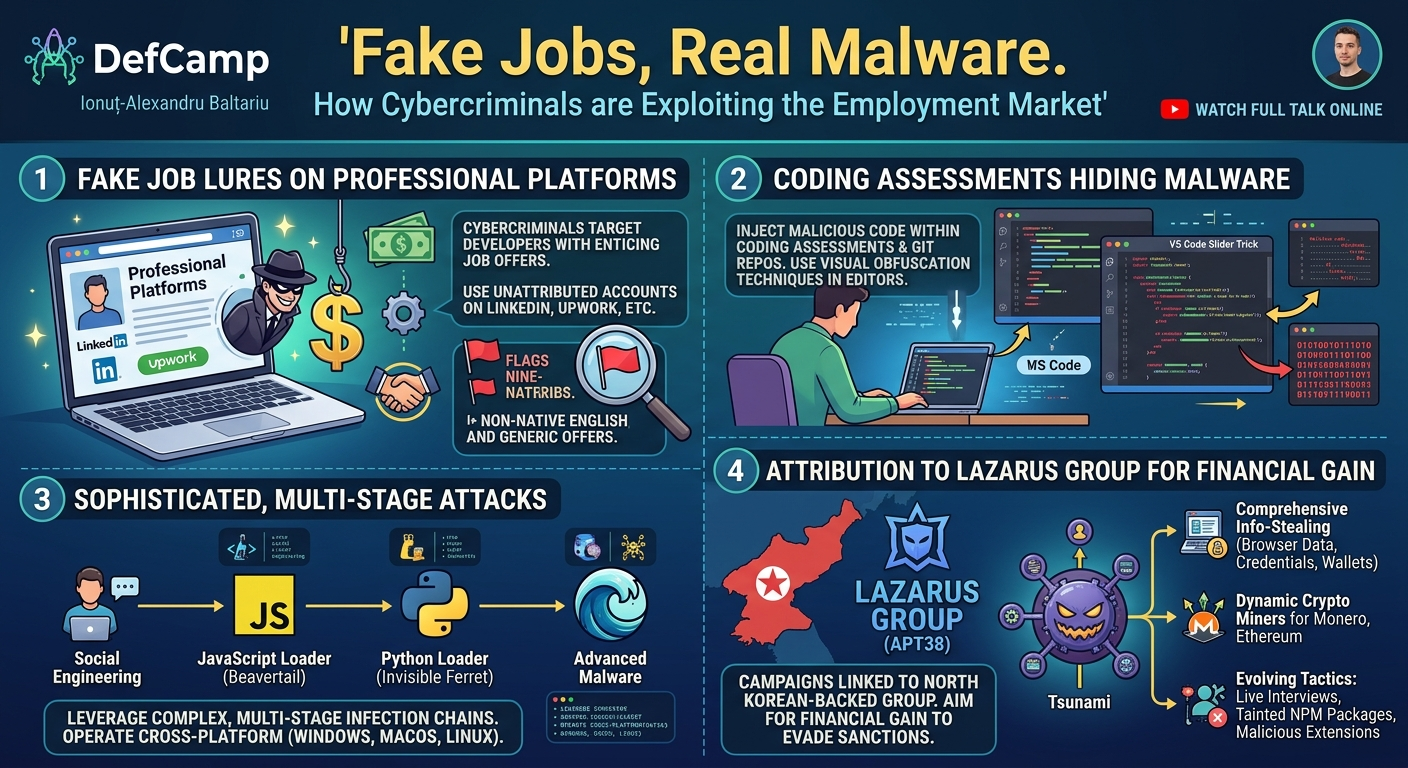
- Sophisticated Multi-Stage Infection Chain: The attacks involve a complex sequence of steps, starting with social engineering, progressing through initial JavaScript loaders, Python loaders, and culminating in highly capable, multi-module malware like Tsunami. This complexity makes detection and analysis challenging.
- Advanced Evasion Techniques: The threat actors employ a range of stealth and obfuscation methods, including visual obfuscation (e.g., hiding code far to the right with numerous spaces in a VS Code editor), dynamic code loading from public resources or attacker-controlled domains, embedding malicious logic in error handlers, and multi-layered encoding (Base64, Base85, XOR).
- Cross-Platform Capabilities: The malware is designed to operate across different operating systems (Windows, macOS, Linux), adapting its execution commands and targeting browser-specific data irrespective of the underlying OS.
- Attribution to Lazarus Group (APT38): Bitdefender attributes these campaigns, also known as "Contagious Interview" or "Deceptive Development," to the Lazarus Group, a North Korean-backed APT. The use of crypto-mining and crypto-jacking aligns with the DPRK's broader objectives of evading international sanctions and generating illicit revenue.
- Constant Evolution of Tactics: The attackers continuously refine their methods. Recent developments include hosting live interviews to pressure victims into running malicious code, distributing malware via tainted npm packages, developing malicious code editor extensions (e.g., for VS Code), and even leveraging generative AI to improve their malware and learn about system internals.
- Comprehensive Malicious Functionalities: The deployed malware is highly potent, capable of extensive information exfiltration (browser data, credentials, credit cards, crypto wallets), persistent keylogging, establishing multiple backdoors (e.g., AnyDesk, reverse shells), and resource hijacking through dynamic crypto miners that evade detection by monitoring user activity and system tools.
Technical Deep Dive
▶ Watch: Malware Variants: Beavertail, Invisible Ferret, Tsunami (14:30)
The infection chain meticulously detailed by Baltariu is a testament to the Lazarus Group's sophisticated capabilities, showcasing a multi-stage approach designed for stealth and persistence.
The initial lure involves a fake job offer on professional platforms. Once a target expresses interest, they are directed to a Git repository (Bitbucket, GitHub, GitLab) containing a seemingly legitimate project. These projects are typically written in JavaScript or TypeScript and leverage common runtimes like Node.js with npm (Node Package Manager). Crucially, the repositories often exhibit red flags: vague names (e.g., uddex), random-looking usernames (e.g., vte3mox), and atypical commit histories (e.g., all files committed on the same day, or an old open-source project forked and updated with a single, recent malicious commit attributed to a potentially compromised account, such as one from Washington University, with a faked author date).
The first stage of malware deployment is often a malicious JavaScript file embedded within the project. Attackers use several techniques to hide this code:
- Horizontal Obfuscation: One method involves inserting hundreds of spaces (e.g., 700+) before the malicious code, pushing it far to the right in code editors like VS Code, making it invisible without horizontal scrolling.
- Dynamic Loading: Malicious code is frequently loaded dynamically from third-party APIs or public services controlled by the attackers (e.g.,
api.endpoint.io). Theeval()function is then used to execute this fetched code, making it challenging for static analysis to identify. - Error Handler Abuse: In a particularly clever technique, attackers configure web requests to an attacker-controlled domain that always returns a 500-type HTTP error. This forces the execution into an error handler branch, where a dynamically created function loads and executes the malicious payload.
- Encoding Layers: Simple encoding algorithms like Base64 and ASCII are used to further obfuscate the initial loader.
This initial JavaScript loader, identified as Beavertail, serves a dual purpose: it performs some basic browser information stealing (collecting browser-specific locations and extension identifiers) and, more importantly, downloads and executes a Python script. The command to execute this Python script is constructed dynamically based on the victim's operating system (e.g., different commands for Windows versus Mac/Linux shell environments).
The Python loader, part of the Invisible Ferret malware family, is responsible for downloading and executing further malicious Python scripts. These Python files are heavily obfuscated, often featuring multiple layers of self-decryption. Common techniques include recursive Base64 decoding (sometimes up to 50 intermediary layers), XOR algorithms, and Base85 decoding, making static analysis a laborious process.
Two key specialized Python scripts are repeatedly observed:
pay.py: This script is a comprehensive info-stealer, keylogger, and backdoor installer. It collects system information (internal/external IP addresses), monitors keyboard events and clipboard content for sensitive data, and configures backdoors such as AnyDesk or reverse shells. It communicates with the C2 (command and control) server via sockets, sending data like the operating system and "get any desk" status.- Browser Stealer: This cross-platform script specifically targets Chromium-based browsers (Chrome, Opera, Brave, Yandex, Microsoft Edge). It leverages knowledge of browser internals to access and decrypt protected values from SQLite databases used by these browsers. It extracts sensitive data such as login credentials, credit card numbers (including name, expiration date, and encrypted card numbers), using functions like
decryptWindowsPasswordto bypass encryption.
In some advanced variants, the browser stealer may also act as a loader for the Tsunami Injector. This injector is downloaded through an incredibly stealthy method: iterating through a list of up to 10,000 XOR-encrypted Pastebin URLs until the correct one containing the malicious executable's URL is found. The Tsunami Injector then downloads and executes the Tsunami Malware, a multi-stage .NET application.
The Tsunami Malware is a highly capable and multi-purpose threat. Its core functionality involves setting up a Tor proxy on port 9500 to route all HTTP requests, ensuring anonymized C2 communication. All malicious modules within Tsunami run as separate threads, demonstrating its sophisticated design. Key modules include:
- Crypto Miner: This module mines Monero and Ethereum. It's designed to evade detection by dynamically throttling its resource consumption (CPU, GPU, RAM) based on hardware availability and user activity. For instance, it will limit itself when a full-screen application (like a game) is detected and suspend execution entirely if monitoring applications like Process Explorer, ProcMon, or Task Manager are run.
- Keylogger: Silently captures and stores keystrokes, enabling the exfiltration of not only system secrets but also private conversations.
- Secret File Stealer: Configurable via a JSON file downloaded from the Tor C2 endpoint, this module scans for specific file types (documents, pictures) and content. It targets crypto-related terms (e.g., "wallets," "seeds," "mnemonics") in multiple languages (English, French, Spanish) and can be configured to ignore specific directories (e.g., "Euro Truck Simulator").
- Backdoor: Provides persistent access to the compromised system.
This intricate chain, from initial social engineering to the deployment of multi-functional malware, underscores the extensive planning and technical expertise of the Lazarus Group in their pursuit of financial and intelligence objectives.
Demo / Proof of Concept
▶ Watch: Latest Threat Evolutions: Live Interviews, AI, Extensions (29:00)
While a full, end-to-end live demonstration of the entire infection chain was not performed, Ionuț-Alexandru Baltariu effectively illustrated key technical aspects of the attack through targeted code snippets and a compelling visual proof of concept. He specifically demonstrated the horizontal obfuscation technique by showing a VS Code editor with a seemingly empty line, then revealing the hidden malicious JavaScript code by scrolling horizontally. This visual trick, relying on hundreds of spaces, highlighted how easily developers could overlook embedded threats during a quick code review.
Throughout the presentation, Baltariu presented various code snippets directly from the analyzed malware samples. These included examples of:
- Dynamically loaded JavaScript using
eval()from public services. - Malicious code embedded within error handlers designed to always trigger.
- Obfuscated Python code, showcasing the recursive Base64 decoding layers.
- SQL queries used by the browser stealer to extract credit card and login data from Chromium browser databases.
- Configuration files for the Tsunami malware's secret file stealer, demonstrating how it targets crypto assets and adapts to different languages.
These concrete examples provided a clear understanding of the technical mechanisms at play, reinforcing the detailed static analysis presented by Bitdefender's research. The presentation thus served as a robust technical deep dive, supported by direct evidence from the attackers' code.
Defensive Implications
▶ Watch: Q&A: Evasion of Endpoint Security Solutions (34:00)
Understanding the sophisticated tactics of the Lazarus Group in these "Contagious Interview" campaigns is paramount for developing effective defensive strategies. Defenders, particularly developers and organizations in the tech sector, must adopt a multi-layered approach:
- Cultivate Extreme Skepticism: The primary defense is vigilance. Always be skeptical of unsolicited job offers, especially those that seem too good to be true (e.g., unusually high pay, remote-only, vague company details). Scrutinize recruiter profiles, company websites, and the language used in communications for inconsistencies or red flags.
- Rigorous Code Review: Never blindly trust code, even if it appears to come from a legitimate source or is part of a coding assessment. Perform thorough static analysis of any provided project. Look for unusual code structures, excessive obfuscation, dynamic loading mechanisms (
eval(),require()), unexpected network requests, or attempts to interact with system internals. Be aware of visual obfuscation techniques like the horizontal scroll trick demonstrated. - Isolate Development Environments: Crucially, avoid running untrusted code directly on your primary development machine or, more critically, on any company-issued device. Utilize isolated and ephemeral environments such as Docker containers, virtual machines (VMs), or cloud-based sandboxes for all coding assessments or projects from unknown sources. This containment prevents malware from accessing sensitive data or spreading across your network.
- Enhance Endpoint Security: Implement robust Endpoint Detection and Response (EDR) solutions across all workstations. While attackers constantly adapt, EDRs can detect suspicious behaviors like process injection, unusual network connections (especially to Tor nodes), attempts to access browser databases, or file system modifications indicative of data exfiltration. Regularly update security software and operating systems.
- Supply Chain Security for Dependencies: The emerging threat of malicious npm packages necessitates caution with third-party dependencies. Verify the legitimacy and integrity of any new library, especially if it's a direct dependency of a project provided for an assessment. Use tools that scan dependencies for known vulnerabilities and malicious code.
- User Awareness Training: Organizations must educate their development teams and other employees about these specific social engineering tactics. Training should cover how to identify fake job offers, the risks of running untrusted code, and the importance of reporting suspicious activity.
- Monitor System Resources and Network Traffic: Be aware of sudden, unexplained increases in CPU, GPU, or RAM usage, which could indicate a crypto miner. Monitor network traffic for unusual outbound connections, especially to non-standard ports or known Tor exit nodes.
- Browser Security Best Practices: Maintain up-to-date browsers, use strong and unique passwords, and consider dedicated browser profiles or containers for sensitive work to limit the impact of browser-stealing malware.
By combining technical safeguards with a culture of skepticism and continuous education, developers and organizations can significantly reduce their susceptibility to these evolving and highly targeted attacks.
Key Takeaways
- Fake Job Offers are a Primary Attack Vector: Cybercriminals, notably the Lazarus Group, exploit professional platforms like LinkedIn with highly convincing, yet malicious, job offers targeting developers.
- Multi-Stage and Sophisticated Malware: The attacks involve complex infection chains, utilizing initial JavaScript loaders (Beavertail), Python loaders (Invisible Ferret), and advanced multi-module malware like Tsunami for comprehensive system compromise.
- Advanced Evasion and Obfuscation: Attackers employ diverse techniques including visual obfuscation (hidden code in editors), dynamic code loading, abuse of error handlers, and multi-layered encoding to evade detection.
- Lazarus Group's Financial Motives: These campaigns are attributed to the North Korean-backed Lazarus Group (APT38), with objectives aligned to financial gain through info-stealing, credential harvesting, and crypto-mining, supporting DPRK's sanction evasion efforts.
- Evolving Tactics Require Constant Vigilance: The threat actors continuously adapt, now incorporating live interviews to pressure victims, distributing malicious npm packages, developing tainted code editor extensions, and leveraging generative AI for malware development.
- Proactive Defense is Crucial: Developers must exercise extreme skepticism, conduct rigorous code reviews, and utilize isolated environments (Docker, VMs) for testing untrusted code. Robust endpoint security and ongoing user awareness training are essential for mitigation.
About the Speaker(s)
Ionuț-Alexandru Baltariu is a Software Engineer and Technical Lead at Bitdefender, based in Romania. His work at Bitdefender primarily involves the development of digital identity protection products and internal automation projects. Baltariu's current interests are focused on social media threats, including account takeovers and malicious advertising (malvertising). He is also a notable author on the Bitdefender blogs, where he has contributed analyses of phenomena such as stream jacking and various malicious advertising campaigns. His expertise spans software development, threat analysis, and digital security.
Reviews
Dr. Zero (Offensive Security Researcher) — SOLID
Competent walkthrough of Lazarus Group's fake job recruitment campaigns. Good operational detail on the infection chain, but this is essentially a Bitdefender blog post delivered live — the core research has been public for over a year, and the talk doesn't meaningfully advance it.
Heather Calloway (CISO) — SOLID
Competent operational briefing on a real threat vector targeting your developer population. Worth circulating to engineering leadership and security awareness teams, but the analysis stays at the malware-mechanics level without addressing the organizational controls that actually reduce exposure.