Cash, Drugs, and Guns - Why Your Safes Aren't Safe
Mark Omo, James Rowley
DEF CON 33 · Day 2 · Main Stage
Overview
Mark Omo and James Rowley spent two years reverse-engineering electronic safe locks—primarily the SecuRAM lock series used by Liberty Safe and other major safe manufacturers—and found a systematic set
Key moments
- 0:03 Introduction: Physical safe security research overview
- 7:29 Safe lock mechanism analysis: electronic and mechanical
- 11:04 Physical bypass techniques for common safe models
- 1:45 Electronic lock vulnerabilities: default codes and firmware bugs
- 18:12 Live demonstration opening commercial safes without the combination
- 32:12 Brand-specific vulnerabilities in popular safe manufacturers
- 32:29 Fire safe false security: bypass methods revealed
- 37:29 What to look for when buying a secure safe
- 42:29 Q&A: audience questions about safe security
Cash, Drugs, and Guns - Why Your Safes Aren't Safe
Speakers: Mark Omo, James Rowley
Conference: DEF CON 33
YouTube: https://www.youtube.com/watch?v=N3SXVOVUD1s
Slides: https://media.defcon.org/DEF%20CON%2033/DEF%20CON%2033%20presentations/Mark%20Omo%20James%20Rowley%20-%20Cash%2C%20Drugs%2C%20and%20Guns%20Why%20Your%20Safes%20Aren%27t%20Safe.pdf
Overview
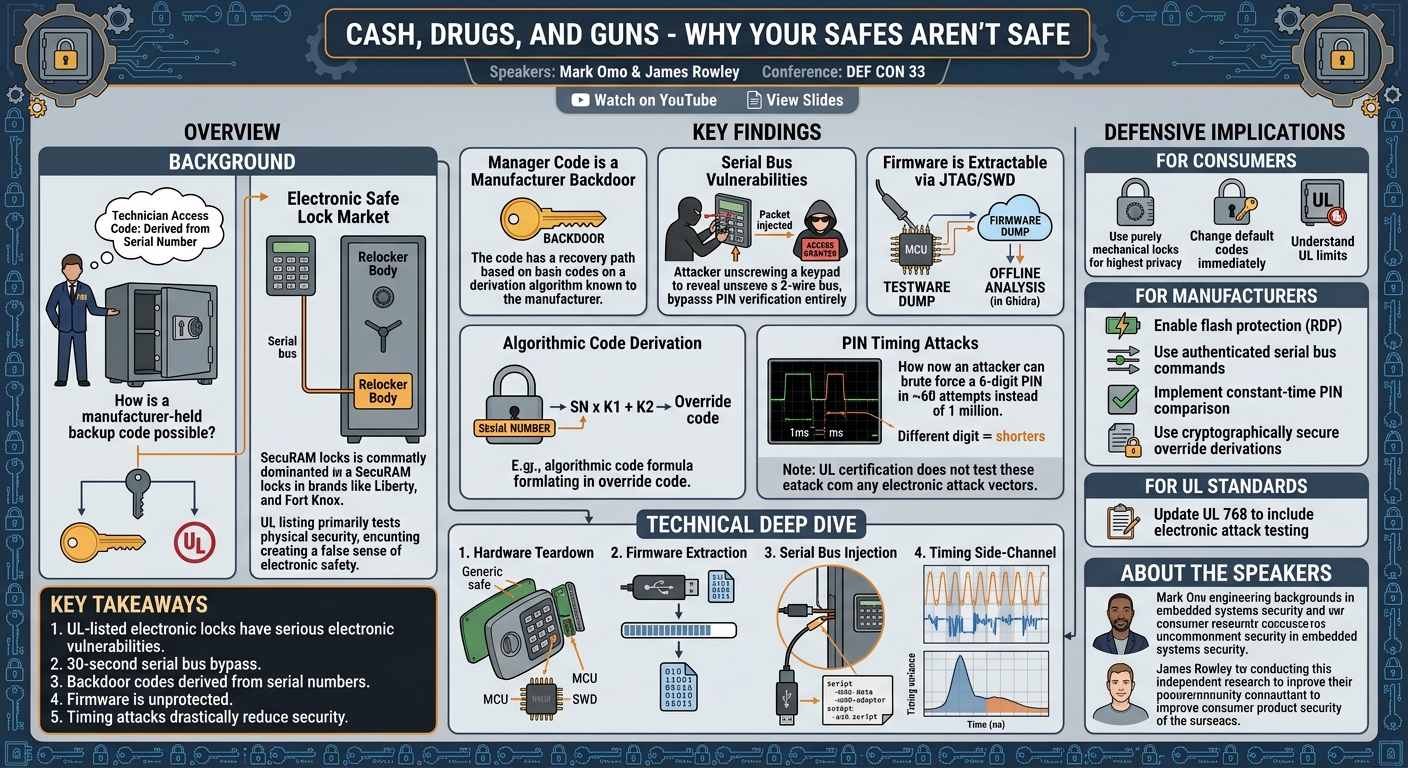
Mark Omo and James Rowley spent two years reverse-engineering electronic safe locks—primarily the SecuRAM lock series used by Liberty Safe and other major safe manufacturers—and found a systematic set of hardware and software vulnerabilities that allow bypassing the locks without knowing the combination. The talk covers their methodology for obtaining and disassembling commercial safe hardware, the firmware analysis and binary reverse engineering process, protocol vulnerabilities in the lock's serial communication bus, and the practical exploitation techniques they developed.
The research was motivated by a real-world incident: in 2023, Liberty Safe provided the FBI with a backup code that allowed agents to open a customer's safe pursuant to a search warrant. This raised the question: how is it possible for a manufacturer to have a code that opens a safe installed in a private home? The answer, as Omo and Rowley discovered, revealed a much broader set of security issues than just the manufacturer-held backup code.
Background
▶ Watch: Introduction: Physical safe security research overview (0:03)
The Electronic Safe Lock Market
Modern consumer and commercial safes increasingly use electronic locks—keypads with microcontrollers that control a motorized bolt or solenoid release—rather than purely mechanical combination locks. These locks offer user-friendly features like multiple user codes, audit logs, time-delay lockout, and remote management. They are also UL-rated and marketed as high-security products. The UL listing (Underwriters Laboratories) confers significant trust in the market: buyers and insurers assume that a UL-listed lock meets a rigorous security standard.
The dominant lock OEM in the US high-security electronic safe market is SecuRAM. Their locks are found in Liberty Safe, Fort Knox, Browning, and other major brands. The keypad (user interface) and the relocker (motor assembly) are separate units connected by a serial communication bus—a critical architectural detail for the attack.
The Liberty Safe Incident
In August 2023, Liberty Safe confirmed it had provided a technician access code to FBI agents with a valid search warrant, allowing them to open a safe in a customer's home. This sparked significant controversy: the safe had not been lost or forgotten—the owner had deliberately not provided the combination to law enforcement. The manufacturer's ability to override the lock raised questions about the security architecture that were never fully answered publicly. Omo and Rowley set out to answer them through hardware reverse engineering.
Key Findings
▶ Watch: Safe lock mechanism analysis: electronic and mechanical (7:29)
The "manager code" is a manufacturer backdoor. SecuRAM locks support multiple user code slots and a special "manager code" with elevated privileges. The manager code can be set by the end user but also has a default or recovery path known to the manufacturer. This is the mechanism by which Liberty Safe provided the FBI with access—they knew or could compute the manager code for a specific lock serial number.
The serial bus between keypad and relocker has no authentication. The keypad communicates with the lock body (the motor/solenoid assembly) over a two-wire serial bus. Commands on this bus include "grant access" and "deny access." Because the bus is accessible from the keypad compartment—which is mounted on the outside of the safe door—an attacker with a screwdriver can access the bus wires and inject an "access granted" command directly, bypassing code verification entirely.
Firmware is extractable via JTAG/SWD debug interface. The keypad microcontroller (an ARM Cortex-M class MCU) exposes debug interface pins that are accessible after removing the keypad housing. Omo and Rowley extracted the full firmware using a JTAG probe, enabling offline analysis of the code verification logic, the manager code algorithm, and any cryptographic implementations.
The manager code is algorithmically derived from the serial number. One of the most significant findings is that the manager code (or a factory default code) for SecuRAM locks is not randomly generated per unit—it follows a derivation algorithm based on the lock's serial number. This means that anyone with knowledge of the algorithm (including the manufacturer, and potentially anyone who reverse-engineers it) can compute the override code for any lock given its serial number. Serial numbers are often visible on the exterior of the safe.
Timing attacks on code verification. The firmware's PIN verification routine executes in non-constant time—it compares digits sequentially and returns early on a mismatch. This classic timing oracle allows an attacker to enumerate the correct PIN one digit at a time by measuring the response time difference between a correct first digit and an incorrect one.
UL certification does not test these attack vectors. The UL 768 Group 2 rating (the standard for high-security electronic locks) does not include testing for serial bus injection, JTAG firmware extraction, or timing side-channel attacks. The certification primarily tests physical attack resistance (drilling, torch) and basic brute-force lockout. Electronic attack surfaces are largely out of scope.
Technical Deep Dive
▶ Watch: Physical bypass techniques for common safe models (11:04)
Hardware Teardown
The researchers acquired a Liberty Safe keypad unit (OEM by SecuRAM) from eBay and disassembled it. The keypad housing uses Torx screws and is not otherwise physically hardened—no epoxy potting, no anti-tamper mesh. Inside, they found:
- An ARM Cortex-M3 (or similar) microcontroller.
- A small LCD driver IC.
- A 2-wire communication interface (RS-485 or similar proprietary serial) leading to the cable that connects to the relocker body inside the safe.
- Exposed test pads corresponding to SWD (Serial Wire Debug) interface pins.
Firmware Extraction
Using a standard ARM SWD debug probe (e.g., J-Link or Black Magic Probe), the researchers connected to the exposed SWD test pads. The debug interface was not locked (no flash readout protection / RDP). A full firmware dump was extracted in minutes. This is a common finding in consumer IoT products—manufacturers leave debug interfaces enabled in production hardware.
The firmware was loaded into Ghidra for static analysis. They identified:
- The PIN verification routine—a simple loop comparing input digits to stored digits.
- The manager code storage and derivation logic.
- The serial bus command protocol—specific byte sequences that trigger lock open/close.
Serial Bus Injection
The serial bus connector exits the keypad through the door hole for the cable. With the door ajar (as during installation or maintenance) or by drilling a small hole next to the cable grommet, an attacker can access the bus wires. Using a USB-to-serial adapter and the protocol learned from firmware analysis, the researchers constructed a Python script to send an "access granted" command. The lock motor activated and the door opened—without any PIN entry.
This attack requires approximately 30 seconds with physical access to the exterior of the safe door.
Manager Code Derivation
The specific algorithm for manager code derivation was not fully disclosed in the public talk to prevent immediate widespread exploitation. However, the researchers confirmed:
- The algorithm takes the lock serial number as input.
- It is a simple mathematical transformation, not a cryptographic hash.
- Given the serial number (visible on the safe exterior sticker), the manager code can be computed offline.
This means that Liberty Safe's ability to provide a code to the FBI was not based on a secret database of per-unit codes—it was based on knowing the derivation algorithm.
Timing Side-Channel
The PIN verification routine was shown to have measurable timing differences: a correct first digit took approximately 2ms longer to process than an incorrect one before the early-return. Using an oscilloscope or a serial communication timer, an attacker can recover a 6-digit PIN in roughly 60 attempts (6 digits × 10 possibilities each) rather than the 10^6 brute force attempts the lock's anti-brute-force lockout was designed to prevent.
The researchers note that after a certain number of failed attempts, the lock enters a lockout mode—but the timing oracle allows correct-digit enumeration, so each "attempt" in the timing attack is a valid partial match and does not consume lockout budget in the same way.
Demo / Proof of Concept
▶ Watch: Brand-specific vulnerabilities in popular safe manufacturers (32:12)
The talk includes live hardware demonstrations:
- Firmware extraction is shown step-by-step: removing the keypad, connecting the SWD probe, and running the extraction command. The resulting binary file is shown in Ghidra.
- Serial bus injection is demonstrated on a safe installed in the normal configuration: two wires accessed at the exterior cable, a laptop runs the injection script, and the safe door opens with no PIN input.
- Manager code computation is demonstrated using the serial number visible on the safe exterior to compute a valid manager code, which is then entered on the keypad to open the safe.
- Timing side-channel is shown using an oscilloscope trace, with the timing difference between correct and incorrect digits clearly visible.
Defensive Implications
▶ Watch: Fire safe false security: bypass methods revealed (32:29)
For consumers:
- Understand that UL-listed electronic locks are not certified against electronic attack—the rating primarily addresses physical attack resistance.
- The manager code (sometimes called a "dealer code" or "override code") is a real backdoor that the manufacturer knows or can derive. If privacy from your manufacturer is a requirement, use a purely mechanical combination lock with no electronic components.
- Disable or change any manufacturer default codes upon safe installation.
- Consider whether a networked or smart safe is appropriate for sensitive contents—connectivity expands the attack surface significantly.
For safe manufacturers:
- Enable flash readout protection on microcontrollers in production firmware.
- Authenticate commands on the serial bus between keypad and relocker using a shared secret established at manufacturing time.
- Implement constant-time PIN comparison to eliminate timing side-channels.
- Derive override codes using a cryptographically secure one-way function (e.g., HMAC-SHA256), not a reversible mathematical transformation.
- Disclose clearly to customers that manufacturer override codes exist and what data is required to derive them.
For the UL standards body:
- The UL 768 standard should be updated to include electronic attack testing, covering serial bus injection, debug interface protection, and PIN comparison timing.
Key Takeaways
- Consumer electronic safe locks certified to UL 768 have serious electronic attack vulnerabilities that the certification process does not evaluate.
- Serial bus injection provides a ~30-second bypass of code verification with trivial tools and physical access to the safe exterior.
- Manager codes are algorithmically derived from serial numbers in at least one major OEM's product line, meaning anyone with the algorithm can compute an override code for any unit.
- JTAG/SWD debug interfaces are left enabled in production hardware, enabling full firmware extraction and offline analysis.
- Timing side-channels in PIN verification reduce brute force complexity from 10^6 to ~60 attempts.
About the Speaker(s)
▶ Watch: Q&A: audience questions about safe security (42:29)
Mark Omo leads an engineering team focused on embedded systems security, with a background in highly regulated design domains including industrial, aerospace, and military IoT. James Rowley works alongside Omo on product security design, analysis, and reverse engineering. This research was conducted entirely independently—nights and weekends over two years—and does not represent the views of their employer. Both speakers emphasized that their goal is to improve the security of consumer products and push for stronger UL standards that reflect real-world electronic attack capabilities.
Reviews
Dr. Zero (Offensive Security Researcher) — STRONG ACCEPT
Two-year independent hardware research project exposing that UL-listed electronic safe locks (SecuRAM/Liberty Safe) have serial bus injection bypass in ~30 seconds, algorithmically-derived manager codes computable from the exterior serial number, exposed JTAG with no flash protection, and timing side-channels in PIN verification.
Heather Calloway (CISO) — STRONG ACCEPT
Omo and Rowley spent two years reverse-engineering electronic safe locks and found serial bus injection, algorithmically derived master codes, unprotected firmware, and timing side-channels — none of which are tested by the UL certification that consumers and insurers trust. The institutional failure story (UL certifies against the wrong attack model) is sharp. The Liberty Safe context makes it publicly legible.