Keynote: The First Five Year Plan A.C.: Milestones for Security in the Age of AI
Juan Andres Guerrero-Saade (Senior Technical Fellow (Research & Innovation) · SentinelOne)
Ekoparty Miami 2026 · Main Track
Overview
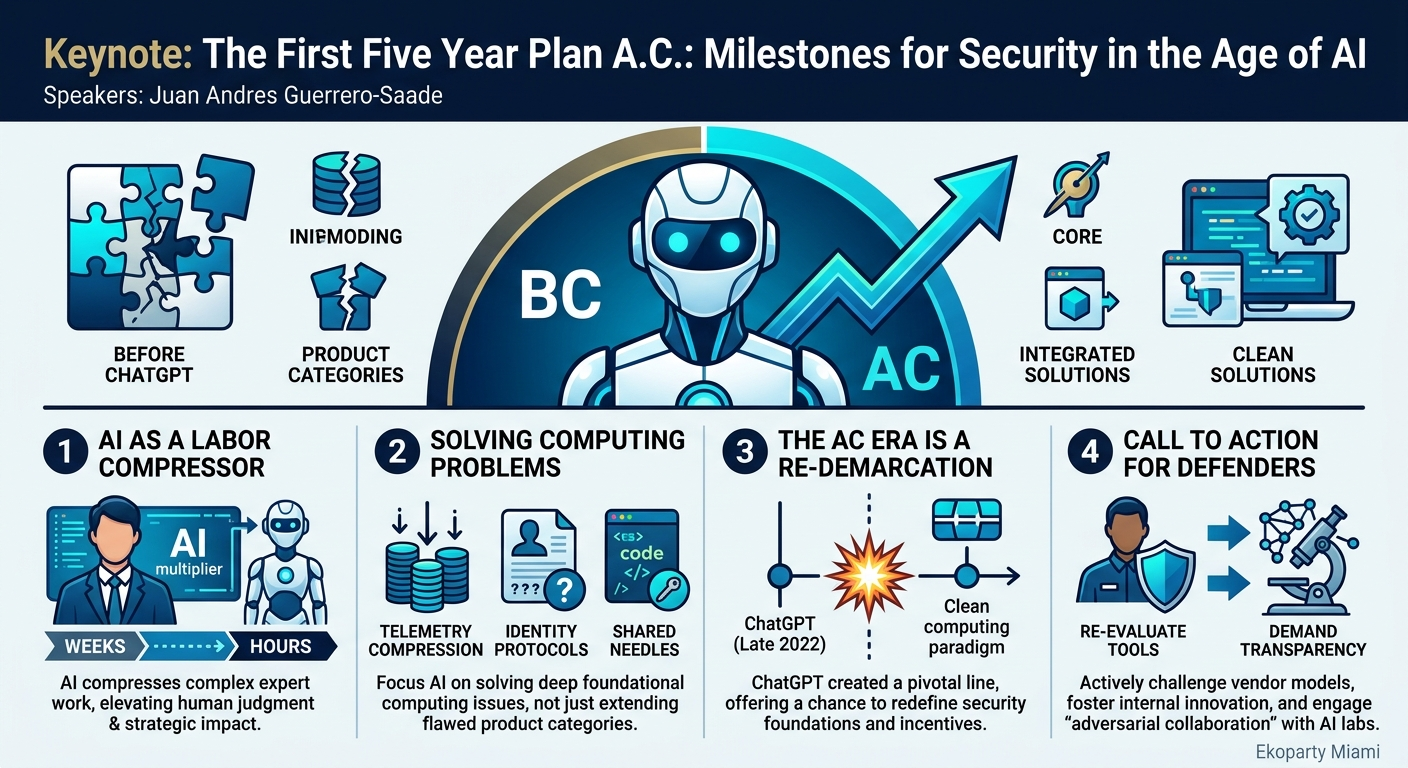
In this provocative keynote at Ekoparty Miami, Juan Andres Guerrero-Saade delivered a stark diagnosis of the cybersecurity industry, arguing that it is fundamentally broken and failing to deliver meaningful security outcomes. He posits that the advent of ChatGPT in late 2022 serves as a pivotal "line of demarcation," dividing security into Before ChatGPT (BC) and After ChatGPT (AC) eras. This talk is a rallying cry for the security community to seize the opportunity presented by AI to redefine foundational security challenges, rather than passively allowing vendors and frontier AI labs to dictate the future based on existing, flawed economic models.
Key moments
- 5:00 Define security needs before vendors dictate solutions.
- 14:00 SIM is a central point of visibility failure.
- 18:00 Five forces crippling security innovation and products.
- 26:00 The "shared needles" problem: modern systems are indefensible.
- 40:40 Capturing expert knowledge: analysts are the most valuable asset.
- 46:00 AI compresses labor, elevates expert judgment.
- 53:20 Reshuffle the incentive structure to foster innovation.
- 56:00 Engage AI labs with adversarial collaboration.
Keynote: The First Five Year Plan A.C.: Milestones for Security in the Age of AI
Speakers: Juan Andres Guerrero-Saade, Senior Technical Fellow (Research & Innovation), SentinelOne
Conference: Ekoparty Miami
YouTube: https://www.youtube.com/watch?v=6cUGrtMfbgo
Overview
In this provocative keynote at Ekoparty Miami, Juan Andres Guerrero-Saade delivered a stark diagnosis of the cybersecurity industry, arguing that it is fundamentally broken and failing to deliver meaningful security outcomes. He posits that the advent of ChatGPT in late 2022 serves as a pivotal "line of demarcation," dividing security into Before ChatGPT (BC) and After ChatGPT (AC) eras. This talk is a rallying cry for the security community to seize the opportunity presented by AI to redefine foundational security challenges, rather than passively allowing vendors and frontier AI labs to dictate the future based on existing, flawed economic models.
Guerrero-Saade's presentation challenges the audience to adopt a "no-bullshit, pragmatic approach" to assess past failures and articulate what is truly needed for a secure computing paradigm in the age of AI. He meticulously dissects the systemic issues that have stifled innovation and perpetuated an intractable problem space, emphasizing that AI, while a powerful lever, must be directed by the collective needs of defenders, not by the commercial interests of those seeking to repackage old solutions. The talk serves as a critical call to action, urging security professionals to reshuffle incentives, engage in "adversarial collaboration" with AI developers, and elevate their expertise to navigate a rapidly transforming landscape.
Background
▶ Watch: Define security needs before vendors dictate solutions. (5:00)
Guerrero-Saade begins with a sweeping indictment of the current security landscape, asserting that existing product categories are not ends in themselves but merely point at a need, failing to deliver security as a complete outcome. He likens the current state to a jigsaw puzzle where customers are expected to assemble disparate pieces—endpoint agents, network devices, cloud deployments, identity management, data protection, SecOps, AppSec—only to find that even a complete assembly still yields a "hodgepodge" requiring extensive managed services to bridge the gap between promised and delivered security. This leads to an unsustainable cycle where increased investment does not correlate with improved security posture.
He systematically critiques common security product categories:
- Endpoint Security (AV, EDR, XDR): Promised detection before attacker objectives, delivered granular telemetry in pockets, failing to cover entire enterprises, mobile, OT, or cloud.
- Network Security (NGFW, Zero Trust): Promised consistent policy enforcement regardless of location, delivered traffic accounting and inspection around SaaS apps, with limited visibility into internal workings.
- Cloud Security (CNAPP): Promised awareness and control over cloud deployments, delivered only configuration management, lacking behavioral visibility within legitimate control planes.
- Identity Management (IAM, IGA, PAM, ITDR): Promised authentication/authorization assurance across all surfaces, delivered an outsourced stack built on the flawed assumption that identities equal people doing intentional things, overlooking automation and non-human actors.
- Data Protection (DLP, DSPM): Promised no accidental data loss, delivered systems with so many false positives they operate in monitor-only mode.
- Application Security (SAST, DAST, SCA, ASPM): Promised "shift left" to manage vulnerabilities pre-deployment, delivered enormous lists of findings that developers lack cycles to address.
A particular focus of his critique is the Security Information and Event Management (SIM) system, which he describes as a "central point of visibility failure and budget exhaustion." Having been employee number 30 at Chronicle, a company that aimed to fix the SIM space, Guerrero-Saade speaks from direct experience. He argues that SIMs are built on four fundamental contradictions:
- Limited Retention Windows: These are "pricing artifacts," not natural facts, limiting investigative scope.
- Lack of Semantic Compression: SIMs store raw logs without normalizing, congealing, or semantically compressing data, making it difficult to traverse.
- Pricing Model: The more telemetry ingested and searched, the higher the cost, disincentivizing the product's core purpose.
- Misaligned Incentives: Incumbents like Splunk have no meaningful incentive to change, as their revenue is tied to data volume and search usage, making SIM a "billing instrument adjacent to security."
Guerrero-Saade identifies five systemic forces that have shaped this dysfunctional industry:
- Investor Multiples: Products are shaped by investor returns, not by genuine security needs.
- Procurement as Moat: The lengthy and expensive procurement cycle (9-18 months) acts as a barrier to innovation, starving startups.
- SKU-Driven Category Creation: "RSA acronym farming" prioritizes compliance checkboxes and vendor breadth over deep, focused solutions, disincentivizing specialized innovation.
- Acquisition as Innovation Graveyard: Acquisitions primarily serve for stock bumps (e.g., Cisco's 2% bump for six weeks), with acquired technologies often disappearing or being shoehorned into existing, ineffective products.
- Lack of Internal R&D: Research teams are disbanded or repurposed into revenue-generating services roles, stifling cutting-edge work and public good contributions.
The outcome of these forces, he concludes, is a "black hole that swallows any and all innovation," leading to a perception that the security space isn't innovating, despite the immense effort of its workforce.
Key Findings
▶ Watch: Five forces crippling security innovation and products. (18:00)
The central thesis of Guerrero-Saade's keynote is that the security industry, as currently structured, is fundamentally broken due to misaligned incentives that actively work against solving the very problems it purports to address. The arrival of ChatGPT marks a critical juncture, providing a unique, perhaps singular, opportunity to redefine the foundational principles of secure computing.
His key findings include:
- The BC/AC Divide: ChatGPT (late 2022) created a clear line of demarcation, making "security before ChatGPT (BC)" and "security after ChatGPT (AC)" distinct eras. This moment offers a chance to "recreate some of the foundations of the computing paradigm."
- Industry's Structural Failures: The current security product ecosystem is a "jigsaw puzzle" that fails to deliver complete security outcomes, relying heavily on expensive services to fill gaps. This failure is not due to a lack of ideas or hardworking people, but a "climate where doing innovative things is actually disincentivized."
- The Incentive Problem: The industry's incentives, driven by investor multiples, procurement moats, SKU proliferation, destructive acquisitions, and defunded R&D, are "aligned against solving the problems the industry is supposed to be solving."
- AI as a Lever, Not a Panacea: AI presents a powerful opportunity to address deep-seated computing problems rather than merely being an additive feature to existing product categories. However, incumbents have a "structural interest in the AI security narrative being shallow and additive," aiming to resell existing products with an "AI" label.
- AI as a Labor Compressor, Not a Job Replacer (Yet): AI today compresses the labor portion of expert work, significantly reducing time for tasks like malware analysis (e.g., weeks to hours for complex samples). This elevates the importance of human judgment, verification, and strategic oversight, meaning experts need to "adopt a new altitude."
- The Need for Redefinition: If the security community does not articulate what it actually needs from AI, the future will be defined by those who want to "sell us what they want to sell us," repeating past failures at an accelerated clock speed. This requires a willingness to "let go of" existing product categories and business models.
Technical Deep Dive
▶ Watch: Capturing expert knowledge: analysts are the most valuable asset. (40:40)
Guerrero-Saade shifts from critiquing the current state to defining six fundamental "computing problems" that security After ChatGPT (AC) needs to solve, emphasizing these are not product categories but core challenges that AI might address or exacerbate.
1. The Shared Needles Problem
What it is: Modern systems are "effectively indefensible" because their integrity is constantly eroded by the routine execution of foreign code. This includes software installs, dependencies, patches, container images, model weights, and browser extensions—all forms of "transitive semi-anonymous grafting." The supply chain, he argues, is a euphemism for this uncontrolled introduction of unaudited foreign code.
Why it has resisted solution: We cannot be prescriptive about how user systems are constituted, and existing security categories defend around this grafting rather than addressing its root.
What defenders need: The ability to verify the "root of integrity" of a system and identify recent changes.
AI Implications: Agentic AI will "accelerate the rate of foreign code introduction," making this problem catastrophic before it becomes tractable. Solving it would make the "constituted system" the primary defended object.
2. Semantic Compression on Telemetry
What it is: The inability to codify the bulk of logs into something semantically compressed, preserving meaning while shedding volume. This leads to massive storage costs and limited retention windows (e.g., 3-6 months), making long-term analysis impossible.
Why it has resisted solution: The "storage as product economics" model and schema-on-read culture, where detection logic operates on raw events, is the most expensive approach. Dominant vendors' profit models are "directly opposed to compression," as a SIM that compresses telemetry 100x would mean a 100x revenue cut.
What defenders need: Durable security memory to answer questions with certainty and completeness across analytical time scales. They need to know the "operational surface delta"—what has changed since yesterday.
AI Implications: Language Models are "empirically semantic compressors"—that is their core function. This technology is already here, but the industry's incentive structure resists its adoption due to the threat to existing revenue models.
3. The Inventory Problem
What it is: The inability to definitively answer whether a specific file (by hash, name, code, path, version) or network resource (by IP, domain, DNS resolution, session length) has ever been in an organization's systems, or interacted with its network, without "extremely expensive computation." The "enterprise network" is an incoherent fiction.
Why it has resisted solution: Each defensive product owns its own slice of data, with none owning the union. Cross-domain consolidation is needed, but perceived liability for discarding logs is too high.
What defenders need: The ability to answer these fundamental inventory questions.
AI Implications: This is a representation and retrieval problem ripe for AI solutions using embeddings, learn indices, and semantic similarity at scale. Solving it would make threat intelligence "operationally meaningful for the first time" and collapse incident scoping from weeks to minutes, but the bottleneck remains incentives, not technology.
4. Identity of Non-Human Goal-Directed Actors
What it is: The entire identity stack assumes identities are people doing intentional things on their own behalf. This fails for service accounts, OAuth tokens, CI/CD pipelines, machine identities, and critically, AI agents which act autonomously in a goal-directed fashion. There is no agreed-upon protocol to govern the behavior of these non-human actors with delegated authority.
Why it has resisted solution: Fragmentation of management (service accounts, OAuth scopes, vaults) and a human-shaped taxonomy of identity products (e.g., Okta's focus on users). The solution doesn't fit existing vendor categories.
What defenders need: To answer: "On whose authority is this action being taken?" and "Towards what stated objective, with what budget of resources?" to determine if an action is within the "letter and spirit of the delegation."
AI Implications: The AC era "genuinely changes the problem shape" as agents represent a "qualitative inversion" of delegation. Solving this is essential for AI agents to operate securely within enterprises.
5. Resource Control at Granularity Finer than Allow or Deny
What it is: Every enforcement mechanism in security is binary (e.g., firewall block/pass, IAM permit/deny, EDR quarantine/not). This "hostage binary choice" forces defenders to wait for catastrophic failure before interfering, due to the core belief that they must be "dead certain" before disrupting users.
Why it has resisted solution: It stems from the "architectural ancestor of the firewall" and a risk-scoring model focused on binary thresholds. Graduated controls require "continual behavioral semantics," which is not possible without solving problems like semantic compression and inventory.
What defenders need: The ability to throttle, observe without blocking, allow elevated logging, manage resource budgets, or require additional verification. This buys investigation time with "proportionate, reversible intervention" without disrupting business continuity.
AI Implications: This is a "structural primitive that AI enables"—continuous semantic intent-aware modulation. AI can provide an "evaluator that can always be looking" without human burnout, making this technically feasible for the first time. Defense would become a "control system," moving from a gatekeeper model to a clinician one.
6. Expert Knowledge Capture
What it is: The most valuable assets in any security organization are the analysts, hunters, and responders whose judgment, synthesis, and pattern recognition are critical. However, there's a "lossy encoding gap" where only the "thinnest slice" of their knowledge is encoded into products (detection rules, IOC feeds, playbooks, blog posts).
Why it has resisted solution: Services are structurally disincentivized from making knowledge transferable, as knowledge is their intellectual property. Analysts themselves often resist, fearing displacement ("If I tell you how to do this better, you're going to fire me"). Better service is rewarded, not better knowledge.
What defenders need: To make their best analyst judgment "available to the whole team," enabling durable, permanent diffusion without making the analyst a bottleneck or burning them out.
AI Implications: This is the problem AI "most plausibly addresses directly." Language Models are "machinery for encoding and applying expert reasoning in narrow scope and diverse settings." Solving this could reconfigure the services product economic split and make the "30-year shortage of qualified defenders" tractable. However, the risk is that the industry will merely "wrap it in subscription shape wrappers and sell it back to us at a markup."
Demo / Proof of Concept
▶ Watch: AI compresses labor, elevates expert judgment. (46:00)
While no live demonstration was performed during the keynote due to time constraints, Guerrero-Saade referenced a recorded session that serves as a powerful proof of concept for AI's capability as a multiplier for expert work. He described an experiment involving the analysis of Fast 16 malware, a complex sample that took "one of the best reverse engineers on Earth" (likened to Vitalik Buterin) weeks to fully analyze.
In contrast, a "less informed, less qualified human being" utilizing AI (Claude Code Opus 4.7 and GPT 5.5) was able to achieve similar conclusions in a verifiable way, taking only "hours instead of weeks, days instead of months." This was accomplished with direct human supervision, where the AI was allowed to "grind for hours and millions of tokens" but required constant human oversight to verify its output, correct its direction, and ensure it stayed on task. This highlights that AI acts as a labor compressor and multiplier, not an autonomous replacement, with human judgment and verification remaining "load-bearing" and critical.
Defensive Implications
▶ Watch: Engage AI labs with adversarial collaboration. (56:00)
Guerrero-Saade's talk is a direct call to action for the security community, offering concrete steps for defenders to navigate and shape the "After ChatGPT" era:
- Re-evaluate Vendor Tooling and Budget Allocation: Defenders must critically assess if their existing "AI-powered" security products are truly delivering value. If internal experts can use frontier AI tools (like Claude Code or GPT 5.5) directly to outperform these products in solving core problems, then the value proposition of those vendor tools "collapses." The implication is to "spend less money on vendor shit, spend more money on tokens" for internal, AI-capable teams, as it can be "cheaper than a single SKU in your existing stack."
- Reform Procurement and Signal Assessment: Replace the reliance on "Gartner rubber stamping" and compliance checkboxes with "true signal assessment." This involves running internal evaluations, sharing results with peers, and making the assessment of security tooling "honest again."
- Foster Internal Innovation and Knowledge Sharing: Defenders can "kickstart innovation by replacing vendor tooling with your own." This means leveraging AI to build internal capabilities without needing to hire an army of engineers. The output should then be shared as "recipes" to make capabilities that were once gated by cost "freely available," thereby dissolving parts of the artificial vendor moat.
- Demand Transparency and Challenge Vendor Models:
- Direct-to-Consumer Pricing: Challenge the procurement "hell" by demanding transparent pricing (e.g., "direct-to-consumer pricing on the tin") to streamline acquisition.
- Public Research and R&D: Treat public research and visible R&D as "proof of innovation." If vendors are not engaging in this, it signals that they don't expect their products to mature, and this should be a "signal of risk" against purchase.
- Reward Services-Shaped Innovation: Support lifestyle businesses and models that genuinely improve capabilities rather than perpetuate service dependencies.
- Elevate Expert Altitude: As AI compresses the manual labor of expert work, security professionals must "rise to match it." This means spending "less time on the work you used to do with your hands, more time on what of that actually matters"—focusing on judgment, verification, and strategic impact. An expert who fails to "zoom out" will find themselves competing with a model "on the model's own grounds," which is a losing battle.
- Engage in Adversarial Collaboration with AI Labs: The AI labs (e.g., OpenAI, Anthropic) are defining the future of AI in security. The security community must not be "starstruck" or subservient. Instead, it needs to engage in "adversarial collaboration"—being honest, technically credible, and "unafraid to call bullshit" when necessary. He specifically criticizes the Anthropic Mythos and Glasswing hype cycle for focusing on vulnerability finding (which wasn't the problem) rather than fixing, and cautions against letting security become "just an offshoot of an AI lab that's going to move on." The ultimate responsibility for fixing AI's security flaws will fall on the security community, not the labs.
Key Takeaways
- The existing cybersecurity industry is fundamentally broken by misaligned incentives, leading to a perpetual cycle of product gaps, expensive services, and stifled innovation.
- ChatGPT marks a unique opportunity to redefine security by addressing deep-seated "computing problems" rather than merely extending existing, flawed product categories with AI.
- Six core problems—shared needles, semantic telemetry compression, comprehensive inventory, non-human identity, granular resource control, and expert knowledge capture—are critical areas where AI can, and must, provide transformative solutions.
- AI functions as a powerful labor compressor and multiplier for security experts, demanding a "higher altitude" for human judgment, verification, and strategic oversight, rather than replacing human expertise outright.
- Defenders must actively challenge the status quo by re-evaluating vendor tools, directing resources towards direct AI utilization, reforming procurement, fostering internal innovation, and demanding transparency from vendors.
- Engaging in "adversarial collaboration" with frontier AI labs is crucial to ensure that the future of AI in security is shaped by genuine security needs and accountability, not solely by commercial interests or hype cycles.
About the Speaker(s)
Juan Andres Guerrero-Saade is a Senior Technical Fellow in Research & Innovation at SentinelOne, known for his incisive critiques of the cybersecurity industry and deep expertise in threat intelligence and malware analysis. Born and raised in Miami, he maintains a unique perspective on the global security landscape. Prior to his current role, he was notably an early employee (number 30) at Chronicle, where he aimed to address the fundamental flaws in the SIM space. Guerrero-Saade is also an educator, teaching a course at Johns Hopkins University on malware analysis for non-technical individuals, a feat he credits to the enabling power of AI. He is actively involved in shaping the dialogue around AI's impact on security, including participation in OpenAI's Frontier Risk Council. His talks are characterized by their direct, "no-bullshit" analytical style, often leaving audiences with a critical, yet ultimately inspiring, call to action.
Reviews
Dr. Zero (Offensive Security Researcher) — STRONG ACCEPT
JAGS delivers a genuinely useful structural critique of why the security industry's incentive architecture actively prevents solving the problems it claims to address. The BC/AC framing is theatrical but the six 'computing problems' taxonomy is the real payload—it's a coherent framework for thinking about what AI might actually fix versus what vendors will just slap labels on. Not a research talk, but a strategic keynote that says things most people in his position won't.
Heather Calloway (CISO) — STRONG ACCEPT
A forceful diagnosis of why the security industry's incentive structures actively prevent solving the problems we claim to solve. Guerrero-Saade articulates six foundational computing problems AI could address—if the community demands it rather than accepting vendor repackaging. Worth your leadership team's time for the framing, even if the five-year roadmap stays abstract.