DI.Days as Anarchist Practice/Anarchist Practices for DI.Days
Alexandra
Gulaschprogrammiernacht 24 (GPN24) · Day 4 · ZKM Medientheater
Overview
The Digital Independence Days, or DI.Days, emerged from the Chaos Computer Congress in December 2025 as a grassroots movement aimed at empowering individuals to break free from the pervasive influence of "evil big tech" and "US big tech" monopolies. These events typically involve monthly gatherings where participants collectively take small steps towards digital autonomy, such as migrating from proprietary platforms like WhatsApp to alternative messaging clients. While the initiative has seen positive impact and fostered community, the speaker, Alexandra, posits that there remain significant gaps between the DI.Days' stated promises and their practical execution, particularly in achieving a truly equitable and liberated digital landscape.
Key moments
- 0:00 Introduction to DI.Days and anarchism's relevance
- 4:30 Anarchist action: means align with goals, prefiguration
- 15:45 Critique: 'EU big tech' is not a democratic alternative
- 21:30 Critique: DI.Days reproduce privilege and lack accessibility
- 26:30 Finding positive 'seeds' and envisioning a better utopia
- 31:45 Moving beyond 'independence' to power to choose
- 39:15 Q&A: Balancing perfectionism with incremental progress
DI.Days as Anarchist Practice/Anarchist Practices for DI.Days
Speakers: Alexandra
Conference: GPN24
YouTube: https://www.youtube.com/watch?v=RcJF_VV4YjQ
Overview
The Digital Independence Days, or DI.Days, emerged from the Chaos Computer Congress in December 2025 as a grassroots movement aimed at empowering individuals to break free from the pervasive influence of "evil big tech" and "US big tech" monopolies. These events typically involve monthly gatherings where participants collectively take small steps towards digital autonomy, such as migrating from proprietary platforms like WhatsApp to alternative messaging clients. While the initiative has seen positive impact and fostered community, the speaker, Alexandra, posits that there remain significant gaps between the DI.Days' stated promises and their practical execution, particularly in achieving a truly equitable and liberated digital landscape.
In her GPN24 talk, Alexandra critically examines the DI.Days through the lens of anarchist thinking and anarchist practice. She argues that while DI.Days are not inherently anarchist—describing them instead as a "democratic citizen thing"—they contain "seeds" of anarchist potential. The core premise of her presentation is to explore how applying anarchist principles, which emphasize horizontal power structures, mutual aid, and direct action, can help the DI.Days movement evolve beyond mere reformism and address its inherent limitations, ultimately working towards a more truly independent and just digital future.
This analytical deep dive scrutinizes the DI.Days' underlying assumptions, identifies critical blind spots in their current approach, and highlights existing "seeds" of anarchist practice within the broader free and open-source software (FOSS) community. Alexandra challenges the audience to move beyond superficial technological switches and engage in a more profound re-evaluation of technology's role in society, questioning not just who controls our digital tools, but what technologies we truly need and how they shape our social relations.
Background
▶ Watch: Introduction to DI.Days and anarchism's relevance (0:00)
The Digital Independence Days movement, initiated at the Chaos Computer Congress, is fundamentally a reformist project. Its core analysis posits that US tech monopolies wield undue power over society by controlling information and media, thereby influencing democratic processes. The stated goal is to preserve democracy and the status quo by encouraging users to switch away from US big tech and engage in public discourse to influence policy. The chosen means for this are "relaxed rebellion"—small, incremental steps like attending monthly events, discussing alternatives, and using specific hashtags. This approach, while fostering awareness, primarily aims to navigate existing democratic processes to prevent further societal slippage into authoritarianism.
Alexandra introduces her interpretation of anarchism as a framework for deeper systemic change. She defines it not as chaos, but as a utopian vision of a totally inclusive world where everyone is heard and no one is ignored, characterized by international solidarity. Crucially, anarchism also possesses a "destructive" urge—the necessity to dismantle existing social, technological, and state relations that bind us to the current world, in order to create something better. From an academic standpoint, anarchism seeks a society free of coercion and coercive institutions, specifically vertical power structures that dictate individual choices.
The path to achieving this anarchist vision, Alexandra explains, is through action where the means align with the goals. Drawing on Gustaf Landauer, she emphasizes that the way we achieve a goal must already embody the goal itself; there is no separation between the desired future and the process of getting there. This concept is further refined by prefiguration in anarcha-feminist thought, meaning that new social structures are realized now, within the existing "shell of the old world," rather than merely preparing for a future revolution. This makes revolution a continuous process. Anarchists understand that not only the state and capital but also technology itself configures social relations. Therefore, transforming our world necessitates changing how we relate to each other, which in turn requires dismantling existing vertical power structures.
Practical anarchist organizing, often termed "small 'a' anarchy," is guided by three core principles:
- Consensual: Every voice matters, and a single individual can block decisions until a compromise is reached that works for everyone. This avoids majority voting and single leaders.
- Mutable: No fixed ideology, decisions, or structures. Everything created, whether by accident or design, can and should be changed.
- Conscious: Constant critical reflection on created power structures, being explicit about their existence, and actively confronting authority when it overreaches. This fosters conflict as a mechanism for change rather than avoidance.
Alexandra uses the metaphor of "anarchy already exists in our society, but it's a seed beneath the snow" to frame her critique and vision. The "snow" represents prevailing forces like nationalism, capitalism, and colonialism, under which the potential for a power-free, utopian world lies buried. The talk's objective is to identify these hidden seeds within the DI.Days and pinpoint what is missing to cultivate a truly liberated digital future.
Key Findings
▶ Watch: Critique: 'EU big tech' is not a democratic alternative (15:45)
Alexandra's critical analysis of the DI.Days uncovers several significant findings, highlighting both the movement's strengths and its fundamental shortcomings when viewed through an anarchist lens.
Firstly, she identifies that there is "no true DI.Day," revealing a schism within the movement itself. The original DI.Days, spearheaded by Maru Vlling, exhibit a strong alignment with corporate interests, featuring an expert council drawn from industry. In contrast, an alternative, community-led initiative, DI.day.org (started by CCC Hamburg), explicitly rejects corporate alignment. While this decentralized nature (with 1,500 DI.Day-related events occurring in 30 days, primarily in Germany and Central Europe, but also Portugal and the US) is positive in its lack of central authority, it also reveals a significant limitation: DI.Days are overwhelmingly a Western phenomenon, failing to meaningfully spread to most of the world.
Secondly, Alexandra challenges the foundational premise that the problem lies specifically with "US big tech." She argues that merely switching from American cloud providers like AWS or Google Cloud to European alternatives like "the stacked cloud" or "the honest cloud" is insufficient. European big tech, exemplified by companies like d.gis (with its influence on German politics and collaboration with police on Palantir-like systems), operates under the same capitalist profit logic that transcends national borders. This logic, she asserts, will invariably push towards authoritarian thinking and fascism, regardless of the company's geographical origin.
Thirdly, the talk critiques the DI.Days' reliance on existing democratic states and legal frameworks, such as the General Data Protection Regulation (GDPR). Alexandra points out that such protections are fragile and easily undermined by capitalist interests. She cites the Digital Omnibus, which attempts to weaken data protection rights by allowing data to be used for AI model training, and new German police laws that expand surveillance capabilities, effectively legalizing tools like Palantir. This demonstrates that preserving the status quo under capitalism and the state is an inadequate response to the encroaching surveillance state.
A profound finding relates to the ethics and value neutrality of technology. Alexandra questions whether technologies like AI (e.g., alternatives to ChatGPT) should be adopted at all, given their extractive nature, environmental impact, and problematic roots. She extends this critique to hardware, highlighting the colonialist and extractive supply chains that rely on forced and child labor. This leads to the radical question: should we even be striving for digital alternatives, or should we consider reducing our reliance on digital technology altogether, perhaps reverting to simpler tools or paper? The current DI.Days approach, which often answers "how do I get this to work on Linux?" without asking "why do we need this technology?", fails to address this fundamental ethical dilemma.
Finally, Alexandra exposes critical blind spots within the DI.Days movement itself, which inadvertently reproduce existing power structures. Attendees are typically privileged: white, educated, financially stable, and possess the leisure time and technical capacity to handle the complexities and potential failures of switching technologies. Digital independence, she concludes, is currently a luxury for the privileged, leaving those who cannot afford to protect themselves vulnerable. This privilege also manifests in a limited international solidarity, where Western-centric solutions (like OpenStreetMap being ineffective in India) are naively promoted without considering global applicability. Most glaringly, the movement suffers from a significant accessibility blind spot, with no apparent consideration for blind, deaf, or wheelchair-bound individuals, or non-English speakers, leading to the recreation of marginalization within open-source communities.
Technical Deep Dive
▶ Watch: Critique: DI.Days reproduce privilege and lack accessibility (21:30)
The technical discussion within Alexandra's talk serves not as a guide for implementation, but as a critical examination of the underlying assumptions and implications of various technological choices, both within and outside the DI.Days movement.
The core technical challenge addressed by DI.Days participants often revolves around replacing proprietary big tech services. Common requests include migrating from WhatsApp to alternative messaging clients, or switching operating systems to Linux on desktop computers. A particularly frequent and complex request, highlighted by Alexandra, is finding an alternative smartphone OS. This is a difficult area due to the deep integration of software with hardware. The "wrong answer," as she puts it, is simply recommending purchasing a Google Pixel to install a custom ROM, as this still relies on a specific corporate hardware ecosystem and doesn't address the broader issues of hardware supply chains.
Alexandra deeply critiques the DI.Days' proposed "cloud" alternatives. The movement often suggests moving data and services from AWS, Google Cloud, or Azure to "the stacked cloud" or "the honest cloud." Her argument is that this merely shifts the problem from US big tech to EU big tech, without fundamentally altering the capitalist profit logic or the inherent vertical power structures. She cites the example of d.gis (likely Dataport or similar German public-sector IT service providers, though not explicitly named in full) and its strong influence on German politics, including collaborations with the German police and government on systems akin to Palantir. This illustrates how surveillance state capabilities are not exclusive to US companies and can be implemented by national or regional entities, blurring the lines of "good" versus "bad" tech based solely on origin.
The discussion extends to emerging technologies like Artificial Intelligence (AI). Alexandra questions the uncritical adoption of AI alternatives to services like ChatGPT. She points out the extractive nature of AI, which often relies on vast datasets obtained through questionable means, and its significant environmental impacts due to energy-intensive training and operation. The speaker challenges whether such technologies, even if open-source or hosted by ethical providers, align with the movement's goals, or if their problematic roots and uses mean they should be rejected entirely.
A more fundamental technical critique is directed at the hardware supply chain. Alexandra emphasizes that every computer and new device we use is built upon a deeply colonialist and extractive supply chain, often implicated in forced labor and child labor. This raises the question of whether "digital independence" can ever be truly achieved without addressing the ethical provenance of the physical components underpinning our digital lives. She provocatively suggests that perhaps the solution isn't always digital alternatives, but sometimes a return to simpler, non-digital technologies or even paper-based workflows.
In contrast to these problematic approaches, Alexandra highlights existing examples of sustainable decentralized infrastructures that embody anarchist principles. The Fediverse and Matrix are presented as powerful nodes of technology that are decentralized, often offered for free by individuals hosting servers, and do not demand payment with user data. The Fediverse, in particular, is noted for its acceptance beyond just tech-savvy users. These platforms demonstrate how communities can contribute (if privileged to host or donate) without obligation, fostering an ecosystem where there are no inherent power relations and individuals can autonomously choose their interactions. Other local examples mentioned include Guix (a functional package manager and operating system), and community-hosted event calendars like KNU and Keep Karlsruhe Boring in Karlsruhe. These projects, often initiated by non-techies, exemplify how the "pure expert mindset" can be overcome, allowing everyone to participate as both producer and consumer of technology, thereby avoiding the creation of new power structures.
Demo / Proof of Concept
▶ Watch: Moving beyond 'independence' to power to choose (31:45)
While the talk itself did not feature a live technical demonstration or a traditional proof of concept for a specific vulnerability or tool, Alexandra's presentation served as a powerful proof of concept for applying a critical philosophical framework—anarchism—to an existing social and technological movement.
The entire structure of her argument, moving from an idealized vision of anarchy to a rigorous critique of the DI.Days and then to a hopeful articulation of "seeds" for a better future, acts as a methodological demonstration. It shows how theoretical constructs can be used to dissect complex real-world initiatives, expose their hidden biases and limitations, and guide them towards more aligned and effective outcomes.
Furthermore, the examples Alexandra provides of existing decentralized technologies like the Fediverse and Matrix function as practical demonstrations of anarchist principles in action. These platforms, characterized by their lack of central authority, voluntary contributions, and absence of data monetization, illustrate that digital systems can indeed be built and sustained in a manner that prefigures the horizontal, consensual, and community-driven structures desired by anarchists. They are living "proofs of concept" that alternatives to corporate-controlled, surveillance-laden digital spaces are not only possible but are already thriving, built by and for autonomous users.
Defensive Implications
▶ Watch: Q&A: Balancing perfectionism with incremental progress (39:15)
Alexandra's analysis offers profound defensive implications, not in the traditional cybersecurity sense of patching vulnerabilities or deploying firewalls, but in re-evaluating the very foundations of digital independence and building resilient, equitable digital communities.
For DI.Days organizers and participants, the primary defensive implication is a call for radical self-reflection and a broadening of scope. It's insufficient to merely switch from US big tech to EU big tech; the defense must be against all forms of capitalist and state-aligned technology that reproduce vertical power structures. Organizers must consciously prioritize accessibility and inclusivity, actively reaching out to and co-creating solutions with marginalized groups—blind, deaf, neurodivergent, non-English speakers, and those without financial or educational privilege. This involves designing alternatives that are truly usable and culturally relevant globally, moving beyond Western-centric solutions. Furthermore, the focus must shift from merely "getting technology to work" to critically questioning why certain technologies are needed and if they align with utopian goals, considering the entire ethical supply chain from hardware to software. Fostering truly decentralized, community-led initiatives where mutual support replaces expert-client dynamics is paramount, empowering non-techies to contribute and participate.
For general tech users, advocates, and policymakers, the implications are equally significant. There's a defensive need to be wary of "nationalist tech" as a false panacea; the borderless nature of capitalist profit logic means that surveillance and exploitation can originate anywhere. Over-reliance on legal frameworks like GDPR is also shown to be a weak defense, as such regulations can be easily undermined by corporate and state interests, as evidenced by the Digital Omnibus and new police laws. A robust defense involves questioning the necessity and ethical implications of all digital technologies, especially those with extractive or environmentally damaging roots. Instead, individuals and communities should actively support, build, and migrate to federated and decentralized alternatives like the Fediverse and Matrix, which inherently resist centralized control and data exploitation. Recognizing the inherent privilege in achieving "digital independence" is crucial, prompting a defensive strategy that actively works to lower barriers and provide equitable access to digital autonomy for everyone, rather than inadvertently creating new forms of exclusion. Ultimately, the most effective defense is not just technological, but social: building diverse, mutualistic, and horizontal communities that empower individuals to choose their digital relations and collectively resist coercive power structures.
Key Takeaways
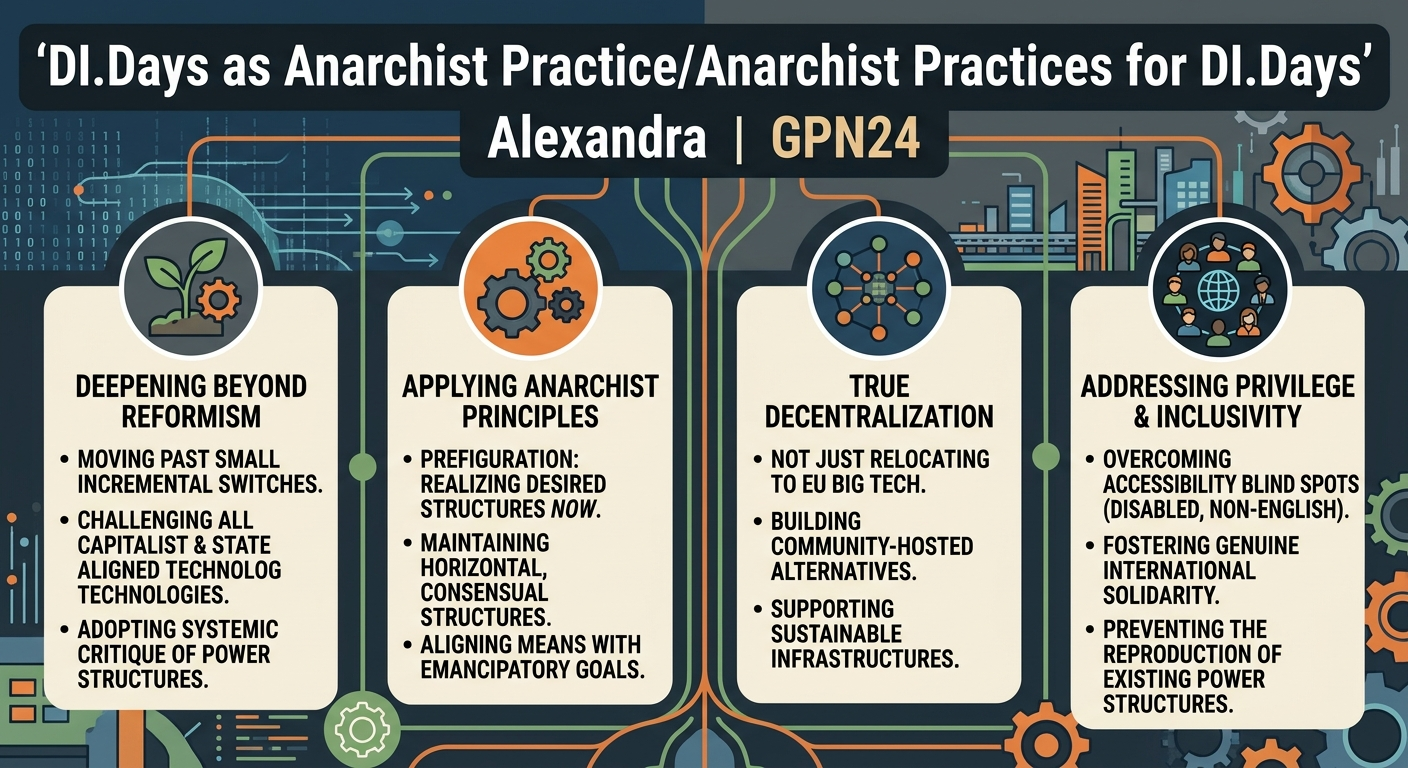
- Beyond Reformism: The DI.Days' current reformist approach, focusing on incremental switches from US big tech, is insufficient. A deeper, systemic critique of all capitalist and state-aligned technologies is necessary to achieve true digital liberation.
- Anarchist Framework for Action: Anarchist principles, particularly prefiguration (realizing desired social structures now) and the alignment of means with goals, offer a powerful framework for guiding the DI.Days towards truly emancipatory practices that foster horizontal, consensual, and mutable power structures.
- Decentralization, Not Just Relocation: Simply moving from US to EU big tech (e.g., AWS to "honest cloud") fails to address the fundamental issues of capitalist profit logic and vertical power structures. True independence requires a shift towards sustainable decentralized infrastructures and community-hosted alternatives.
- Addressing Privilege and Inclusivity: The DI.Days currently reproduce existing power structures, serving primarily privileged, educated, and well-resourced individuals. Critical blind spots in accessibility (for disabled, non-English speakers) and international solidarity (Western-centric solutions) must be actively addressed to avoid creating new forms of marginalization.
- Ethical and Critical Technology Use: It is crucial to question the ethical implications and necessity of technologies (e.g., AI's extractive nature, hardware's colonialist supply chain) rather than uncritically seeking alternatives. Sometimes, the most independent choice might be to reduce reliance on digital technology altogether.
- Power to Choose Relations: "Digital independence" should evolve from merely getting rid of relations to empowering individuals with the education, skills, and support to choose their digital relations autonomously. The goal is to cultivate diverse, mutualistic, and horizontal communities that collectively build a better digital world.
About the Speaker(s)
Alexandra is a speaker deeply engaged with the Digital Independence Days (DI.Days) movement, having organized and participated in events in Karlsruhe. Her work is driven by a profound interest in utopian thinking and the creation of better worlds, leading her to critically examine existing initiatives. Alexandra brings a unique perspective to discussions around technology and society, informed by her personal experience as a neurodivergent person, which shapes her understanding of accessibility and the challenges individuals face when navigating complex technological changes. She advocates for a more inclusive, equitable, and anarchistically-inspired approach to digital autonomy.
Reviews
Dr. Zero (Offensive Security Researcher) — SOLID
A thoughtful critique of reformist tech activism that lands some real punches—particularly on the privilege blindspots and the fantasy that EU cloud is somehow cleaner than US cloud. But it's ultimately a philosophy talk dressed as tech criticism, and the anarchist framework does more hand-waving than heavy lifting.
Heather Calloway (CISO) — WEAK
This is a philosophical critique dressed as a tech movement strategy talk. The anarchist framework is internally coherent but produces no actionable guidance for anyone running a security program, making policy decisions, or defending infrastructure. It's an academic exercise that mistakes radical critique for operational relevance.