Ultrafast Lasers 101: A Photonic Adventure for Molecular Dynamics Enthusiasts
Sally
Gulaschprogrammiernacht 24 (GPN24) · Day 2 · ZKM Medientheater
Overview
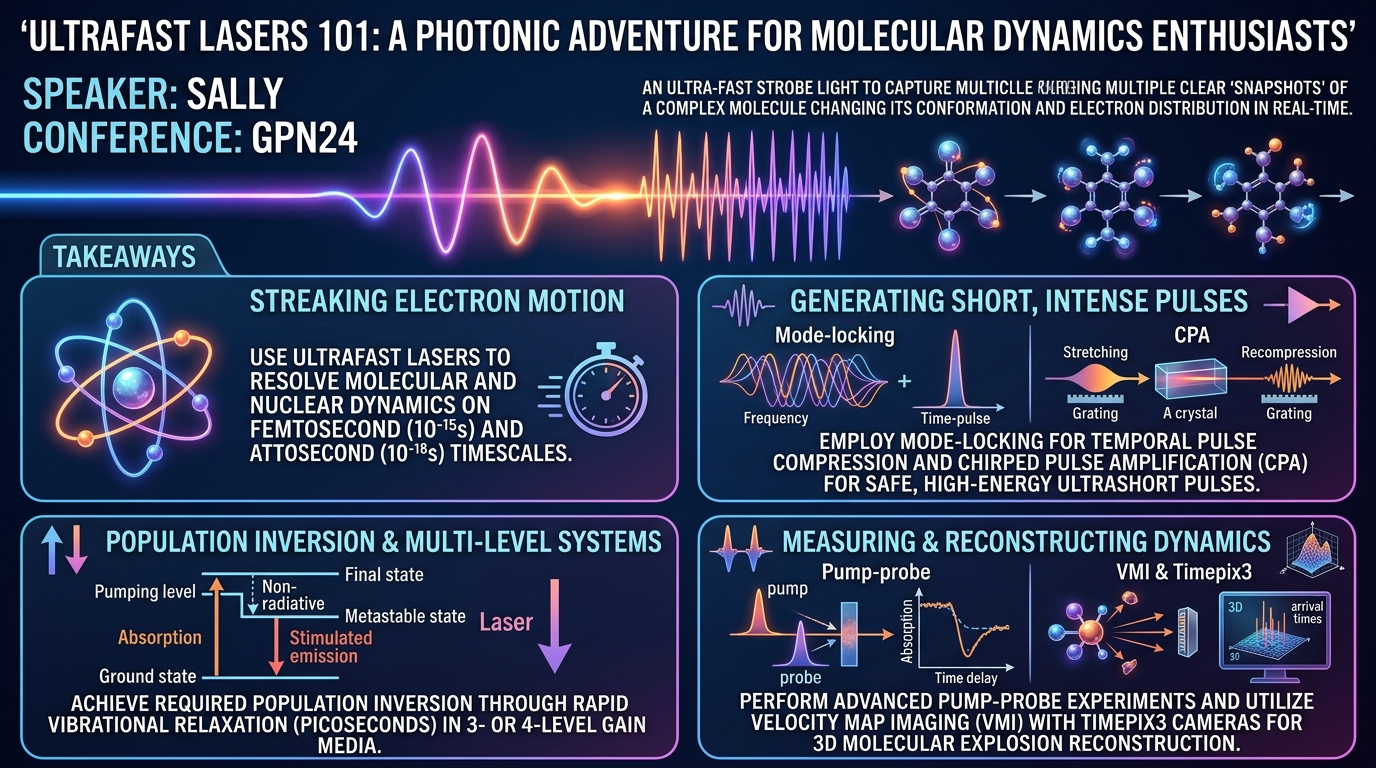
This talk, presented by Sally, a bachelor's student working at a research institute, offers a comprehensive introduction to the fascinating world of ultrafast lasers, specifically those operating in the femtosecond (10⁻¹⁵ seconds) and attosecond (10⁻¹⁸ seconds) regimes. The core objective of these advanced photonic tools is to resolve extremely rapid processes, such as molecular dynamics (electron movement) and nuclear dynamics, which occur on timescales too fast for conventional observation methods. Sally eloquently distills a university-level lecture on ultrafast laser physics into an accessible yet detailed presentation, emphasizing the joy and profound scientific impact of working with these cutting-edge technologies.
Key moments
- 0:00 Introduction to ultrafast lasers and Sally's background
- 4:00 The 'falling cat problem' illustrates need for fast lasers
- 15:00 Generating nanosecond pulses using Q-switching
- 22:00 How Kerr-lens mode-locking generates femtosecond pulses
- 33:00 Chirp Pulse Amplification for high-energy ultrashort pulses
- 44:00 Velocity map imaging reveals molecular explosion dynamics
- 46:00 Cutting-edge Timepix3 camera for 3D molecular reconstruction
Ultrafast Lasers 101: A Photonic Adventure for Molecular Dynamics Enthusiasts
Speakers: Sally
Conference: GPN24
YouTube: https://www.youtube.com/watch?v=duGnYcSw1vA
Overview
This talk, presented by Sally, a bachelor's student working at a research institute, offers a comprehensive introduction to the fascinating world of ultrafast lasers, specifically those operating in the femtosecond (10⁻¹⁵ seconds) and attosecond (10⁻¹⁸ seconds) regimes. The core objective of these advanced photonic tools is to resolve extremely rapid processes, such as molecular dynamics (electron movement) and nuclear dynamics, which occur on timescales too fast for conventional observation methods. Sally eloquently distills a university-level lecture on ultrafast laser physics into an accessible yet detailed presentation, emphasizing the joy and profound scientific impact of working with these cutting-edge technologies.
The significance of ultrafast lasers lies in their ability to act as "stroboscopes" for the microscopic world, allowing scientists to capture snapshots of atoms and molecules in motion. Just as early photographers struggled to understand the mechanics of a falling cat due to slow camera speeds, modern physicists face similar challenges in visualizing the intricate dance of electrons that dictates chemical reactions and material properties. By providing unprecedented temporal resolution, ultrafast lasers unlock new avenues for fundamental research in chemistry, physics, and materials science, promising breakthroughs in areas like efficient energy conversion, novel material design, and deeper understanding of biological processes.
Sally’s personal journey into this field, sparked by repairing a mass spectrometer and connecting with her current professor, highlights the interdisciplinary nature of scientific discovery and the opportunities available to enthusiastic students. Her talk serves as both an educational primer and an inspiring testament to the power of curiosity and hands-on experience in advanced scientific research.
Background
▶ Watch: Introduction to ultrafast lasers and Sally's background (0:00)
The fundamental challenge addressed by ultrafast lasers is the observation of phenomena that occur on extremely short timescales. Sally introduces this concept with the historical "falling cat problem" – how does a cat always land on its feet? The solution was only found when cameras became fast enough to capture sequential images, effectively using strobes of light to overcome shutter speed limitations. This analogy perfectly sets the stage for the modern problem: understanding molecular and nuclear dynamics.
Molecules are held together by electrons, which move and rearrange on the femtosecond timescale. Nuclear dynamics, involving the nuclei themselves, are even faster, occurring in attoseconds. Traditional measurement techniques are simply too slow to resolve these processes, leading to blurry, averaged observations that obscure the underlying mechanisms. To truly understand chemical reactions, energy transfer, and phase transitions, scientists need "cameras" that can capture these fleeting moments.
Sally's research group utilizes liquid helium nanodroplets as a unique environment to capture and study single molecules. These droplets serve as tiny, isolated reaction chambers, allowing researchers to introduce specific molecules and then probe their behavior using ultrafast laser pulses. This setup enables the study of fundamental interactions without interference from bulk solvent effects, providing a clean slate for observing molecular dynamics.
The talk then delves into the foundational principles of laser operation, starting with continuous wave (CW) lasers. Key concepts include Einstein coefficients for absorption, stimulated emission, and spontaneous emission. Crucially, for a laser to function, it requires population inversion, where more electrons reside in a higher energy state than a lower one. This is challenging in simple two-level systems because the emitted photon can be re-absorbed. The solution lies in three- or four-level systems, where intermediate energy levels allow for efficient pumping and rapid vibrational relaxation (on the picosecond scale) to a metastable state, creating the necessary population inversion for sustained stimulated emission. This rapid relaxation is orders of magnitude faster than spontaneous emission (microseconds to milliseconds), making it a critical factor in laser efficiency.
Key Findings
▶ Watch: Generating nanosecond pulses using Q-switching (15:00)
While the talk is primarily an educational exposition on ultrafast laser physics rather than a presentation of novel research findings, it effectively outlines the key capabilities and contributions that ultrafast laser technology brings to scientific discovery. These "findings" are the techniques and principles that enable groundbreaking research in molecular dynamics.
One central contribution is the generation of extremely short, high-intensity laser pulses. The talk details how mode-locking techniques, particularly Kerr-lens mode-locking, overcome the limitations of continuous-wave lasers to produce femtosecond pulses. This involves precisely aligning the phases of many different laser modes to create a sharp, intense peak of constructive interference, effectively converting a broad spectrum of frequencies into a brief temporal pulse.
Another significant capability highlighted is the manipulation and amplification of these ultrafast pulses without damaging the laser medium. Chirped Pulse Amplification (CPA) is presented as a crucial technique that stretches a short pulse in time (reducing its peak intensity), amplifies it, and then recompresses it. This allows for the creation of exceptionally high-energy, ultrashort pulses that would otherwise destroy the amplifying medium, making them suitable for demanding experiments. The talk also briefly mentions Optical Parametric Amplification (OPA), a highly versatile nonlinear optical technique that can generate a wide range of wavelengths from a single input pulse, further expanding experimental possibilities.
Finally, the talk emphasizes the development of advanced measurement techniques that are commensurate with the speed of the laser pulses themselves. Pump-probe experiments are a cornerstone, using one pulse to initiate a molecular event and a second, delayed pulse to probe its evolution. Specific methods like transient absorption, photoion detection (time-of-flight mass spectrometry), and photoelectron spectroscopy are detailed as means to extract information about molecular structures and reaction pathways. The introduction of velocity map imaging (VMI), combined with the Timepix3 camera, represents a significant advancement, enabling the 3D reconstruction of molecular explosions with nanosecond temporal resolution, providing unprecedented insights into the spatial distribution and dynamics of molecular fragments. These capabilities collectively form the bedrock for resolving the most fundamental processes in physical chemistry and molecular physics.
Technical Deep Dive
▶ Watch: How Kerr-lens mode-locking generates femtosecond pulses (22:00)
The talk provides a meticulous breakdown of the physical principles and engineering solutions behind ultrafast lasers, starting from basic laser operation and progressing to complex mode-locking and pulse manipulation.
At the heart of any laser is the concept of population inversion within a gain medium. Sally explains how three- and four-level systems are superior to two-level systems. In these multi-level schemes, electrons are pumped to a high energy level, rapidly relax non-radiatively (via intramolecular vibrational redistribution in molecules or phonon coupling in solid-state lattices) to a metastable "lasing" level. From this level, stimulated emission occurs, transitioning electrons to a lower level, which then quickly relaxes to the ground state. This rapid relaxation from the lower lasing level prevents re-absorption and maintains population inversion. Sally notes that vibrational relaxation typically occurs on the picosecond timescale, significantly faster than spontaneous emission (micro- to milliseconds), which is critical for efficient laser operation.
For nanosecond pulses, a technique called Q-switching is employed. This involves incorporating a Pockels cell and a polarizer into the laser cavity. A Pockels cell acts as a switchable wave plate, rotating the polarization of light. When "off," it might rotate diagonally polarized light into circularly polarized light. Upon reflection from a mirror, the polarization is shifted by 180 degrees. If the Pockels cell is then switched "on" (e.g., acting as a lambda-half wave plate), it inverts the wave, causing the polarization to align with the polarizer. By initially misaligning the polarization (e.g., 90 degrees out of phase with the polarizer), the Pockels cell effectively blocks the laser cavity, preventing stimulated emission. This allows for a massive buildup of excited state population in the laser rod. When the Pockels cell is then rapidly switched to allow light transmission, all the stored energy is released in a very intense, short (nanosecond) pulse. This is akin to opening a floodgate after a dam has built up a huge reservoir of water.
The generation of femtosecond pulses relies on mode-locking, which requires a broad spectrum of frequencies with precisely aligned phases to constructively interfere into a very short temporal pulse. Sally elucidates that a short pulse in the time domain corresponds to a broad spectrum in the frequency domain, analogous to how a square wave in electronics contains many harmonic frequencies. Kerr-lens mode-locking (KLM) is a passive technique often used. It leverages three key nonlinear optical effects within the laser medium:
- Dispersion: Different wavelengths travel at different speeds through the medium, causing the pulse to spread out in time.
- Self-focusing: High-intensity light changes the refractive index of the medium, causing the beam to focus itself. The central, more intense part of the Gaussian beam focuses more strongly.
- Self-phase modulation (SPM): The intensity-dependent refractive index also causes the phase of the pulse to shift, leading to a time-dependent frequency shift (chirp) and broadening the pulse's spectrum.
To counteract the inherent positive dispersion (blue light travels slower, longer optical path) introduced by the laser medium, negative dispersion elements are crucial. Sally explains how this seemingly counterintuitive concept is achieved using two prisms or gratings, which can be angled such that blue light effectively takes a shorter path, compressing the pulse. The KLM setup also incorporates a slightly bent mirror for initial focusing, a birefringent filter to adjust the optical path length without moving mirrors, and an adjustable slit. This slit spatially filters the beam, allowing only the highly self-focused (and thus high-intensity, mode-locked) light to pass, forcing the laser into a pulsed, mode-locked operation. The process starts with a broad, non-short pulse, which, through propagation and subsequent closing of the slit, is forced into a mode-locked state, generating a broad spectrum necessary for short pulses.
For manipulating and amplifying these delicate ultrashort pulses, Chirped Pulse Amplification (CPA) is indispensable. A short pulse is first stretched in time using a positive dispersion element (e.g., gratings where blue light travels a longer path) to reduce its peak intensity. This "chirped" pulse is then filtered to ensure a uniform spectral profile and amplified significantly in a power amplifier. Finally, it is compressed back to its original duration (or even shorter) using a negative dispersion element (e.g., gratings where blue light travels a shorter path), yielding a very high-energy, ultrashort pulse. CPA prevents damage to the amplification medium that would occur if the original high-intensity pulse were amplified directly.
Sally also briefly mentions Optical Parametric Amplification (OPA), a versatile method for generating tunable wavelengths. OPAs utilize highly nonlinear crystals and a strong "pump" pulse to amplify a weak "seed" signal or even generate new wavelengths from quantum noise. A fascinating detail is the generation of this weak seed signal itself: very high-intensity ultrashort pulses can generate white light through extreme nonlinear effects in dense optical materials. This white light is then dispersed, and a specific wavelength is selected via a delay stage to act as the seed for the OPA, allowing for tunable output.
Demo / Proof of Concept
▶ Watch: Velocity map imaging reveals molecular explosion dynamics (44:00)
While Sally's talk is a foundational explanation rather than a live demonstration of a specific experimental result, she effectively describes the operational principles of the experiments conducted in her research group, which serve as the practical application of the ultrafast laser technologies discussed. The "demo" in this context is the conceptual walkthrough of these advanced experimental setups.
The primary experimental technique is the pump-probe experiment. Here, a single ultrafast laser pulse is split into two. One pulse, the pump, initiates a process in the sample (e.g., excites a molecule to a higher energy state). The second pulse, the probe, is delayed by a precisely controlled amount and then used to interrogate the evolving system. By varying the delay time between the pump and probe, scientists can capture snapshots of the molecular or electronic changes as they unfold in real-time.
Sally elaborates on several detection methods used in pump-probe experiments:
- Transient Absorption: The probe pulse passes through two parts of a sample—one pumped and one unpumped—and the difference in absorption is measured. This reveals how the sample's absorption spectrum changes over time after excitation.
- Photoion Detection (Time-of-Flight Mass Spectrometry): The laser ionizes molecules, and the resulting ions are accelerated through a drift tube. Their flight time is measured, which allows for the determination of their mass-to-charge ratio. This is crucial for identifying molecular fragments after a laser-induced reaction.
- Photoelectron Spectroscopy: The pump pulse excites a molecule, and the probe pulse then rips an electron from it. The kinetic energy of the emitted electron is measured, providing information about the energy levels and electronic structure of the excited state.
A specific example provided is the study of acetone, where different kinetic energies of ejected electrons at various time delays provide insights into its decay pathways.
The most sophisticated "proof of concept" discussed is Velocity Map Imaging (VMI), a technique actively used and further developed in Sally's lab. In VMI, ionized fragments from a laser-induced molecular explosion are guided by an electric field towards a microchannel plate (MCP) amplifier and then to a phosphor screen. The spatial distribution of the detected fragments on the screen, combined with their time-of-flight, allows for a 3D reconstruction of the molecular explosion. This provides not only mass information but also the kinetic energy and angular distribution of the fragments, revealing the geometry of the dissociation and the orientation of the molecule's interaction dipole moment relative to the laser polarization.
A key highlight of the group's current work is the integration of the Timepix3 camera with the VMI setup. This advanced, event-based camera offers nanosecond temporal resolution and can capture both the hit position and the exact arrival time of individual electrons on the phosphor screen. This capability enables the reconstruction of an entire 3D image of a molecular explosion from a single laser shot. Sally is actively involved in developing the C++ software for live, high-throughput data processing (up to 2.5 GB per measurement), addressing the bottleneck of traditional frame-based cameras and enabling immediate analysis of the complex data generated by these experiments. This sophisticated setup allows researchers to study phenomena like microsolvation within liquid helium nanodroplets, investigating how the environment influences molecular reactions.
Defensive Implications
▶ Watch: Cutting-edge Timepix3 camera for 3D molecular reconstruction (46:00)
While this talk focuses on fundamental physics and advanced experimental techniques rather than cybersecurity, the information presented has significant implications for scientific research, technological advancement, and the broader understanding of matter at its most fundamental level. These are "defensive implications" in the sense of building robust scientific knowledge and capabilities to address future challenges.
Firstly, the detailed exposition of ultrafast laser generation and manipulation provides a roadmap for researchers and engineers seeking to develop more precise and powerful light sources. Understanding the intricacies of mode-locking, Kerr-lens mode-locking, and Chirped Pulse Amplification (CPA) is crucial for designing next-generation lasers that push the boundaries of temporal resolution and peak intensity. This knowledge is vital for advancing fields like extreme ultraviolet (EUV) lithography for semiconductor manufacturing, high-field physics, and even medical applications where precise laser-tissue interaction is required.
Secondly, the discussion of pump-probe experiments and various detection methods (transient absorption, photoion detection, photoelectron spectroscopy, velocity map imaging) offers a comprehensive toolkit for observing and understanding ultrafast chemical and physical processes. For chemists, this means gaining unprecedented insight into reaction mechanisms, potentially leading to the design of more efficient catalysts or novel synthetic pathways. For materials scientists, it enables the study of charge carrier dynamics in new materials, critical for developing advanced photovoltaics or quantum computing components. The ability to reconstruct 3D molecular explosions, as demonstrated with the Timepix3 camera, provides a powerful diagnostic tool for understanding fragmentation pathways and molecular structure.
Thirdly, the emphasis on live data processing and the use of event-based cameras like the Timepix3 highlights a crucial trend in modern experimental science: managing and extracting information from massive, high-speed datasets. The challenge of processing 2.5 GB of data live, as Sally is tackling, is representative of the "big data" problem across many scientific disciplines. Developing efficient software and computational pipelines to handle such data streams is essential for maximizing the scientific return from cutting-edge instruments. This has implications for fields far beyond optics, including astrophysics, particle physics, and bioinformatics.
Finally, the talk implicitly underscores the continuous pursuit of higher precision and shorter timescales. The mention of attosecond pulses for nuclear dynamics signifies the ongoing quest to resolve even more fundamental processes. This relentless drive for technological improvement and deeper understanding is a core "defensive" strategy against the unknown, expanding humanity's knowledge base and equipping future generations with the tools to solve complex scientific and technological problems.
Key Takeaways
- Ultrafast lasers are essential for resolving molecular and nuclear dynamics: They act as ultra-fast "stroboscopes" to capture processes occurring on femtosecond (electron motion) and attosecond (nuclear motion) timescales, enabling a deeper understanding of chemical reactions and material properties.
- Laser generation relies on population inversion in multi-level systems: Efficient laser operation requires pumping electrons to a higher state, followed by rapid vibrational relaxation (picoseconds) to a metastable level, allowing for stimulated emission while preventing re-absorption.
- Mode-locking and Chirped Pulse Amplification (CPA) are key to ultrafast pulse creation and manipulation: Mode-locking (e.g., Kerr-lens mode-locking) ensures all laser modes constructively interfere into a short pulse with a broad spectrum. CPA stretches, amplifies, and then recompresses pulses to achieve high energy without damaging the laser medium.
- Nonlinear optics are fundamental to ultrafast laser physics: Effects like self-focusing, self-phase modulation, and dispersion are leveraged in mode-locking, while nonlinear crystals are crucial for tunable wavelength generation via Optical Parametric Amplification (OPA).
- Advanced pump-probe experiments enable real-time observation of molecular processes: By initiating a reaction with one pulse and probing its evolution with a delayed second pulse, techniques like transient absorption, photoelectron spectroscopy, and velocity map imaging provide detailed insights into molecular dynamics.
- Cutting-edge detectors and data processing are crucial for modern experiments: The Timepix3 camera, with its nanosecond temporal resolution and event-based data acquisition, allows for 3D reconstruction of molecular explosions, requiring sophisticated live software processing to handle massive data volumes and extract meaningful scientific information.
About the Speaker(s)
Sally is an enthusiastic bachelor's student currently working at a research institute affiliated with her university. Her journey into ultrafast laser physics was sparked by her practical skills and curiosity, notably after she presented a talk at the CCC Congress about repairing a mass spectrometer. This experience led to an opportunity to work in a research group under a professor whose lectures on measurement techniques and ultrafast laser physics she highly regards. Sally is actively involved in the group's cutting-edge research, including the development of C++ software for live data processing from advanced cameras like the Timepix3, contributing directly to the 3D reconstruction of molecular explosions. Her passion for lasers and experimental physics is evident throughout her detailed and engaging presentation.
Reviews
Dr. Zero (Offensive Security Researcher) — SOLID
A competent intro-level physics lecture on ultrafast lasers, well-delivered by a bachelor's student who clearly knows her material. Zero security relevance, zero novel contribution — this is a university course segment that wandered into a hacker con. Fine for curious generalists; nothing here for practitioners.
Heather Calloway (CISO) — SOLID
This is a well-delivered physics lecture on ultrafast laser technology for molecular dynamics research. It has no enterprise security relevance whatsoever — no threat implications, no dual-use concerns, no infrastructure angles. Competent academic content, wrong conference track for my purposes.