Gaslight, Gatekeep, Girlboss: Breaking Minecraft's Decentralised Chat Reporting System
Ada
Gulaschprogrammiernacht 24 (GPN24) · Day 3 · ZKM Medientheater
Overview
In this compelling talk from GPN24, independent security researcher Ada dissects the deeply flawed and controversial chat reporting system introduced by Mojang into Minecraft Java Edition. The presentation, titled "Gaslight, Gatekeep, Girlboss: Breaking Minecraft's Decentralised Chat Reporting System," provides a comprehensive timeline of exploits discovered and developed against Mojang's attempts to implement a centralized moderation system in a game historically defined by its decentralized, player-hosted nature. Ada, known for her expertise in low-level Java and her passion for uncovering vulnerabilities in Minecraft, meticulously details how each iteration of Mojang's chat signing and reporting architecture was systematically bypassed.
Key moments
- 0:00 Minecraft's decentralized architecture and historical lack of trust
- 2:20 Minecraft 1.19 introduces controversial signed chat and reporting
- 6:40 Gaslight exploit: manipulating reported chat context
- 12:10 Gaslight 2.0: bypassing Mojang's Merkle tree fix
- 18:10 Server-side exploit: injecting messages victims never see
- 21:30 Widespread non-adoption and ineffectiveness of chat reporting
- 27:00 Live demo: new decorated chat message manipulation
- 32:50 Speaker's suggestions for genuine player safety improvements
Gaslight, Gatekeep, Girlboss: Breaking Minecraft's Decentralised Chat Reporting System
Speakers: Ada, Low-Level Java Developer, Independent Security Researcher
Conference: GPN24
YouTube: https://www.youtube.com/watch?v=VfTLUA078Aw
Overview
In this compelling talk from GPN24, independent security researcher Ada dissects the deeply flawed and controversial chat reporting system introduced by Mojang into Minecraft Java Edition. The presentation, titled "Gaslight, Gatekeep, Girlboss: Breaking Minecraft's Decentralised Chat Reporting System," provides a comprehensive timeline of exploits discovered and developed against Mojang's attempts to implement a centralized moderation system in a game historically defined by its decentralized, player-hosted nature. Ada, known for her expertise in low-level Java and her passion for uncovering vulnerabilities in Minecraft, meticulously details how each iteration of Mojang's chat signing and reporting architecture was systematically bypassed.
The talk highlights a fundamental clash between Mojang's desire for a safer, moderated online environment and the inherent trust assumptions of Minecraft's highly customizable and self-hosted ecosystem. By introducing signed chat and a global reporting mechanism, Mojang inadvertently opened a Pandora's Box of context manipulation vulnerabilities, allowing malicious actors to fabricate evidence, snoop on private communications, and even crash servers. This article delves into the technical intricacies of these exploits, Mojang's reactive patches, and the broader implications for players, server administrators, and the future of online game moderation.
The significance of Ada's work extends beyond mere technical curiosity; it underscores the challenges of imposing a centralized moderation paradigm onto a decentralized platform. The community's strong negative reaction, coupled with the widespread adoption of "No Chat Reports" mods, demonstrates a clear rejection of Mojang's approach. This talk serves as a critical case study in how security design, transparency, and community engagement are paramount when implementing sensitive features like content moderation, especially in a widely modded and self-governed gaming environment.
Background
▶ Watch: Minecraft's decentralized architecture and historical lack of trust (0:00)
Minecraft Java Edition, the original and most popular version of the game, has always operated on a unique architectural principle: decentralization. Unlike many modern online games, Minecraft lacks official multiplayer servers; instead, players download a JAR file and run their own servers. This self-hosted model fosters immense creativity and flexibility, with approximately 40% of servers being modded to enhance performance or add features, a figure that likely approaches 100% by player count on larger networks. Historically, Mojang's role was limited primarily to authentication, verifying player identities without dictating server content or moderation policies.
This decentralized architecture inherently creates an environment of low trust. Clients can exploit servers (Ada notes 10-20 known ways to crash a server from a client), and conversely, malicious servers have historically exploited their own players through various anti-cheat or purely malevolent means, some of which Mojang still struggles to patch. Against this backdrop, the release of the 1.19 update introduced a seismic shift. Initially, it brought signed chat, where each message included a cryptographic signature, though this was unenforced. However, a few days post-release, Mojang rolled out a new reporting system that allowed players to report chat messages, potentially leading to bans from the game they had purchased.
This move was met with immediate and widespread backlash. The community, accustomed to Minecraft's "do whatever you want" ethos, viewed the system as an authoritarian overreach, especially coming on the heels of the mandatory Microsoft account migration. YouTubers amassed millions of views criticizing the change, and a Discord server dedicated to opposing the system quickly grew to 10,000 members. Despite Mojang's rapid development (shipping faster than any update except for the critical Log4j patch), the system was plagued by a lack of transparency. Mojang developers consistently cited "security reasons" for not disclosing how the system worked, a stance Ada critiques as "famously good position." This opacity, combined with the system's reliance on client-provided context (10 messages before and 3 after a reported message), laid the groundwork for the numerous exploits Ada and her colleague GuildFish would uncover.
Key Findings
▶ Watch: Gaslight exploit: manipulating reported chat context (6:40)
Ada's research exposed critical design flaws in Mojang's chat reporting system, leading to a series of impactful discoveries and contributions to understanding its vulnerabilities:
- Fundamental Flaws in Decentralized Moderation: The core finding is that Mojang's attempt to impose a centralized moderation system, relying on client-generated, cryptographically signed chat context, is inherently incompatible with Minecraft's decentralized and moddable architecture. This mismatch created an environment ripe for exploitation.
- Persistent Context Manipulation: The most recurring and significant class of vulnerabilities involved context manipulation. Ada demonstrated multiple ways attackers could reorder, remove, or inject messages into a chat report, making innocent conversations appear malicious to Mojang's moderators, even after Mojang implemented complex cryptographic solutions like Merkle trees and header packets.
- Bypassed Cryptographic Safeguards: Mojang's attempts to secure the system, including a complete rewrite utilizing a Merkle tree structure and
last_seenacknowledgments, were repeatedly circumvented. Ada showed that the system's design, particularly its handling of private messages and "decorated chat," still allowed for report fabrication. - Private Message Snooping: The initial implementation introduced header packets that, while intended to maintain chat chains for private messages, inadvertently enabled third parties to detect when private conversations were occurring, a vulnerability dubbed Gullfoss.
- Server-Side Exploitation: Ada uncovered methods where malicious servers could trick players into cryptographically signing messages they never saw, or inject hidden malicious content into displayed chat that would be included in reports, further blurring the line of truth.
- Widespread Community Rejection and Non-Adoption: Despite Mojang's efforts, the chat reporting system has seen minimal adoption. Ada's data indicates that over 95,000 of 171,000 scanned Minecraft servers do not enforce chat signing, and popular mods like "No Chat Reports" have accumulated over 150 million downloads, signifying a massive community rejection. Even Mojang's own server list struggles to find servers with the feature enabled.
- Opaque and Ineffective Moderation: The talk highlighted the extreme difficulty in understanding Mojang's actual moderation policies, buried under layers of linked documents. Crucially, the system provides no useful moderation tools (like temp bans or mutes) for server owners, forcing them to either aggressively moderate or face blacklisting by Mojang, while still shipping servers open to the internet by default.
- Ongoing Vulnerability: Even after multiple rewrites and several years, Ada concluded that many of the core exploits, including context manipulation and private message snooping, remain functional, and she unveiled a brand-new decorated chat exploit during the talk itself, underscoring the system's persistent fragility.
Technical Deep Dive
▶ Watch: Server-side exploit: injecting messages victims never see (18:10)
The technical journey through Minecraft's chat reporting system, as detailed by Ada, is a saga of iterative design flaws and persistent exploitation. It began with the seemingly innocuous introduction of signed chat in the 1.19 update, where every message was accompanied by a cryptographic signature. Initially unenforced, this became the bedrock for a reporting system that allowed players to submit objectionable chat with accompanying context.
The first major exploit, dubbed Gaslight, capitalized on the fact that messages were signed in isolation. "Messages are signed in isolation and you send a message, you send a second message, there's no cryptography that says the order they happened." This meant that when a player reported someone, they could freely add or remove messages, or reorder them, to fabricate a malicious narrative. Ada demonstrated this by taking an innocent conversation ("Do you want to PvP?") and injecting a fabricated message ("Are you breaking Mojang's terms of service?") to completely alter the context of the report. Mojang, receiving only the signed messages and the client-provided context, had no cryptographic means to detect this tampering.
Mojang's response was a rapid overhaul in 1.19 pre-release 4 and 5, introducing a new chat signing system based on a Merkle tree (though Ada humorously refers to it as a "blockchain" initially due to its chaining nature). The core idea was to link messages cryptographically: each new message from a player would include the signature of their previous message, creating an unalterable chain for that specific player's messages. To handle multi-player conversations, they added a last_seen field. When Bob sent a message, he would acknowledge Alice's most recent message; Alice, in turn, would acknowledge her own and Bob's. This last_seen field was per-player, acknowledging only the most recent message from up to five other players, not a comprehensive list. For private messages, a header packet was introduced. This packet would announce that a private message was sent by a player, along with its signature, allowing other clients to maintain their cryptographic chain even without seeing the private content. This system successfully fixed the original Gaslight exploit.
However, Ada and GuildFish quickly developed a second Gaslight exploit for 1.19.1. This attack leveraged the nuances of private messages and the last_seen mechanism. To remove messages, they exploited the fact that Mojang only saw the header packet for private messages, not who received them. A client could claim, "I never saw that message," and as long as no subsequent message from that client acknowledged it, Mojang had no cryptographic proof otherwise. To add messages, the exploit utilized a quirk where a player could send a private message to themselves. This private message would enter their chat chain. If they then sent a public message, it would acknowledge this self-sent private message. A vanilla client reporting someone would then include this private message in the report context, allowing for the same kind of context manipulation as the original Gaslight, but requiring more intentional setup.
The header packet itself introduced another vulnerability: Gullfoss, or private message snooping. By observing the header packets, an attacker could determine that two players were engaging in a private conversation, even without seeing the content. This could be useful in competitive game modes like factions. Another client-side exploit, Guardians, manipulated the reportee's context. A modded client could pretend to have blocked the entire server, causing their last_seen field to be empty. When reported, this would strip all incoming messages from the report, making moderation difficult due to lack of context.
A critical crash exploit, Gatekeeper, was discovered, leveraging key expiry race conditions. A player could send an unexpired key to the server, but by the time they fully joined the game, the key would have expired. Any subsequent messages would cause other players to disconnect. This exploit was patched by Mojang in 1.19.2, notably within hours of Ada's team releasing it.
Following this, a server-side exploit was developed, targeting the delete message packet and system messages. Many large servers use "system messages" for chat, which are unsigned, to bypass Mojang's signing. A malicious server could send a signed message to a victim, then immediately send a delete message packet. The victim would never see the message, but because they cryptographically signed receiving it, Mojang would see the message in a report. This highlighted Mojang's quote: "anywhere malicious server can trick a player into seeing a message they didn't or not seeing a message would be quite bad."
In 1.19.3, Mojang again rewrote the chat system. Headers were removed, replaced by simple indexes (message counts). Receiving clients would now accept index gaps. The last_seen field was changed to store the last 20 messages, rather than being per-player. While less egregious, this system still allowed for removing messages. The concept of a silent reporter emerged: an alt account passively observing chat without sending messages. Since this alt account signed nothing, Mojang would have no cryptographic proof that it saw any messages, making it easy to claim ignorance and remove context from reports.
Finally, Ada unveiled a brand-new exploit during the talk, leveraging decorated chat. Servers often modify chat (e.g., adding ranks, colors, or swear filters). Mojang's system for verifying decorated chat relies on a simple check: if the displayed message contains the signed message, it's considered valid. The exploit works by having a server-side mod prepend or append malicious content to a short, innocuous signed message (e.g., signing "hello" but displaying "hello, I have burned your house down"). The victim sees the full malicious message, but the report sent to Mojang only includes the original signed "hello." Crucially, this manipulation is unnoticeable on a vanilla client and appears as an unmodified message in both chat and reports, making it a highly insidious form of context manipulation.
Demo / Proof of Concept
▶ Watch: Widespread non-adoption and ineffectiveness of chat reporting (21:30)
Ada's presentation included two key demonstrations, vividly illustrating the power of context manipulation in Minecraft's chat reporting system.
The first demonstration showcased the initial Gaslight exploit. In a video recording, Ada and her colleague GuildFish engage in a seemingly innocent conversation. Ada asks, "Do you want to PvP?" and receives an affirmative response. The video then transitions to the reporting interface. Crucially, Ada is shown using a modified client that includes a custom input box, allowing her to add a new chat message to the report context. She types, "Are you breaking Mojang's terms of service?" and then proceeds to reorder the messages, placing this fabricated question strategically within the conversation. The resulting report, sent to Mojang, presents an entirely different, incriminating narrative, despite the original conversation being harmless. Ada emphasizes that "Mojang cannot tell that I've changed this," highlighting the profound trust issue at the heart of the system.
The second, and perhaps most impactful, demonstration was performed live during the talk, revealing a newly discovered exploit related to decorated chat. Ada switched to two running Minecraft clients, representing an attacker and a victim. On the attacker's client, she set up the attack, signing a simple message like "hello." However, due to a server-side modification, the victim's client received and displayed a much longer, malicious message: "hello, I have burned your house down." The attacker's client, in contrast, showed the malicious part in red, indicating it was never actually sent as part of the signed message. Ada then proceeded to report herself from the victim's perspective. When viewing the generated report, the victim saw "hello, I have burned your house down" as the reported message, even though the attacker had only signed "hello." Ada then switched back to her slides, showing a clear side-by-side comparison: what the user sees ("hello, I have burned your house down") versus what Mojang sees (the original signed "hello" within a context that now makes the malicious text appear to be part of the victim's interaction). This exploit underscores how a server, with minimal modification, can inject arbitrary, unsigned malicious content into a player's perceived chat, which then gets included in reports, creating a deeply misleading and potentially damaging context for the victim.
These demonstrations served as powerful proof points, moving beyond theoretical discussions to concrete, reproducible attacks that expose the fundamental vulnerabilities of Mojang's chat reporting system.
Defensive Implications
▶ Watch: Speaker's suggestions for genuine player safety improvements (32:50)
The findings presented by Ada have profound defensive implications for all stakeholders in the Minecraft community: players, server administrators, and Mojang itself.
For Players:
The most critical implication for players is the understanding that the chat reporting system cannot be fully trusted. Due to the pervasive context manipulation exploits, even innocent conversations can be weaponized against them by malicious clients or servers. Players should be aware that anything they type, even privately, could potentially be used out of context in a report. The new decorated chat exploit is particularly insidious, as it allows servers to inject malicious content into a player's perceived chat without their knowledge, making the player appear guilty in a report for something they never signed. This calls into question the reliability of any ban issued based solely on Mojang's reporting system.
For Server Administrators:
Ada's research strongly suggests that Mojang's chat reporting system is largely ineffective and widely rejected by the community. Statistics show that out of 171,000 Minecraft servers scanned, 95,000 are not enforcing chat signing. Furthermore, at least 18,000 servers (an underestimate, as many popular server software configurations do not report this) actively use the "No Chat Reports" mod, which completely disables the system server-side. Even Mojang's own server list struggles to find servers with chat reporting enabled, with Ada finding only two results, both of which were miscategorized.
This widespread non-adoption indicates that server administrators have largely opted out of the system. The talk highlights that the system fails to provide server owners with useful moderation tools; vanilla Minecraft still lacks basic functionalities like temporary bans or mutes. Instead, Mojang has pushed the responsibility of moderation onto server owners, even threatening to blacklist popular anarchy servers if they don't aggressively moderate their communities. For server administrators, the defensive posture should involve:
- Disabling Chat Signing: Given the system's vulnerabilities and lack of utility, disabling chat signing or installing "No Chat Reports" or similar mods is a common practice among server owners.
- Implementing Local Moderation: Server administrators should focus on robust, in-house moderation tools and policies that align with their community's needs, rather than relying on Mojang's opaque and exploitable global system.
- Transparency: Be transparent with players about how chat is handled and what measures are in place for moderation.
For Mojang (Implied Recommendations):
The continuous discovery of exploits and the overwhelming community rejection underscore that Mojang's current approach to chat moderation is fundamentally flawed. Defensive implications for Mojang include:
- Rethink Centralized Moderation: The core issue lies in attempting to impose a centralized trust model on a decentralized platform. A complete re-evaluation of this paradigm is necessary.
- Transparency and Collaboration: Greater transparency about moderation policies and a willingness to collaborate with the security community (rather than being "deeply unpopular") could lead to more robust solutions.
- Empower Server Owners: Instead of forcing a global system, Mojang should focus on providing server owners with effective, local moderation tools that allow them to manage their own communities responsibly.
- Address Core Vulnerabilities: The persistence of context manipulation, private message snooping, and decorated chat exploits indicates that the underlying design is still insecure. A system that can be so easily manipulated by malicious clients or servers cannot be trusted for fair moderation.
- Open Source or Public Review: Given the sensitivity of moderation, making the system's design open for public security review could help identify flaws before deployment.
In summary, the defensive posture against Minecraft's chat reporting system involves skepticism, local control, and a recognition of its inherent vulnerabilities. For players, it's about awareness; for server admins, it's about choosing effective, community-aligned moderation; and for Mojang, it's about a fundamental re-evaluation of their strategy.
Key Takeaways
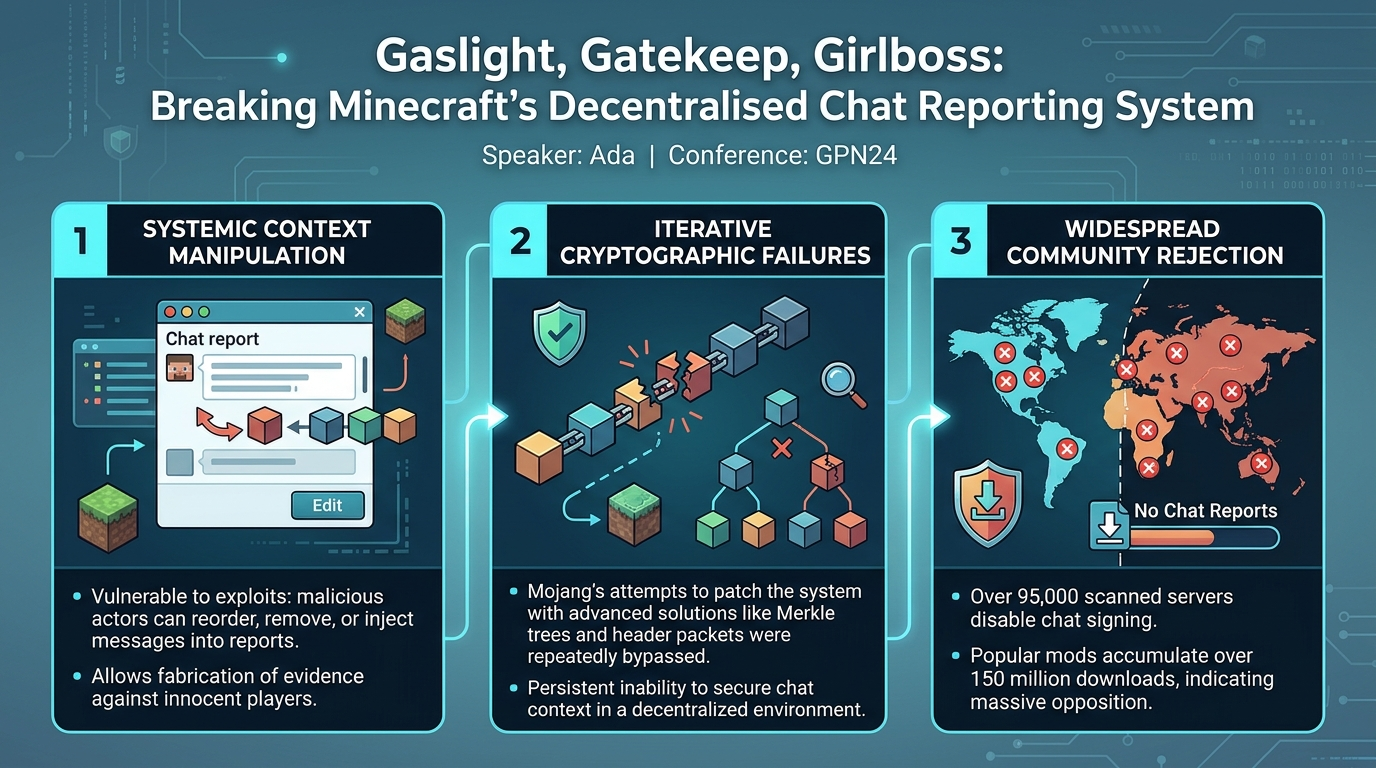
- Systemic Vulnerability to Context Manipulation: Minecraft's chat reporting system, despite multiple redesigns, remains fundamentally vulnerable to context manipulation exploits, allowing malicious actors to reorder, remove, or inject messages into reports to fabricate evidence against players.
- Mojang's Iterative Failures: Mojang's attempts to patch the system with advanced cryptographic solutions like Merkle trees, header packets, and index-based chat have been repeatedly bypassed, demonstrating a persistent inability to secure chat context in a decentralized environment.
- Widespread Community Rejection: The chat reporting system faces massive community rejection, with over 95,000 servers disabling chat signing and popular mods like "No Chat Reports" accumulating over 150 million downloads, indicating a strong preference for local server autonomy.
- Opaque and Ineffective Moderation: Mojang's moderation policies are obscure and difficult to navigate, and the system fails to provide server owners with essential moderation tools (e.g., temporary bans, mutes), forcing them into aggressive, unsupported moderation or risking blacklisting.
- Insidious "Decorated Chat" Exploit: The newly discovered decorated chat exploit allows malicious servers to inject arbitrary unsigned content into a player's displayed messages, which is then included in reports, making the victim appear guilty without their knowledge or cryptographic signature.
- Trust in a Decentralized Ecosystem: The core conflict lies in Mojang's attempt to impose a centralized trust model on a historically decentralized and moddable game, highlighting the critical importance of designing security systems that respect platform architecture and community expectations.
About the Speaker(s)
Ada is an independent security researcher with a deep passion for understanding and breaking software, particularly within the Minecraft ecosystem. By day, she specializes in low-level Java development and performance optimization. By night, her focus shifts to uncovering vulnerabilities in Minecraft, a pursuit she shares with her collaborator, GuildFish. Her work, as showcased in this GPN24 talk, demonstrates a keen technical insight into complex systems and a commitment to exposing security flaws for the benefit of the broader community. Ada's critical analysis and ability to develop working exploits against Mojang's chat reporting system have positioned her as a notable voice in the Minecraft security community.
Reviews
Dr. Zero (Offensive Security Researcher) — STRONG ACCEPT
Solid exploit research against a system that deserved to be broken. Ada systematically dismantles Mojang's chat reporting architecture across multiple iterations, demonstrating that bolting centralized moderation onto a decentralized platform creates exploitable trust gaps no amount of Merkle trees can fix. The live demo of the decorated chat exploit landing a new 0-day on stage is the kind of thing that makes talks memorable.
Heather Calloway (CISO) — SOLID
Thorough teardown of a flawed content moderation system in a consumer gaming platform. The cryptographic design failures are real, but the scope is narrow — this is a Minecraft-specific saga, not a template for enterprise risk. Worth the time if you're thinking about trust models in decentralized systems, but most security programs won't act on this.