Bagel: History of a bread with a hole
Johannes Bechberger
Gulaschprogrammiernacht 24 (GPN24) · Day 3 · ZKM Vortragssaal
Overview
In a delightful departure from the typical cybersecurity fare, Johannes Bechberger at GPN24 presented "Bagel: History of a bread with a hole," an illuminating talk that delves into the rich, complex, and often surprising cultural history of the humble bagel. Far from being a mere culinary curiosity, Bechberger meticulously traces the bagel's origins from its early forms in Eastern Europe to its iconic status in New York and beyond, revealing a narrative deeply intertwined with Jewish migration, economic shifts, and culinary innovation. This presentation offers a unique lens through which to appreciate how food traditions serve as powerful markers of identity, resilience, and cultural exchange across centuries and continents.
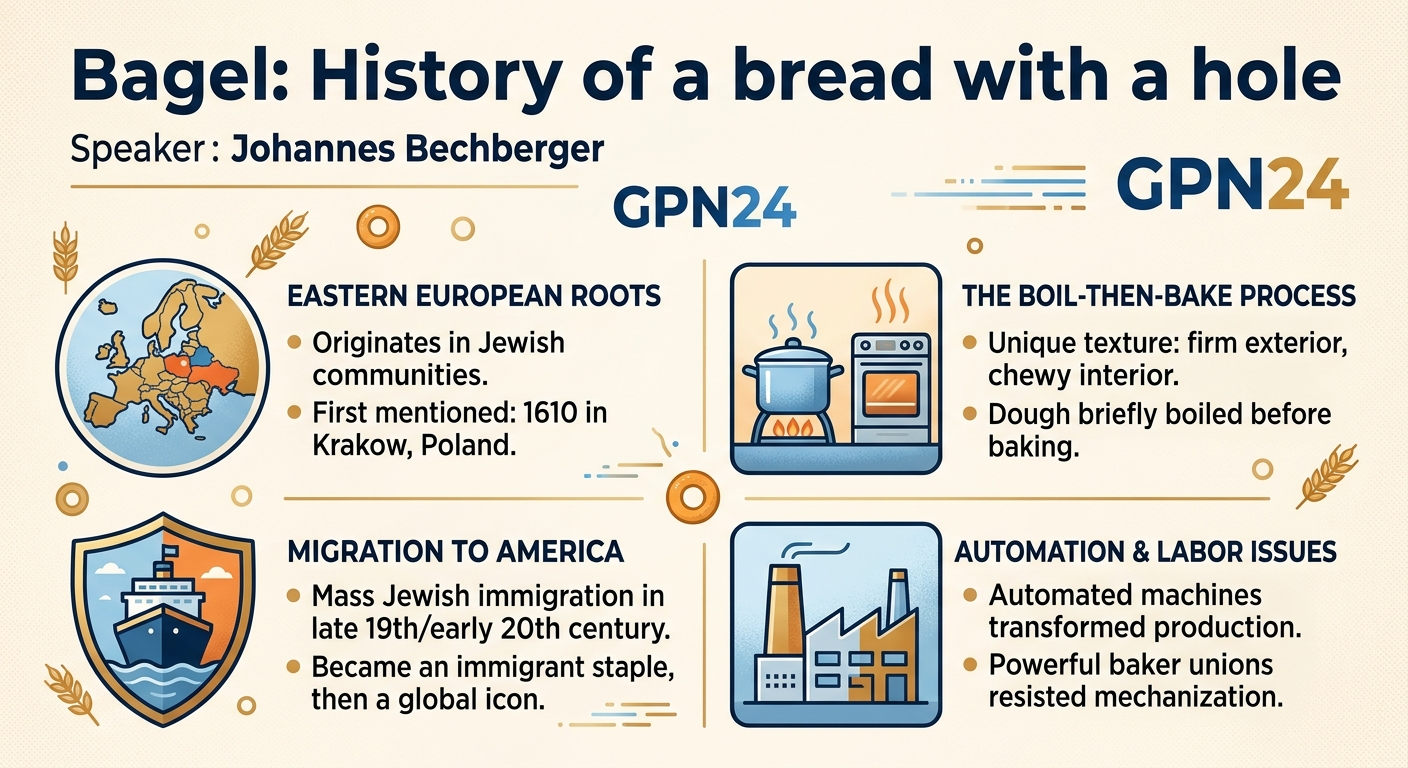
Key moments
- 2:09 Early perception: "Bagel is a donut with rigor mortis"
- 6:00 Pretzels: The bagel's surprising original ancestor
- 9:54 First written mention: 1610 Jewish Council regulations
- 14:00 Bagels as a means for women's emancipation
- 18:30 Jewish migration brings bagels to New York City
- 24:00 The "purest New York bagel" preparation described
- 26:30 Intense bagel bakers union and automation's impact
Bagel: History of a bread with a hole
Speakers: Johannes Bechberger
Conference: GPN24
YouTube: https://www.youtube.com/watch?v=gzWNcyqPZk0
Overview
In a delightful departure from the typical cybersecurity fare, Johannes Bechberger at GPN24 presented "Bagel: History of a bread with a hole," an illuminating talk that delves into the rich, complex, and often surprising cultural history of the humble bagel. Far from being a mere culinary curiosity, Bechberger meticulously traces the bagel's origins from its early forms in Eastern Europe to its iconic status in New York and beyond, revealing a narrative deeply intertwined with Jewish migration, economic shifts, and culinary innovation. This presentation offers a unique lens through which to appreciate how food traditions serve as powerful markers of identity, resilience, and cultural exchange across centuries and continents.
Bechberger's talk transcends a simple recipe or food history, instead crafting a compelling story of adaptation and survival. He explores the linguistic evolution of the word "bagel," its ritualistic significance in Jewish communities, and the socio-economic factors that propelled its journey from a regional specialty to a global phenomenon. For a security conference, this talk serves as a poignant reminder that the human element—culture, history, and community—underpins all technological advancements and social structures, offering a refreshing perspective on the interconnectedness of seemingly disparate fields.
The significance of this talk at a technical conference lies in its demonstration of how deep dives into seemingly mundane topics can uncover profound insights into human history and ingenuity. It highlights the value of interdisciplinary thinking and the often-overlooked stories embedded within everyday objects. By presenting a detailed historical and cultural analysis of the bagel, Bechberger not only entertains but also subtly encourages attendees to appreciate the rich tapestry of human experience that exists alongside, and often influences, the digital world they inhabit.
Background
▶ Watch: Early perception: "Bagel is a donut with rigor mortis" (2:09)
The journey of the bagel is a testament to cultural transmission and adaptation, beginning long before its association with New York City. Bechberger challenges the common misconception that the bagel is a relatively modern American invention, revealing its deep roots in Eastern European Jewish communities. The word itself, Beigel, traces its origins to Yiddish, influenced by the German word Beugel, meaning "bracelet" or "round." This linguistic connection hints at its characteristic circular shape, which has been central to its identity for centuries.
The earliest forms of bagel-like breads can be traced to various European traditions, including the Italian tarallo from Puglia and the Roman flatbread bucellatum. While a popular narrative links the bagel's introduction to Poland via an Italian queen from the Medici family, Bechberger quickly debunks this, noting that the word "bagel" appeared in Yiddish rule books before her arrival, making it a "dead end, but a nice story." Instead, the pretzel, particularly its boiled and steamed precursors, is identified as a significant cousin or even a direct ancestor, originating in German monasteries and later evolving within the Polish-Lithuanian Commonwealth.
The true crucible for the bagel's development was Poland, specifically within the Grand Duchy of Poland-Lithuanian Commonwealth. During the 14th to 16th centuries, Polish kings, seeking to boost their economy, offered religious freedom and opportunities to persecuted Jewish communities from elsewhere in Europe. This influx of Jewish people, potentially bringing pretzel-making traditions, led to the flourishing of unique customs and foods. The first documented mention of the word "bagel" appeared in 1610 in Jewish Council regulations, highlighting its status as a luxury good made from expensive wheat, intended to be reserved for the wealthy. This early association with exclusivity and its symbolic role in life cycle events—eaten at funerals and circumcisions to symbolize the eternal cycle of life and ward off evil—underscores its profound cultural significance well before its global popularization.
Key Findings
▶ Watch: First written mention: 1610 Jewish Council regulations (9:54)
Johannes Bechberger's talk unveils several key findings that reframe our understanding of the bagel's history and cultural impact:
- Eastern European Jewish Origin: Contrary to popular belief, the bagel is not a 20th-century New York invention. Its roots are firmly planted in the Jewish communities of Eastern Europe, particularly within the Polish-Lithuanian Commonwealth. The earliest known written mention of the word "bagel" dates back to 1610 in Krakow, Poland, found in Jewish Council regulations.
- Pretzel as a Precursor: The German pretzel is identified as a direct precursor or close sibling to the bagel. Both share the characteristic of being boiled before baking, a process that creates a distinct firm exterior and soft interior. The talk presents vegan pretzels baked with a similar dough as contemporary bagels, illustrating this ancestral connection.
- Cultural and Ritualistic Significance: Early bagels held significant cultural and religious importance within Jewish communities. They symbolized the "eternal cycle of life" due to their round shape and were consumed at significant life events such as funerals and circumcisions, believed to ward off evil. This deep symbolic meaning contrasts sharply with its later commercialization.
- Socio-Economic Catalyst for Popularity: The widespread availability of cheap wheat, particularly from the fertile soils of Ukraine in the mid-19th century, was a major factor in the bagel's growing popularity. This made wheat-based goods, previously a luxury, accessible to a broader population, leading to increased consumption.
- Immigration to America and the "Melting Pot": The late 19th and early 20th centuries saw massive waves of Jewish immigration to the United States, driven by persecution and pogroms in Eastern Europe. Between 1882 and 1920, over 2.3 million Jews arrived in the US, with many settling in New York's Lower East Side. They brought their culinary traditions, including the bagel, which then became a staple of immigrant life, often baked in cramped, unsanitary conditions.
- Evolution of Bagel Varieties: The talk highlights how bagels adapted to new palates. Flavors like raisin and cinnamon were introduced to appeal to non-Jewish consumers (gentiles), drawing inspiration from German Easter dough traditions. More modern additions like blueberry bagels are noted as being driven by entirely new market preferences, such as their unexpected popularity in South Korea, demonstrating the bagel's ongoing multicultural evolution.
- The Rise of Baker Unions and Automation: Bagel baking was historically hard labor, often done by foot-kneading moist dough. This led to the formation of powerful baker unions in New York, which, despite having only 300 Yiddish-speaking members by the 1950s, could cause "bagel famines" through strikes. The invention of the first viable automated bagel machine by Canadian Thompson marked a significant shift towards mass production, leading to further industry changes and standardization.
- New York vs. Montreal Bagels: Bechberger distinguishes between the two major North American bagel styles. While New York bagels are known for their dense, chewy texture (achieved by boiling in water and then baking), Montreal bagels (like those from Fairmont or St-Viateur) are characterized by being slightly sweeter (often using honey or malt in the boiling water) and baked in wood-fired ovens, giving them a distinct crispier, chewier texture and a slightly smaller, denser form, often rolled by hand.
Technical Deep Dive
▶ Watch: Bagels as a means for women's emancipation (14:00)
While "technical" in a cybersecurity context typically refers to code, protocols, or system architectures, in the realm of culinary history, it pertains to the detailed processes, ingredients, and transformations that define a food item. Bechberger's talk provides a fascinating technical deep dive into the culinary science and historical evolution of the bagel, focusing on its unique production method and the variations that emerged over time.
At its core, the bagel's distinct texture is a direct result of its unique two-stage cooking process: boiling followed by baking. This is the key "technical" aspect that sets it apart from other breads.
- Dough Composition: Traditional bagel dough is a relatively stiff, yeasted wheat dough. The speaker notes that early bagels were made from expensive wheat, indicating a higher quality flour. The kneading process, historically done by foot due to the dough's moist and dense nature, was physically demanding.
- Shaping: The dough is rolled into ropes, then formed into rings. This circular shape, as noted, is deeply symbolic and contributes to its identity.
- The Boiling Process (Gelatinization): This is the critical step. The shaped dough rings are briefly immersed in violently boiling water, typically for about 30 seconds to a minute. The water may contain honey or malt (as in Montreal bagels) to add sweetness and aid browning. The primary scientific effect of boiling is gelatinization of the starch on the outer surface of the dough. The heat causes the starch molecules to absorb water and swell, forming a firm, glossy, and slightly rubbery skin. This gelatinized exterior then acts as a barrier during baking, preventing excessive expansion and creating the characteristic dense, chewy interior and crisp, shiny crust. Bechberger aptly quotes a 1950s New York Times description: "a donut with rigor mortis," referring to the firm exterior.
- Baking: After boiling, the bagels are drained, cooled, and then baked at high temperatures. The gelatinized surface quickly sets, contributing to the glossy crust and preventing the interior from drying out completely. This results in the desired contrast: a firm, slightly crisp exterior and a soft, chewy, and spongy interior.
Bechberger also delves into the architectural differences of bagel styles:
- New York Bagels: While the speaker doesn't detail specific water mineral content (a popular theory for New York bagel superiority), he emphasizes the dense, chewy texture. The quote "throwing rings of risen dough into a violently boiling water for a few seconds, then draining, cooling, and baking them quickly to golden, shiny, and crisp" perfectly encapsulates the New York method.
- Montreal Bagels: These are presented as a distinct variant, often smaller, denser, and sweeter. They are typically boiled in water with honey or malt and then baked in wood-fired ovens. This imparts a unique smoky flavor and a slightly crispier, browner crust compared to their New York counterparts. The talk shows a picture of Montreal bagels being hand-rolled in a café, highlighting the traditional craftsmanship.
Furthermore, the "technical" aspect extends to the mechanization of bagel production. The invention of the first viable automated bagel machine by Canadian Thompson transformed bagel making from a manual, labor-intensive craft (where a skilled baker could roll 832 bagels an hour, compared to an event team struggling to make 200 in two hours) into an industrial process. This innovation, while enabling mass production and national distribution (often through freezing for shipping), also led to labor disputes and "bagel famines" as baker unions resisted automation and sought better working conditions. This shift represents a significant technical advancement in food production and its socio-economic consequences.
Demo / Proof of Concept
▶ Watch: The "purest New York bagel" preparation described (24:00)
While "Bagel: History of a bread with a hole" was primarily a historical and cultural exposition, Johannes Bechberger incorporated several engaging "demos" and "proofs of concept" within the spirit of the talk, allowing the audience to physically engage with the subject matter.
The most direct demonstration was the provision of freshly baked vegan pretzels to the audience. Bechberger explicitly stated, "If these are vegan pretzels, if you want pretzels, just like maybe take also parts of them. Just pass them through. Freshly baked vegan with the same dough as the bagels today." This served as a tangible "proof of concept" for the historical connection he was making: that pretzels are a direct precursor to bagels, sharing a similar dough and the crucial boiling step. By tasting the pretzels, attendees could directly experience a key element of the bagel's ancestral culinary "architecture."
He also referenced a "bagel shift" from the previous year, where attendees could have participated in making bagels. Although this year he was "too busy baking than to take photos," the mention reinforces the practical, hands-on aspect of understanding the bagel's creation. He humorously detailed the manual labor involved, noting that a proper bagel baker could roll 832 bagels an hour, while his team managed only 200 in two hours, highlighting the skill and effort required in the traditional process.
Furthermore, the speaker shared personal experiences related to the bagel's journey, functioning as a form of experiential validation. He mentioned visiting "eight bagel bakeries in seven days" during a trip to New York, and proudly displayed a T-shirt from St-Viateur bagels in Montreal, declaring himself a "St-Viateur fan boy." These anecdotes, coupled with photos he took of bagels being hand-rolled in Montreal, serve as informal "field research" demonstrations, grounding the historical narrative in contemporary culinary reality and personal passion.
In essence, while there wasn't a live, on-stage baking demonstration, the provision of a related baked good, the references to past hands-on events, and the speaker's personal culinary explorations collectively served as the "Demo / Proof of Concept" for the rich, tangible history of the bagel.
Defensive Implications
▶ Watch: Intense bagel bakers union and automation's impact (26:30)
In the traditional context of a security conference, "Defensive Implications" typically refers to actionable strategies, tools, or policies that security practitioners can employ to protect systems and data from threats. However, Johannes Bechberger's talk, "Bagel: History of a bread with a hole," is a cultural and historical exposition and, as such, does not present any direct cybersecurity vulnerabilities, exploits, or defensive measures in the conventional sense.
Therefore, there are no "defensive implications" for digital security from this talk.
However, if we interpret "defensive implications" in a broader, metaphorical sense—defending against ignorance, cultural erosion, or narrow-mindedness—then the talk offers profound insights:
- Defending Cultural Heritage: The meticulous tracing of the bagel's history, its symbolic significance, and its evolution across continents serves as a powerful reminder of the importance of preserving and understanding cultural heritage. In an increasingly globalized world, appreciating the origins and transformations of cultural artifacts like food helps to defend against the homogenization of identity and the loss of historical memory.
- Defending Against Misinformation: Bechberger's debunking of myths (e.g., the Italian queen's role, the bagel as a purely modern American invention) highlights the importance of rigorous historical research and critical thinking. This indirectly "defends" against the spread of inaccurate narratives, a lesson that can be broadly applied to the challenge of misinformation in the digital age.
- Defending Community Resilience: The narrative of Jewish communities in Eastern Europe, facing persecution yet finding ways to thrive and maintain their traditions (like bagel baking in the shtetls), underscores the resilience of human communities. Understanding these historical patterns can offer lessons in adapting to adversity and maintaining cohesion, even when facing significant external pressures.
- Promoting Inclusivity and Understanding: The bagel's journey is a story of multicultural melting pots, adaptation, and the blending of traditions (e.g., gentiles liking raisin and cinnamon bagels, South Koreans popularizing blueberry bagels). This promotes an understanding of how cultures interact and enrich each other, implicitly "defending" against isolationism and fostering greater empathy and cross-cultural appreciation—values that are crucial in any global community, including cybersecurity.
In conclusion, while the talk offers no technical security defenses, it provides a rich tapestry of human history and cultural insight that can metaphorically "defend" against a lack of understanding, fostering a more informed, resilient, and culturally aware perspective among its audience.
Key Takeaways
- The Bagel's Deep Eastern European Roots: The bagel is not a recent New York invention but originated in Jewish communities of the Polish-Lithuanian Commonwealth, with its first recorded mention in 1610 Krakow.
- Cultural and Ritualistic Significance: Early bagels held profound symbolic meaning, representing the "eternal cycle of life" and consumed at significant life events like funerals and circumcisions.
- The Crucial Boiling-Then-Baking Process: The unique texture of a bagel (firm, shiny crust and chewy interior) is achieved by briefly boiling the dough before baking, a process that gelatinizes the outer layer.
- Immigration as a Catalyst for Global Popularity: Mass Jewish immigration to the United States in the late 19th and early 20th centuries, particularly to New York, brought the bagel to America, where it became a staple of immigrant life and eventually a national phenomenon.
- Evolution and Diversification of Bagel Styles: Bagels have adapted to new tastes, leading to variations like New York (dense, chewy) and Montreal (sweeter, wood-fired) styles, and new flavors like raisin-cinnamon (for gentiles) and blueberry (driven by Asian markets).
- Impact of Automation and Labor: The invention of the automated bagel machine transformed production from hard manual labor into an industrial process, leading to mass availability but also significant labor disputes and "bagel famines" caused by powerful baker unions.
About the Speaker(s)
Johannes Bechberger is the speaker for "Bagel: History of a bread with a hole" at GPN24. While the talk does not provide a formal biography, insights from his presentation reveal his passion for history, culture, and culinary traditions. He describes himself as someone deeply interested in Jewish history and bread, which led him to research and present on the bagel. Bechberger is also interested in Arabic cooking, suggesting a broad curiosity about global food cultures. He mentioned traveling from Bulgaria to attend the conference and bake bagels, indicating a hands-on approach and dedication to his subject matter. His ability to switch between languages (English and German) and his humorous, engaging presentation style further highlight his dynamic personality.
Reviews
Dr. Zero (Offensive Security Researcher) — SOLID
A charming, well-researched cultural history talk that has absolutely nothing to do with security but delivers exactly what it promises: the surprisingly deep story of bread with a hole. Bechberger clearly did the work, the audience got pretzels, and nobody pretended this was anything other than a fun detour.
Heather Calloway (CISO) — OUT OF SCOPE
This is a food history talk about bagels at a security conference. Well-researched, engaging, clearly a passion project. Zero relevance to security leadership, risk, or operations.