Ok - for the last and final time: Patents are good. And Patents are bad. A 3D printer project to prove it.
Justin Otherguy
Gulaschprogrammiernacht 24 (GPN24) · Day 2 · ZKM Vortragssaal
Overview
In this thought-provoking GPN24 talk, "Ok - for the last and final time: Patents are good. And Patents are bad. A 3D printer project to prove it.", Justin Otherguy takes the audience on a journey through the intricate history of 3D printing, exploring the paradoxical roles that proprietary patents and open-source hardware have played in its evolution. Far from being a dry legal discussion, Otherguy illustrates this complex relationship through a compelling hands-on project: the revival of a 15-year-old, high-end commercial Stratasys Dimension 3D printer, transforming it from a proprietary, broken, and prohibitively expensive-to-run machine into a fully functional, modern open-source device.
Key moments
- 1:00 Bambu Lab's recent 3D printing innovations
- 7:00 RepRap's origin: parts printed on a commercial Stratus Dimension
- 11:00 Original 1989 FDM patent's enduring design principles
- 20:20 Prusa's Open Community License to protect open source
- 23:00 Starting the project: reviving a proprietary Stratus printer
- 28:00 Replacing proprietary electronics with open-source components
- 30:00 First successful movement and test print
- 45:00 Future plans: increasing printer speed and calibration
Ok - for the last and final time: Patents are good. And Patents are bad. A 3D printer project to prove it.
Speakers: Justin Otherguy
Conference: GPN24
YouTube: https://www.youtube.com/watch?v=hr-DYb4MbRg
Overview
In this thought-provoking GPN24 talk, "Ok - for the last and final time: Patents are good. And Patents are bad. A 3D printer project to prove it.", Justin Otherguy takes the audience on a journey through the intricate history of 3D printing, exploring the paradoxical roles that proprietary patents and open-source hardware have played in its evolution. Far from being a dry legal discussion, Otherguy illustrates this complex relationship through a compelling hands-on project: the revival of a 15-year-old, high-end commercial Stratasys Dimension 3D printer, transforming it from a proprietary, broken, and prohibitively expensive-to-run machine into a fully functional, modern open-source device.
Otherguy, a maker from the Section 77 makerspace in Offenburg, demonstrates how the detailed documentation inherent in early patents inadvertently laid the groundwork for the thriving open-source 3D printing community. He then showcases how current open-source technologies can breathe new life into seemingly obsolete proprietary hardware, challenging the conventional wisdom surrounding planned obsolescence and vendor lock-in. This talk is a testament to the power of community, the enduring value of mechanical engineering, and the adaptability of open-source principles in overcoming commercial limitations.
The significance of this talk extends beyond the realm of 3D printing, offering broader insights into the lifecycle of technology, the tension between innovation and intellectual property, and the growing right-to-repair movement. By dissecting the journey from a patented invention to a community-driven ecosystem, and then demonstrating a practical application of open-source resurrection, Otherguy provides a powerful narrative for anyone interested in hardware hacking, sustainable technology, or the future of digital fabrication.
Background
▶ Watch: Bambu Lab's recent 3D printing innovations (1:00)
The journey of modern filament-based 3D printing (specifically FDM or FFF printing) traces a fascinating path, beginning in the proprietary realm before blossoming into a vibrant open-source ecosystem, only to face renewed challenges from commercial interests. According to Otherguy, if one were to pinpoint the origin of what we recognize as consumer-grade 3D printing today, it would lead back to a patent filed in 1989 and granted in 1992, assigned to Stratasys. This foundational patent meticulously detailed the mechanical setup, including the XYZ moving system for the print head and build plate, the heated nozzle for melting plastic filament, and even the conceptual framework for the entire toolchain, from CAD software to slicing software (then called "layering software") and the machine controller. This detailed documentation, while protecting commercial interests, inadvertently became a comprehensive blueprint for future innovators.
Fast forward to the mid-2000s, and a pivotal moment arrived with Professor Andrew Bowyer at the University of Bath. Inspired by the idea of self-replicating machines, he launched the RepRap project (Replicating Rapid Prototyper). The core concept was to create an open-source hardware printer capable of printing most of its own parts. The initial RepRap Darvin, completed in 2007, famously printed its first "self-replicating" components using a commercial Stratasys Dimension printer – the very type of machine whose underlying technology was protected by the aforementioned patent. This act symbolically linked the proprietary origins with the nascent open-source movement.
The RepRap project thrived on the principles of open-source hardware, leveraging existing accessible technologies like the Arduino Uno microcontroller platform. This ethos fostered a massive community where individuals could contribute, build, and improve upon the designs. From this fertile ground emerged prominent companies like Prusa Research, Ultimaker, and Makerbot. Joseph Prusa, for instance, started his company by innovating the heated print bed – a now-standard feature that significantly improved print adhesion – and releasing his designs as open-source while simultaneously selling the manufactured components.
However, this collaborative spirit faced its first major challenge in 2012 when Makerbot controversially announced its decision to cease publishing its designs as open-source, opting instead for a proprietary model. This move sparked significant backlash and marked a turning point. Later, in 2017, Ultimaker began filing patents, though they claimed these were purely for "defensive purposes" – to prevent others from patenting their open-source contributions and then blocking their use. While Ultimaker has reportedly held true to this promise, the shift highlighted the inherent vulnerabilities of a purely open-source model in a commercial landscape.
Most recently, in August 2023, Joseph Prusa expressed pessimism about the long-term viability of the purely open-source 3D printing model, citing that many players (like Bambu Lab, identified by Otherguy as a major innovator) benefit from community contributions without giving back their improvements. In response, Prusa Research introduced the Open Community License (OCL) in December 2023. This license attempts to strike a balance, allowing for free use, modification, and redistribution for personal and commercial printing, but restricting the commercial sale of printers based on their designs unless a separate license is obtained. It also explicitly permits the use of files to produce spare parts for repair, a key aspect of the growing right-to-repair movement. This evolving landscape sets the stage for Otherguy's practical demonstration of patent paradox and open-source resilience.
Key Findings
▶ Watch: Original 1989 FDM patent's enduring design principles (11:00)
Justin Otherguy's talk presents several key findings and compelling arguments, primarily revolving around the dual nature of patents and the enduring power of open-source principles in the context of hardware innovation.
Firstly, he highlights the paradox that patents, while designed for commercial protection, can inadvertently serve as detailed technical documentation that fuels future innovation. The original Stratasys patent from 1989, for example, provided a comprehensive blueprint of FDM technology, which, once its commercial protections expired or were circumvented by open-source efforts, became the bedrock for projects like RepRap. This demonstrates that intellectual property, even when restrictive, can contribute to the collective knowledge base, enabling subsequent generations of makers to understand, replicate, and improve upon foundational technologies.
Secondly, Otherguy's project unequivocally demonstrates that obsolete, high-cost proprietary hardware can be successfully revitalized and made relevant again using modern, affordable open-source electronics and software. The successful conversion of the €40,000, 15-year-old Stratasys Dimension printer, originally bound by expensive proprietary filament (€250/kg) and outdated electronics, into a fully functional open-source machine running Klipper is a powerful testament to this. This finding challenges the notion of planned obsolescence and vendor lock-in, showing that the underlying robust mechanical systems of older machines often retain significant value, even if their control systems become outdated or unsupported.
Thirdly, the talk underscores the critical importance of "playing by the rules" within the open-source ecosystem. Otherguy echoes Joseph Prusa's concerns about companies that leverage open-source contributions for their commercial products without reciprocating improvements back to the community. This one-sided engagement, he argues, undermines the collaborative spirit that drives open-source innovation. The introduction of licenses like Prusa's Open Community License (OCL) represents an attempt to formalize these "rules," ensuring that the benefits of open collaboration are sustained, while still allowing for legitimate commercial activity.
Finally, a more personal finding from Otherguy's experience is the immense reward and educational value of undertaking "weird projects". The journey of dissecting, understanding, and rebuilding the Stratasys printer was not just about achieving a functional machine, but about the learning process, the problem-solving, and the satisfaction of overcoming complex technical challenges with a community-driven approach. This reinforces the core ethos of maker culture and encourages others to embrace seemingly daunting hardware challenges.
Technical Deep Dive
▶ Watch: Starting the project: reviving a proprietary Stratus printer (23:00)
The technical core of Otherguy's talk revolves around the deconstruction of a proprietary Stratasys Dimension 3D printer and its subsequent resurrection using contemporary open-source components. This deep dive reveals both the sophisticated engineering of the original machine and the elegant simplicity of modern open-source solutions.
The original Stratasys Dimension, a commercial FDM printer acquired by Otherguy's friend around 15 years ago for approximately €40,000, was a behemoth. Measuring roughly 1 meter in length, 1 meter in height, and 70 centimeters in width, and weighing an estimated 70 kg, it was built with a robust and massive mechanical system. A key feature of this printer, and a primary reason for its size and insulation, was its heated build chamber, designed specifically for printing ABS plastic. ABS is notorious for warping at lower ambient temperatures, so the chamber maintained a consistent 80°C to ensure print quality. Interestingly, this machine predated the widespread adoption of heated print beds (an innovation credited to Joseph Prusa), relying instead on ambient chamber heating.
The proprietary nature of the Stratasys Dimension was pervasive. It used specific filament provided in cartridges, which included a DRM chip to track usage and prevent the use of third-party materials. This proprietary filament was exorbitantly priced at around €250 per kilogram, roughly ten times the cost of premium open-market filament. The printer's internal control system ran on Red Hat Linux 5, an extremely old distribution (predating Red Hat Enterprise Linux) housed on a physical hard disk, reflecting the technology of its era. When the print head eventually broke, the manufacturer's repair estimate of €5,000 sealed its fate as a candidate for the open-source conversion project.
The conversion process was radical, beginning with the complete removal of all proprietary electronics. This included the antiquated Linux machine, controller boards, and DRM-related circuitry. The only original electrical components retained were the robust power supplies, deemed "pretty handy" by the team.
The heart of the new control system comprises two modern, off-the-shelf open-source boards:
- A Raspberry Pi (specifically a 24-volt variant), which serves as the central processing unit and runs the Klipper firmware. Klipper is a popular open-source 3D printer firmware known for offloading complex motion planning calculations from the microcontroller to a more powerful host (like a Raspberry Pi), enabling faster and more precise printing.
- A standard 3D printer controller board, readily available today due to the iterative improvements derived from the RepRap and Arduino heritage. This board manages the stepper motors and heating elements.
A significant challenge was interfacing with the original Nema 23 stepper motors. Unlike the smaller Nema 17 motors common in most consumer 3D printers, Nema 23 motors are larger, require higher voltage and current, and typically have six wires (compared to four for Nema 17s). Despite initial concerns about compatibility and the need for specific drivers, Otherguy's team found that simply hooking up the readily available stepper controllers "just worked," showcasing the robust and adaptable nature of these components.
The original dot-matrix display with four buttons was replaced with a modern tablet running a Klipper interface, offering a much more intuitive and feature-rich control experience. The team also leveraged the machine's existing robust mechanics and identified opportunities for future upgrades. The powerful original ventilation system, designed to circulate hot air within the ABS printing chamber, is being repurposed to provide strong cold air cooling for faster printing with modern filaments. Additionally, the team plans to integrate an acceleration sensor for resonance calibration – a technique used in Klipper to measure and compensate for vibrations, allowing for higher print speeds without sacrificing precision.
While some original features, like the complex filament feeding mechanism from the proprietary cartridges, were deemed too labor-intensive to reactivate, the project successfully brought the core functionality back to life. The first test prints, though "far from perfect," were highly promising, demonstrating the viability of the approach. The project is an ongoing effort at the Section 77 makerspace, continually optimizing print quality and speed, proving that even a 15-year-old €40,000 proprietary machine can be transformed into a cutting-edge open-source asset.
Demo / Proof of Concept
▶ Watch: Replacing proprietary electronics with open-source components (28:00)
The core demonstration of Justin Otherguy's talk is the living, breathing, and printing Stratasys Dimension 3D printer, which was physically present at the GPN24 assembly. The journey from a broken, proprietary relic to a functional open-source machine served as the central proof of concept.
The speaker began by describing the acquisition of the printer in November (presumably 2023, given the conference year), a 15-year-old machine that was not only expensive to buy (€40,000) but also prohibitively costly to run due to its proprietary filament (€250/kg). The machine was broken, specifically its print head, with a €5,000 repair estimate from the manufacturer. This made it a perfect candidate for a "weird project."
The critical stages of the demonstration included:
- Initial Assessment and Gutting: The speaker showed images of the printer's interior, revealing its old Red Hat Linux 5 system, hard disk, and numerous proprietary control boards. The decision was made to remove all these components, retaining only the power supplies.
- Open-Source Integration: The installation of the new control system was highlighted, featuring a Raspberry Pi (24V variant) and a standard, off-the-shelf 3D printer controller board. These replaced the entire original electronic brain of the machine.
- Motor Activation: A video clip demonstrated the successful activation of the large Nema 23 stepper motors using the new open-source controller. This was a significant milestone, as the team was unsure if the common stepper drivers would be compatible with these higher-power, six-wire motors. The motors moved smoothly, confirming the mechanical system's integrity and the compatibility of the modern electronics.
- Speed Test: Another video showed the print head moving rapidly across the build area, indicating promising speeds and suggesting that the machine would indeed become a functional printer rather than a "fridge or microwave" as jokingly predicted by a colleague.
- First Print: The speaker proudly displayed a picture of the "first cube" printed on the converted machine. While acknowledging it was "far from perfect," the mere fact of a successful print was a powerful validation of the project's feasibility. The print bed was initially covered with tape as a precaution, given the original bed was unheated plastic.
- Live Printing at the Assembly: Throughout the talk, a live video feed showed the printer actively working at the Section 77 makerspace's booth at the GPN24 assembly. This provided real-time proof of its functionality. The camera showcased details like the custom print head, the BLTouch bed leveling sensor, and the massive, stable mechanical rods.
- User Interface Update: The original dot-matrix display was replaced with a tablet running Klipper, offering a modern and user-friendly interface for controlling the printer and monitoring print progress.
The ongoing work, such as optimizing the print settings, leveraging the original strong ventilation system for better cooling, and planning for an acceleration sensor for resonance calibration, further reinforced the idea that this was a dynamic, evolving project, not just a one-off hack. The successful demonstration served as a compelling argument for the adaptability and power of open-source hardware and software.
Defensive Implications
▶ Watch: Future plans: increasing printer speed and calibration (45:00)
The detailed account of resurrecting a proprietary 3D printer with open-source technology carries significant defensive implications for individuals, makerspaces, and even businesses operating within the technology landscape.
Firstly, for consumers and makers, this talk serves as a powerful endorsement of the right-to-repair movement and the longevity of hardware. It demonstrates that expensive, seemingly obsolete, and manufacturer-abandoned proprietary devices may still possess immense value in their underlying mechanical and structural components. Rather than discarding a €40,000 machine due to a €5,000 repair estimate or prohibitive filament costs, the open-source community provides the tools and knowledge to extend its lifespan indefinitely. This empowers users to take control of their technology, reducing e-waste and fostering a more sustainable approach to consumption.
Secondly, for makerspaces and DIY communities, the project highlights the accessibility and robustness of modern open-source 3D printing ecosystems. The ability to replace complex, outdated proprietary electronics with readily available, inexpensive components like a Raspberry Pi and an off-the-shelf controller running Klipper is a game-changer. It lowers the barrier to entry for advanced hardware projects and encourages experimentation. The project also underscores the importance of community collaboration; tackling such a complex task is often easier and more rewarding when shared within a group.
Thirdly, from a broader industry perspective, the talk illuminates the double-edged sword of intellectual property. While patents like the original Stratasys one protect innovation and incentivize investment, they can also lead to vendor lock-in, stifled competition, and ultimately, technological dead ends when manufacturers cease support or charge exorbitant prices. The open-source model, conversely, fosters rapid, collaborative innovation, as seen in the explosion of 3D printing development post-RepRap. However, it also presents challenges regarding commercialization, as highlighted by Prusa's concerns about companies that take without giving back. This suggests a need for clearer licensing models, such as Prusa's Open Community License (OCL), to define the terms of engagement between open-source communities and commercial entities, ensuring sustainable growth for both.
Finally, the project implicitly advocates for security through transparency and modularity. By replacing a closed, proprietary system (running an ancient and likely unpatched Red Hat Linux 5) with modern, open-source components, the "security posture" of the printer is arguably improved. Open-source software benefits from community scrutiny, leading to faster identification and patching of vulnerabilities. Furthermore, the modular nature of the new setup makes troubleshooting and future upgrades significantly easier, as components can be swapped out independently. This contrasts sharply with the black-box nature of the original system, where diagnosis and repair were entirely dependent on the manufacturer.
In essence, the defensive implications are clear: embrace open-source, understand the value of raw hardware, advocate for repairability, and participate in communities that foster shared knowledge and innovation.
Key Takeaways
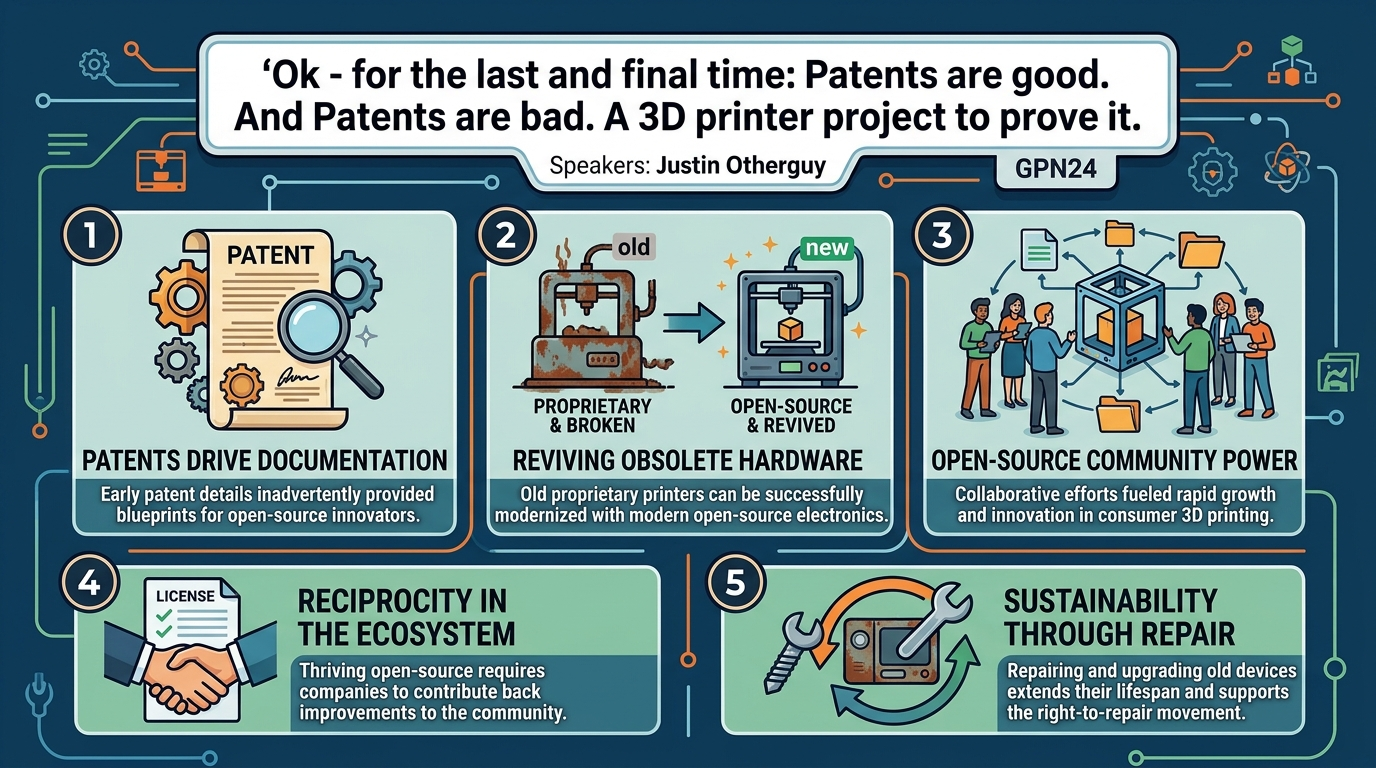
- The Dual Nature of Patents: Proprietary patents, while designed for commercial protection, can paradoxically serve as detailed technical documentation that lays the groundwork for future open-source innovation, as seen with Stratasys and the RepRap project.
- Revitalizing Obsolete Hardware: Even expensive, proprietary, and seemingly broken legacy hardware can be successfully repurposed and modernized using readily available open-source electronics and software (e.g., replacing a €40,000 Stratasys Dimension's brain with a Raspberry Pi and Klipper).
- Open-Source Community Power: The rapid growth and innovation in consumer 3D printing are directly attributable to the open-source community's collaborative efforts, highlighting its ability to drive technological advancement beyond proprietary limitations.
- The Importance of "Playing by the Rules": For the open-source ecosystem to thrive, companies and individuals must contribute back to the community when leveraging its innovations, a principle that licenses like Prusa's OCL aim to enforce.
- Embrace "Weird Projects": Tackling unconventional and challenging hardware projects, such as converting an old industrial 3D printer, offers immense learning opportunities, personal satisfaction, and contributes to the broader knowledge base of the maker community.
- Sustainability through Repair: The ability to repair and upgrade old devices with open-source components significantly extends hardware lifespan, reduces e-waste, and supports the growing right-to-repair movement.
About the Speaker(s)
Justin Otherguy is an enthusiastic hardware hacker and member of the Section 77 makerspace in Offenburg, Germany. His work is characterized by a keen interest in "weird projects" and a practical approach to understanding and repurposing technology. As demonstrated by his talk, he is adept at dissecting complex systems, integrating open-source solutions, and sharing his findings with the community. His background suggests a hands-on experience in 3D printing, electronics, and community-driven development, making him a knowledgeable and engaging advocate for open-source hardware and the maker movement.
Reviews
Dr. Zero (Offensive Security Researcher) — SOLID
A fun makerspace war story about gutting a proprietary Stratasys printer and dropping in Klipper. Good vibes, honest about limitations, but the 'patents are good AND bad' framing promises more intellectual heft than it delivers. This is a project show-and-tell, not an analysis.
Heather Calloway (CISO) — SOLID
This is a maker/hardware talk about reviving a proprietary 3D printer with open-source components. It's well-executed for its audience — hobbyists and makerspace members — but has no meaningful security, governance, or enterprise relevance. Not my lane.