How to decompile a DSP architecture
Alkalem
Gulaschprogrammiernacht 24 (GPN24) · Day 2 · ZKM Vortragssaal
Overview
In this insightful talk from GPN24, Alkalem, a computer science student and CTF team member, delves into the intricate process of creating a decompiler plugin for a notoriously complex and poorly documented architecture: the Texas Instruments TMS320C6X (C6X) Digital Signal Processor (DSP). The presentation emerged from a personal challenge to reverse engineer a binary for a CTF competition, only to discover it targeted an "unknown" CPU architecture lacking conventional tooling. This journey led to the development of a comprehensive Binary Ninja plugin, meticulously designed to overcome the unique complexities of the C6X's Very Long Instruction Word (VLIW) design, parallel execution, and delayed operations.
Key moments
- 0:40 Discovering an unknown CPU architecture for a CTF
- 2:50 Decompiler goals and Binary Ninja plugin approach
- 12:00 Introducing the TMS320C6X DSP architecture
- 16:40 C6X challenges: branch delay, conditional & compact instructions
- 26:20 Custom basic block analysis with new Binary Ninja API
- 42:00 Lifting whole functions and serializing parallel execution
- 48:00 Collaborating with Binary Ninja developers on API improvements
- 56:00 Demonstrating current medium and high-level IL output
How to decompile a DSP architecture
Speakers: Alkalem
Conference: GPN24
YouTube: https://www.youtube.com/watch?v=A1ZKlPWmSKg
Overview
In this insightful talk from GPN24, Alkalem, a computer science student and CTF team member, delves into the intricate process of creating a decompiler plugin for a notoriously complex and poorly documented architecture: the Texas Instruments TMS320C6X (C6X) Digital Signal Processor (DSP). The presentation emerged from a personal challenge to reverse engineer a binary for a CTF competition, only to discover it targeted an "unknown" CPU architecture lacking conventional tooling. This journey led to the development of a comprehensive Binary Ninja plugin, meticulously designed to overcome the unique complexities of the C6X's Very Long Instruction Word (VLIW) design, parallel execution, and delayed operations.
The talk highlights the significant challenges inherent in reverse engineering DSPs, which are critical components in many embedded systems, from automotive radar to medical devices and audio processing. Traditional decompilation approaches often falter when confronted with architectures that deviate from standard RISC or CISC paradigms, particularly those optimized for high-throughput signal processing. Alkalem's work demonstrates that effective analysis of such systems necessitates a deep understanding of their architectural quirks and a willingness to extend existing reverse engineering tools with highly specialized custom logic.
Ultimately, this presentation is not just a technical deep dive into a specific DSP; it's a testament to the evolving landscape of reverse engineering. It underscores the importance of flexible tooling APIs, the power of community collaboration (even with commercial tool vendors), and the critical need for security researchers to push the boundaries of analysis into often-overlooked hardware domains. By demystifying the decompilation of a challenging DSP, Alkalem provides a roadmap for analyzing proprietary embedded firmware, a crucial step in enhancing the security posture of modern cyber-physical systems.
Background
▶ Watch: Discovering an unknown CPU architecture for a CTF (0:40)
The genesis of this project was a seemingly straightforward CTF challenge: reverse engineer an unknown binary. Initial attempts using standard tools like file revealed a critical hurdle: the binary's CPU architecture was listed as "unknown arc." Further investigation traced this to a machine value 1, an identifier for a rarely used, very old Tiny C compiler shipped with Valgrind Perth, targeting the Texas Instruments TMS320C6X (C6X) architecture. This discovery immediately signaled a lack of readily available, robust tooling for analysis.
Alkalem's objective was to develop a decompiler plugin for Binary Ninja, aiming to recover higher-level structures like loops and functions from the low-level assembly. Decompilers are essential for reverse engineering, acting as an IDE that allows naming functions, creating types, and tracking changes, ultimately bringing the code closer to its original source. However, building such a plugin requires fundamental architecture support, which was entirely missing for the C6X.
Binary Ninja was chosen for this endeavor due to its relatively stable API, particularly the Python API, which facilitates rapid development cycles. Despite being a commercial product, its extensibility was key. The C6X architecture itself presented a formidable challenge:
- DSP Architecture: Designed for digital signal processing (e.g., audio, radar), optimized for specific tasks like multiply-and-accumulate loops.
- 32-bit RISC: Addresses, registers, and instructions are all 32-bit. It's a load/store architecture with two register files (16 or 32 registers each).
- VLIW (Very Long Instruction Word): A defining feature. Instructions are typically grouped into "fetch packets" of up to eight 32-bit instructions. These eight instructions can theoretically execute in parallel across eight functional units (e.g., M-unit for multiply, D-unit for load/store).
- Instruction-Level Parallelism: The compiler decides which instructions execute in parallel (an "execution packet," a subset of a fetch packet). This is encoded by a "parallel bit" (least significant bit) in each instruction.
- Complex Latencies: Functional units can be blocked for multiple cycles. Crucially, load instructions have a 4-cycle delay, and branches have a significant 5-cycle delay. This means up to five branches can be queued before the first one takes effect, a major deviation from typical architectures.
- Conditional Execution: Almost every instruction can be conditionally executed based on predicate registers (e.g., B0-B2, A1-A2).
- Architecture Versions: Multiple versions exist (e.g., 604x for fixed-point, 67x for floating-point), adding features like 8/16-bit arithmetic, non-aligned loads, and compact instructions.
- Compact Instructions: A later innovation, frequently used instructions could be encoded in 16 bits. This required a complex encoding scheme where the last instruction in an 8-instruction fetch packet determined if other instructions were compact and how they were laid out and expanded.
- Hardware Loop Support: Specialized instructions like
sploop,spkernel, andspmaskprovide hardware-accelerated loops that operate in a loop buffer, executing in a highly optimized, single-cycle manner.
These architectural specifics, particularly the VLIW nature, parallel execution, and multi-cycle delays, fundamentally break the assumptions of most general-purpose decompilers, making the C6X an ideal, albeit challenging, target for custom plugin development.
Key Findings
▶ Watch: Introducing the TMS320C6X DSP architecture (12:00)
The development of the C6X decompiler plugin yielded several critical findings regarding the reverse engineering of complex, specialized architectures:
Firstly, standard decompiler APIs are often insufficient for highly specialized DSP/VLIW architectures. The C6X's unique features—such as its VLIW instruction grouping, instruction-level parallelism, multi-cycle delayed branches and loads, and compact instruction encoding—do not map cleanly to the single-instruction, sequential processing model assumed by many decompiler frameworks. This necessitated extensive customization beyond basic architectural definitions.
Secondly, successful decompilation requires custom algorithms for core decompiler tasks. Alkalem's work demonstrated that the default algorithms for control flow recovery, disassembly, and intermediate language (IL) lifting in Binary Ninja (and likely other tools) are inadequate for the C6X. Custom implementations were required to correctly identify basic blocks amidst delayed and queued branches, accurately represent parallel instructions in disassembly, and serialize parallel execution into the decompiler's sequential IL.
Thirdly, tool flexibility and vendor responsiveness are paramount. Binary Ninja's API, initially lacking certain features, evolved to incorporate functionalities directly addressing the challenges encountered with the C6X. These included the ability to completely replace the default basic block analysis algorithm, introduce "newline tokens" for multi-line disassembly, and implement "function context" and "function-level lifting." This iterative collaboration between the researcher and the tool vendor (Vector 35) proved crucial for overcoming architectural hurdles.
Fourthly, inter-block context management is essential for accurate analysis. Due to delayed operations and VLIW instruction packing, information needed to correctly interpret one instruction might reside in a prior instruction, a different basic block, or even a different "fetch packet." The introduction of "function context" in Binary Ninja's API allowed the plugin to store and retrieve this vital information, enabling correct decoding of compact instructions and proper handling of delayed branches that cross basic block boundaries.
Finally, even with custom tooling, external data sources must be validated meticulously. Alkalem noted a specific instance where the libopcodes specification for the ADDH instruction was incorrect regarding register access types. Relying solely on such external specifications without verification can lead to subtle but significant errors in the lifting process, highlighting the need for rigorous cross-referencing and empirical testing.
In essence, the key finding is that decompiling architectures like the C6X is a non-trivial undertaking that demands a combination of deep architectural knowledge, advanced plugin development, and a collaborative approach to tool enhancement.
Technical Deep Dive
▶ Watch: Custom basic block analysis with new Binary Ninja API (26:20)
The core of Alkalem's work involved extending Binary Ninja to support the C6X architecture. This required implementing three primary tasks within the plugin: control flow recovery, disassembly, and lifting.
The plugin was developed using Binary Ninja's Python API, chosen for its rapid development cycles. The first step was to register the custom architecture, providing general information such as name, address size (32-bit), instruction alignment, and defining the architecture's registers.
Control Flow Recovery
The initial challenge was control flow recovery, specifically identifying functions, basic blocks, and branches. Binary Ninja's default algorithm expects an InstructionInfo object, which provides the instruction size, branch type, target, and any instruction delays. However, the C6X's unique branch semantics rendered this insufficient.
- Branch Delay: C6X branches have a 5-cycle delay, not an instruction delay. This means instructions after a branch will execute before the branch target is reached.
- Multiple Queued Branches: Due to the VLIW nature and delays, multiple branches can be "pending" simultaneously, breaking the default single-branch-per-instruction assumption.
To address this, Binary Ninja introduced an API update allowing for custom basic block analysis via the analyze_basic_blocks function. This function takes the function object, a context object, and the binary_view, returning a list of BasicBlock objects and their branches.
- C6X Implementation: Alkalem's custom algorithm iterates over the function, processing instructions in "execute packets" (groups of parallel instructions). For each packet, it queues any delayed branches. Each cycle, one queued branch is "drained" and applied to the current basic block. Crucially, pending branches must be explicitly transferred to subsequent basic blocks to maintain correct control flow analysis across block boundaries. This approach correctly handles scenarios like compiler-generated
NOPblocks for branch delays and conditional branches that become unconditional in target blocks due to prior conditions.
Disassembly
Providing disassembly involves translating the raw instruction bytes into a human-readable format that Binary Ninja can tokenize for highlighting and navigation. While the basic translation was straightforward, two C6X features posed problems:
- Parallel Instructions: The parallel execution syntax (e.g.,
|| A) is encoded in the preceding instruction's parallel bit. Displaying this correctly required associating information from one instruction with another. - Newline Tokens: Initially, Binary Ninja's API for
get_instruction_textonly allowed emitting a single line of text per instruction. This meant parallel instructions or instructions spanning multiple "conceptual" lines (like thesploopinstruction with its associatedspkerneloperand) could not be displayed with separate addresses and hex dumps.
A Binary Ninja API update introduced newline tokens and optional parameters for specifying offsets. This allowed the plugin to emit multiple lines of disassembly for a single native instruction, with each line correctly attributed with its address and hex dump. For example, a parallel instruction A || B could now be rendered on two distinct lines, with B correctly offset to reflect its position relative to A.
Lifting
Lifting is the process of translating native machine instructions into Binary Ninja's Low-Level Intermediate Language (LLIL), a tree-based, architecture-independent representation. This is where the "magic" of decompilation truly happens, enabling higher-level analysis. For the C6X, lifting was the most problematic area due to parallelism and delays.
- Serialization of Parallel Execution: LLIL expects serial instructions. Directly translating parallel instructions (
A || B) by simply appending them would lead to incorrect semantics, especially regarding register reads and writes (e.g.,MOV A, B || MOV B, Awould behave differently if processed sequentially). - Basic Block Boundaries and Pending Instructions: Instructions with multi-cycle latencies might initiate in one basic block but complete (write back results) in a subsequent one. This "pending" state needed to be managed across block boundaries.
The ultimate solution was the introduction of function-level lifting via the lift_function API, which provides full control over the lifting process for an entire function. This function receives a function_lifter_context (including basic blocks) and the LLIL function object.
- C6X Lifting Approach: To serialize parallel execution, each native instruction is conceptually split into three phases: reads, computation, and writes. The custom lifter processes instructions in "execute packets" cycle by cycle:
- Read Phase: Read condition registers and all input operands for instructions executing in the current cycle.
- Computation Phase: Translate instructions that have all their inputs available into LLIL.
- Write Back Phase: Write back results of completed instructions.
- Branch Application: Apply branches at the very end of the cycle, as they terminate block translation.
- Inter-Block Context for Lifting: The
function_contextAPI, also introduced as an update, was crucial here. It allowed the plugin to store and retrieve information (e.g., pending instruction states, branch targets) across basic block boundaries. For instance, temporary global registers (e.g.,temp_101) could be used to pass branch target addresses between different source blocks and a common target block, enabling Binary Ninja's higher-level ILs to correctly resolve a singlememsetcall from multiple delayed, conditional sources. - Data Specification Errors: Alkalem noted a specific bug where
libopcodesincorrectly specified the access type for theADDHinstruction (a 16-bit constant add). It claimed to "read a constant" when it actually needed to read the destination register (which also serves as a source for the add operation). This required manual correction in the plugin's lifting logic.
The C6X's compact instructions (16-bit) also leveraged the function_context. Since their decoding depends on the last instruction in an 8-instruction fetch packet, function_context could store the "fetch packet headers" during basic block analysis, making them available to get_instruction_text and lift_function for correct decoding. Similarly, information about hardware loops (sploop parameters) could be stored and retrieved to correctly parse subsequent spkernel instructions.
Demo / Proof of Concept
▶ Watch: Lifting whole functions and serializing parallel execution (42:00)
Alkalem provided a live demonstration of the C6X decompiler plugin operating within Binary Ninja. The demo showcased the tool's ability to process and display C6X assembly, and critically, to generate higher-level intermediate representations.
The demonstration included:
- Disassembly View: Showing the corrected multi-line disassembly for parallel instructions, with proper address and hex dump alignment, a direct result of the "newline tokens" API update.
- Pseudo C / High-Level IL View: The decompiler's output in a C-like syntax was displayed, illustrating the recovery of high-level constructs such as function parameters, loops, and
if/elsestructures. This is a significant achievement for an architecture as complex as the C6X, which typically lacks such robust tooling. - Inter-Block Branch Resolution: An example was shown where two different source blocks conditionally queued the same delayed branch to a
memsetfunction. By passing the target address via a temporary global register (temp_101) across basic block boundaries using thefunction_context, the decompiler was able to correctly resolve this into a singlememsetcall in the high-level IL, which is the desired outcome for accurate program understanding. - Compact Instruction and SP Kernel Resolution: The demo showed how the plugin correctly decoded compact instructions and resolved the operands for the
spkernelinstruction, leveraging thefunction_contextto retrieve necessary information (like fetch packet headers andsploopparameters) that would otherwise be out of scope for single-instruction processing.
While acknowledging that the plugin is "not completely finished" and some high-level IL outputs still contained "broken" elements (e.g., an memset call with many unresolved arguments), the demonstration clearly served as a compelling proof of concept. It validated that the custom algorithms and the enhanced Binary Ninja APIs could effectively handle the most challenging aspects of the C6X architecture, moving beyond mere disassembly to meaningful decompilation. The example binary, despite having an empty main function, contained static functions that conveniently utilized all the complex architectural features Alkalem needed to test and demonstrate.
Defensive Implications
▶ Watch: Demonstrating current medium and high-level IL output (56:00)
The work presented by Alkalem has profound implications for defensive security, particularly in the realm of embedded systems and Internet of Things (IoT) devices. Many critical systems, ranging from automotive control units and industrial machinery to consumer electronics and specialized military hardware, rely on DSPs like the TMS320C6X for high-performance signal processing.
- Demystifying Proprietary Firmware: Historically, the lack of effective reverse engineering tools for exotic DSP architectures has created a significant "security through obscurity" barrier. Manufacturers often rely on the complexity and proprietary nature of these chips to deter analysis. Alkalem's work demonstrates that this barrier can be overcome, allowing security researchers to analyze firmware and understand the low-level operations of these devices. This is crucial for identifying vulnerabilities that would otherwise remain hidden.
- Vulnerability Discovery in Embedded Systems: The ability to decompile DSP code directly enables the discovery of security flaws that reside within the signal processing logic. These could include:
- Buffer overflows or integer overflows in data manipulation routines.
- Logic flaws in critical algorithms (e.g., cryptographic operations, sensor data processing, communication protocols).
- Side-channel vulnerabilities stemming from specific instruction timings or memory access patterns.
- Backdoors or malicious implants hidden deep within the DSP's firmware, which might not be detectable by analyzing only the main application processor.
- Enhanced Threat Intelligence: Understanding the specific architectural features and their exploitation potential provides valuable threat intelligence. For instance, knowledge of delayed branches or parallel execution could inform the design of novel code injection attacks or evasion techniques that exploit these very features. Defenders can then use this knowledge to develop more robust detection and prevention mechanisms.
- Supply Chain Security: Many DSPs are integrated into larger systems. The ability to audit their firmware contributes to supply chain security by allowing independent verification of the code running on these components. This is especially relevant in contexts where trust in hardware manufacturers is paramount.
- Improved Incident Response: In the event of an embedded device compromise, having the tools and expertise to quickly analyze DSP firmware can significantly accelerate incident response efforts, helping to understand the attack vector, scope of compromise, and potential remediation steps.
For defenders, the key takeaway is that the attack surface of modern systems extends deep into specialized hardware like DSPs. Relying on obscurity is no longer a viable security strategy. Instead, organizations must advocate for:
- Transparency and tooling: Encourage hardware vendors to provide better documentation and tooling for their architectures.
- Comprehensive security assessments: Ensure that security audits and penetration tests include an analysis of DSP firmware, not just high-level application code.
- Investment in specialized skills: Develop or acquire expertise in reverse engineering diverse hardware architectures.
This research breaks down barriers, making these critical components amenable to security scrutiny and ultimately contributing to a more secure embedded ecosystem.
Key Takeaways
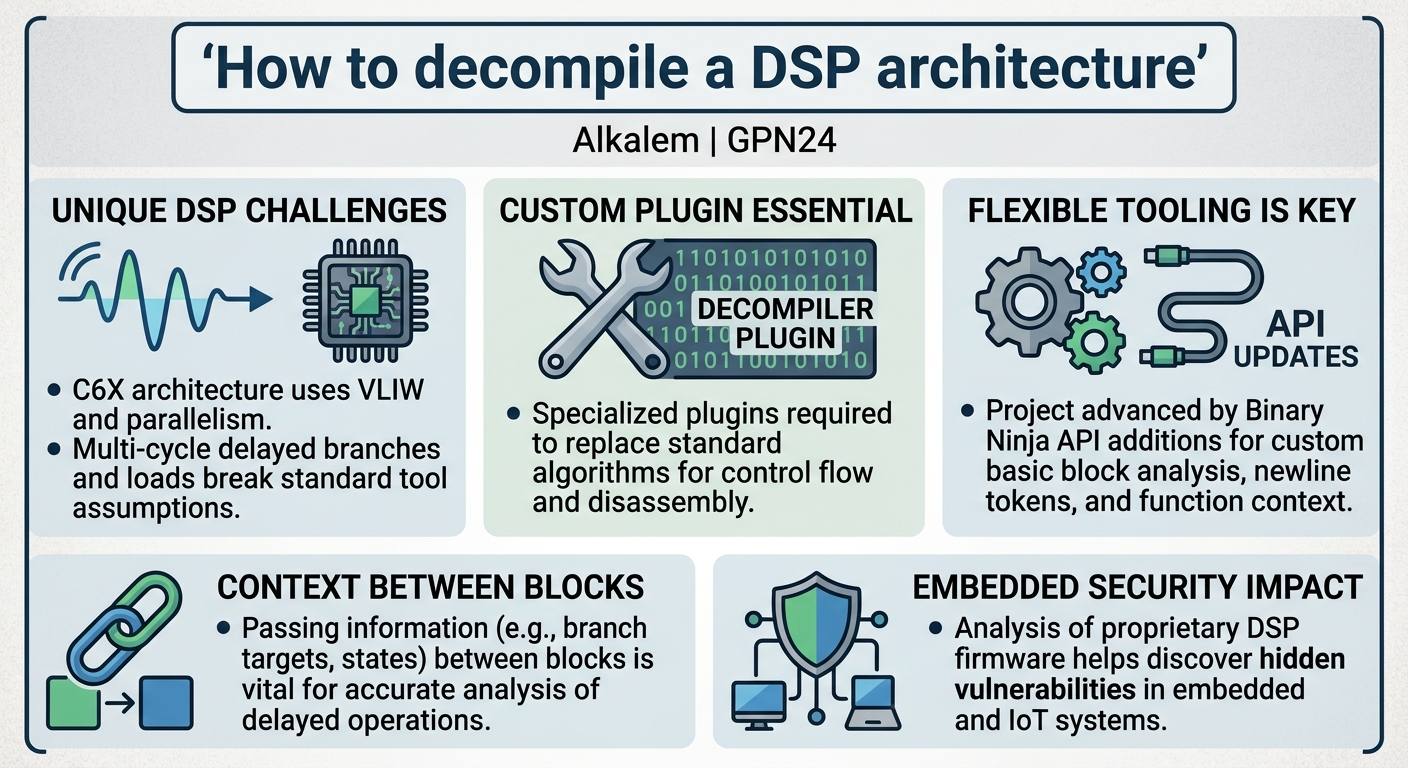
- DSPs Pose Unique Reverse Engineering Challenges: Architectures like the C6X, with VLIW, parallel execution, multi-cycle delayed operations (e.g., 5-cycle branch delay), and complex instruction encoding (e.g., compact instructions), fundamentally break assumptions of standard decompilers.
- Custom Decompiler Plugin Development is Essential: Overcoming these challenges requires building highly specialized plugins that can replace or augment default decompiler algorithms for control flow recovery, disassembly, and intermediate language lifting.
- Flexible Tooling APIs are Crucial: Binary Ninja's evolving API, particularly updates enabling custom basic block analysis, newline tokens for disassembly, function context for inter-block information passing, and full function-level lifting, was instrumental in enabling this advanced architectural support.
- Inter-Block Context Management is Key: Due to delayed operations and VLIW packing, correctly interpreting code often requires information from previous instructions or different basic blocks. Mechanisms like Binary Ninja's
function_contextare vital for passing this context. - Meticulous Data Verification is Required: Even authoritative external specifications (e.g.,
libopcodes) can contain subtle errors regarding instruction behavior, which can significantly impact lifting accuracy and necessitate empirical validation. - DSPs are Critical for Embedded System Security: The ability to decompile and analyze these often-overlooked components is crucial for discovering vulnerabilities in proprietary firmware and enhancing the security posture of embedded and IoT devices.
About the Speaker(s)
Alkalem is a computer science student at KIT (Karlsruhe Institute of Technology). He is an active member of the local CTF team, Kit CTF, which annually hosts a CTF competition. In addition to his academic pursuits and CTF involvement, Alkalem gains practical experience through pentesting at a local company. His work on the C6X decompiler plugin originated from a CTF challenge, demonstrating his expertise in reverse engineering and passion for tackling complex technical problems.
Reviews
Dr. Zero (Offensive Security Researcher) — STRONG ACCEPT
Real work on a genuinely hard problem. Alkalem built a Binary Ninja plugin for TI's C6X DSP—VLIW, 5-cycle branch delays, parallel execution, compact instructions—and actually got decompilation working. Not a paper exercise; this required pushing Vector 35 to ship new API features. The talk is a practical roadmap for anyone who needs to extend a decompiler to handle weird architectures.
Heather Calloway (CISO) — SOLID
Deep technical work on building a decompiler for an obscure DSP architecture. Impressive execution on a hard problem, but the immediate relevance to enterprise security leadership is narrow. Worth knowing this capability exists if you have embedded systems in your supply chain.