Why Even Signal Calls Apple & Google
Merle
Gulaschprogrammiernacht 24 (GPN24) · Day 2 · ZKM Kubus
Overview
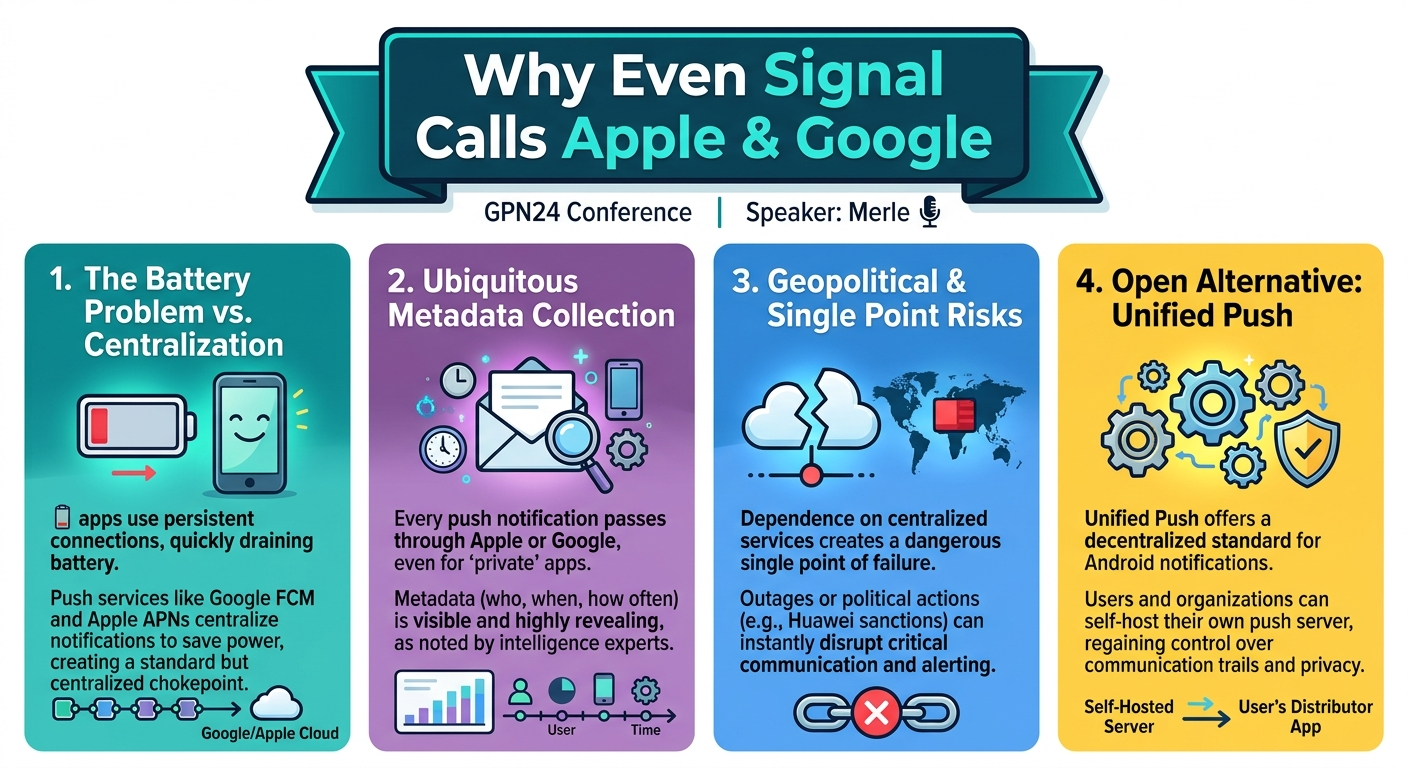
In this compelling GPN24 talk, Merle, a seasoned technologist, dissects the pervasive and often overlooked dependency of modern mobile applications on the centralized push notification services provided by tech giants Apple and Google. The talk, titled "Why Even Signal Calls Apple & Google," reveals that even privacy-focused applications like Signal, Element, and Telegram rely on Firebase Cloud Messaging (FCM) and Apple Push Notification Service (APNs) to deliver their "wake-up pings." This reliance, born out of a necessity to conserve mobile battery life, introduces significant privacy, security, and geopolitical risks, transforming these seemingly innocuous services into critical chokepoints.
Key moments
- 2:25 Messenger not notifying: the battery drain problem
- 4:50 Google/Apple's solution: centralized push notification services
- 10:20 Metadata is content: NSA/CIA directors on its power
- 12:00 Government demands for push notification metadata revealed
- 15:00 Introducing Unified Push: an open-source, self-hostable alternative
- 26:00 Global outages and geopolitical risks of centralized push
- 36:00 Call to action: Try Molly or Unified Push for privacy
Why Even Signal Calls Apple & Google
Speakers: Merle
Conference: GPN24
YouTube: https://www.youtube.com/watch?v=c3ennD3wKn0
Overview
In this compelling GPN24 talk, Merle, a seasoned technologist, dissects the pervasive and often overlooked dependency of modern mobile applications on the centralized push notification services provided by tech giants Apple and Google. The talk, titled "Why Even Signal Calls Apple & Google," reveals that even privacy-focused applications like Signal, Element, and Telegram rely on Firebase Cloud Messaging (FCM) and Apple Push Notification Service (APNs) to deliver their "wake-up pings." This reliance, born out of a necessity to conserve mobile battery life, introduces significant privacy, security, and geopolitical risks, transforming these seemingly innocuous services into critical chokepoints.
Merle's presentation meticulously uncovers how this infrastructure, while technically efficient, grants Apple and Google an unparalleled view into user behavior through metadata collection. This metadata, as highlighted by former NSA and CIA directors, can be as revealing, if not more so, than message content itself. The talk not only exposes the depth of this dependency but also champions Unified Push as a viable, open-source, and self-hostable alternative for Android users, advocating for greater control and transparency in digital communications and critical alerting systems.
Background
▶ Watch: Messenger not notifying: the battery drain problem (2:25)
The genesis of this deep dive began with Merle's personal frustration. Upon joining a new company that utilized Zulip, an open-source, self-hosted Slack alternative, Merle discovered that the mobile app failed to deliver timely notifications. While Zulip offered a push service, its self-hosted nature and per-user costs for more than ten users meant many organizations opted out. Merle's initial attempt to solve this involved building a small Capacitor app that used long polling – a method where the client repeatedly asks the server for new data, holding the connection open until a response. This solution worked but quickly revealed a critical flaw: permanent polling for every app would rapidly deplete a phone's battery.
This observation led to a fundamental question: how do other apps manage notifications efficiently? The answer lies in the centralized push services developed by Apple and Google. APNs launched in 2009, followed by Google Cloud Messaging (GCM) in 2012 (later rebranded as Firebase Cloud Messaging (FCM)). Their innovation was to centralize push notifications through a single, persistent, and highly optimized connection from the system to the device. Instead of 50 apps each maintaining their own connection, the operating system manages one connection for all apps. This approach drastically improved battery life and reliability, integrated deeply into the OS (e.g., Play Services on Android), and optimized for scenarios like network switching and Android's Doze mode (battery-saving feature). For iOS, this centralization is not merely an option but a mandate; Apple prohibits persistent background connections, making APNs the sole avenue for push notifications. This historical evolution, while solving a critical technical challenge, inadvertently laid the groundwork for the privacy and control issues that Merle's talk meticulously explores.
Key Findings
▶ Watch: Metadata is content: NSA/CIA directors on its power (10:20)
Merle’s investigation uncovered several critical findings that underscore the profound implications of centralized push notification services:
- Ubiquitous Metadata Collection: Every single push notification, regardless of the app, passes through Google or Apple's infrastructure. While the content is often encrypted, the "envelope" – which app is pinged, at what time, how often, and on which device – is fully visible. When correlated with user accounts (as most Android users are logged into a Google account), this creates a massive dataset spanning billions of devices and over 15 years. This metadata reveals patterns of work, social interactions, dating habits, and more, as starkly illustrated by the example of a user's daily notification timeline.
- Metadata's Potent Value: The talk powerfully emphasizes the significance of metadata. Stewart Baker, former general counsel of the NSA, famously stated, "Metadata absolutely tells you everything about somebody's life. If you have enough metadata, you don't really need content." This sentiment was echoed by former CIA and NSA director Michael Hayden, who chillingly noted, "We kill people based on metadata," in the context of drone strikes. These quotes highlight that even seemingly innocuous data points can be pieced together to form comprehensive profiles and enable targeted actions.
- Government Access to Metadata: In December 2023, US Senator Ron Wyden revealed that foreign governments had been demanding smartphone push notification records from Google and Apple since at least spring 2022. Apple initially faced a federal prohibition from even disclosing these requests. While Apple has since increased transparency (requiring court orders instead of subpoenas) and reported a tripling of such requests, Google does not separately report push notification requests, obscuring the full scope of government access.
- App-Specific Metadata Leaks: A research paper titled "The Medium Is the Message" examined 21 messaging apps and found alarming data leaks to Firebase:
- 11 out of 21 apps forwarded additional metadata.
- 7 out of 21 apps leaked sender or recipient names.
- 4 out of 21 apps sent the full message content in plain text through Google's servers, impacting over a billion installs, often without clear disclosure in privacy policies. While Signal correctly uses push-to-sync (empty pings), the metadata problem persists.
- Single Point of Failure and Geopolitical Risk:
- Global Outages: A broken quota update in Google's service control on June 12th, 2025 (likely referring to a past event, possibly 2022 or 2023), caused a 7-hour global outage for Firebase and Cloud Messaging, impacting major services like Spotify, Discord, Snapchat, OpenAI, and GitLab. This demonstrated the fragility of relying on a single, centralized infrastructure for critical communication.
- Geopolitical Impact (Huawei): In May 2019, a US executive order placed Huawei on an entity list, severing its access to Google Play Services and, critically, FCM. Overnight, new Huawei phones lost access to Google's ecosystem, forcing Huawei to rapidly develop its own Huawei Mobile Services (HMS). This resulted in an estimated $12 billion in lost revenue in 2019 alone and a drastic reduction in European market share, proving that political decisions can instantly dismantle a mobile strategy built on third-party services.
- Vendor Lock-in and Discontinuation: Google's terms of service allow material changes to take effect with just 14 days' notice, with no service level agreement (SLA) for FCM. Historical examples, like the Google Maps API price increase of up to 1,400% in 2018, illustrate the risk of relying on free services that can change terms or be "killed" (as documented by
killedbygoogle.com).
These findings collectively paint a picture of a digital infrastructure where convenience has inadvertently sacrificed significant user privacy, organizational control, and resilience against external pressures.
Technical Deep Dive
▶ Watch: Government demands for push notification metadata revealed (12:00)
The core of the problem and its potential solutions lie in understanding the technical mechanisms of push notifications.
Centralized Push Services (FCM/APNs):
Google's FCM and Apple's APNs operate on a "triangle model." When an app's server wants to send a notification:
- The server sends a message to Google's FCM or Apple's APNs infrastructure.
- FCM/APNs, which maintains a single, always-on, highly efficient connection to the user's phone, then pings the device.
- The device's operating system wakes up the specific app.
- The app then fetches the actual message content from its own server.
This design is genuinely clever because it replaces potentially dozens or hundreds of individual, battery-draining app connections with one centrally managed, optimized connection. Apple, in particular, enforces this strictly on iOS, preventing apps from maintaining their own persistent background connections. Google has invested 15 years in optimizing this system for factors like heartbeat intervals, network switching, and battery-saving modes like Doze mode. A notable aspect of FCM is its "free and unlimited" nature, which Merle highlights as a strategic decision by Google, prompting the question: "If the product is free, hm."
Chinese Alternatives:
The Western reliance on FCM/APNs is not universal. In China, where FCM is blocked by the Great Firewall, developers integrate multiple proprietary push SDKs from various phone manufacturers (e.g., Xiaomi Push, Huawei Push, Oppo Push, Vivo Push, Honor Push). This messy, fragmented approach, while functional, underscores that technical alternatives to Google/Apple's dominance can exist, even if they are less elegant.
Signal's Approach and its Limits:
Signal, a leading privacy app, uses FCM but employs a strategy called push-to-sync. It sends only empty notifications through Google's infrastructure, prompting the app to wake up and fetch/decrypt the actual message content locally from Signal's servers. While this protects message content, it does not prevent Google from collecting the metadata (who, when, how often). For users avoiding Google services (e.g., on GrapheneOS), Signal offers a WebSocket fallback, maintaining a direct connection with a keep-alive every 55 seconds. However, this fallback has been reported to cause significant battery drain (40-50% in some cases), presenting users with a dilemma: battery drain or metadata for Google. Signal has historically resisted requests for alternative push mechanisms, citing maintenance burden for a small user base.
Unified Push: The Open-Source Alternative:
Unified Push is an open standard designed to decentralize mobile push notifications. Its architecture mirrors FCM/APNs but places control back with the user:
- Instead of Google Play Services, the user installs a distributor app (e.g., Notify, Sunup, or a fork of Conversations XMPP client).
- This distributor app maintains a single WebSocket connection to a server that the user trusts or self-hosts.
- Other apps on the phone register with the distributor, which then notifies them when a message arrives from the user's chosen push server.
This model ensures that every component in the notification chain can be controlled by the user, eliminating the dependency on Google or Apple.
Notify (ntfy.sh) is presented as a prime example of a Unified Push distributor. It's a lightweight Go binary, easy to set up, and even offers a free public instance (ntfy.sh) for testing. It uses simple HTTP POST requests, making integration straightforward.
Challenges for Unified Push:
Despite its technical elegance, Unified Push faces a significant hurdle: Android's aggressive battery-saving measures. Android vendors often kill background apps to conserve power, directly impacting the distributor app's ability to maintain a persistent connection. The website don'tkillmyapp.com highlights this issue, showing many vendors with poor scores for background process management. To counteract this, Unified Push distributors often require a persistent "app is running in the background" notification, which users often dislike but is necessary to prevent the OS from terminating the service.
Adoption and Forks:
Unified Push has gained traction within the self-hosting and Fediverse communities, with support in apps like Element, Tusky, FediLab, FluffyChat, Nextcloud, and Molly. While Matrix (via its Sygnal push gateway) can be self-hosted, the default Element client often still routes through matrix.org's gateway, which relies on FCM.
For Signal users seeking full de-Googled privacy, Molly is a hardened Signal fork available on F-Droid. It includes Unified Push support, encrypted database, and Tor integration. Molly achieves this by running a Rust gateway on a self-hosted server, which registers as a linked Signal device and acts as a "doorbell" without handling encryption keys.
iOS Limitations:
For iOS, the situation remains challenging. While Web Push was introduced in iOS 16.4, it still routes through APNs. iOS's strict control over background processes means that Unified Push, which requires a constantly running app, is effectively blocked. Merle suggests that political pressure, perhaps through extensions of the Digital Markets Act, might be necessary to force Apple to allow alternatives.
Demo / Proof of Concept
▶ Watch: Global outages and geopolitical risks of centralized push (26:00)
Merle provided a clear and concise live demonstration of Notify (ntfy.sh), showcasing the simplicity and effectiveness of the Unified Push concept. The speaker subscribed their phone to a specific topic on the public ntfy.sh instance. Then, using a basic curl command from their laptop, they sent a message:
Upon executing this command, a notification instantly appeared on the speaker's phone. This demonstration effectively illustrated that sending a notification via Unified Push requires nothing more than a simple HTTP POST request, without the need for complex API tokens, service accounts, or Firebase project setups. It underscored the "stupid easy" nature of the system, proving that basic web technologies can facilitate reliable, decentralized push notifications.
Defensive Implications
▶ Watch: Call to action: Try Molly or Unified Push for privacy (36:00)
The insights from this talk carry significant defensive implications for both individual users and enterprises, particularly those concerned with privacy, operational resilience, and compliance.
For Enterprises and Critical Infrastructure:
The widespread reliance on FCM for critical alerting systems (e.g., Prometheus, PagerDuty, Grafana, Pushover, CI/CD pipelines feeding into Slack) creates a dangerous single point of failure. Merle highlights that even expensive services like PagerDuty, costing $40,000 to $65,000 annually, ultimately rely on Google's free FCM service for the "last mile" – the crucial wake-up ping – which comes with no Service Level Agreement (SLA).
- Outage Risk: The 7-hour Firebase outage demonstrated that critical alerts might not reach on-call personnel during a Google service disruption, making organizations potentially "the last to know."
- Compliance & Auditing: Regulations like NIST 2 (EU directive for network and information security) and requirements from agencies like Germany's BSI mandate early warning systems and incident reporting within strict timelines (e.g., 24 hours for initial warning, 72 hours for assessment). Relying on FCM means having no logs to prove when an alert arrived on a phone or if it arrived at all, hindering compliance and post-incident analysis.
- Network Isolation: For highly secure or isolated networks (military, nuclear plants, government, critical infrastructure) that cannot reach the internet, FCM is not an option. Self-hosted solutions are not just a preference but a necessity.
- Solution: Self-Hosted Unified Push: Implementing a self-hosted Unified Push distributor (like Notify) allows organizations to keep their entire alerting chain within their own infrastructure. This involves configuring alert managers (e.g., Prometheus Alertmanager) to send webhooks to the self-hosted Notify server, which then delivers alerts to devices running the Notify app. This setup is inexpensive (a VM with a few hundred MB of RAM), provides full logging, and can be made highly available, offering superior control and resilience compared to FCM-dependent solutions.
For Individual Users and Privacy Advocates:
- Decentralized Control: Users concerned about metadata collection can adopt Unified Push. This involves installing a distributor app (e.g., Notify or an alternative) and connecting it to a trusted or self-hosted push server. This shifts control away from Google and Apple.
- App Selection: Users should check
unifiedpush.org/users/appsto see if their favorite applications support Unified Push. This encourages the adoption of privacy-respecting alternatives like Element, Tusky, and Molly. - Molly as a Signal Alternative: For Android users prioritizing de-Googled privacy, Molly (a hardened Signal fork from F-Droid) offers Unified Push support, encrypted databases, and Tor integration, providing a robust alternative to Signal's reliance on FCM.
- Understanding Trade-offs: Users on GrapheneOS or similar de-Googled environments must understand the trade-offs between battery life (if using Signal's WebSocket fallback) and metadata exposure (if using FCM).
- iOS Limitations: Users with iOS devices face significant challenges due to Apple's strict control. While Web Push exists, it still routes through APNs. Advocacy for political changes, like expanding the Digital Markets Act to cover push notification services, is crucial for future alternatives on iOS.
- Speaker's Own Project: Merle's Zulip Mobile Notifs project serves as a practical example of building custom, privacy-aware notification solutions, including an Android foreground service for direct polling and a Cloudflare worker for Web Push, with plans for full Unified Push integration.
In essence, the defensive implication is a call to critically examine and regain control over the "last mile" of communication, ensuring that crucial alerts and personal messages are delivered not just efficiently, but also securely, transparently, and independently.
Key Takeaways
- Metadata is Highly Revealing: Even without content, push notification metadata (who, when, how often) provides extensive insights into user behavior, as confirmed by former NSA and CIA directors.
- Centralized Push Creates Critical Dependencies: Relying on FCM/APNs establishes a single point of failure, making organizations and individuals vulnerable to outages, political sanctions (e.g., Huawei), and changes in vendor terms.
- Government Agencies Access Metadata: Foreign governments actively demand push notification records from Apple and Google, often under strict secrecy, raising significant privacy and sovereignty concerns.
- Unified Push Offers a Decentralized Android Alternative: Unified Push is an open standard that enables self-hosted or trusted third-party push notification services, allowing users and organizations to maintain control over their notification infrastructure on Android.
- iOS Remains a Walled Garden: Apple's strict control over background processes severely limits alternatives to APNs on iOS, necessitating political pressure for change.
- Evaluate Alerting Chains for Hidden Dependencies: Enterprises must scrutinize their critical alerting systems to identify and mitigate hidden dependencies on services like FCM, ensuring operational resilience and compliance with security regulations.
About the Speaker(s)
The talk was delivered by Merle (who also goes by Mada), a passionate and experienced technologist. Merle describes herself as someone who "makes things, breaks things, and occasionally writes about it." She has been programming since the age of 14 and boasts familiarity with a wide array of tech stacks. Merle completed her apprenticeship at SUSE Linux as a Fachinformatiker in Anwendungsentwicklung (a German term roughly translating to a computer science expert in software engineering). Currently, she works in Linux client management at a consulting company, focusing on Linux desktops for corporate environments, and extensively uses tools like Foreman, OpenQA, and Python tooling. In her free time, Merle channels her technical curiosity into building apps designed to notify her, a pursuit that directly led to the research and insights shared in this talk.
Reviews
Dr. Zero (Offensive Security Researcher) — STRONG ACCEPT
A genuinely useful talk that maps an infrastructure dependency most practitioners ignore. Merle does the homework—government subpoenas, the Huawei case, the Firebase outage, the metadata research paper—and stitches it into a coherent argument about why your pager might not page you when Google sneezes. Not novel exploitation research, but solid systems-level threat modeling with a working alternative.
Heather Calloway (CISO) — STRONG ACCEPT
This is the talk I'd forward to my infrastructure security lead and my general counsel the same day. It maps a dependency most organizations haven't inventoried — FCM/APNs as the unaudited last mile of every alerting chain — and connects it to regulatory exposure, outage risk, and government access that's already happening.