Three Languages, Triple the Confusion
Eric, Matheus Gagno Brunetti
Gulaschprogrammiernacht 24 (GPN24) · Day 4 · ZKM Kubus
Overview
In their GPN24 talk, "Three Languages, Triple the Confusion," Eric and Matheus Gagno Brunetti, both backend developers and DevOps engineers at Link 11, delve into the subtle, often bewildering, and sometimes exploitable quirks of three widely used programming languages: C, Java, and Python. The presentation highlights unexpected behaviors that arise from language specifications, historical design choices, and common implementation details, demonstrating how these seemingly innocuous features can lead to confusion, hard-to-debug errors, and even potential security vulnerabilities in production environments.
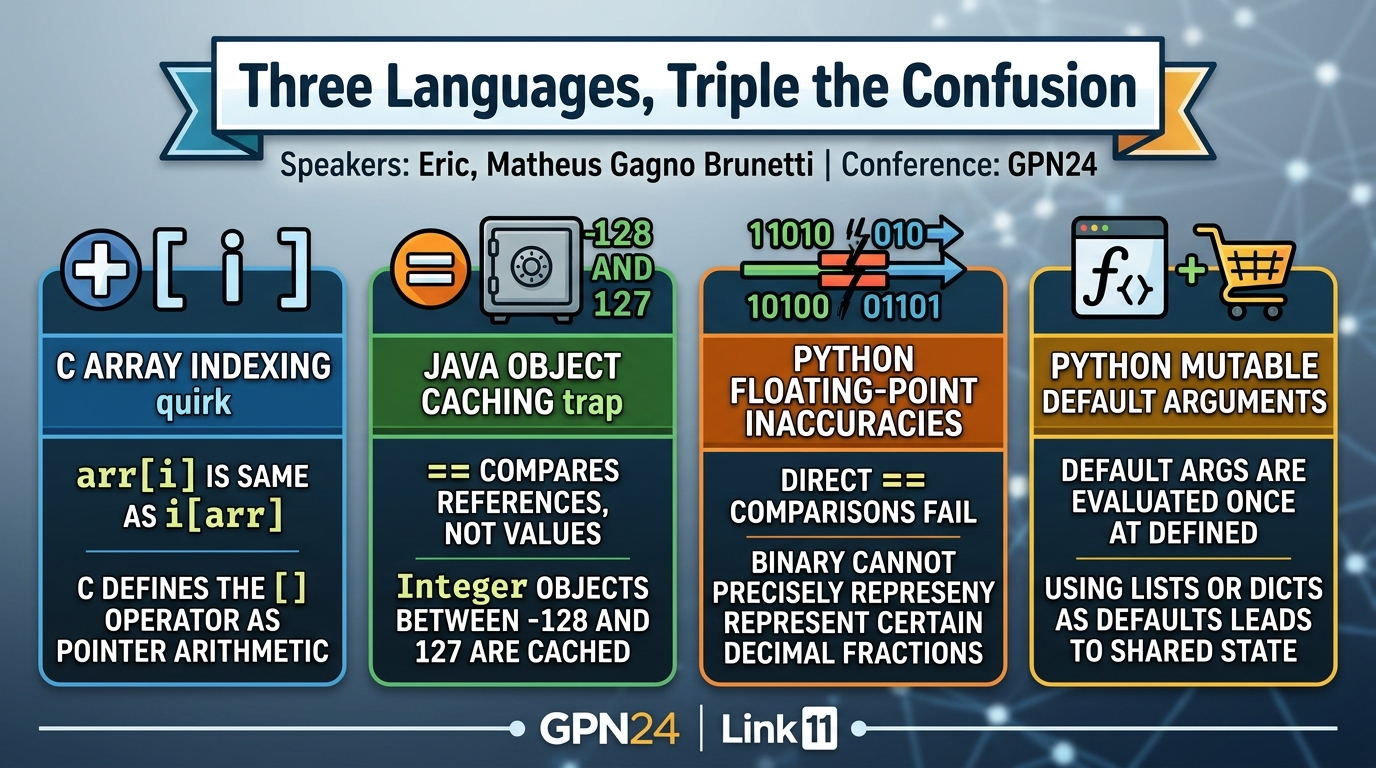
Key moments
- 0:40 Surprising C syntax: 5[a] is valid
- 5:50 Java's Integer object cache explained
- 7:00 Changing Java's cached values via reflection (now removed)
- 8:20 Python's floating-point inaccuracy (0.1 + 0.2 != 0.3)
- 11:00 Python's mutable default arguments trap
- 15:00 Python generators: one-time iteration and memory efficiency
- 17:00 Python's finally clause can swallow return statements
- 18:30 Q&A: Why Java's Integer cache stops at 127
Three Languages, Triple the Confusion
Speakers: Eric, Matheus Gagno Brunetti
Conference: GPN24
YouTube: https://www.youtube.com/watch?v=V8oDCHBl0qc
Overview
In their GPN24 talk, "Three Languages, Triple the Confusion," Eric and Matheus Gagno Brunetti, both backend developers and DevOps engineers at Link 11, delve into the subtle, often bewildering, and sometimes exploitable quirks of three widely used programming languages: C, Java, and Python. The presentation highlights unexpected behaviors that arise from language specifications, historical design choices, and common implementation details, demonstrating how these seemingly innocuous features can lead to confusion, hard-to-debug errors, and even potential security vulnerabilities in production environments.
The speakers meticulously unpack a series of "fun parts" – as they call them – ranging from C's arcane syntactic sugar and Java's object caching mechanisms to Python's floating-point arithmetic pitfalls and mutable default arguments. Their goal is to illuminate aspects of these languages that are often overlooked or misunderstood by developers, emphasizing that even seasoned professionals can be caught off guard by these peculiarities. The talk serves as a crucial reminder for developers to not only understand the syntax of their chosen language but also its deeper semantic and operational intricacies, especially when building robust and secure applications.
Ultimately, this talk underscores the critical importance of a thorough understanding of programming language fundamentals, beyond surface-level syntax. For security professionals, it highlights how unexpected language behaviors can be vectors for logic flaws or, in some historical cases, even serve as attack surfaces. For developers, it provides actionable insights to write more predictable, robust, and maintainable code, preventing common pitfalls that can lead to significant headaches in development and production.
Background
[▶ Watch: Surprising C syntax: 5[a] is valid (0:40)](https://www.youtube.com/watch?v=V8oDCHBl0qc&t=40s)
The challenges highlighted in this talk stem from a variety of sources inherent to programming language design and evolution. Modern software development often relies on languages that have evolved over decades, accumulating layers of features, optimizations, and backward compatibility considerations. This complexity can lead to behaviors that are unintuitive or deviate from a developer's common-sense expectations.
In the case of C, its age and direct memory manipulation capabilities make it prone to low-level quirks. The language standard, particularly early versions like C89, often defined behaviors that were practical for the hardware of the time but now seem archaic. The concept of syntactic sugar, where a simpler syntax masks a more complex underlying operation (like arr[i] being equivalent to *(arr + i)), is a double-edged sword: it simplifies common operations but can obscure fundamental truths about how the language works, leading to unexpected equivalences like i[arr]. Furthermore, historical constraints, such as the limited character sets on keyboards in the 1970s, led to the introduction of trigraphs, sequences like ??( that map to standard characters, a feature largely obsolete but still part of the standard until recent removals.
Java, a language designed with "write once, run anywhere" in mind, introduces its own set of complexities, particularly around object-oriented concepts and performance optimizations. The distinction between primitive types (like int) and object types (like Integer) is fundamental but often a source of confusion, especially when combined with autoboxing (automatic conversion between primitives and their wrapper objects) and the use of the == operator. Java's runtime environment, the JVM, employs various optimizations, such as object caching for frequently used immutable objects (like small integers or common strings), to improve performance. While beneficial, these caches can lead to counter-intuitive results when comparing objects using ==, which checks for reference equality rather than value equality.
Python, celebrated for its readability and ease of use, is not immune to these complexities. Its dynamic typing and high-level abstractions can sometimes mask underlying computational realities. Floating-point arithmetic, for instance, is a universal challenge across almost all programming languages, rooted in the fundamental limitations of representing real numbers in binary format. The inability to precisely represent certain decimal fractions (like 0.1 or 0.2) in binary leads to minute inaccuracies that can accumulate and cause unexpected comparison failures. Additionally, Python's function definition mechanism, where default arguments are evaluated only once at the time the function is defined (not each time it's called), creates a significant pitfall when mutable types (like lists or dictionaries) are used as defaults, leading to unintended shared state across function calls. Finally, language constructs like generators, designed for memory efficiency by producing values on demand, behave differently from traditional data structures, requiring a clear understanding of their single-pass nature.
These examples collectively illustrate that programming languages, despite their apparent simplicity or familiarity, harbor intricate details that can significantly impact software correctness, performance, and security. A deep dive into these "confusing behaviors" is not merely an academic exercise but a practical necessity for any developer striving to build robust and reliable systems.
Key Findings
▶ Watch: Changing Java's cached values via reflection (now removed) (7:00)
The talk presented several distinct "confusing behaviors" across C, Java, and Python, each revealing a specific aspect of language design or implementation that can lead to unexpected results.
In C, Eric highlighted two main points:
- Commutativity of Array Indexing: The seemingly absurd
i[arr]syntax works identically toarr[i]. This is due to C's definition of the bracket operator[]as equivalent to pointer arithmetic(arr + i). Since addition is commutative,(arr + i)is the same as*(i + arr), makingi[arr]a valid, though highly unconventional, way to access array elements. - Trigraphs: C historically supported trigraphs (e.g.,
??(for[,??)for],??'for^) to allow developers to type certain C symbols on keyboards that lacked them (a common issue in the pre-ASCII era of the 1970s). While largely obsolete and often requiring specific compiler flags (-trigraphs) to enable, their existence underscores how historical context can bake peculiar features into a language standard.
For Java, the focus was on equality comparisons and object caching:
- Integer Object Caching: Java caches
Integerobjects for values between -128 and 127 (inclusive). When twoIntegerobjects are assigned values within this range using literal assignment (e.g.,Integer a = 127; Integer b = 127;), they often refer to the same cached object. Consequently,a == bevaluates totruebecause==compares object references. However, for values outside this cache range (e.g., 128), newIntegerobjects are created, leadinga == bto evaluate tofalseeven if their values are identical. This demonstrates the critical distinction between==(reference equality) and.equals()(value equality) for objects. - String Caching: Similar to integers, Java also employs a string cache (the string intern pool). Literal strings are often interned, meaning multiple references to the same string literal point to the same object, affecting
==comparisons. - Historical Cache Manipulation: The speakers noted that in older Java versions (pre-Java 13), it was theoretically possible to use reflection to access and modify the values within these internal caches (e.g., changing the value associated with the
Integerobject representing1to2), leading to highly unpredictable and potentially exploitable behavior. This capability has since been removed.
Python presented a trio of common pitfalls:
- Floating-Point Inaccuracies: Due to the nature of representing decimal numbers in binary, many common decimal fractions (like 0.1, 0.2, 0.3) cannot be represented precisely. This leads to
0.1 + 0.2not being exactly0.3, causing0.1 + 0.2 == 0.3to evaluate toFalse. The talk demonstrated solutions using thedecimalmodule for precision ormath.isclose()for approximate comparisons. - Mutable Default Arguments: A frequent source of bugs, using mutable objects (like lists or dictionaries) as default arguments in Python functions leads to shared state. The default argument is evaluated once when the function is defined, not each time it's called. Subsequent calls to the function without explicitly providing the argument will modify the same mutable object, leading to unexpected accumulation of data across calls or instances, as demonstrated with a shopping cart example.
- Generators and Single-Pass Iteration: Python generators are designed for memory efficiency, yielding values one at a time on demand rather than building a full list in memory. A key finding is that generators are single-pass iterators; once exhausted, they cannot be re-iterated without being re-created. Attempting to iterate over an exhausted generator will result in an empty sequence, which can be surprising for developers accustomed to list-like behavior.
returninfinallyBlocks: Placing areturnstatement within afinallyblock in Python can "swallow"returnstatements from thetryorexceptblocks. This means the value returned by thefinallyblock takes precedence, potentially masking intended results or error conditions. While Python 3.14 now issues a warning for this, older versions would silently exhibit this counter-intuitive behavior.
These findings collectively illustrate how deep understanding of language specifications, runtime optimizations, and historical baggage is essential for writing correct and predictable code.
Technical Deep Dive
▶ Watch: Python's mutable default arguments trap (11:00)
The technical deep dive into these language quirks reveals intricate details about how C, Java, and Python operate under the hood.
C: The Arithmetic of Pointers and Trigraphs
The C standard defines array indexing a[b] as precisely equivalent to ( (a) + (b) ). This means that the subscript operator [] is essentially syntactic sugar for pointer arithmetic and dereferencing. Since addition is commutative (a + b is the same as b + a), it follows that (a + b) is equivalent to *(b + a). Therefore, arr[i] is functionally identical to i[arr].
Consider the example shown in the talk:
While technically correct according to the C standard, i[arr] is universally considered bad practice due to its extreme lack of readability and potential to confuse maintainers.
Another arcane feature discussed was trigraphs. Introduced in the C89 standard, trigraphs allowed certain characters that might not be available on all keyboards (especially older ones) to be represented by sequences of three characters, always starting with ??. For example:
??(is equivalent to[??)is equivalent to]??'is equivalent to^??/is equivalent to\??=is equivalent to#??<is equivalent to{??>is equivalent to}??!is equivalent to|??-is equivalent to~
A C compiler would replace these trigraph sequences with their corresponding single characters during the earliest phases of compilation. While most modern compilers disable trigraphs by default or require a flag like -trigraphs (as mentioned in the talk), their historical presence highlights the lengths language designers went to ensure portability across diverse computing environments.
Java: Object Identity and Caching Mechanisms
Java's distinction between primitive types (int, boolean, char, etc.) and object types (Integer, Boolean, String, etc.) is critical. The == operator behaves differently for each:
- For primitive types,
==compares their actual values. - For object types,
==compares their memory addresses (references). It checks if two references point to the exact same object in memory. To compare the values of two objects, the.equals()method should always be used.
The confusion arises with autoboxing and object caching. Java automatically converts primitives to their corresponding wrapper objects when needed (autoboxing) and vice-versa (unboxing). To optimize performance and memory usage, the Java Virtual Machine (JVM) maintains caches for frequently used, immutable objects.
The most prominent example is the Integer cache. For Integer objects representing values from -128 to 127, the JVM pre-allocates and caches these objects. When you create an Integer object within this range using literal assignment, the JVM often returns a reference to the cached instance.
Consider the examples from the talk:
This behavior is not a bug but a specification detail designed for efficiency. However, it violates the intuitive expectation that == would compare values for Integer objects, leading to common programming errors if .equals() is not consistently used.
Similarly, Java's string intern pool caches String literals. When you declare String s1 = "hello"; String s2 = "hello";, both s1 and s2 often refer to the same String object in the intern pool, making s1 == s2 evaluate to true. However, if strings are created dynamically (e.g., String s3 = new String("hello"); String s4 = new String("hello");), s3 == s4 will be false because new String() always creates a new object.
The talk also touched upon the historical ability to manipulate these caches via reflection. In older Java versions (before Java 13), it was possible to use java.lang.reflect.Field to gain access to and modify private static fields within core classes, including the Integer.IntegerCache.cache array. This could lead to scenarios where 1 + 1 might not equal 2 if the cached Integer object for 1 was altered, creating severe logical inconsistencies. This "fun part," as the speakers called it, was a potent demonstration of the power and danger of reflection, and its removal in later Java versions was a security and stability enhancement.
Python: Precision, Mutability, and Control Flow
Python's seemingly straightforward syntax hides several behavioral nuances.
Floating-Point Arithmetic
The issue with 0.1 + 0.2 == 0.3 evaluating to False in Python (and most other languages) stems from the IEEE 754 standard for floating-point numbers. Computers store numbers in binary (base-2), but many decimal fractions (base-10) like 0.1 or 0.2 have infinite, non-repeating binary representations. These must be truncated at some point, leading to tiny precision errors.
To address this, Python provides the decimal module for arbitrary-precision decimal arithmetic and math.isclose() for approximate comparisons:
Mutable Default Arguments
This is a classic Python gotcha. Default arguments are evaluated once when the function is defined, not every time the function is called. If a mutable object (like a list, dictionary, or set) is used as a default, all calls to the function (without overriding the default) will share the same mutable object.
The talk illustrated this with a shopping_cart example:
The standard fix involves using an immutable default (like None) and initializing the mutable object inside the function:
Another solution mentioned is using an immutable type like a tuple as the default, if appropriate, though None is more common when a mutable collection is eventually needed.
Generators
Python generators are functions that contain yield expressions. They produce a sequence of values lazily, one at a time, making them highly memory-efficient for large datasets. However, a key characteristic is their single-pass nature:
Once a generator has yielded all its values, it's exhausted and cannot be iterated over again. To get the sequence again, the generator function must be called again to create a new generator object. This behavior is crucial for understanding how to work with iterators and avoid unexpected empty results.
return in finally
The finally block in Python is guaranteed to execute, regardless of whether an exception occurred or a return statement was encountered in the try or except blocks. However, if a return statement is placed within the finally block, it will override any return statements from the try or except blocks.
This can lead to significant debugging challenges, as the function might appear to execute correctly but return an unexpected value. The speakers noted that Python 3.14 now issues a SyntaxWarning for return or break statements in finally blocks, but older versions would silently allow this confusing behavior.
Demo / Proof of Concept
▶ Watch: Python generators: one-time iteration and memory efficiency (15:00)
The speakers effectively demonstrated each "confusing behavior" through a series of carefully crafted code examples presented directly on their slides. These static code snippets, accompanied by their surprising outputs, served as direct proof-of-concept demonstrations for each point. For instance, the C examples graphically illustrated arr[i] versus i[arr], immediately showing the identical results. The Java examples clearly showed the true and false outcomes for Integer comparisons within and outside the cache range. Similarly, the Python demonstrations provided concrete code for floating-point inaccuracies, the persistent state of mutable default arguments (with the shopping_cart class), the exhaustion of generators, and the return in finally block overriding prior returns. While not interactive live coding, the clarity and directness of these on-screen examples fully conveyed the technical points and their implications, allowing the audience to immediately grasp the unexpected behaviors.
Defensive Implications
▶ Watch: Q&A: Why Java's Integer cache stops at 127 (18:30)
Understanding these language quirks is not just an academic exercise; it has significant defensive implications for writing secure, robust, and maintainable code. Developers and security professionals should take the following actions:
- Prioritize Readability and Convention in C: While
i[arr]is technically valid, it is an anti-pattern. Always use the standardarr[i]for array access. Avoid obscure language features like trigraphs that can make code harder to read, debug, and audit. For legacy codebases, be aware that such constructs might exist and can be enabled by compiler flags. - Master Java Object Equality: For any object comparison in Java, always use
.equals()to compare values (e.g.,str1.equals(str2)), not==, unless you specifically intend to check if two references point to the exact same object in memory. This is critical forString,Integer, and all other object types. Educate teams about the Integer cache and string intern pool to prevent subtle bugs related to==comparisons. Be aware of autoboxing and how it can implicitly convert primitives to objects, potentially masking the==vs..equals()issue. - Handle Python Floating-Point Numbers with Care: Never use
==to compare floating-point numbers directly. Instead, usemath.isclose()for approximate comparisons with a defined tolerance or thedecimalmodule for exact decimal arithmetic where precision is paramount (e.g., financial calculations). - Avoid Mutable Default Arguments in Python: This is a critical best practice. Never use mutable types (lists, dictionaries, sets) as default arguments in Python function definitions. Instead, use
Noneas the default and initialize the mutable object inside the function body ifNoneis passed. This ensures each function call gets its own independent mutable object.
- Understand Python Generator Lifecycle: When working with generators, remember they are single-pass iterators. If you need to iterate over the data multiple times, convert the generator's output to a list (e.g.,
data = list(generator_expr)) or re-create the generator object for each iteration. This prevents unexpected empty results and ensures correct data processing. - Avoid
returnin PythonfinallyBlocks: As a strong rule, do not placereturnstatements withinfinallyblocks. This can silently overridereturnvalues fromtryorexceptblocks, leading to incorrect function outputs and making debugging extremely difficult. Rely onfinallysolely for cleanup operations that must execute regardless of control flow. - Embrace Code Review and Static Analysis: Regular code reviews can help catch instances of these confusing behaviors before they become bugs or vulnerabilities. Static analysis tools (linters) for C, Java, and Python are increasingly capable of flagging many of these anti-patterns and potential pitfalls (e.g., mutable default arguments in Python,
==forIntegerobjects in Java). - Stay Updated with Language Versions and Standards: Language specifications evolve. Features like Java's cache manipulation via reflection are removed, and new warnings (like Python 3.14's
SyntaxWarningforreturninfinally) are introduced to address past ambiguities or vulnerabilities. Keeping up with language updates helps developers avoid deprecated or problematic constructs.
By proactively addressing these areas, development teams can significantly reduce the likelihood of subtle bugs, improve code predictability, and enhance the overall security posture of their applications.
Key Takeaways
- Language Specifications Matter Deeply: Seemingly minor details in programming language standards (like C's
[]operator definition or Java's object caching) can lead to profoundly unexpected and confusing behaviors if not thoroughly understood. - Object Identity vs. Value Equality is Crucial: In Java, always differentiate between
==(reference equality) and.equals()(value equality) for objects, especiallyStringandIntegertypes, to avoid bugs stemming from object caching. - Floating-Point Arithmetic Requires Special Handling: Due to binary representation limitations, direct
==comparisons of floating-point numbers are unreliable across virtually all languages. Usemath.isclose()or thedecimalmodule for accurate comparisons and calculations. - Mutable Default Arguments in Python are a Major Pitfall: Never use mutable objects (lists, dictionaries) as default arguments in Python function definitions; they are evaluated once at function definition and lead to shared state across calls. Use
Noneand initialize inside the function instead. - Generators are Single-Pass and Memory Efficient: Python generators yield values on demand and are exhausted after one iteration. Understand their lifecycle for efficient memory management and to avoid unexpected empty results.
- Avoid
returnin Python'sfinallyBlocks: Areturnstatement in afinallyblock will override anyreturnfrom thetryorexceptblocks, leading to masked results and complex debugging. Usefinallysolely for cleanup.
About the Speaker(s)
Eric and Matheus Gagno Brunetti are backend developers and DevOps engineers at Link 11. Their professional experience in these roles provides them with firsthand insight into the practical implications of programming language quirks in production environments.
Reviews
Dr. Zero (Offensive Security Researcher) — WEAK
A greatest-hits tour of well-documented language gotchas that any developer past their second year should already know. Nothing here advances the field or teaches something you couldn't get from a 2015 Stack Overflow thread. Fine for a university intro course, weak for a conference slot.
Heather Calloway (CISO) — WEAK
A developer-education talk covering well-documented language quirks in C, Java, and Python. No security research, no novel findings, no defender relevance. This is conference filler for junior developers, not material for a security program.